Template · 21-page PDF · Premium
Potty Training Chart with Stickers: A 30-Day System That Works
Potty training chart with stickers that actually sticks: a 30-day tracker, sticker-to-reward ladder, troubleshooting and certificate. See what's inside.

The full workbook, ready to print
- ✓First 48 hours setup script and launch day checklist
- ✓Week-by-week sticker and reward ladder with exact sticker-to-reward ratios
- ✓30-day progress tracker with accident and success log
- ✓Reward menu template (no-cost, low-cost and milestone rewards)
- ✓Six themed chart designs plus DIY templates to make at home
- ✓Troubleshooting flowchart for regression, resistance, refusal and reward-gaming
- ✓Four-step fade-out plan and printable graduation certificate
Hosted on FileJoker. Premium members download instantly; free download has a wait.
In a hurry? Free one-page checklist30 items to tick off · print-ready PDF, no sign-upDownload freeA look inside the PDF
11 sections · 21 pages

Full table of contents
- Why One Chart Isn't Enough (and What This 30-Day Kit Contains)
- Do Sticker Charts Actually Work? The Short Answer
- Setting Up: The First 48 Hours With Your Chart
- The 30-Day Plan: Week-by-Week Sticker and Reward Ladder
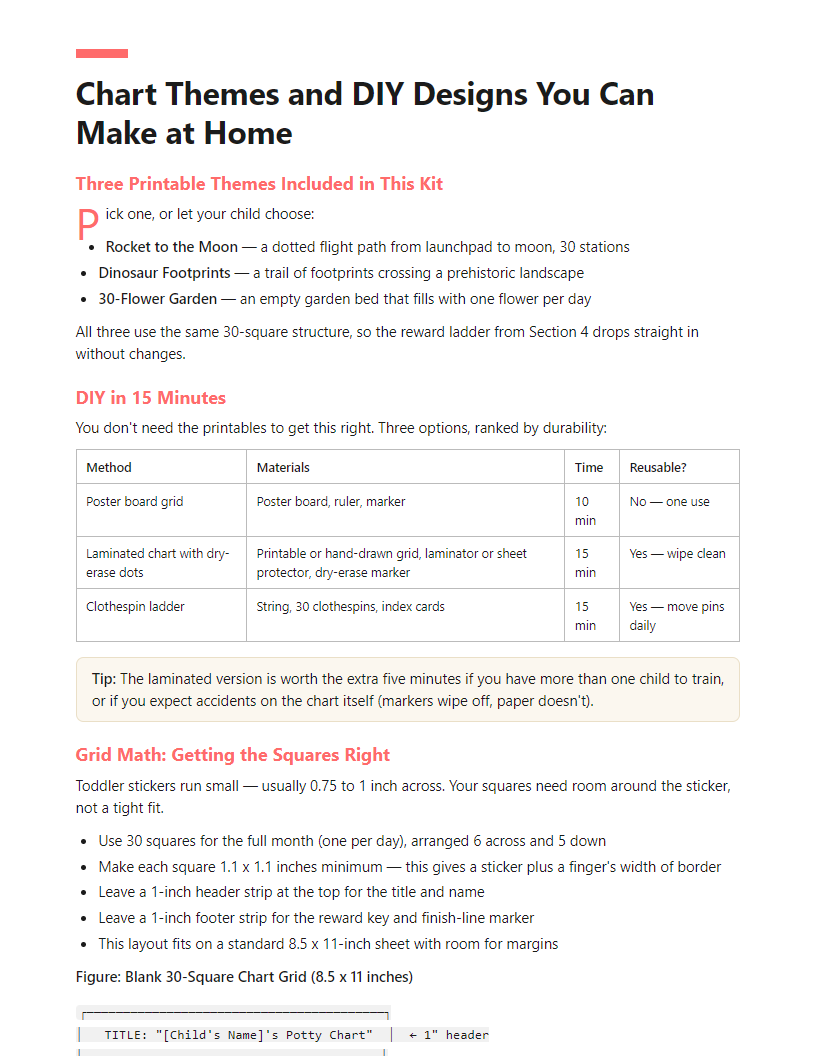
- Chart Themes and DIY Designs You Can Make at Home
- When the Stickers Stop Working: Troubleshooting Guide
- Nine Mistakes That Make a Sticker Chart Backfire
- Fading Out: Moving Off the Chart Without Losing Progress
- Print-and-Use Pack: Charts, Tracker, Reward Menu and Certificate
- Launch Day Checklist
- Parent Questions Answered
In this article
“I just need a potty training chart with stickers I can print tonight” — and then what? Most charts hand you a grid of 20 squares and leave you guessing how many stickers equal a reward, what to do when your two-year-old shrugs at stickers on day four, and how to stop using the chart without losing progress.
This page gives you the honest answer on whether sticker charts work, the nine mistakes that make them backfire, and straight answers to the questions parents actually ask. The premium PDF adds the full 30-day kit: a week-by-week sticker and reward ladder, chart themes you can make at home, a troubleshooting guide for regression and resistance, a fade-out plan, and print-and-use charts, a reward menu and a graduation certificate.
The short answer
A potty training chart with stickers works best as a system, not a single page:
- Print one chart per week, not one for the whole month — short horizons keep a 2–4 year old motivated.
- One sticker per try, at first, then per success once the habit forms.
- Set the exchange rate: 5 stickers = small reward, a full week = a bigger one.
- Scale rewards up as the task gets easier, so the chart stays interesting.
- Fade out deliberately — stretch the intervals, swap stickers for praise, then retire the chart with a certificate.
Why One Chart Isn’t Enough (and What This 30-Day Kit Contains)
Grab the free one-page chart first: Download the free printable potty chart (PDF, no email required). It’s a single 30-square tracker — print it, tape it up, start today. Everything else below is the paid 30-day kit, built for when that one page stops working.
Many parents report a stall in the second week — the novelty wears off, the squares run out, and you’re left hunting for another one. This kit is built to last the full 30 days, with a reward system that scales as the first sticker stops being exciting on its own.
Free vs. paid:
- Free: one single-page chart, 30 squares, no reward ladder, no themes.
- Paid kit: everything below — 3 themed designs, reward ladder, tracker, scripts, exit plan, certificate.
What’s inside the paid kit:
- A 30-day tracker (one chart, four weeks)
- 3 themed chart designs, so your child picks one they actually want to look at
- A reward ladder that increases in value as streaks build
- Motivation scripts for the moments stickers stop working
- An exit plan for fading off the chart
- A finish-line certificate for day 30
Choose Your Variant
| Variant | Age | Focus |
|---|---|---|
| Toddler potty chart | 2–3 | First sits, rewards for trying, no pressure on accidents |
| Toilet training chart | 4+ | Independence steps: wiping, flushing, hand-washing, nighttime |
Older kids often need a chart that tracks more than “did they go.” The 4+ version adds independence milestones so the chart doesn’t feel babyish.
Printing Notes
- Paper size: A4 or US Letter, both included
- Cardstock holds up better than regular paper if stickers go on daily for a month; plain paper works if you’re laminating
- Sticker size: 0.75–1 inch fits the chart squares without overlap; smaller stickers float and look messy
Tip: Print one extra tracker sheet. Kids lose or tear the first one more often than expected.
Web Version vs. PDF Pack
Use the web version to preview each chart design and see a finished example before you print anything. Use the PDF pack when you’re ready to print at home or at an office store — it includes all three themes, the tracker, reward menu, and certificate as print-ready files, sized for both paper formats.
Do Sticker Charts Actually Work? The Short Answer
Yes — but only under three conditions. A sticker chart works when it gives an immediate reward, shows visible progress, and has a planned exit date. Drop any one of those and the chart turns into wallpaper by day 10.
Immediate reward means the sticker goes on within seconds of the success, not at bedtime “if you remember.” Visible progress means your child can see the row filling up — that’s the actual motivator, not the sticker itself. Planned fade-out means you know from day one how you’ll stop using the chart, so you’re not still stickering a 4-year-old in six months.
What the research says
Azrin and Foxx’s classic study, Toilet Training in Less Than a Day (1974), used immediate tangible rewards (candy, praise) paired with potty success and found this sped up learning compared to no reward. The American Academy of Pediatrics also backs praise and small rewards as part of a positive potty training approach (healthychildren.org).
Both sources treat the reward as a short-term bridge, not the skill itself. The reward helps a child get through the gap until the habit becomes automatic and self-rewarding (dry, comfortable, proud). That’s why fading out matters more than the chart design.
When not to use a chart
- Under 18 months: the skill (bladder awareness) usually isn’t physically ready yet. A chart won’t fix biology.
- Active power struggle: if potty time has become a fight, a chart adds another thing to fight about. Pause the chart, not the training.
- Chart already linked to failure: if your child associates stickers with a chart they “failed,” start with a new design and new name for it. Don’t rehab an old one.
Tip: If you’ve seen this exact scenario discussed on Reddit — parents asking whether the chart “stopped working” after a week — it’s usually one of these three conditions missing, not the chart itself.
Signs it’s working by day 7
- Your child asks for the sticker unprompted.
- You’ve had at least 3–4 successful bathroom trips logged.
- Resistance to sitting on the potty has dropped, even slightly.
If none of these show up by day 7, change the reward (smaller, faster, more novel) before you change the whole chart.
Printable vs. store-bought: quick verdict
Yes, a potty training chart with stickers exists as a store-bought product — but most are smaller and less flexible than a printed version you control.
| Printable PDF | Magnetic/Store-bought | Whiteboard | |
|---|---|---|---|
| Cost | $0–5 | $10–20 | $8–15 |
| Durability | Low (paper) | High | High |
| Customization | Full | Low | Medium |
| Reusability | Print again | Reusable | Reusable |
For a 30-day system with a reward ladder, print-and-replace beats buy-once. You’ll want to change the chart’s look as motivation shifts — harder to do with a fixed store product.
Nine Mistakes That Make a Sticker Chart Backfire
A sticker chart can work for potty training — but most complaints about charts “not working” trace back to one of these nine setup mistakes, not the method itself.
1. Removing Stickers After an Accident
Never peel a sticker back off the chart. A sticker marks something that already happened — it’s not a deposit you can withdraw. Taking it back turns the chart into a punishment tool and teaches your child to fear the chart instead of using it.
2. One Big Reward Instead of Small Frequent Ones
“A bike if you’re trained by the end of the month” means 30 days with zero payoff. Kids under 4 can’t hold a reward that far away in their heads. Small wins — a sticker now, a tiny prize at 5 stickers — keep the behavior and the reward connected.
3. Comparing Siblings or Displaying Failures
Keep the chart private to your child. Don’t hang two charts side by side for siblings, and don’t let relatives comment on gaps or missed days in front of your child. The chart should track progress, not rank performance.
4. Vague Rules About What Earns a Sticker
If a sticker shows up sometimes for trying and sometimes only for success, your child can’t predict what earns it. Pick one clear rule — “a sticker for every pee in the potty” — and apply it the same way every time.
Warning: Inconsistent rules are the top reason charts stop motivating. The child stops trying to figure out the pattern.
5. No Fade-Out Plan
A chart that runs for three or four months with no end in sight stops feeling special. Set a planned exit date before you start (see Section 8) so the chart has a natural finish line instead of fading into background wallpaper.
6. Stacking the Chart on Top of Pressure and Punishment
Mixing rewards with punishment — timers, scolding, or time-outs for accidents — makes the rule unpredictable for your child. One day an accident gets a stern talk, another day it gets ignored, and the chart’s meaning gets muddled. Pick one approach — reward-based — and drop the pressure tactics.
7. Switching Rules Mid-Week Without Explaining
If you decide pull-ups no longer count, or stickers now need two tries instead of one, say so directly. “Starting today, you get a sticker when you tell me first” — then stick to it. Silent rule changes feel like the goalposts moved for no reason.
8. Starting Before Readiness
Layering a reward system on a child who isn’t physically or developmentally ready sets up weeks of frustration with no wins to reward. Confirm readiness signs first (Section 3), then launch.
9. Ignoring the Child’s Own Pace
Forcing the ladder to move faster than your child is ready for — jumping reward tiers early to “speed things up” — breaks the predictability the chart depends on.
Tip: If you only fix one mistake today, fix #4. Consistency is what makes a sticker chart work at all.
Parent Questions Answered
Should you use a sticker chart for potty training?
For most kids ages 2 to 4, yes. Stickers give an instant, visible reward right when your child needs it — before they can understand bigger ideas like “clean underwear” or “no more diapers.” A chart works best as part of a plan with a start date, an end date, and a reward ladder, not as a standalone fix. If your child shows no readiness signs at all, fix that first — no chart replaces readiness.
Is there a potty training chart that uses stickers you can buy instead?
Yes — see the printable-vs-store comparison in “Do Sticker Charts Actually Work?” for price range and the fixed-grid trade-off.
One buying criterion that table doesn’t cover: check whether the store chart is reusable. Laminated or dry-erase versions let you wipe the grid clean and start a new ladder once your child outgrows the first one. Single-use paper charts can’t be reset, so you’ll need to buy a second one when you hit the week-2 stall.
Tip: If you want a physical chart in-store today to get started, buy one — then switch to this kit’s printable pack once you hit the week-two stall. The two aren’t in competition.
What is the 10-10-10 rule for potty training, and does it fit this chart?
The 10-10-10 rule is shorthand some parents use for a three-day intensive method: roughly 10 minutes on the potty, 10 minutes of playtime, repeated for about 10 waking hours a day, for 3 days straight. It’s a different approach from a 30-day chart — faster, more intensive, less sticker-dependent.
You can combine them. Run the 10-10-10 method for the first 3 days, then start the sticker chart on day 4 to reinforce the habit once it’s formed. Don’t run both from day one — it’s too much structure at once for a toddler.
What is the hardest age to potty train?
There’s no fixed “worst age” — readiness signs matter more than birthdays. That said, many parents report two tougher windows:
- Just under 2 years old — physically capable but communication and bladder control are still developing.
- 3.5 to 4 years old — often a battle of will rather than ability; the child understands the toilet fine but resists control.
If your child falls in either window, don’t change the chart — slow the ladder pace and lean harder on the scripts in the troubleshooting section.
Do sticker charts work for poo as well as wee?
Yes, but expect it to lag. Bladder control usually comes first; bowel control follows weeks later for many kids. Give a bigger sticker or bonus reward for bowel movements on the toilet — it takes more physical trust from your child, and the reward should reflect that. Don’t combine wee and poo into one square; track them separately so you can see which one is stalling.
Does changing the reward mid-chart actually help?
It does, and it’s the same fix covered in the troubleshooting guide for boredom after week 1: swap the theme, switch to a surprise-bag reward, or add a mystery square. A chart that still offers the exact same sticker on day 20 as it did on day 1 is the single most common reason parents report giving up. If progress stalls and you haven’t changed anything about the reward in two weeks, that’s the first thing to fix — before you assume the chart itself has failed.
- ✓First 48 hours setup script and launch day checklist
- ✓Week-by-week sticker and reward ladder with exact sticker-to-reward ratios
- ✓30-day progress tracker with accident and success log
- ✓Reward menu template (no-cost, low-cost and milestone rewards)
- ✓Six themed chart designs plus DIY templates to make at home
- ✓Troubleshooting flowchart for regression, resistance, refusal and reward-gaming
- ✓Four-step fade-out plan and printable graduation certificate
Frequently asked questions
Should you use a sticker chart for potty training?
For most 2–4 year olds, yes. Stickers give instant, visible feedback for an abstract achievement, which is exactly how young children learn. They work best for short bursts of 2–4 weeks. Skip or adapt them if your child is highly anxious about performance, under about 20 months, or already resisting the potty — in that case rebuild comfort first, then add the chart.
Is there a potty training chart that uses stickers?
Yes — printable sticker charts are the most common format, and you can use any small stickers, stars or even hand-drawn marks. Single free charts are easy to find; what's harder to find is the system around them. Our premium PDF pairs weekly charts with a reward menu, a progress tracker, themed designs and a graduation certificate.
What is the 10-10-10 rule for potty training?
A common version: sit your child on the potty for about 10 minutes, roughly 10 times a day, for the first 10 days of training. It builds routine and catches successes by sheer frequency. Pair it with the chart by giving a sticker for every sit at first — rewarding the attempt, not just the result — then shift to success-only stickers in week two.
What is the hardest age to potty train?
Many parents find three and over harder than two to two-and-a-half, because older toddlers have stronger routines, firmer opinions and more ability to refuse. Under 18–20 months, bladder awareness usually isn't ready. The sweet spot is typically 22–30 months, when interest in independence is high and power struggles are still manageable.
What do I do when my child loses interest in the stickers?
This is normal around day 4–7. Change one variable at a time: new sticker theme, a different chart shape, or a slightly bigger reward at the next milestone. Let your child choose the stickers and place them himself. If interest doesn't return within two or three days, pause the chart for a week rather than escalating rewards. The PDF's troubleshooting guide walks through each scenario.
We collected 48 real questions and comments about "potty training chart with stickers" (4 from People Also Ask, 44 from search suggestions), grouped them into 13 recurring problems, and built this guide to resolve the 6 that block people most. The top-ranking pages were reviewed for gaps; 7 of those gaps became dedicated sections.
Edited by Alex Hirn · Last updated October 5, 2026 · How we make our guides
More in Family & Baby
 premium
 premium+2 bonuses
 premium
 free