Template · 23-page PDF · Premium
Homeschool Lesson Planner: A Simple System That Survives the Year
Set up a homeschool lesson planner you'll still use in March: a 5-line plan format, format comparison and FAQs. Grab the premium template pack to start.
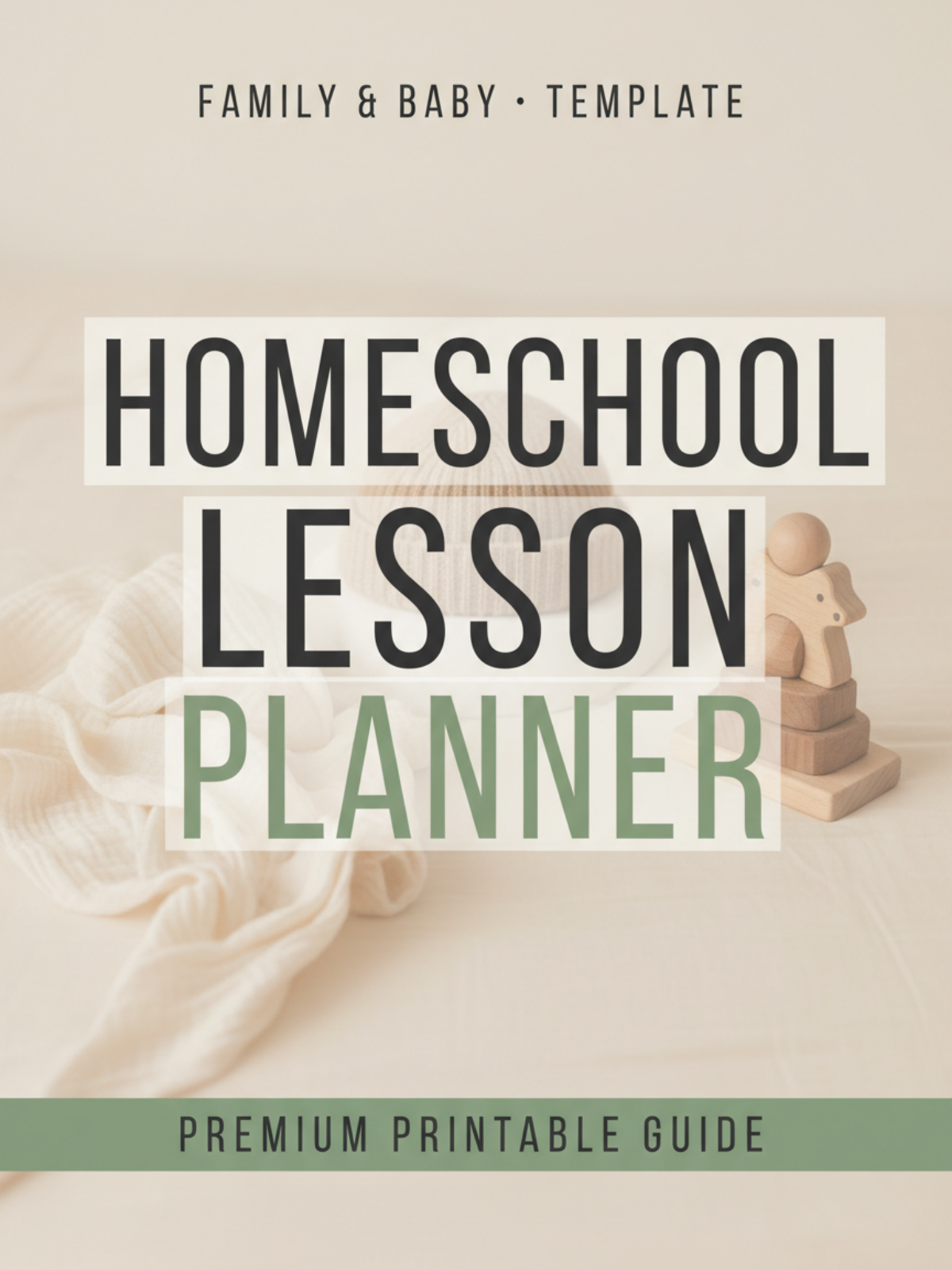
The full workbook, ready to print
- ✓Master template to build your planner in 7 guided steps
- ✓Printable weekly 5-day grid, monthly map and progress tracker
- ✓Records pages for attendance, books read and completed units
- ✓Unit-study blending worksheet with a curriculum coverage checklist
- ✓Seven planning mistakes that recreate school at home, with fixes
- ✓Filled-in sample plans for K–2, Grades 3–5 and middle school
- ✓Sunday-night reset and end-of-term review checklists
Hosted on FileJoker. Premium members download instantly; free download has a wait.
In a hurry? Free one-page checklist31 items to tick off · print-ready PDF, no sign-upDownload freeA look inside the PDF
9 sections · 23 pages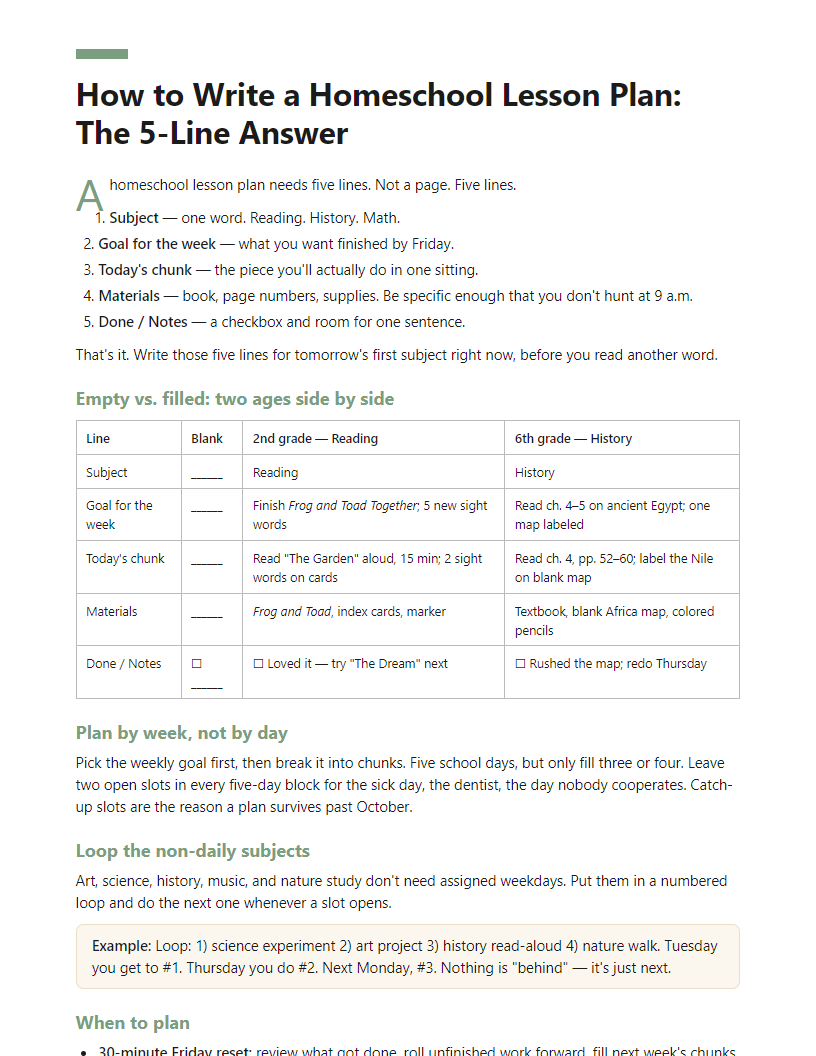
Full table of contents
- Why Most Homeschool Planners Fail After October
- How to Write a Homeschool Lesson Plan: The 5-Line Answer
- Build Your Planner in 7 Steps (With the Master Template)
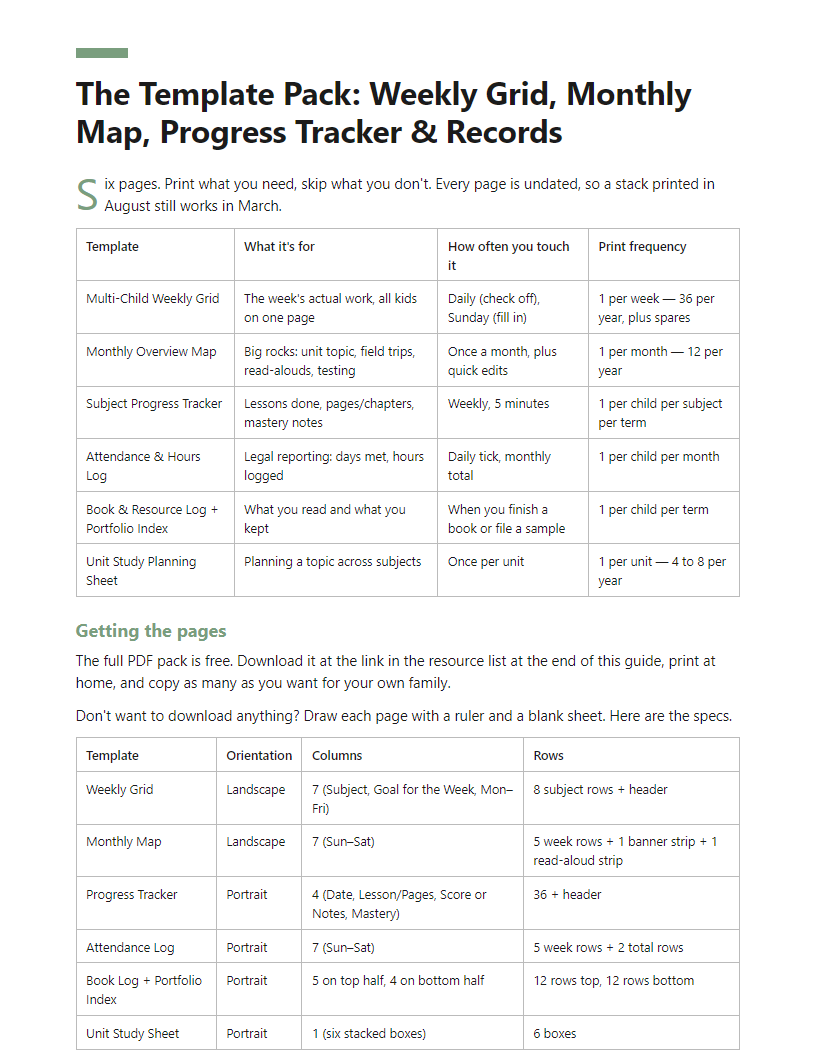
- The Template Pack: Weekly Grid, Monthly Map, Progress Tracker & Records
- Blending Unit Studies With a Curriculum You Already Own
- Free vs Paid vs Digital vs Paper: Choosing Your Planning Format
- Seven Planning Mistakes That Recreate School at Home
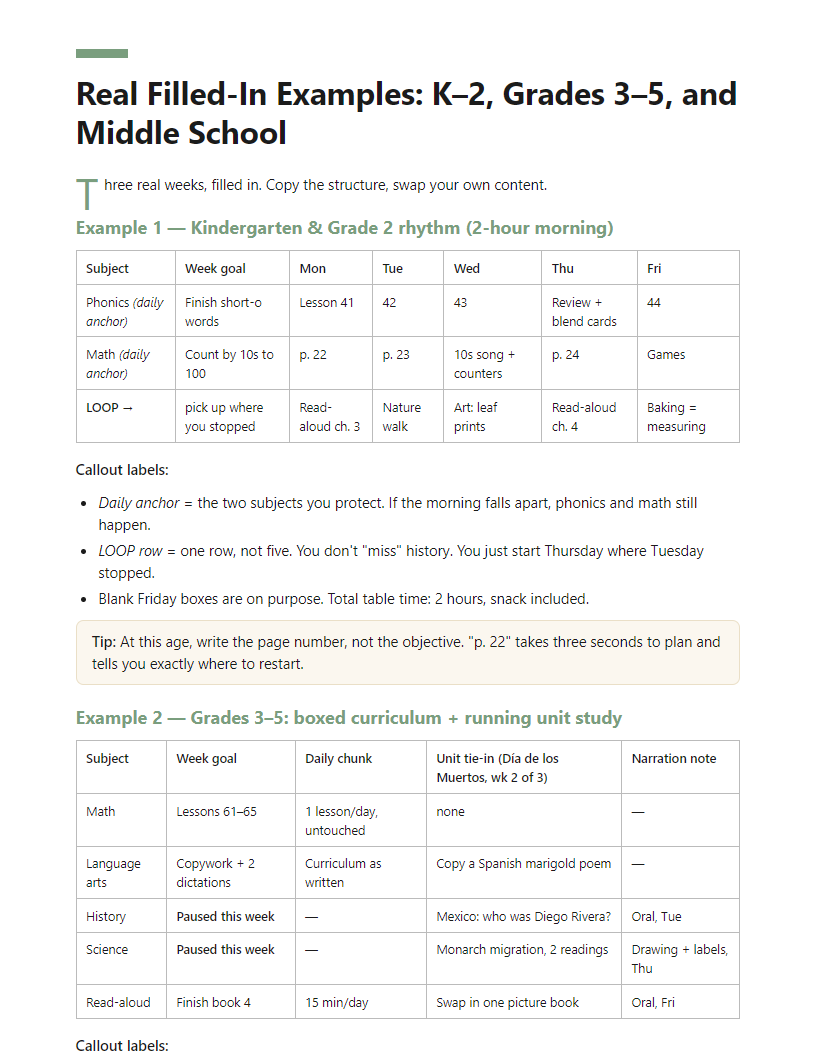
- Real Filled-In Examples: K–2, Grades 3–5, and Middle School
- Your Sunday-Night and End-of-Term Checklists
In this article
By October the binder is a graveyard. You bought a homeschool lesson planner, filled in three gorgeous weeks, then a sick kid and a skipped math lesson knocked the whole grid out of sync — and you quietly stopped writing anything down. Now you’re unsure what’s been covered, whether your records would hold up, and if you should have picked a different planner entirely.
This page gives you the plain mechanics: how to write a lesson plan in five lines, how to choose between paper, digital, free and paid formats, and how to stay accountable when no one nearby homeschools.
The premium PDF adds the full template pack — weekly grid, monthly map, progress tracker, records sheets — plus filled-in examples by grade band.
The short answer
To make a homeschool lesson planner work, write each lesson in five lines:
- Subject and child — who is doing what.
- Goal — one sentence on what they should be able to do afterwards.
- Resource and page — exact book, lesson number or link.
- Activity — the 20–40 minute task itself.
- Evidence — narration, worksheet, photo or checkbox for your records.
Plan subjects in loops rather than fixed days, leave one blank catch-up day per week, and review monthly instead of rewriting the whole term.
Why Most Homeschool Planners Fail After October
You buy the planner in July. You fill it out beautifully in August. By late October it’s in a drawer, and you’re teaching from memory and sticky notes. That’s not a discipline problem. It’s a design problem.
The three failure points
- Too many pre-printed boxes. Seven subjects across five days is 35 boxes a week. If you only teach science twice and skip Friday for co-op, you’re staring at blank squares that read like failure.
- One page per child. With three kids, you flip three pages to answer one question: what are we doing at 10 a.m.? Nobody keeps that up past the first hard month.
- Dated pages. Get sick for a week, and every printed date is now wrong. Either you leave a hole or you shift everything and the dates stop matching your records.
A $40 branded planner fixes none of this. It gives you nicer paper for the same 35 boxes. The real problem is knowing what to write in the boxes — how much math is a week, when to stop a read-aloud, what counts as science. No cover design solves that.
Three jobs, three pages
A planner that survives the year does three separate things, and mixing them is why most break:
| Job | Question it answers | Where it lives |
|---|---|---|
| Plan | What are we doing this week? | Weekly grid |
| Record | What did we actually do? | Subject tracker |
| Prove | Is this child making progress? | Progress + records page |
Plans change. Records don’t. Keep them apart and you stop scribbling over your own evidence.
The minimalist principle
Fewer fixed fields, more reusable blank structure. Write dates in yourself. Use one row per subject, one column per child. Print ten copies of three templates instead of buying 180 pre-dated pages you’ll abandon.
Tip: Before you print anything, write down the number of kids, the number of subjects, and how many days a week you actually school. Those three numbers size your whole system.
This works for one child or six, a boxed curriculum, an eclectic mix, or fully interest-led.
How to Write a Homeschool Lesson Plan: The 5-Line Answer
A homeschool lesson plan needs five lines. Not a page. Five lines.
- Subject — one word. Reading. History. Math.
- Goal for the week — what you want finished by Friday.
- Today’s chunk — the piece you’ll actually do in one sitting.
- Materials — book, page numbers, supplies. Be specific enough that you don’t hunt at 9 a.m.
- Done / Notes — a checkbox and room for one sentence.
That’s it. Write those five lines for tomorrow’s first subject right now, before you read another word.
Empty vs. filled: two ages side by side
| Line | Blank | 2nd grade — Reading | 6th grade — History |
|---|---|---|---|
| Subject | ______ | Reading | History |
| Goal for the week | ______ | Finish Frog and Toad Together; 5 new sight words | Read ch. 4–5 on ancient Egypt; one map labeled |
| Today’s chunk | ______ | Read “The Garden” aloud, 15 min; 2 sight words on cards | Read ch. 4, pp. 52–60; label the Nile on blank map |
| Materials | ______ | Frog and Toad, index cards, marker | Textbook, blank Africa map, colored pencils |
| Done / Notes | ☐ ______ | ☐ Loved it — try “The Dream” next | ☐ Rushed the map; redo Thursday |
Plan by week, not by day
Pick the weekly goal first, then break it into chunks. Five school days, but only fill three or four. Leave two open slots in every five-day block for the sick day, the dentist, the day nobody cooperates. Catch-up slots are the reason a plan survives past October.
Loop the non-daily subjects
Art, science, history, music, and nature study don’t need assigned weekdays. Put them in a numbered loop and do the next one whenever a slot opens.
Example: Loop: 1) science experiment 2) art project 3) history read-aloud 4) nature walk. Tuesday you get to #1. Thursday you do #2. Next Monday, #3. Nothing is “behind” — it’s just next.
When to plan
- 30-minute Friday reset: review what got done, roll unfinished work forward, fill next week’s chunks.
- 2-hour term map: three or four times a year. Set the big goals per subject, mark holidays, list books to order.
Free vs Paid vs Digital vs Paper: Choosing Your Planning Format
“Best planner” is the wrong question. A planner is a container. The same five lines work in any of them.
The four formats, scored
| Format | Cost | Setup time | Rescheduling | Multi-child | Record export | Screen-free | Recommended for |
|---|---|---|---|---|---|---|---|
| PDF printable (like this pack) | $0–15 | 10 min to print | Cross out, rewrite, or reprint the page | One column per kid, up to 4 on a page | Manual — file the pages in a binder | Yes | 1–4 kids, low reporting states, anyone who thinks better on paper |
| Spreadsheet (Sheets/Excel) | Free | 20–60 min to build | Drag, copy, auto-roll unfinished items | Unlimited — add a column block per child | Sort, filter, print to PDF, sum hours | No | 5+ kids, hour logging, states requiring attendance counts |
| App-based planner | $5–15/month, or ~$60–100/year | 1–3 hours to load curriculum | Best in class — one tap reschedules everything | Built in, per-child dashboards | One-click reports and transcripts | No | High school credits, heavy reporting, parents who plan on a phone |
| Branded paper planner | $25–60 | Arrives ready | Cross out only; dated pages waste | Fixed number of columns you can’t change | Manual | Yes | One or two kids, a parent who loves a bound book |
Print costs are the usual catch with PDFs. Check current figures at your print shop, but black-and-white pages are cheap, and you only need six.
When a spreadsheet genuinely beats paper
Paper stops working at a certain load. Switch when two or more of these are true:
- You teach five or more children and the weekly grid won’t fit them.
- Your state requires logged hours or days, and you’re adding columns by hand.
- You want unfinished work to roll to next week without recopying it.
- You need a year-end total per subject without a calculator.
Below that threshold, paper wins. It’s faster to write on, it never needs charging, and a binder of filled pages is your record.
The hybrid most families land on
Paper weekly grid on the fridge or table. Digital backup for records.
You plan and teach on paper all week. On Friday or Sunday, you photograph the finished grid with your phone and drop it in a dated folder in your cloud drive. Five minutes. You now have a timestamped record of every school day, with your own handwriting on it, and nothing to retype.
Tip: Name the photo files
2025-09-week03.jpg. They sort themselves, and you can pull any week in seconds if someone asks.
Convert these templates to Google Sheets in 20 minutes
One tab holds one week. Rows are subjects. Columns are child-by-day.
- Open a blank sheet. Name the first tab Wk 01.
- Column A, starting in row 3: one row per subject block — Math, Reading, Writing, Science, History, and so on.
- Row 1: each child’s name, merged across five columns. Row 2 under each name:
Mon,Tue,Wed,Thu,Fri. Two kids means ten columns; four kids means twenty. - Add one
Notescolumn at the far right. - Set row height to 40 and turn on text wrapping so a full line of plan fits.
- Right-click the tab → Duplicate each Sunday, then rename the copy
Wk 12. - Add a Records tab: columns for Date, Child, Subject, Minutes, Finished.
- File → Make a copy each August for a fresh year.
Example: With three kids and six subjects, you get a 6-row by 15-column grid, plus Notes. It prints on one landscape page.
Three questions instead of “what’s best”
- How many children am I tracking, and will they fit on one page? More than four, go digital.
- What does my state actually require? Portfolio states need samples; hour states need a running total.
- Will I still open this in October? If it feels like homework now, it won’t survive fall.
Planning Support When There Are No Homeschoolers Nearby
You don’t need a co-op to plan well. You need one other adult who asks you questions, and two or three reliable places to steal ideas from.
The two-person planning swap
Find one homeschooling parent — anywhere, any method, any time zone — and book a 20-minute video call once a month. Set the agenda so it doesn’t drift into chat.
- Two minutes each: what actually got done last month.
- Five minutes each: what you’re planning next month, read straight off your monthly map.
- Three minutes each: one thing you’re stuck on.
- One minute: name the date of the next call.
Knowing someone will ask does more for follow-through than any app reminder.
Steal your content
| Source | What to take |
|---|---|
| Public library | Themed book lists, librarian-built reading ladders, summer program topics |
| Museum and park websites | Free educator guides, pre-visit worksheets, unit topics |
| Public-domain guides | Older nature study and literature guides, free to print |
| Curriculum sample pages | Scope-and-sequence lists showing what a grade usually covers |
Tip: Ask a children’s librarian for “12 books on volcanoes at a second-grade reading level.” That’s a unit study spine in one email.
Run a solo term review
No mentor nearby? Ask yourself these five questions at the end of each term, in writing.
- Which subject slipped most, and why?
- What did the kids talk about without being asked?
- What did I plan but never open?
- What took twice as long as I wrote down?
- What one thing am I changing next term?
Ask better questions online
Pick a forum or group that matches your method — Charlotte Mason, unit study, classical, eclectic. Then ask specifically. “What do I do for history?” gets noise. “Grade 4, 30 minutes a day, reading-heavy kid, I own Story of the World Vol. 2 — how would you stretch it over 12 weeks?” gets real answers.
Build a micro-group of two
Two families is a group. Invite one other family to one field trip a month — a park, a factory tour, a free museum day. Rotate who picks. That’s enough contact to stop the isolation without organizing a co-op.
If you only just found unit studies or a rhythm that works, you haven’t lost ground. You found it.
Homeschool Lesson Planning: Common Questions
What is the best homeschool teacher planner?
The one you’ll still be writing in during February. Format beats brand every time. Judge any planner against four questions:
- Can you fit all your kids on one page, side by side?
- Is it undated, so a skipped week doesn’t waste paper?
- Can you erase or reprint a day without wrecking the layout?
- Does one week fit in one spread, with no flipping?
If a $42 planner fails those and a free printed grid passes, use the grid.
My curriculum already has lesson plans. Do I still plan?
Yes, but you’re not writing lessons — you’re scheduling them. The publisher tells you what to teach. You decide when, and how much fits your real week.
Copy the lesson number into your weekly grid, not the whole lesson. “Math — Lesson 42” is enough. That single line takes four seconds to write and tells you instantly whether you’re on pace.
Tip: Write the lesson number, not the page number. Page numbers change if you skip a review section. Lesson numbers don’t.
How do I organize lessons and materials for three or more kids?
One page for the week, one row per child per subject. Then split subjects into two buckets:
| Bucket | Subjects | How to run it |
|---|---|---|
| Together | History, science, read-aloud, art, Bible, music | Everyone at the table, same topic, different output by age |
| Separate | Math, reading instruction, handwriting, spelling | One-on-one, 10–20 minutes each, rotated |
Materials follow the same split. One shared bin for together-subjects. One labeled folder or magazine box per child for their separate work. Each kid grabs their own box; you carry the shared bin.
What is the most successful homeschool curriculum?
There isn’t one, and the question sends you shopping instead of planning. No curriculum is tested against your kids, your schedule, and your patience level. Fit is the variable that matters.
Better metric: does your student finish the week’s work in a reasonable number of minutes, and can they explain what they learned? If yes, your curriculum is working. If a program has glowing reviews and your 8-year-old cries through it four days a week, it isn’t successful — not for you.
Also check how you’re running the program, not just which one you bought. Fewer subjects, longer blocks, and room to follow interest do more for results than a brand switch. See “Copying the school timetable” in Seven Planning Mistakes That Recreate School at Home.
How far ahead should I plan, and what if we fall behind?
Map the term (6–12 weeks) in broad strokes. Plan one week in detail. That’s it.
When you fall behind, don’t shift everything forward. Pick one:
- Drop the extras and keep the anchor subjects moving.
- Run a catch-up day — no new work, finish what’s open.
- Cut the term goal by 10% and move on.
Do I have to keep records?
It depends on your state — check your current state requirements. Regardless of the law, keep a light record: attendance days, subjects covered, book titles, and one work sample per subject per month. Photos count. A finished workbook counts. That’s proof of learning without a filing project.
- ✓Master template to build your planner in 7 guided steps
- ✓Printable weekly 5-day grid, monthly map and progress tracker
- ✓Records pages for attendance, books read and completed units
- ✓Unit-study blending worksheet with a curriculum coverage checklist
- ✓Seven planning mistakes that recreate school at home, with fixes
- ✓Filled-in sample plans for K–2, Grades 3–5 and middle school
- ✓Sunday-night reset and end-of-term review checklists
Frequently asked questions
What makes a good homeschool teacher planner?
The best planner is the one that matches your family's size and rhythm, not the prettiest one. Look for undated pages, a column or row per child, space for loop subjects, and a separate records section for attendance, books read and completed units. Flexible fields beat pre-printed subject labels, because curricula change mid-year and rigid grids force you to rewrite everything.
How do I actually write a homeschool lesson plan?
Start from your curriculum's table of contents, not from a blank week. Count the lessons, divide by the weeks you plan to school, and you have a realistic pace. Then write each day using five lines: child and subject, goal, resource with page numbers, activity, and evidence for records. Plan two weeks ahead at most — further out and life will rewrite it for you.
How should I organise homeschool lessons day to day?
Group work into three blocks: together time (read-alouds, history, science), independent skill work (math, writing, spelling), and interest time. Use a loop schedule for subjects that don't need daily repetition, so a missed day shifts the loop instead of breaking the plan. Keep one binder or box per child with the week's materials already pulled so mornings don't start with a search.
Which homeschool curriculum is the most successful?
No curriculum wins universally; success depends on consistency and fit. Strong results usually come from a solid math and reading spine used daily, plus rich living books or unit studies for content subjects. Judge a curriculum after one full term by whether you actually taught it and whether your child progressed — not by reviews from families with different children and schedules.
Can I blend unit studies with a curriculum I already own?
Yes. Keep your structured math and language arts untouched, and run unit studies in place of history, science and art. Map the unit's topics against your curriculum's scope so you can see coverage gaps, and log finished topics in a progress tracker. The premium PDF includes a blending worksheet and coverage checklist for exactly this situation.
How do I avoid recreating school at home?
Stop copying bell schedules. Younger children need 1–3 focused hours, not six. Plan by blocks and loops rather than 45-minute periods, allow lessons to run long when interest is high, and measure the week by lessons completed instead of minutes seated. Keep records for legal requirements — but let the child's pace, not the clock, drive the plan.
We collected 25 real questions and comments about "homeschool lesson planner" (12 from YouTube comments, 4 from People Also Ask, 9 from search suggestions), grouped them into 12 recurring problems, and built this guide to resolve the 6 that block people most. The top-ranking pages were reviewed for gaps; 7 of those gaps became dedicated sections.
Edited by Alex Hirn · Last updated October 1, 2026 · How we make our guides
More in Family & Baby
 premium
 premium+2 bonuses
 free
 free