Checklist · 16-page PDF · Premium
Checklist for Hospital Bag: What to Pack, and When to Pack It
Pack once, pack right: a checklist for hospital bag essentials, what hospitals already provide, and c-section extras. Download the printable PDF.
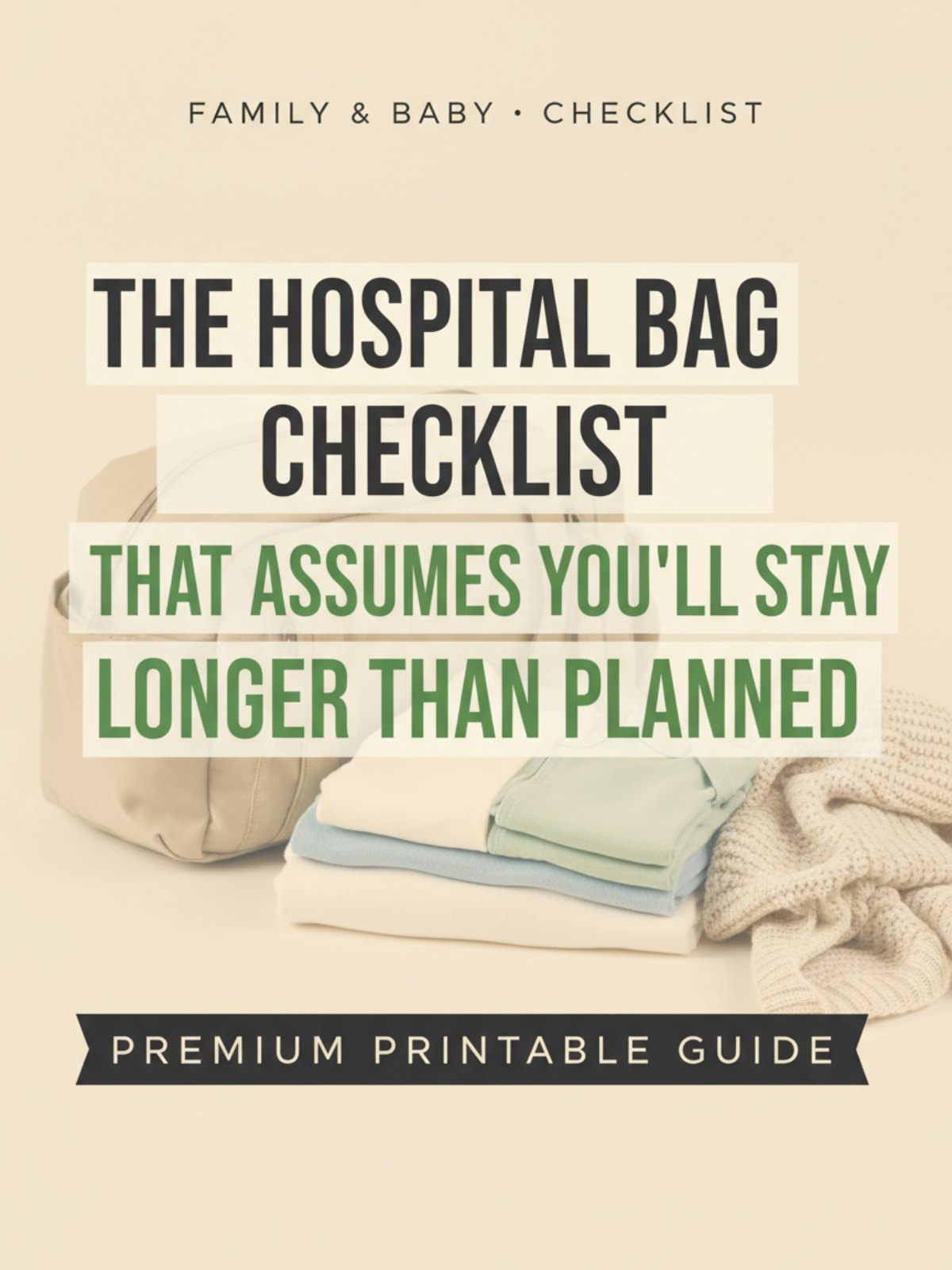
The full workbook, ready to print
- ✓Week-by-week packing timeline for weeks 32–37, with what to add each week
- ✓The three-bag system: labour bag, postpartum bag, partner bag, with contents per bag
- ✓C-section, jaundice and NICU add-on list for an unplanned longer stay
- ✓Baby clothing table: premie vs newborn sizing, zips vs snaps, how many of each
- ✓One-page print-and-tick action sheet (A4 and US Letter)
- ✓"Ask your hospital" question script for confirming what the ward provides
Hosted on FileJoker. Premium members download instantly; free download has a wait.
In a hurry? Free one-page checklist40 items to tick off · print-ready PDF, no sign-upDownload freeA look inside the PDF
9 sections · 16 pages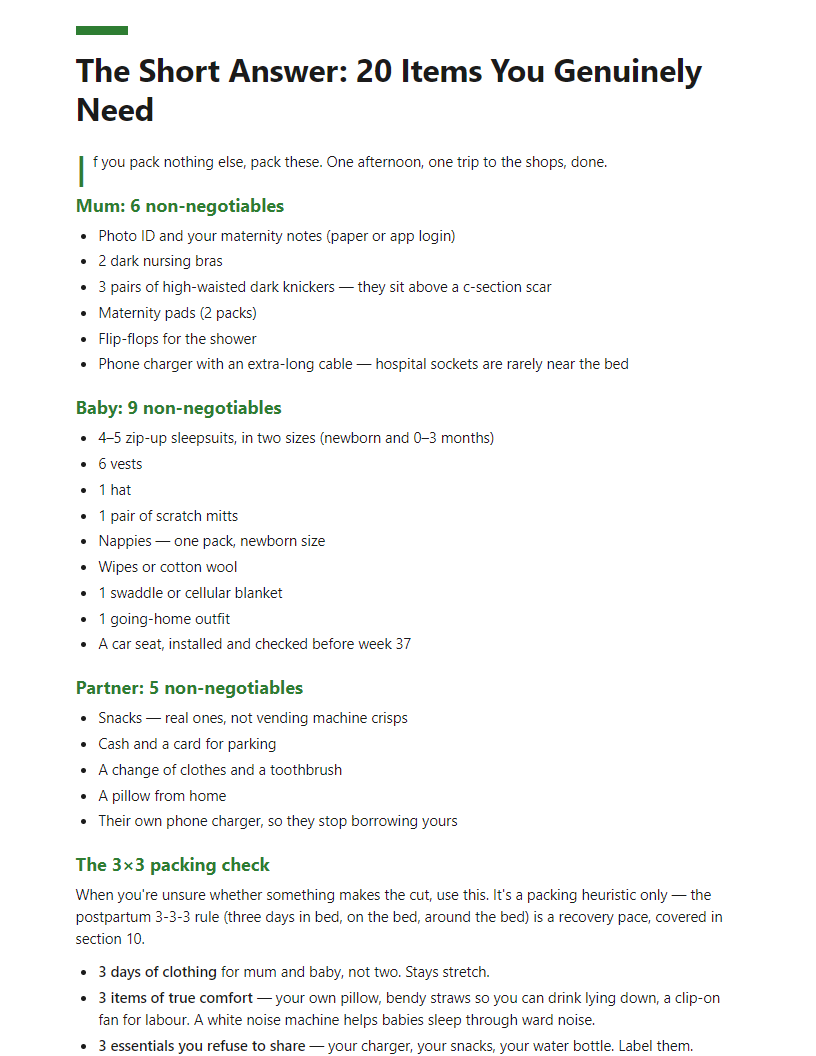
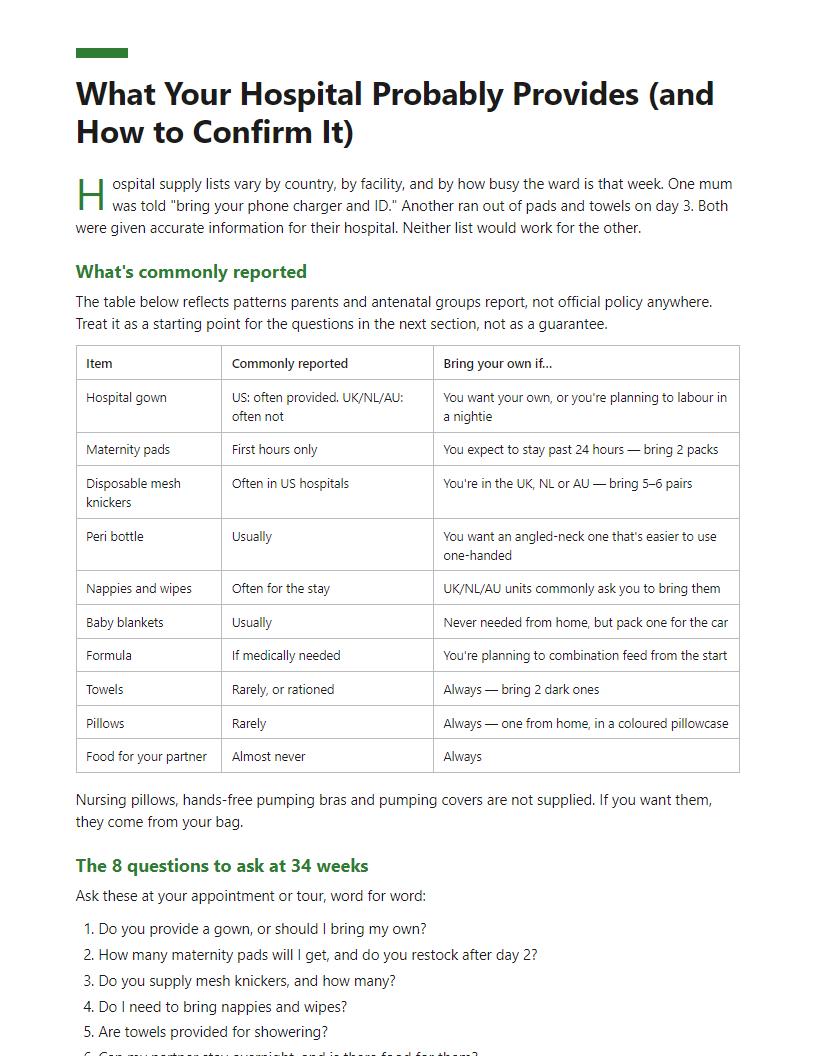
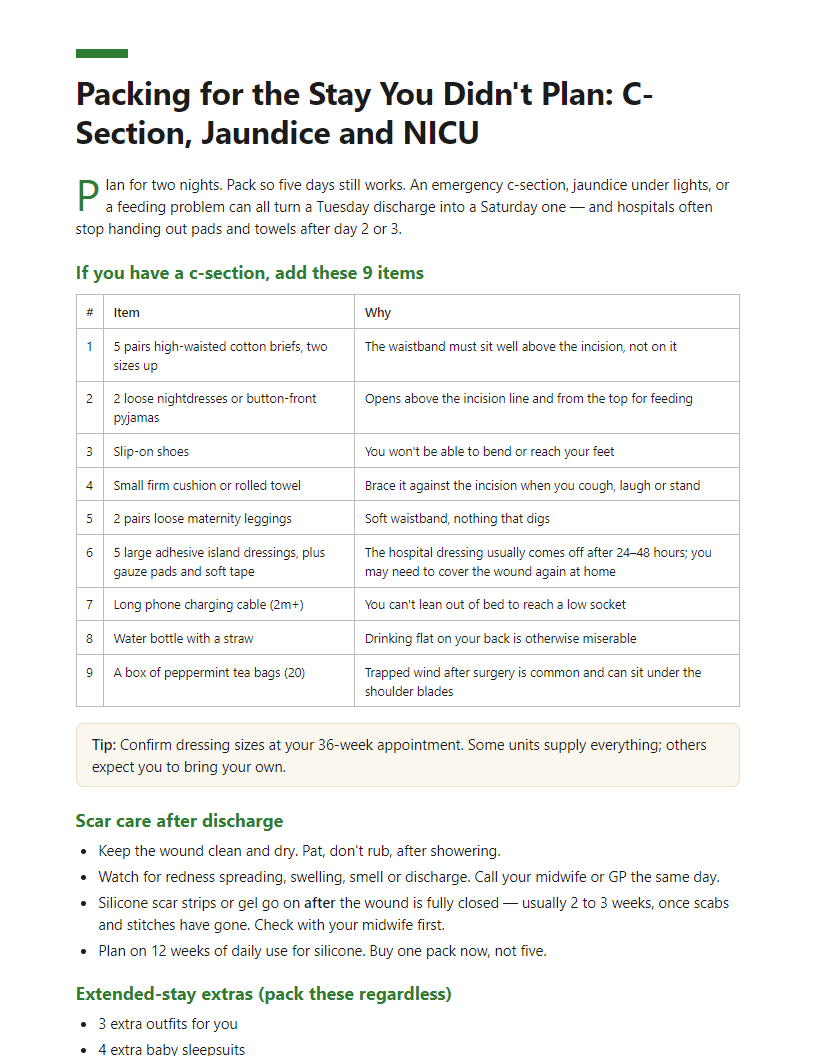
Full table of contents
- The Short Answer: 20 Items You Genuinely Need
- What Your Hospital Probably Provides (and How to Confirm It)
- When to Pack: A Week-by-Week Timeline (Weeks 32–37)
- The Three-Bag System: How to Actually Organise It
- Packing for the Stay You Didn't Plan: C-Section, Jaundice and NICU
- Baby Clothing: Sizes, Zips and How Many to Bring
- The Comfort Items Nobody Puts on the List
- Nine Packing Mistakes and the Fix for Each
- Print, Tick, Pack: Your One-Page Action Sheet
In this article
You’ve read six lists and they all contradict each other. One says 40 items, another says your hospital provides everything, and none of them tell you what happens if you end up in surgery or staying five days instead of one. This checklist for hospital bag packing cuts it down to what genuinely gets used: 20 core items, the comfort things nobody mentions (a fan, bendy straws, your own pillow), and a straight answer on what the ward already stocks. You’ll also see the nine mistakes that send partners driving home at 2am. The premium printable PDF adds a week-by-week packing timeline, a three-bag system, baby clothing sizes, and a C-section and NICU add-on list.
The short answer
Pack a checklist for hospital bag essentials in this order:
- Documents — ID, notes, birth plan, insurance.
- Labour comfort — lip balm, hair tie, handheld fan, bendy straws, snacks.
- Clothing — two loose nighties or dark pyjamas, robe, non-slip socks, slippers.
- Postpartum — high-waisted briefs, maternity pads, nursing bra, nipple cream.
- Toiletries — travel-size wash, toothbrush, dry shampoo, towel.
- Baby — 3 sleepsuits, 3 vests, hat, scratch mitts, nappies, muslins, going-home outfit.
- Tech — long phone charger, power bank.
- Car seat, fitted and left in the car.
Why Most Hospital Bag Lists Fail You
Two mistakes cause most hospital bag panic. Both are easy to fix once you can see them.
Mistake 1: the “ultimate list” trap
You search for a checklist and get 120 items. Lots of it is expensive, and you’ll never open half of it. Worse, those giant lists still miss the things people actually beg for at 3am: a small fan, flexible straws, a second set of baby clothes.
Long doesn’t mean complete. It usually means unedited.
Mistake 2: packing for 48 hours
The opposite trap is packing light because someone told you that you’d be home in two days. Then jaundice, an emergency c-section or a feeding problem stretches the stay to five or six days.
Warning: Hospitals often stop restocking your pads, towels and mesh pants after the first day or two. If your stay runs long, you can be left with nothing clean and no time to shop.
What this guide does differently
Everything is split three ways, so you never stand over an open holdall guessing:
| Split | What it means |
|---|---|
| By person | Mum, baby, partner — separate lists, separate bags |
| By phase | Labour, postpartum, going home |
| By day | Core for days 1–2, plus a day 3–6 top-up bag |
How to use the printable
One page per bag. Tick each item as you buy it, pack it, then initial and date the top of the page. Partners can then find anything without calling you.
Tip: This is a packing guide, not medical advice. Confirm what your hospital provides — and anything about symptoms or your birth plan — with your own midwife team.
The Short Answer: 20 Items You Genuinely Need
If you pack nothing else, pack these. One afternoon, one trip to the shops, done.
Mum: 6 non-negotiables
- Photo ID and your maternity notes (paper or app login)
- 2 dark nursing bras
- 3 pairs of high-waisted dark knickers — they sit above a c-section scar
- Maternity pads (2 packs)
- Flip-flops for the shower
- Phone charger with an extra-long cable — hospital sockets are rarely near the bed
Baby: 9 non-negotiables
- 4–5 zip-up sleepsuits, in two sizes (newborn and 0–3 months)
- 6 vests
- 1 hat
- 1 pair of scratch mitts
- Nappies — one pack, newborn size
- Wipes or cotton wool
- 1 swaddle or cellular blanket
- 1 going-home outfit
- A car seat, installed and checked before week 37
Partner: 5 non-negotiables
- Snacks — real ones, not vending machine crisps
- Cash and a card for parking
- A change of clothes and a toothbrush
- A pillow from home
- Their own phone charger, so they stop borrowing yours
The 3×3 packing check
When you’re unsure whether something makes the cut, use this. It’s a packing heuristic only — the postpartum 3-3-3 rule (three days in bed, on the bed, around the bed) is a recovery pace, covered in section 10.
- 3 days of clothing for mum and baby, not two. Stays stretch.
- 3 items of true comfort — your own pillow, bendy straws so you can drink lying down, a clip-on fan for labour. A white noise machine helps babies sleep through ward noise.
- 3 essentials you refuse to share — your charger, your snacks, your water bottle. Label them.
| Pack this | Leave at home | |
|---|---|---|
| Mum | Dark high-waisted knickers, nursing bras, flip-flops, long charger cable | Full make-up bag, candles, jeans, jewellery |
| Baby | Zip-up sleepsuits in two sizes, vests, hat, mitts | Newborn shoes, headbands, a second going-home outfit |
| Partner | Pillow, snacks, parking money, toothbrush | Laptop for “getting work done” |
Tip: Buy sleepsuits with zips, not poppers. At 3am, in dim light, with one hand, zips win.
What Your Hospital Probably Provides (and How to Confirm It)
Hospital supply lists vary by country, by facility, and by how busy the ward is that week. One mum was told “bring your phone charger and ID.” Another ran out of pads and towels on day 3. Both were given accurate information for their hospital. Neither list would work for the other.
What’s commonly reported
The table below reflects patterns parents and antenatal groups report, not official policy anywhere. Treat it as a starting point for the questions in the next section, not as a guarantee.
| Item | Commonly reported | Bring your own if… |
|---|---|---|
| Hospital gown | US: often provided. UK/NL/AU: often not | You want your own, or you’re planning to labour in a nightie |
| Maternity pads | First hours only | You expect to stay past 24 hours — bring 2 packs |
| Disposable mesh knickers | Often in US hospitals | You’re in the UK, NL or AU — bring 5–6 pairs |
| Peri bottle | Usually | You want an angled-neck one that’s easier to use one-handed |
| Nappies and wipes | Often for the stay | UK/NL/AU units commonly ask you to bring them |
| Baby blankets | Usually | Never needed from home, but pack one for the car |
| Formula | If medically needed | You’re planning to combination feed from the start |
| Towels | Rarely, or rationed | Always — bring 2 dark ones |
| Pillows | Rarely | Always — one from home, in a coloured pillowcase |
| Food for your partner | Almost never | Always |
Nursing pillows, hands-free pumping bras and pumping covers are not supplied. If you want them, they come from your bag.
The 8 questions to ask at 34 weeks
Ask these at your appointment or tour, word for word:
- Do you provide a gown, or should I bring my own?
- How many maternity pads will I get, and do you restock after day 2?
- Do you supply mesh knickers, and how many?
- Do I need to bring nappies and wipes?
- Are towels provided for showering?
- Can my partner stay overnight, and is there food for them?
- What’s your policy on me bringing snacks into labour?
- If we stay 4 or more days, what stops being supplied?
Warning: “They’ll give you some” often means the first 24–48 hours. Parents commonly report that restocking tails off around day 3, which is when a jaundice or c-section stay gets long. Question 2 and question 8 will tell you what your hospital actually does. Write the answers straight onto your printed checklist.
The Comfort Items Nobody Puts on the List
These are the items mums come back and add to the list afterwards. Most are cheap, and few of them make it onto the hospital’s own leaflet.
Labour
Wards are hot. A clip-on stroller fan or handheld fan comes up again and again in parents’ own lists. Bendy straws mean you can drink lying flat instead of doing a sit-up every time you’re thirsty — the same goes for the first days after a c-section. Add lip balm (gas and air dries your mouth), hair ties, and your own pillow in a coloured pillowcase so it doesn’t get mixed up with hospital linen. A cosy blanket from home helps if you get the shivers afterwards.
Sound and light
Postnatal wards are loud and never fully dark. An eye mask, earplugs and a white noise machine or phone app help you sleep between feeds — and help the baby sleep through trolleys, buzzers and other people’s visitors.
Food and drink
The kitchen closes. Bring snacks you can eat one-handed at 3am, plus a large insulated bottle with a straw so someone can refill it once and you’re set for hours.
Recovery and morale
Your own peri bottle (angled-neck ones are easier than the hospital cup) makes the first week of weeing far less grim. Add nipple cream and cooling or witch hazel pads — check with your midwife before using anything on stitches. A nursing pillow is bulky but worth it after a c-section, when you can’t rest the baby on your stomach. Shower flip-flops, dry shampoo and your own towel do more for morale than they should.
Tip: Pack an extension lead or a 2m charging cable. The socket is never next to the bed.
| ✓ | Labour | ✓ | Postpartum | ✓ | Sleep & sanity |
|---|---|---|---|---|---|
| ☐ | Clip-on or handheld fan | ☐ | Peri bottle | ☐ | Eye mask |
| ☐ | Bendy straws (10+) | ☐ | Cooling/witch hazel pads | ☐ | Earplugs |
| ☐ | Lip balm | ☐ | Nipple cream | ☐ | White noise machine or app |
| ☐ | Hair ties | ☐ | Nursing pillow (if room) | ☐ | Night snacks |
| ☐ | Own pillow, coloured case | ☐ | Hands-free pumping bra | ☐ | Insulated bottle with straw |
| ☐ | Blanket from home | ☐ | Own towel + flip-flops | ☐ | Extension/long charging cable |
| ☐ | Hand-held fan batteries | ☐ | Baby’s going-home outfit — newborn and 0–3 months, tags on | ☐ | Dry shampoo |
Nine Packing Mistakes and the Fix for Each
Run through this list with your bag open. Fix what you find before week 37.
| # | Mistake | Fix |
|---|---|---|
| 1 | Car seat still boxed when labour starts | Fit it and check the straps at week 32. Most hospitals won’t discharge you without one. |
| 2 | Car seat cover never washed | Check the manual, remove the cover and wash it now. It takes a day or two to dry, and you don’t want that job at 39 weeks. |
| 3 | No cash for parking | Some hospital meters and barriers still take coins only. Keep £10 in change plus a card in the glovebox, and check current charges for your site. |
| 4 | Nobody notes where the car is | Have your partner photograph the level, row and bay number before you walk in. After 20 hours awake, they will not remember. |
| 5 | One giant suitcase | Three labelled bags: bag 1 (labour), bag 2 (postpartum + baby), bag 3 (extended stay). Inside bags 2 and 3, use day-based packing cubes. |
| 6 | Going-home outfit in pre-pregnancy size | Pack what fits you at 36 weeks. Soft waistband, dark colour, nothing that sits on a c-section scar. |
| 7 | Maternity notes behind an app login you can’t recall | Write the login on paper and keep it with your ID, or carry a printed copy. Signal on a ward is patchy. |
| 8 | Nothing for the long night hours | Downloaded shows, headphones, a book, snacks you actually like. Nights on a postnatal ward are long and loud. |
| 9 | No written list | One page: who to call, what’s in which bag, what’s still in the car. Tape it inside bag 2. |
Tip: Screenshot the car park photo and send it to yourself as well. Phones get handed around and batteries die.
Warning: Valuables have nowhere secure to live on most wards. Leave jewellery, spare cards and anything you’d hate to lose at home.
Hospital Bag FAQ
What should actually be in a hospital bag checklist?
The 20-item core from section 2, split three ways:
- Mum (6): photo ID and maternity notes, 2 dark nursing bras, 3 pairs of high-waisted dark knickers, 2 packs of maternity pads, flip-flops for the shower, a phone charger with an extra-long cable.
- Baby (9): 4–5 zip-up sleepsuits in two sizes, 6 vests, 1 hat, 1 pair of scratch mitts, one pack of newborn nappies, wipes or cotton wool, 1 swaddle or cellular blanket, 1 going-home outfit, a car seat installed and checked.
- Partner (5): real snacks, cash and a card for parking, a change of clothes and a toothbrush, a pillow from home, their own phone charger.
That covers a straightforward two-night stay. Two common extras, not part of the 20: your own toiletries, and a going-home outfit for you that you’d be happy to sit in for the drive.
Then add by likely stay length:
| Stay | Add |
|---|---|
| 2 nights | Nothing extra |
| 3–4 nights | Second set of clothes, 20 more nappies, extra pads |
| 5+ nights / c-section | Third set, loose trousers that sit above the scar, high-waisted briefs, a water bottle you can reach one-handed |
C-section specifics — clothing that avoids the scar, what to wear over the dressing — are in section 6.
What is the 3-3-3 rule for postpartum?
Three days in bed, three days on the bed, three days around the bed. It’s a recovery pace, not a medical rule, but it’s a useful planning tool. If your first nine days are meant to be near-horizontal, you need things within arm’s reach: snacks, a big water bottle, lip balm, a long charger cable. Pack that way for the ward, then set the same things up at home before you leave.
Is there a printable PDF version of this checklist?
Yes. The full checklist prints as a two-page tick sheet. Print double-sided on one A4 sheet, tick as you pack, and clip it to the outside of the bag so your partner can find things without unpacking.
What week should you pack your hospital bag?
Aim for the end of week 36. Bring it forward to 32–34 weeks for twins, a planned c-section, or if your care team has flagged early delivery.
Do I need a bag for a home birth or birth centre?
Yes. Pack the same bag. Transfers happen, and you won’t want someone hunting for knickers while you’re in the car.
- ✓Week-by-week packing timeline for weeks 32–37, with what to add each week
- ✓The three-bag system: labour bag, postpartum bag, partner bag, with contents per bag
- ✓C-section, jaundice and NICU add-on list for an unplanned longer stay
- ✓Baby clothing table: premie vs newborn sizing, zips vs snaps, how many of each
- ✓One-page print-and-tick action sheet (A4 and US Letter)
- ✓"Ask your hospital" question script for confirming what the ward provides
Frequently asked questions
What should actually go in a hospital bag?
Twenty items cover almost every birth: ID and maternity notes, two loose nighties, a robe, non-slip socks, high-waisted briefs, maternity pads, a nursing bra, toiletries, a towel, a long phone charger, snacks, bendy straws, a handheld fan, lip balm, three sleepsuits, three vests, a hat, mitts, nappies and muslins. The car seat stays fitted in the car, not packed.
What does the 3-3-3 rule mean after birth?
It's a recovery pacing guide: three days in bed, three days on the bed, three days near the bed. Roughly nine days of deliberate rest before you resume normal movement. For packing, it means bringing enough comfortable clothing, pads and easy snacks for a slow first week rather than assuming you'll be up and dressed by day two.
Is there a printable PDF version of this checklist?
Yes. The premium PDF is a tick-box, one-page action sheet plus separate mum, baby and partner lists, a week-by-week packing timeline for weeks 32 to 37, a baby clothing size table, and a C-section, jaundice and NICU add-on list. It's formatted for A4 and US Letter so it prints cleanly in black and white.
What week of pregnancy should you pack your hospital bag?
Have the core bag ready by week 35, and fully finished by week 36 to 37. Start gathering items around week 32 so you're not buying in a rush. If you're expecting twins, have a history of early labour, or are booked for a planned C-section, bring that forward by two to three weeks.
What do hospitals usually provide, and what must I bring?
Most wards supply nappies for the first day or two, basic formula if needed, a bassinet, blankets, mesh underwear and pads — but this varies widely, and many UK units provide far less. Call your unit's triage line and ask three questions: do you provide nappies, pads and towels? Pack your own towel and pads regardless; hospital ones are thin.
What extra should I pack in case of a C-section?
Add high-waisted knickers two sizes up so the waistband sits above the scar, loose dark joggers, a longer-stay supply of pads, a V-shaped pillow for feeding and for bracing when you cough, flat slip-on shoes, and dry shampoo. Pack for four nights rather than one, and add extra baby vests in case of an extended stay.
We collected 96 real questions and comments about "checklist for hospital bag" (82 from YouTube comments, 4 from People Also Ask, 10 from search suggestions), grouped them into 12 recurring problems, and built this guide to resolve the 6 that block people most. The top-ranking pages were reviewed for gaps; 7 of those gaps became dedicated sections.
Edited by Alex Hirn · Last updated September 23, 2026 · How we make our guides
More in Family & Baby
 premium+2 bonuses
 premium
 free
 free