Checklist · 28-page PDF · Premium
Checklist for Newborn: Gear, Prep and the First 14 Days
A practical checklist for newborn prep: the 12 real essentials, 11 costly mistakes, and a premium workbook with hospital bag, budget and freezer meal plans.

The full workbook, ready to print
- ✓Week-by-week prep plan from 28 weeks to day 14
- ✓Hospital and birth centre bag list, plus a C-section version
- ✓Partner's playbook: a day-by-day grid for the first 14 days
- ✓Freezer meal plan for weeks 1–6 with recipes and exact quantities
- ✓Budget worksheet and purchase tracker, personalisable by baby's gender
- ✓Postpartum recovery timeline with mental health warning signs
- ✓Paperwork and benefits checklist plus car seat trial-run steps
Hosted on FileJoker. Premium members download instantly; free download has a wait.
In a hurry? Free one-page checklist32 items to tick off · print-ready PDF, no sign-upDownload freeIncluded bonuses — free with the guide
2 extra guides from the same topic Free PDF · 15 pagesPotty Training Chart DIY: Templates, Rules and a Reward System That SticksBuild a potty training chart DIY in 15 minutes: layout, sticker rules, reward stages and a fade-out plan. Free printable templates and setup checklist inside.
 Free PDF · 14 pagesPotty Training Chart Ideas: Themes, Mechanics and Rewards That LastPotty training chart ideas compared by theme, plus reward rules that avoid tantrums. Free printable charts, a 7-step setup plan and a first-week checklist.
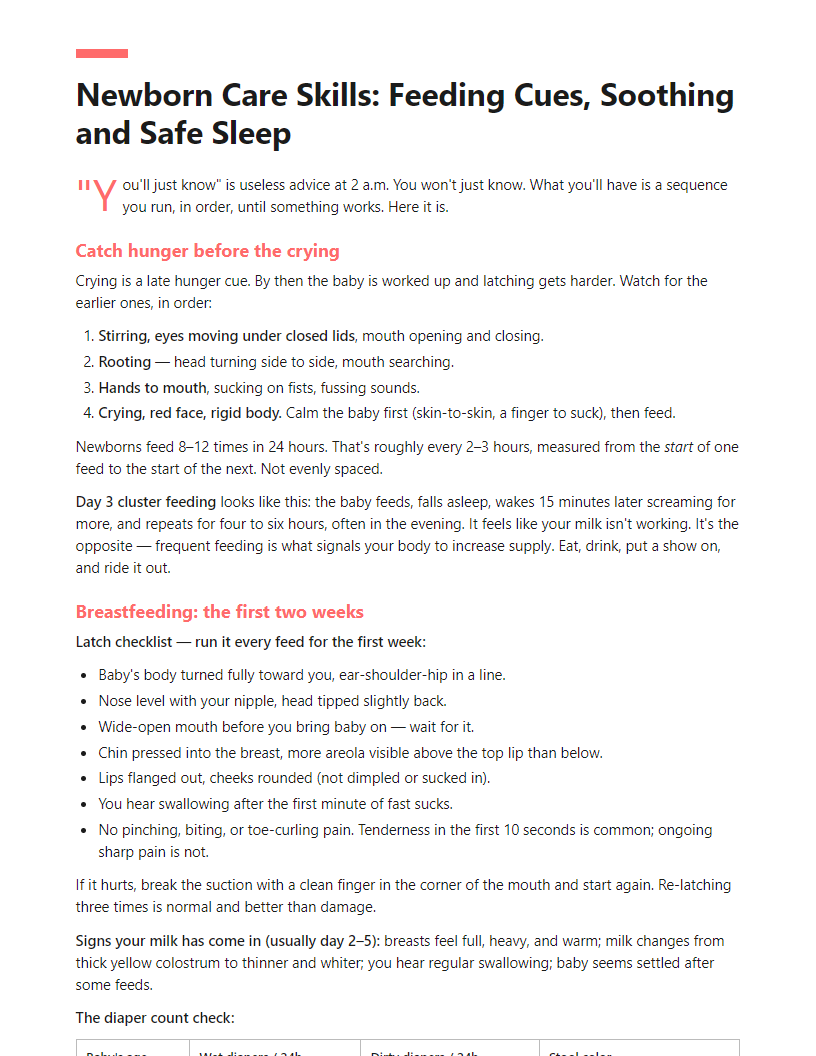
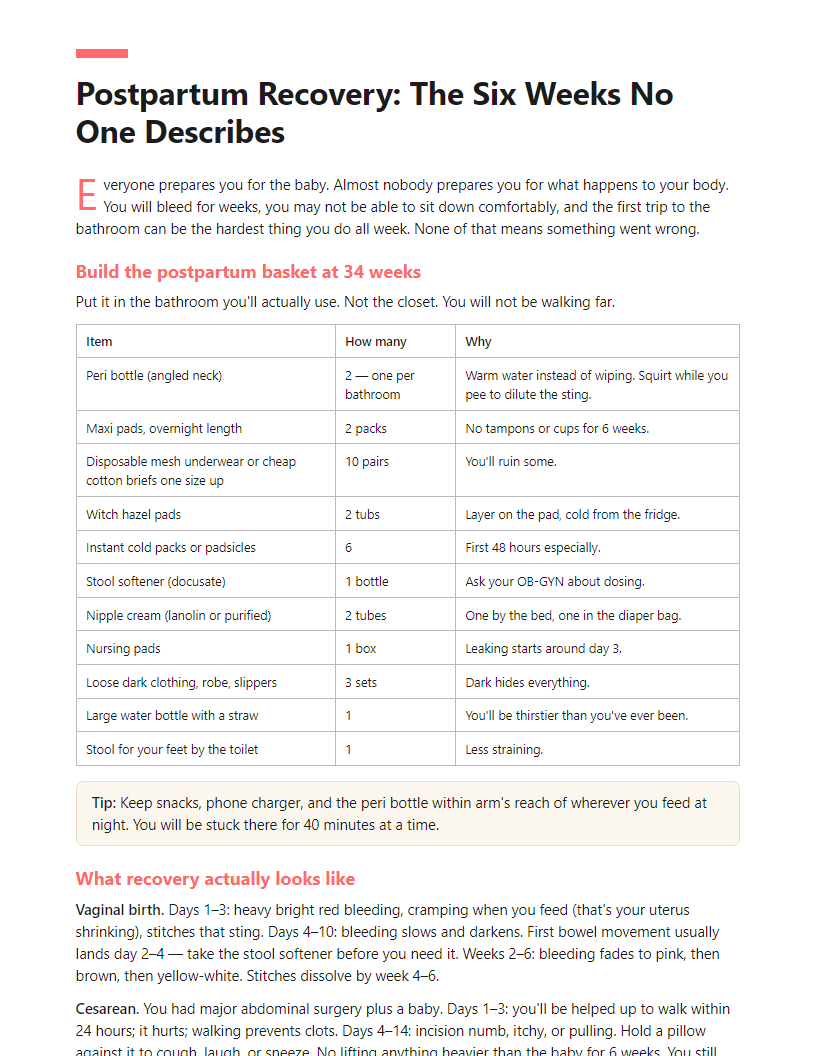
A look inside the PDF
11 sections · 28 pages
Full table of contents
- Why Lists Alone Don't Make You Ready
- The Short Answer: 12 Things a Newborn Actually Needs
- Week-by-Week Prep Plan: 28 Weeks to Day 14
- The Hospital & Birth Centre Bag (Including the C-Section Version)
- Newborn Care Skills: Feeding Cues, Soothing and Safe Sleep
- Postpartum Recovery: The Six Weeks No One Describes
- The Partner's Playbook: First 14 Days
- Freezer Meals and Food Plan for Weeks 1–6
- Budget, Purchase Tracker and Personalisation
- Paperwork, Benefits and the Car Seat Trial Run
- 11 Preparation Mistakes That Cost Parents Money and Sleep
In this article
“I genuinely don’t know what we actually need — and everyone’s list is different.” If you’re staring at a 200-item registry at 2am, wondering whether you’re buying the right things or just buying things, this checklist for newborn preparation strips it back. You’ll see the 12 items a newborn truly needs, the 11 preparation mistakes that quietly cost parents money and sleep, and straight answers to the rules everyone quotes online.
The premium PDF workbook goes further than a shopping list: a week-by-week plan from 28 weeks to day 14, hospital bag (including a C-section version), feeding cues and safe sleep, postpartum recovery, a partner’s playbook, freezer meals with quantities, and a budget tracker you can personalise.
The short answer
A realistic checklist for newborn essentials covers twelve things:
- Safe sleep space (crib, bassinet or Moses basket) with firm mattress
- Fitted sheets, 2–3
- Rear-facing car seat, correctly fitted
- Feeding kit: bottles and formula, or nursing bras and pads
- Nappies and wipes
- Changing mat and barrier cream
- 6–8 bodysuits and 6 sleepsuits
- 2–3 swaddles or sleeping bags
- Muslins and burp cloths
- Pram or sling
- Baby bath, towels and nail file
- Thermometer and infant pain relief
Everything else — monitors, bouncers, bottle warmers — can wait until baby arrives.
Why Lists Alone Don’t Make You Ready
You can own every item on a 200-line registry and still freeze at 3 a.m. on day three. That’s the trap. Most baby checklists cover gear — maybe a quarter of what the first six weeks actually demand. They say nothing about how to read a hunger cue, how to get a car seat off its base in a parking lot, or what week-two bleeding looks like.
Parents say it plainly: “I prepared SO much about what to buy and nothing about what to do once baby got here.” Another: “I’m more overwhelmed by the registry than actual motherhood.” Both are symptoms of the same gap.
The four pillars
This workbook splits readiness into four parts. Every checklist here is tagged with one.
- Gear — the small list of things a newborn actually uses, plus what to skip.
- Skills — feeding cues, latch basics, soothing, safe sleep, diapering, car seat handling.
- Recovery — your body and mind for six weeks after birth, whatever the delivery.
- Logistics — paperwork, benefits, meals, visitors, who does what at 2 a.m.
Where to start
- 28–32 weeks: Start at Section 3 and work forward. You have time to do this cheaply.
- 36–40 weeks: Go to Section 4 (bag), then Section 5 (skills), then Section 10 (car seat trial run). Gear can wait; skills can’t.
- Already home: Skip to Section 5, 6 and 7. Buy nothing for a week.
No sponsored brands
We name no brands, take no product fees, and run no affiliate links. The rule is function first, brand last: we describe what the item must do, and you buy whatever meets that at your budget. You shouldn’t have to wonder who paid for a recommendation.
90-second self-check
Mark each statement true or false.
- I know what to do in the first hour at home.
- I can name three early hunger cues.
- I’ve installed and unclipped the car seat myself.
- I know what normal postpartum bleeding looks like.
- We’ve agreed who handles night diapers.
- I know the number for a lactation consultant.
- There are five meals in my freezer.
- I know which forms are due in week one.
Every “false” points to a pillar you’ve been avoiding. Start there.
The Short Answer: 12 Things a Newborn Actually Needs
A newborn needs twelve things. Everything else is convenience, preference, or a gift someone else will buy you. No brands here — none of this is sponsored, and the brand matters far less than the count.
The 12-item core
| Item | How many | Why this number |
|---|---|---|
| Infant car seat | 1 | Required for the drive home, and hospitals won’t discharge you without one |
| Safe sleep surface (crib, bassinet, or play yard) | 1 | Firm, flat, no padding; a borrowed bassinet is fine with a new mattress |
| Bodysuits and sleepers | 5–7 newborn, 10–12 in 0–3 months | Newborns soil 2–3 outfits a day; this is two days of laundry slack |
| Diapers | 1 pack newborn, 1 pack size 1 | 8–12 a day; don’t stockpile newborn size |
| Wipes | 2 packs | Buy more later, cheaper, in bulk |
| Diaper cream | 1 tube | Red skin shows up in week one, usually at 2 a.m. |
| Feeding kit | 1 set | Nursing bras and pads, or 4–6 bottles and nipples, or both |
| Digital thermometer | 1 | Rectal or temporal; your pediatrician wants an accurate number |
| Muslins and burp cloths | 8–10 total | Burp cloth, sun shade, spit-up mop, swaddle; keep one on every couch |
| Stroller or carrier | 1 | Pick the one that fits your daily walk, not both |
| Baby nail file | 1 | Newborn nails scratch faces within days |
| Hooded bath towel | 2 | One in the wash, one in use |
Quantities are the whole game. If you run laundry every other day, 10–12 pieces in 0–3 months works. If you run it twice a week, buy toward the top of each range.
Borrow, don’t buy
Bassinet, bouncer, bottle warmer, changing table. All four get used for weeks or months, not years, and all four turn up free in local parent groups. Buy a new mattress for any borrowed bassinet or crib. A bottle warmer heats what a mug of hot water heats, and a changing table is a dresser with a mat on top.
Wait until week three
These depend on your actual baby:
- Pacifiers — some babies refuse every shape
- Swaddles vs. sleep sacks — some babies fight arms-down
- Breast pump — wait until feeding is established, and check your insurance coverage first
- Bottle brand — if one nipple causes gas, you don’t want 12 of them
- Formula — if you need it, start with what the hospital gives you
Rough spend
| Level | New-item spend | What it looks like |
|---|---|---|
| Lean | $250–$450 | New car seat and crib mattress; everything else secondhand |
| Mid | $600–$1,000 | New core 12, borrowed extras |
| Full | $1,500–$2,500+ | New stroller system, nursery furniture, monitor |
Buy the car seat new. Buy the crib mattress new. Price-check everything else against your local buy-nothing group this week.
11 Preparation Mistakes That Cost Parents Money and Sleep
1. Buying newborn-size clothes in bulk
A 9 lb baby skips newborn size entirely. Buy 5–7 newborn pieces, keep the tags on, and have a pack of 0–3 month as backup. Buy the rest after you’ve met the baby.
2. Spending on the nursery, skipping the postpartum basket
One mom of five: “I completely forgot about postpartum care — the same mistake I made with my first.” A peri bottle, witch hazel pads, overnight pads, and stool softener cost under $40 and sit in the bathroom before you leave for the hospital. The crib goes unused for months. The basket gets used on hour one.
3. Never practicing the car seat release
“I called my husband at work in a panic because I couldn’t figure out how to get the car seat out of the base.” Do the full sequence ten times before the birth: click in, unclick, carry, re-click. Practice in the dark and with the stroller frame too.
4. Assuming breastfeeding just works
It often doesn’t in week one. Save a lactation consultant’s name and number in your phone before you give birth, and find out what your insurance covers. If milk supply is low or the latch hurts, you want a call booked within 24 hours — not a week of pain and guessing.
5. Leaving freezer meals to the last week
At 39 weeks you’re too tired, and if the baby comes early you get nothing. Cook two extra portions a week from 32 weeks instead. You’ll be at 14 meals without ever having a “meal prep day.”
6. One hospital bag, no C-section plan
A reader had an emergency C-section weeks into the third trimester: “My husband kept going back and forth because there were things I forgot to ask him for.” Split into labor, postpartum, and baby bags. Add high-waisted underwear and loose pants for the surgical version — about a third of births are C-sections, many unplanned.
7. Trusting sponsored gear lists
If a list has affiliate links on 20 items, it’s a storefront. Cross-check any purchase over $100 against secondhand marketplaces and friends with toddlers. Buy new: car seat, crib mattress, bottle nipples, pacifiers. Borrow freely: bassinet, swing, carrier, clothes, bouncer.
8. Visitors with no boundaries and no job
Decide the rule before the birth: no drop-ins, no one sick, everyone who comes runs the dishwasher or holds the baby while you shower. Text it, don’t announce it at the door.
9. Washing nothing in advance
Wash and fold clothes, sheets, and swaddles at 36 weeks. Tags on day two are a bad surprise.
10. Only one adult knowing how anything works
If you’re the only one who can work the bottle warmer or the stroller fold, you can’t nap.
11. Registering for the 200-item list
“I’m more overwhelmed by the registry than actual motherhood.” Register for 30 items. Add more in month two if you miss something.
Newborn Prep FAQ
What is the 5-5-5 rule for newborns?
It’s a postpartum rest plan, not a medical rule: 5 days in bed, 5 days on the bed, 5 days near the bed. The point is that you stay horizontal for roughly two weeks while someone else handles the house. No doctor’s group issues it. Treat it as a useful target, not a prescription.
A second, unrelated version floats around for breast milk storage (5 hours on the counter, 5 days in the fridge, 5 months in the freezer). Numbers vary by source — check current CDC storage guidance rather than a rhyme.
What is the 3-3-3 rule for newborns?
Same idea, shorter: a 9-day version of the rest plan (3 days in bed, 3 on the bed, 3 near it) for parents who can’t get two weeks of help. A milk storage variant also circulates (3 hours out, 3 days fridge, 3 months freezer), as does a wake-window guide.
None of these are safe sleep rules. Back to sleep, firm flat surface, empty crib, room-share — full rules in Section 5.
What do I actually need for a newborn?
Twelve things: car seat, safe sleep surface, diapers, wipes, bodysuits, a feeding method, thermometer, and a few others. The full list with quantities is in Section 2.
What are 10 things you need if money is tight?
- Car seat (new, not used)
- Crib or bassinet with a firm mattress
- Fitted sheets (2)
- Diapers and wipes
- Onesies and sleepers (8–10 total)
- Swaddles or sleep sacks (3)
- Burp cloths (6)
- Digital thermometer
- Diaper cream
- Postpartum supplies for mom
How many of each clothing size?
| Size | Pieces |
|---|---|
| Newborn | 5–7, tags on |
| 0–3 months | 10–12 |
| 3–6 months | Buy later |
Babies over 9 lb skip newborn size. Don’t wash anything past the first pack until you’ve met your baby.
When should I pack my hospital bag?
By 35 weeks. Earlier if you’ve had a preterm birth before, are carrying twins, or live more than 30 minutes from the hospital.
What changes for baby three, or twins?
Gear stops being the problem. Your constraints are childcare for the older kids, meals, and recovery time. Prep food and a daily coverage schedule first; buy diapers, a car seat, and clothes, and skip the registry entirely.
- ✓Week-by-week prep plan from 28 weeks to day 14
- ✓Hospital and birth centre bag list, plus a C-section version
- ✓Partner's playbook: a day-by-day grid for the first 14 days
- ✓Freezer meal plan for weeks 1–6 with recipes and exact quantities
- ✓Budget worksheet and purchase tracker, personalisable by baby's gender
- ✓Postpartum recovery timeline with mental health warning signs
- ✓Paperwork and benefits checklist plus car seat trial-run steps
Frequently asked questions
What does the 5-5-5 rule for newborns mean?
The 5-5-5 rule is a breast milk storage guide: up to 5 hours at room temperature, 5 days in the fridge, and 5 months in the freezer. Some parents also use "5-5-5" for postpartum rest — 5 days in bed, 5 days on the bed, 5 days near the bed — to encourage recovery and feeding before resuming normal activity.
What is the 3-3-3 rule for newborns?
The 3-3-3 rule is a rough feeding and settling rhythm: feed roughly every 3 hours, keep awake windows near 3 for many wake periods in the early weeks, and expect sleep stretches around 3 hours overnight. Treat it as a loose guide — newborns feed on cue, and 8–12 feeds in 24 hours is normal and healthy.
What are 10 things you really need for a newborn baby?
Safe sleep space, car seat, nappies, wipes, bodysuits, sleepsuits, swaddles or sleeping bags, feeding supplies (breast or bottle), muslins, and a changing mat with barrier cream. That covers sleeping, feeding, changing and travel — the four things a newborn genuinely does. Add a pram or sling and a thermometer, and you're ready for day one.
How do I prepare for caring for a newborn, not just buying gear?
Practise the skills before birth: nappy changing, safe swaddling, back-to-sleep positioning, recognising early feeding cues (rooting, hand-to-mouth, stirring) rather than waiting for crying, and soothing with contact, motion and sound. Book a breastfeeding or feeding class, save your lactation support number, and agree a night shift plan with your partner. The PDF covers each skill step by step.
What should my partner do in the first two weeks?
Partners handle everything that isn't feeding: nappies, winding, settling, laundry, visitor gatekeeping, meals, water and snacks within reach at every feed, and medication timing for recovery. Track feeds and nappy counts so you can answer questions at appointments. Watch for postpartum warning signs — persistent low mood, intrusive thoughts, heavy bleeding, fever — and make the call when needed.
We collected 178 real questions and comments about "checklist for newborn" (174 from YouTube comments, 4 from People Also Ask), grouped them into 17 recurring problems, and built this guide to resolve the 7 that block people most. The top-ranking pages were reviewed for gaps; 7 of those gaps became dedicated sections.
Edited by Alex Hirn · Last updated October 19, 2026 · How we make our guides
More in Family & Baby
 premium
 premiumfreefree