Template · 15-page PDF · Free
Potty Training Chart DIY: Templates, Rules and a Reward System That Sticks
Build a potty training chart DIY in 15 minutes: layout, sticker rules, reward stages and a fade-out plan. Free printable templates and setup checklist inside.

The full guide as a PDF
- ✓Measured build instructions with exact grid and box sizes
- ✓Four copy-these template layouts: grid, path, jar and ladder
- ✓Three theme variants — boy, girl and neutral designs
- ✓Four-stage reward system with a week-by-week fade-out table
- ✓Regression rescue plan for new siblings, illness or house moves
- ✓Print-and-tick setup checklist for your first seven days
Hosted on FileJoker. Free download, no sign-up.
A look inside the PDF
8 sections · 15 pages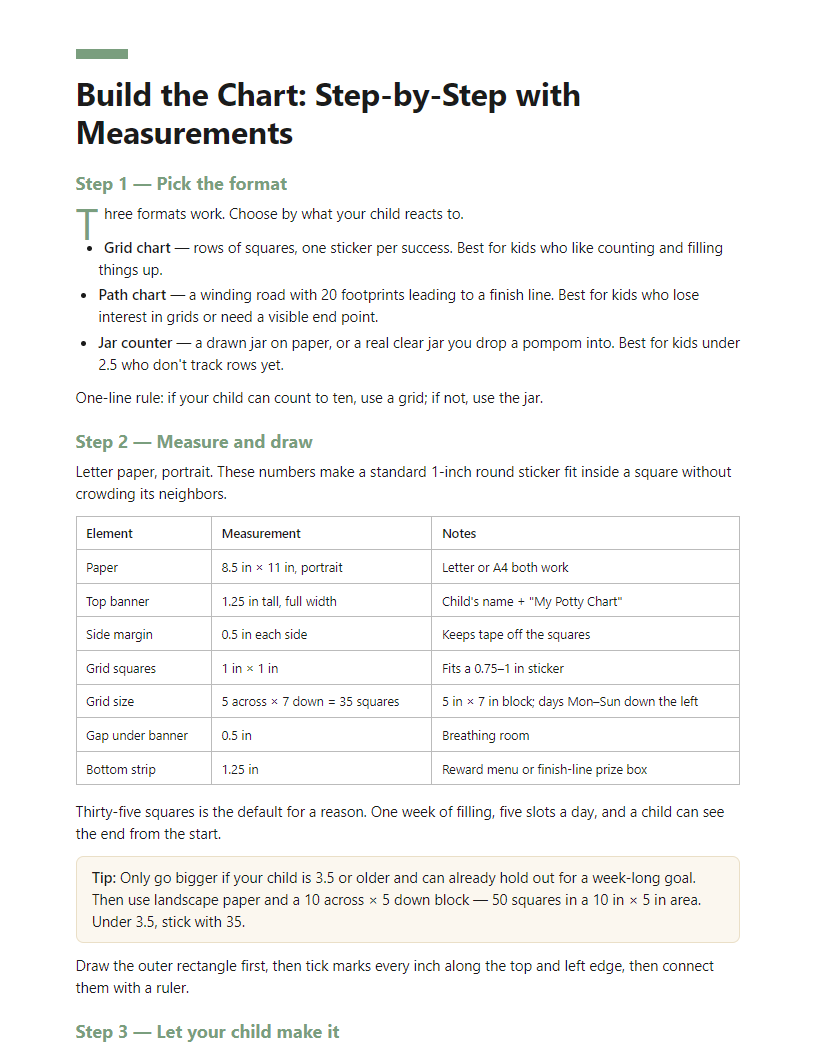


Full table of contents
- Why Most Potty Charts End Up on the Floor by Day Four
- Build the Chart: Step-by-Step with Measurements
- Copy-These Templates: Grid, Path, Jar and Three Theme Variants
- The Four-Stage Reward System (and How to Fade It Out)
- Fast-Track Methods Decoded: 3-Day, 1-Day and the 10-10-10 Rule
- Nine Mistakes That Kill a Reward Chart
- When Motivation Fades or Regression Hits
- Print-and-Tick Setup Checklist
In this article
“I made a potty training chart DIY on Sunday, and by Wednesday it was face-down under the sofa.” If that sounds familiar, the problem usually isn’t your drawing skills — it’s the rules around the chart: how often stickers are earned, what counts as a win, and when rewards should shrink.
Here you get the fast build (15 minutes, paper you already own), a plain-English breakdown of the 3-day, 1-day and 10-10-10 methods, and the nine mistakes that kill a chart by day four.
The free PDF turns it into a kit: measured build instructions, four copy-these template layouts with boy/girl/neutral themes, a four-stage reward system with a fade-out plan, and a regression rescue section.
The short answer
Make a working potty training chart DIY in 15 minutes:
- Cut an A4 or card sheet; draw a 5×7 grid (5 days, 7 slots) or a 20-step path.
- Define one win — sitting on the potty counts at first, not just successes.
- Set reward tiers: a sticker per win, a small prize per full row.
- Hang it at child height, next to the potty, with stickers within reach.
- Let your child place the sticker — the act is the reward.
- Review weekly and fade prizes once a habit forms.
Why Most Potty Charts End Up on the Floor by Day Four
A potty chart is not magic. It’s a tracking tool with a built-in excuse to celebrate. Do sticker charts actually work? Yes — when they do three specific things:
- Make invisible progress visible. Four dry days in a row feels like nothing to a toddler until it’s four stickers in a row.
- Script your praise. You don’t have to invent enthusiasm at 6 a.m. You walk to the fridge, stick the sticker, say the line.
- Create a shared goal. The chart belongs to both of you. That matters more than the prize.
Why charts fail
Three reasons, almost always. You reward the wrong behavior — sitting, trying, announcing — instead of actual pee or poop in the potty. You put the reward too far away; a 2-year-old cannot hold out for Saturday. Or the chart stays on the fridge for two months after your child stopped looking at it, which teaches them charts are wallpaper.
The honest readiness check
Skip the chart for now if most of these aren’t true:
- Stays dry for about 2 hours at a stretch
- Tells you after (or better, before) they pee
- Can pull pants down without help
- Shows some interest in the toilet or in you using it
Age changes everything
A 2-year-old needs a sticker in their hand within five seconds and a chart with ten squares, not fifty. A 3.5-year-old can handle a week-long goal, a path chart, and a reward they chose themselves. Same system, different scale.
The range for independent toileting is wide and completely normal. Some kids manage it at 20 months. Plenty of 4-year-olds still have accidents because they got busy playing. Your friend’s child is not the benchmark, and losing your temper on day five doesn’t mean you’ve failed.
This kit gives you the chart template with measurements, three theme variants, clear sticker rules, and a four-stage plan that tells you when to stop.
Quick Answer: Make a Working Potty Chart in 15 Minutes
You need one sheet of paper and 15 minutes. Here’s the whole thing.
Grab these
- One sheet of letter or A4 paper
- A ruler and a marker
- Round stickers — or draw circles and let your child color them in
- Optional: crayons for your child to decorate the edges
Draw a 7×5 grid
Seven rows, one per day, labeled Mon through Sun down the left side. Five columns of sticker squares across. That’s 35 slots — small enough that a child can fill it in about a week, which matters. A 100-square chart feels endless to a 2-year-old.
Leave a wide box across the top and a strip at the bottom.
| Zone | Where | What goes in it |
|---|---|---|
| Name box | Top left of header | “RILEY’S POTTY CHART” in big letters |
| Character | Top right of header | Their pick — dinosaur, truck, Elsa. Drawn or cut out |
| Target behavior | Under the header, one line | One behavior only: “Sit on the potty” |
| Sticker grid | Middle, 7 rows × 5 columns | Day names down the left edge, Mon to Sun |
| Reward milestone | Bottom strip | “10 stickers = [prize]” with 10 small boxes to shade in |
The sticker rule, in one line
Week one: a sticker for every sit-down attempt. Week two onward: successes only.
That switch matters. Rewarding attempts forever stalls progress, and your child will notice. Tell her the rule is changing before it changes, so the first refused sticker isn’t a shock.
Hand the prize over at 10 stickers
Not at the end of the chart. Ten is close enough to stay real for a toddler. Draw the ten milestone boxes at the bottom so she can see the gap shrinking.
Keep the prize outside the bathroom — on a stool by the door works. Candy stored next to the potty gets grabbed.
Do sticker charts actually work?
They work as a launcher, not a permanent system. In most families the novelty lasts a few weeks, then interest drops. Expect that — it’s not failure. It’s your signal to move to the next reward stage rather than print a bigger chart.
Fast-Track Methods Decoded: 3-Day, 1-Day and the 10-10-10 Rule
Fast methods don’t skip the work. They compress it into a block where you do nothing else.
The 3-day method
- Clear your calendar for three full days. No outings, no visitors, no work calls.
- Diapers off. Underwear or bare bottom at home. Diapers only for naps and night.
- Offer drinks steadily — water, milk, diluted juice. More fluid means more practice chances.
- Sit your child on the potty for 3–5 minutes at a time, on a timer. Longer sits only suit older children who are happy to stay put.
- End the sit when the timer goes off, or sooner if your child asks to get off. Always let them off when they ask.
- No punishment, no “uh-oh” face. Accidents get a flat, calm response and a change of clothes.
Expect day 1 to be mostly accidents, day 2 to show a few catches, day 3 to show some self-initiating. That’s the pattern — not a guarantee.
What “10-10-10” means
Ten minutes after a drink, offer a sit, then repeat roughly every 10 to 15 minutes early on. Despite the name, keep the sit itself to 3–5 minutes — a 10-minute sit is a long time for a 2-year-old and invites resistance. It’s a prompting rhythm that stacks the odds: full bladder plus seat time equals a catch you can celebrate. It doesn’t teach the body signal. It just buys you enough successes for the signal to connect.
The 1-day / intensive approach
One adult, one child, one entire day of undivided attention. Usually built around demonstrating with a doll that “wets,” heavy fluids, and constant practice runs to the potty. It suits a child over 2½ who already shows readiness signs, and an adult who can genuinely give a full day with no interruptions.
| 3-day | 10-10-10 | 1-day intensive | |
|---|---|---|---|
| Time required | 3 clear days at home | Ongoing, flexible | 1 full day, one-on-one |
| Child age | 2–3+ | Any age in training | 2½+ with readiness signs |
| Chart role | Stage 1 rewards, daily total | Prompt tracker | Chart starts day 2 |
| Main risk | Burnout by day 2 | Sit fatigue, resistance | Too much pressure, too fast |
Honest expectations
Fast methods front-load effort; they don’t end it. Most families still see accidents for 2–6 weeks afterward, especially when tired, excited, or out of the house.
Plugging the chart in
During an intensive block, don’t sticker every sit — you’ll run out of chart by lunchtime. Sticker catches only. Add one end-of-day sticker for “tried all day.”
Warning: Stop the intensive attempt if your child withholds stools, cries at the toilet, or becomes constipated. Put diapers back on, wait two to four weeks, restart.
Nine Mistakes That Kill a Reward Chart
1. Taking stickers back after an accident
This kills a chart faster than anything else. A sticker records something that already happened. Remove it and the chart stops being true, and your child stops trusting it. Accidents get a neutral line: “Pee goes in the potty. Let’s try again.”
2. One big reward, far away
“A new truck at the end” means nothing to a 2-year-old. They can’t link Tuesday’s potty trip to Saturday’s toy. Keep the sticker immediate and the bigger reward no more than five successes away in Stage 1.
3. Rewarding attempts instead of successes
Sitting is worth praise. It isn’t worth a sticker. If “trying” earns the same as going, the chart teaches sitting. Expect a fit or two the first time you hold the line — say “You sat, that was good practice. Sticker’s for pee in the potty,” and stay calm.
4. Storing the treats in the bathroom
Earn it in the bathroom, collect it outside. See the placement rule in Step 5 of the build section.
5. Running three charts at once
Potty, bedtime, and eating charts at the same time split your child’s attention and yours. Run the potty chart alone. Everything else waits two weeks.
6. Asking “Do you need the potty?”
The answer is almost always no — it’s a yes/no question, and “no” means play continues. Say “Potty time” and walk there together. Statement, not question.
7. Leaving the chart up for months
Once the novelty dies, the chart becomes wallpaper and the stickers lose value. Four to six weeks total, then retire it on purpose with a small ceremony. A retired chart is a win, not a failure.
8. Comparing out loud
“Your cousin was trained at two.” “Everyone at daycare uses the big toilet.” Kids hear all of it. Some children are reliable at 20 months; some are still having accidents at 4 because they were busy playing. Different timing is normal, not behind.
9. One caregiver uses the chart, the other doesn’t
Take a photo of your chart rules and send it to every adult who takes your child to the bathroom — sitter, grandparent, partner, daycare. Three rules have to match, word for word:
- The target behavior — exactly what earns a sticker today (“pee in the potty”), and nothing broader.
- The sticker trigger — handed over within 10 seconds, at the potty, by whoever is there.
- Where the reward lives — one agreed spot, the same one every time.
If a caregiver won’t follow them, don’t argue about method. Ask them to skip the chart entirely and just say “Pee goes in the potty” — no stickers, no treats. Inconsistent rewards do more damage than no rewards.
Potty Chart FAQ
What is the 10-10-10 rule for potty training?
Two versions circulate online. One is a sitting schedule: 10 minutes on the potty, 10 times a day, for 10 days. The other — the one this guide uses — is a prompting rhythm: sit about 10 minutes after a drink, stay up to 10 minutes, repeat every 10 to 15 minutes early on. Either way, it’s a timing rule, not a reward rule. Pair it with your chart: a sticker for every sit in the first stage, then stickers only for results.
How do I make a reward chart if I can’t draw?
You don’t need to draw anything. Fold a sheet of paper into squares and trace the creases with a ruler — that’s a grid. For a “fill the jar,” trace around a drinking glass twice and join the sides with two straight lines. For a path, draw 20 circles by tracing a coin. Let your child color the rest. A wobbly chart your child decorated beats a perfect printable they didn’t touch.
What is the 3-day potty training trick, and does it work for every child?
Three days at home, no diapers during waking hours, potty sits every 20–30 minutes, and a chart on the wall. It works well for children who are already showing readiness signs. It does not work for every child. If you’ve been consistent for three days and seen no progress, stop, go back to diapers for two to four weeks, and try again. That’s a pivot, not a failure.
Do sticker charts actually work — and for how long?
Yes, for a window. A chart makes progress visible, gives you a reason to praise, and gives your child a job to do. The effect fades after a few weeks as the novelty wears off — which is why the four-stage fade exists. Charts don’t create readiness. They sharpen motivation in a child who is already close.
Should I reward attempts or only successes?
Reward attempts for the first few days only, while sitting is the skill being learned. After that, stickers go to actual use of the potty. Expect protests. Hold the line — if trying earns the same as succeeding, there’s no reason to succeed.
Tip: Keep edible rewards outside the bathroom — a small container on a stool by the door. It keeps candy away from the toilet and makes the reward a separate step from the potty itself.
My child is 3.5 and still in diapers — are they behind?
No. Some children are reliable at 20 months; some are 4 and still have accidents because they were too busy playing. Talk to your pediatrician if your child shows pain, straining, or no interest at all by age 4. Otherwise, wait for readiness instead of forcing a date.
How long should the reward chart phase last?
Four to six weeks total, then retire it. If your child has had seven dry days in a row, you’re done.
- ✓Measured build instructions with exact grid and box sizes
- ✓Four copy-these template layouts: grid, path, jar and ladder
- ✓Three theme variants — boy, girl and neutral designs
- ✓Four-stage reward system with a week-by-week fade-out table
- ✓Regression rescue plan for new siblings, illness or house moves
- ✓Print-and-tick setup checklist for your first seven days
Frequently asked questions
What does the 10-10-10 rule for potty training mean?
It's a simple timing routine: your child sits on the potty for about 10 minutes, roughly every 10 minutes of structured practice early on, with 10 seconds of praise or a sticker straight after. In practice, most parents use it as sit-often, sit-briefly, reward-immediately. The key part is the instant feedback — delayed praise teaches nothing to a two-year-old.
How do I make a reward chart for potty training at home?
Use one sheet of card, a ruler and a marker. Draw a grid of 25–35 boxes or a winding path with numbered steps. Add your child's name and a theme they love. Stick it at their eye level beside the potty. Keep stickers in an open jar nearby so your child can place their own after every attempt.
What is the 3-day potty training trick?
You clear the calendar for three days at home, remove nappies entirely during waking hours, offer extra drinks, and prompt potty sits every 20–30 minutes. Accidents are cleaned up calmly without scolding. By day three most children recognise the urge and tell you. It works best for children showing readiness signs and needs full adult availability — it's not a weekend of half-attention.
Do sticker charts actually work for potty training?
Yes, for most children aged two to four — but only for a few weeks. Stickers give instant, visible feedback that a toddler can understand. They stop working when the novelty fades, the goal is too far away, or you reward only successes. Plan from the start to shrink rewards: sticker for every attempt, then daily, then weekly, then nothing but praise.
What do I do when the chart stops working?
Change one variable, not everything. Shorten the goal row, switch the design or theme, let your child help redraw it, or move from stickers to a marble jar. If motivation is gone entirely, pause the chart for a week without comment and restart with a new layout. Persistent refusal usually signals readiness or stress, not stubbornness.
My child seems behind other kids their age — is that a problem?
Readiness ranges widely from 18 months to nearly four years, and later starters often train faster. Look for signs rather than dates: dry for two hours, interest in the toilet, able to pull trousers down, telling you when wet. If those are missing, waiting two to four weeks beats weeks of conflict. Talk to your GP or paediatrician past four.
We collected 50 real questions and comments about "potty training chart diy" (15 from YouTube comments, 4 from People Also Ask, 31 from search suggestions), grouped them into 11 recurring problems, and built this guide to resolve the 6 that block people most. The top-ranking pages were reviewed for gaps; 7 of those gaps became dedicated sections.
Edited by Alex Hirn · Last updated October 18, 2026 · How we make our guides
More in Family & Baby
 premium
 premium+2 bonuses
 premium
 free