Template · 14-page PDF · Free
Potty Training Chart Ideas: Themes, Mechanics and Rewards That Last
Potty training chart ideas compared by theme, plus reward rules that avoid tantrums. Free printable charts, a 7-step setup plan and a first-week checklist.
The full guide as a PDF
- ✓Printable chart set: stickers, vehicles, princess, animals, poop-only and blank DIY designs
- ✓7-step setup plan for the first two weeks, day by day
- ✓Reward ladder table: what to reward at 2, 3 and 4 years old
- ✓Regression restart script for after a new baby, move or illness
- ✓4-week chart fading plan that builds intrinsic motivation
- ✓One-page caregiver agreement for daycare, grandparents and co-parents
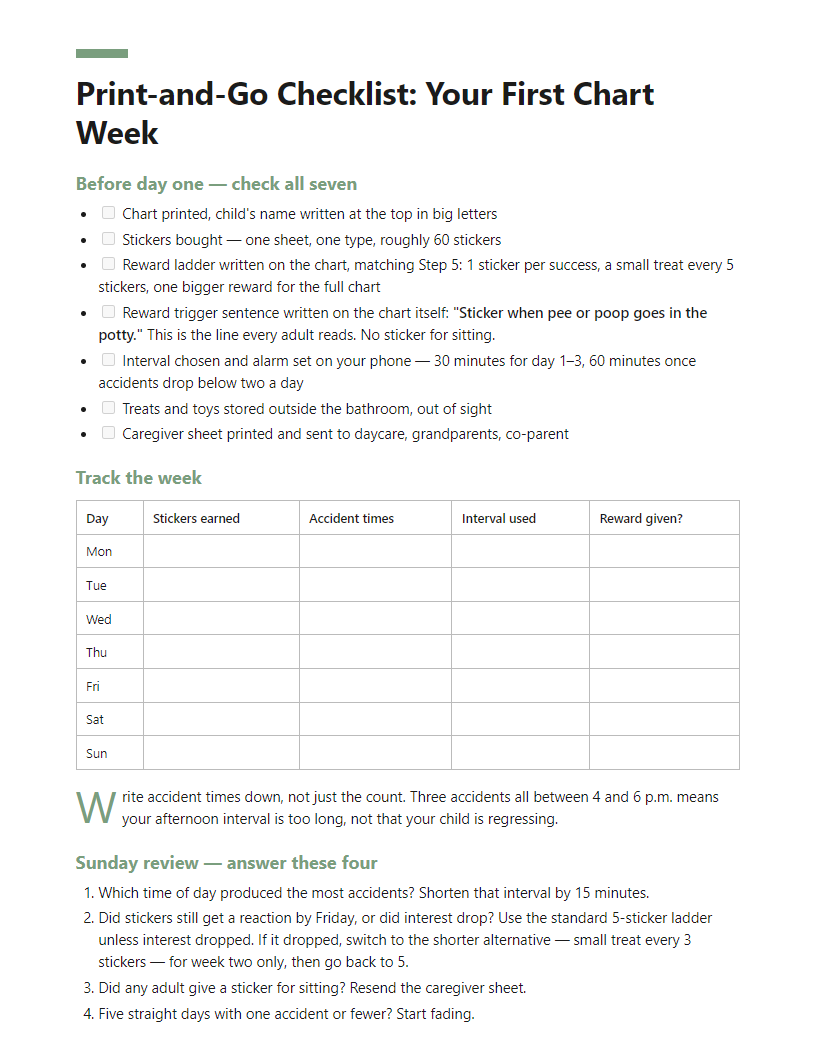
- ✓Print-and-go first chart week checklist
Hosted on FileJoker. Free download, no sign-up.
A look inside the PDF
9 sections · 14 pages

Full table of contents
- Why Most Potty Charts Stop Working by Day Four
- Pick Your Chart: 6 Themes Compared
- Set Up and Run the Chart: 7 Steps for the First Two Weeks
- What the '10-10-10 Rule' and Other Popular Rules Actually Mean
- Seven Chart Mistakes That Cause Tantrums and Regression
- Regression and Restart Plan After a Big Life Change
- Fading the Chart and Building Real Motivation
- Keeping It Consistent Across Daycare, Grandparents and Co-Parents
- Print-and-Go Checklist: Your First Chart Week
In this article
“The sticker chart worked for two days, then she lost interest” — if that sounds familiar, you are not doing it wrong, and your child is not behind. Most potty training chart ideas fail because the mechanics are vague: how often to sit, what exactly earns a sticker, and what happens when your toddler demands a reward for trying but not going.
On this page you get the honest answer on whether charts work, six chart themes compared for different ages and personalities, and the seven mistakes that trigger tantrums or regression.
The free PDF adds the printable charts themselves plus a day-by-day setup plan, a regression restart script, and a fading plan so the stickers eventually become unnecessary.
The short answer
The potty training chart ideas that actually work share four features:
- One clear behaviour — reward a successful potty use, not every attempt, so expectations stay predictable.
- A visible theme your child chose — stickers, vehicles, princesses, animals, a dedicated poop chart, or a DIY path chart.
- A short time frame — one page covering 5–7 days, not a month-long grid that never fills.
- A small, instant reward — a sticker now beats a toy on Friday for a two-year-old.
Add a fixed potty schedule, keep the chart at child eye level, and plan from day one how you will fade it out.
Why Most Potty Charts Stop Working by Day Four
Plenty of potty charts get abandoned in the first week. Not because charts don’t work, but because of three setup errors.
- Rewarding attempts instead of results. Your child sits on the potty, gets a sticker, hops off dry, then asks for another sticker two minutes later. Now the chart rewards sitting, not peeing — and when you say no, you get a tantrum.
- Too many squares. A 30-day grid means nothing to a 2-year-old. At this age, “soon” and “later” barely register; what happens next is what counts.
- No end point. If the chart never finishes, there’s no win. Children lose interest in anything with no finish line.
What a chart actually does
It makes invisible progress visible. A toddler can’t remember that yesterday went well. A row of five stickers they can see and touch does that job for them. That’s the whole mechanism — nothing magic, and it only helps a child who is physically ready.
Readiness beats age
Three signals matter more than the number of months:
- Stays dry for 2 hours at a stretch
- Tells you after they’ve gone (that’s the first step toward telling you before)
- Can pull pants down and up with a little help
The American Academy of Pediatrics puts most children’s readiness signs somewhere between 18 and 24 months, with plenty of kids not ready until age 3 or later. The neighbor’s 22-month-old is not the benchmark, and neither is the 4-year-old still having accidents.
What’s in this kit
- Six printable charts in different themes, sized for short wins
- A reward rules card that spells out exactly what earns a sticker
- A caregiver handover sheet for daycare, grandparents, or a co-parent
Do Potty Charts Really Work? The Short Answer
Yes — for the right age, and for a limited window.
A chart works as a visual tracker for kids who understand cause and effect, roughly 2.5 to 4 years old. Your child sees the sticker go up, connects it to what they just did, and wants another one. Under about 24 months, that link usually isn’t there yet, and the chart becomes a sticker toy.
Expect 2 to 4 weeks of real pulling power. After that, most charts lose their shine. That’s not failure — it means the chart did its job and it’s time to fade it out (see the fading section).
The one rule that decides it
Reward the result: pee or poo in the potty. Never the attempt, never the sitting.
This is where most systems break. Give a sticker for trying, and your child learns that sitting down is the behavior that pays. You’ll get repeated two-second sits, and a tantrum the first time you say no. Expect some fits when you hold the line. Hold it anyway.
Warning: Charts don’t replace scheduled prompting. The chart records trips to the potty — you still have to prompt them, on a timer, all day.
If your child shows zero interest after 5 consistent days, stop. Pause 2 to 4 weeks, keep the potty visible, and retry. Not all kids learn the same way, and pushing a child who isn’t ready costs you more time than waiting.
Pick Your Chart: 6 Themes Compared
Pick one chart. Not three. Switching formats mid-week resets your child’s sense of progress.
| Theme | Best age | Motivates best when | Prep time | Reward trigger |
|---|---|---|---|---|
| Classic sticker grid (10 squares) | 2.5–4 | Your child likes filling in boxes and seeing them complete | 2 min (print + stickers) | 1 sticker per successful pee or poo in the potty |
| Path / race track | 3–4 | Interest fades mid-week; child needs to see “how far to go” | 2 min | Move one space per success; prize at the finish |
| Split pee chart + poo chart | 2.5–4 | Poo-withholding is the sticking point | 4 min (two sheets) | Separate stickers; bigger prize on the poo chart |
| Princess / dinosaur / vehicle | 2–4 | Child has a strong character preference | 2 min | 1 sticker per success, same as the grid |
| Color-in water tower or ice cream scoops | 3–4 | No stickers available — daycare, grandparents, travel | 1 min (pen only) | Color one scoop or one level per success |
| Blank DIY template | 2.5–4 | Store themes don’t interest your child | 10–20 min | You set it — keep it to one success = one mark |
Where to get the files
All six charts are in the printable kit linked at the top of this guide. Each one is a single page, sized for US Letter (8.5 x 11 in) with an A4 version in the same file. They all print on plain copy paper in black and white — no color ink, no card stock, no special supplies. Print one copy per chart you plan to use, plus a spare.
How to choose in 30 seconds
- First chart ever? Use the 10-square grid. It’s the simplest to explain.
- Child ignores stickers? Pick a theme they already play with — a truck, digger or rocket beats a generic smiley face. The race track works the same way.
- Poo in the potty is the problem? Run two charts so poo wins don’t get buried among ten pee stickers.
- Chart lives at daycare? Pick the color-in version. Staff always have a pen; they don’t always have your stickers.
Making your own
A DIY chart beats a printable only when your child asks for a specific character. Draw 10 boxes on letter-size paper, add the character at the finish, and tape it at your child’s eye level near the bathroom.
Seven Chart Mistakes That Cause Tantrums and Regression
1. Rewarding “trying” instead of actually going
A sticker for sitting teaches your child that sitting is the job. You get fake sits — ten a day, two minutes each, no pee. Then the day you stop rewarding sits, you get a fit.
Fix: Say it once, plainly: “Stickers are for pee in the potty.” Expect two or three days of protest. Praise the sit with words, save the sticker for results.
2. Too many squares
A 30-square chart has no visible finish line to a 3-year-old. Use 10 to 14 squares, then print a fresh sheet.
3. Taking stickers away
Never remove an earned sticker after an accident. It tells your child the system is not fair, and they stop playing. If you remove stickers, expect your child to disengage; you’ll usually need a fresh sheet and a clean restart.
4. Making the chart your scoreboard
“Your sister had this done at two.” “The kid next door is already in underwear.” Said out loud, these turn the chart into a test your child can fail.
Kids train on wildly different timelines. Some 20-month-olds ask for the potty; some 4-year-olds still have accidents because they were busy playing. Neither is a verdict on your parenting. If you’re anxious about pace, track your own child’s week-over-week progress and nothing else.
Tip: If a relative comments on speed in front of your child, redirect out loud: “She’s working on her own chart.” Your child hears which standard counts.
5. Switching themes mid-chart
Halfway through the dinosaur sheet, the rocket sheet looks more exciting. Swapping wipes out the progress your child can see. Finish the sheet first, then change.
6. Running the chart for months
Once your child is dry most days, the chart has done its job. Keeping it going past that turns an internal habit back into a paid transaction. Section 8 covers fading it out.
7. Running the chart through chaos
Stomach bug, a long trip, a new baby, a move — pause the chart. Put it in a drawer, say “we’ll bring it back next week,” and mean it. Running a reward system during upheaval produces accidents you then have to explain, and nobody wins that conversation.
Potty Chart Questions Parents Ask Most
What is the 10-10-10 rule for potty training?
As commonly used: offer the potty 10 minutes after a drink, have your child sit for 10 minutes, and give 10 praises or small rewards across the day. The 10-minute sit is too long — see the rules section for what to change.
Do potty charts really work?
Yes, for kids roughly 2.5 to 4 years old, for about 2 to 4 weeks. See “Do Potty Charts Really Work?” for the limits.
Is it better to prompt every 15 or 30 minutes?
Start at 30 minutes; 15 is for one intensive day at home. The full interval table is in the 7-step setup section.
What is the most successful potty training method?
There isn’t one that wins for every child. Pick one approach, run it consistently for 10 to 14 days, then decide whether to pivot. Switching every three days is what fails — not the method.
My child is 3.5 and still not trained. Are we behind?
Normal potty training runs from about 18 to 40 months, so no. Check the readiness signals in the first section, and call your pediatrician if there’s pain, straining, or a sudden loss of skills.
What does a chart system cost?
The charts in this kit are free to print. Beyond paper and ink, you need stickers and a small treat jar — budget a few dollars at a dollar store. Name one bigger end reward that you’d be happy to give anyway: the park, ice cream, a $5 toy.
My child pees in the potty but holds poo for days. What now?
Stop rewarding poo on the chart for a week. Withholding usually starts with one painful, hard stool, and pressure makes it worse. Keep the sit short, let them poo in a diaper if that’s what they’ll do, and ask your pediatrician about stool softeners. Bring poo back onto the chart once they’re going comfortably again.
Should I night train at the same time?
No. Staying dry overnight depends on hormones and bladder capacity, not training, and it can lag years behind daytime control. Keep the diaper or pull-up at night and keep the chart for daytime only.
Should I use the same chart for pee and poo?
Same chart, different mark. Use a sticker for pee and a star or stamp for poo. Poo often lags weeks behind pee, and a separate mark lets you reward it without redesigning anything.
- ✓Printable chart set: stickers, vehicles, princess, animals, poop-only and blank DIY designs
- ✓7-step setup plan for the first two weeks, day by day
- ✓Reward ladder table: what to reward at 2, 3 and 4 years old
- ✓Regression restart script for after a new baby, move or illness
- ✓4-week chart fading plan that builds intrinsic motivation
- ✓One-page caregiver agreement for daycare, grandparents and co-parents
- ✓Print-and-go first chart week checklist
Frequently asked questions
What does the 10-10-10 rule for potty training mean?
It is a parent-forum shorthand, not clinical guidance: offer 10 sips of drink, wait about 10 minutes, then sit on the potty for up to 10 minutes. The idea is to create a predictable full-bladder moment you can reward. Treat it as a rhythm for practice days, not a rule — stop sitting early if your child resists, since forced sitting is a common cause of holding and regression.
Do potty charts really work?
For most children aged roughly 2.5–4, yes — but as a tracking and attention tool rather than magic motivation. Charts work when the child is developmentally ready, the target behaviour is specific, and rewards are immediate. They fail when the chart rewards vague "good tries", runs too long, or is used by only one caregiver. Expect a boost for one to three weeks, then plan to fade it.
Should I take my toddler to the potty every 15 or 30 minutes?
Start at 20–30 minutes for most toddlers, and use 15 minutes only for intensive first-day training or children who leak frequently. Shorter intervals mean more chances to succeed, but also more sitting and more resistance. Stretch the interval by 10 minutes once your child stays dry between trips for two days, and always add a sit after waking, meals and before leaving home.
Which potty training method is most successful?
No single method wins for every child. Short intensive methods (two to three days at home, no nappies) suit children already showing readiness signs. Gradual, child-led training suits anxious children or busy households. What predicts success in both is readiness, consistency between caregivers, and calm handling of accidents. A chart supports any method — it does not replace choosing one and sticking with it for at least two weeks.
My child wants a sticker just for sitting — how do I fix it?
Split the chart into two columns: one small mark for sitting on the potty, one bigger sticker for an actual wee or poo. Say the rule out loud before each sit, in the same words every time. Never remove earned stickers. If tantrums continue, drop sit rewards for 48 hours and reward only successes, keeping praise warm but low-key for attempts.
Is my child behind if potty training takes months?
Usually not. Full daytime dryness commonly settles anywhere between 2 and 4 years, and night dryness often comes much later. Regression after a new baby, house move, illness or nursery change is normal and typically short. Compare your child to their own progress two weeks ago, not to other children. Persistent pain, straining, or withholding stools is the one reason to call your doctor.
We collected 59 real questions and comments about "potty training chart ideas" (15 from YouTube comments, 4 from People Also Ask, 40 from search suggestions), grouped them into 11 recurring problems, and built this guide to resolve the 7 that block people most. The top-ranking pages were reviewed for gaps; 7 of those gaps became dedicated sections.
Edited by Alex Hirn · Last updated October 14, 2026 · How we make our guides
More in Family & Baby
 premium
 premium+2 bonuses
 premium
 free