Workbook · 22-page PDF · Premium
Solo Travel Tips: A Planner for Your First Trip Alone
Solo travel tips that work: safety scripts, an arrival-night plan, budget and packing checklists. Premium workbook with fill-in worksheets — see what's inside.
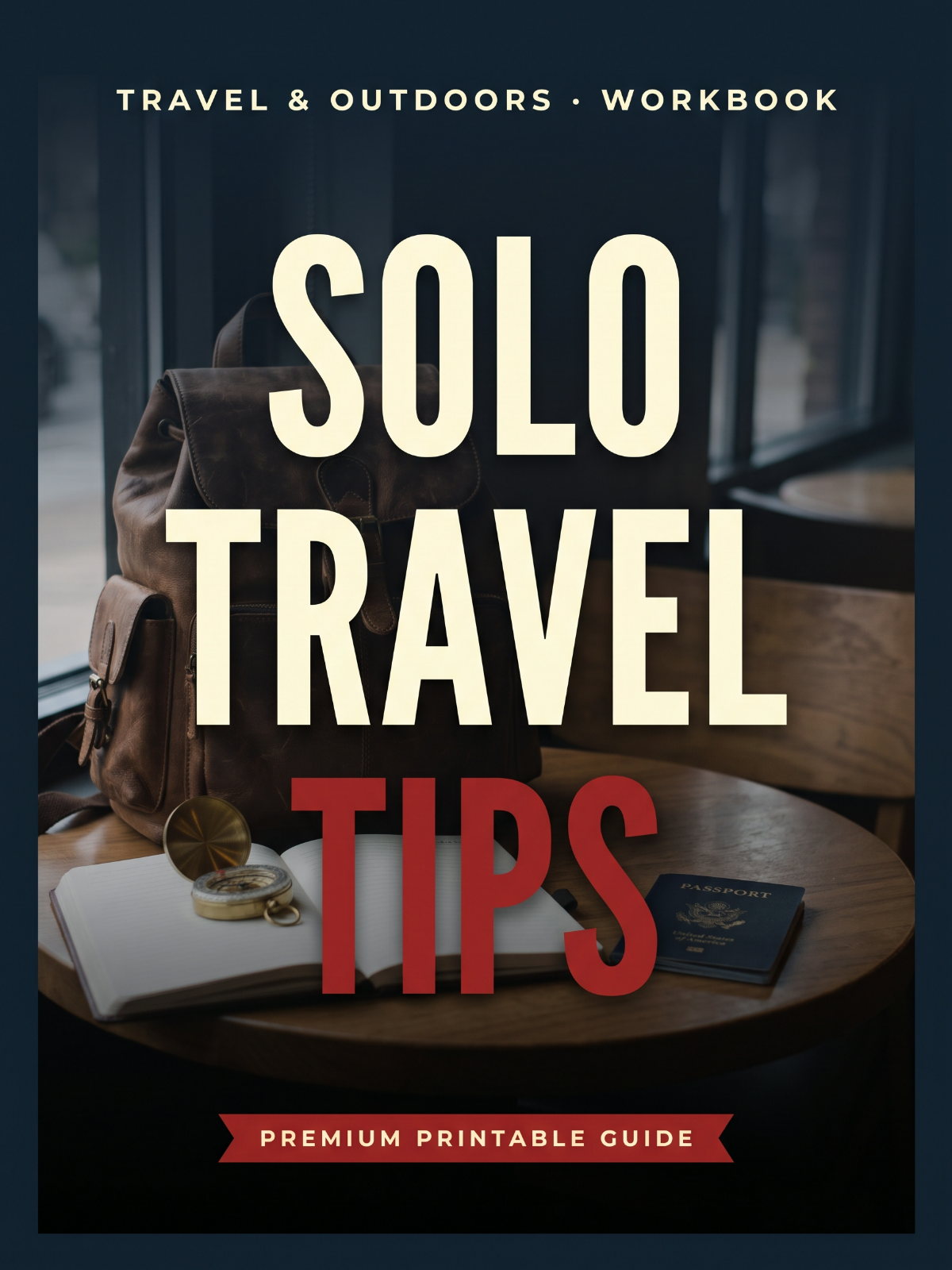
The full workbook, ready to print
- ✓8-week countdown planner with weekly tasks and booking deadlines
- ✓Arrival Night Protocol: a printable checklist for landing after dark
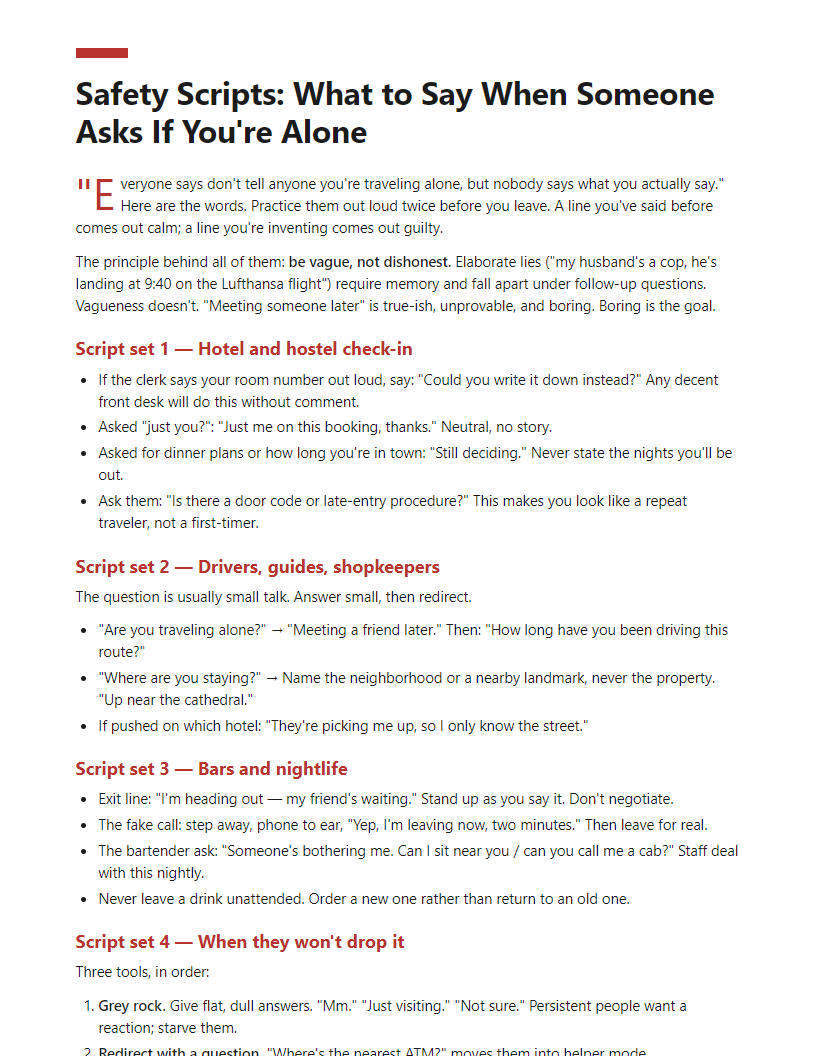
- ✓Safety script cards — 12 word-for-word replies for strangers, taxis and tour guides
- ✓Hotel vs hostel vs short-let scorecard you fill in per booking
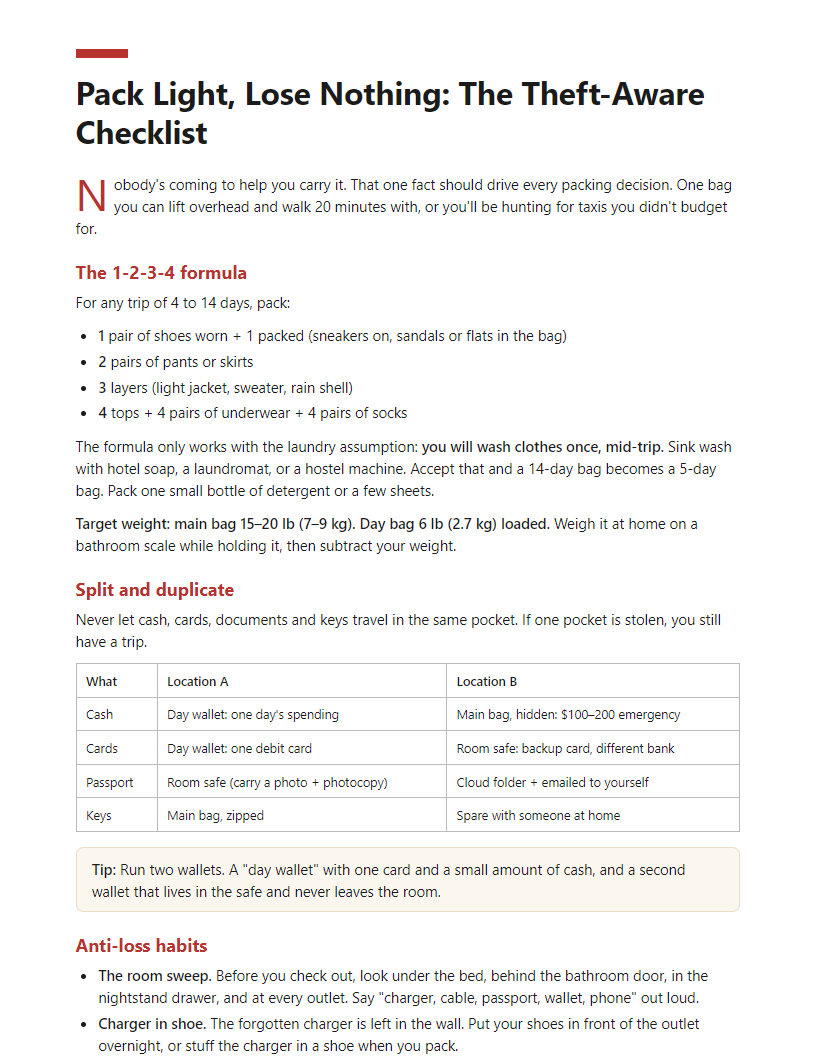
- ✓Theft-aware packing checklist with weight column and cash/card split plan
- ✓Daily budget worksheet with buffer calculation
- ✓Bonus sheets for solo women, introverts and 50+ first-timers
Hosted on FileJoker. Premium members download instantly; free download has a wait.
In a hurry? Free one-page checklist24 items to tick off · print-ready PDF, no sign-upDownload freeIncluded bonuses — free with the guide
3 extra guides from the same topic Free PDF · 15 pagesSki Vacation Packing List for First-Timers and FamiliesBuild a ski vacation packing list that works: exact layer combos, gloves vs mittens, plus printable checklists for day, weekend or week. Free download.
 Free PDF · 17 pagesDisney World Packing List: Comfort, Weather and Four ZonesA Disney World packing list built for sore feet, heat and Florida rain — plus a free four-zone checklist with season and family versions. Download it free.
 Free PDF · 13 pagesNational Park Checklist Map: Track All 63 US Parks on PaperTrack all 63 US national parks with a free national park checklist map: printable map, state-by-state checklist, notes space and progress counter. Download it.
A look inside the PDF
10 sections · 22 pages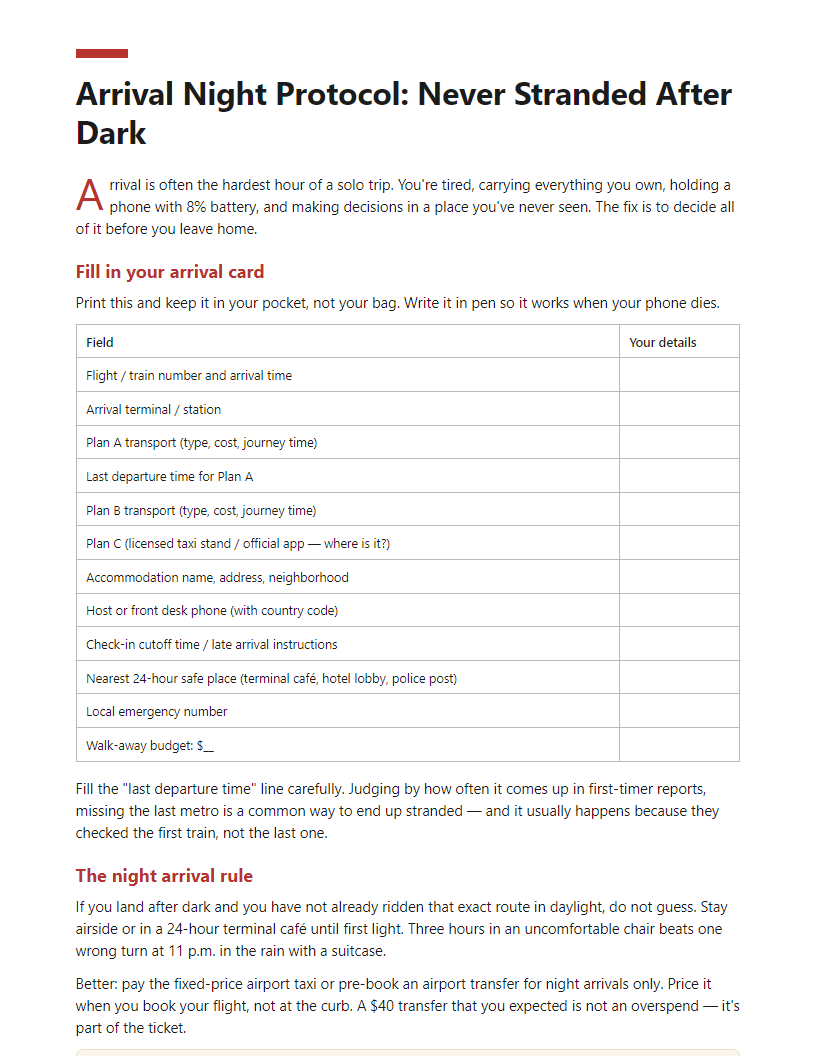
Full table of contents
- Why a Workbook Beats Another List of Tips
- The 10-Minute Answer: Your First Solo Trip in One Page
- Build the Plan: 8 Weeks to Departure
- Arrival Night Protocol: Never Stranded After Dark
- Safety Scripts: What to Say When Someone Asks If You're Alone
- Choosing Where to Sleep: Hotel vs Hostel vs Short-Let Scorecard
- Eating Alone, Meeting People and the Quiet Hours
- Pack Light, Lose Nothing: The Theft-Aware Checklist
- Nine Mistakes First-Time Solo Travellers Make
- Bonus Sheets: Women, Introverts, and 50+ First-Timers
In this article
“What if I get stranded at night? What do I say when a stranger asks if I’m travelling alone? And will I feel ridiculous eating dinner by myself?” If those thoughts have stalled your booking, these solo travel tips are built for you — a first-timer, not a seasoned backpacker.
This page gives you the one-page version: how to structure a first solo trip, the nine mistakes that cause most trouble, and straight answers to the questions that keep you awake.
The premium PDF turns that into a workbook you fill in — an 8-week countdown, an arrival-night protocol, word-for-word safety scripts, an accommodation scorecard, and bonus sheets for women, introverts and 50+ first-timers.
The short answer
How to plan a first solo trip in seven steps:
- Pick an easy first destination — safe, walkable, English-friendly, 1–2 cities max.
- Book arrival in daylight, with pre-paid transport to your door.
- Choose accommodation by 24-hour reception and neighbourhood, not price alone.
- Set a daily budget — accommodation, food, transport, activities, buffer.
- Rehearse safety scripts — “I’m meeting a friend at seven” — before you need them.
- Pack one carry-on you can run up stairs with; split cash and cards.
- Book one group activity in the first 48 hours so meeting people happens by design.
Why a Workbook Beats Another List of Tips
Most solo travel advice fails at the same point: you read it, nod, and change nothing. A plan you’ve written down behaves differently. It gives you something to follow at 11 p.m. in an unfamiliar train station when your brain has stopped making decisions.
Three things go wrong on first solo trips, over and over:
- Night arrivals. You land after dark, the transit you researched has stopped, and you’re improvising with luggage.
- Overpacking. A bag you can’t carry up stairs changes every decision you make for the whole trip.
- Unscripted social moments. Someone asks if you’re traveling alone. You freeze, and answer honestly out of politeness.
Each one is solvable in advance. None is solvable while it’s happening.
How to use this
Fill in each sheet as you book, not the night before you fly. Booking a flight? Do the arrival timeline. Booking a room? Run the accommodation scorecard. The plan builds itself alongside the trip, and you arrive with it already finished.
Worry audit
Rate each zone 1 (fine) to 5 (keeping you awake). Do the high numbers first and skim the rest.
| Worry zone | Your rating 1–5 | Section that fixes it |
|---|---|---|
| Crime and personal safety | s5 Safety Scripts | |
| Arriving or moving at night | s4 Arrival Night Protocol | |
| Eating alone in public | s7 Eating Alone | |
| Loneliness and meeting people | s7 Quiet Hours | |
| Money running out or overspending | s3 Budget build | |
| Logistics, getting lost, missed connections | s3 8 Weeks to Departure | |
| Luggage and theft | s8 Theft-Aware Checklist | |
| Family disapproval or judgment | s10 Bonus Sheets, Sheet D |
Tip: “Pushing 50, you become more and more fearful.” Fear that stays vague grows. Fear written into a box with a page number shrinks.
Bonus sheets
Three extra sheets sit at the back: one for women traveling alone for the first time, one for introverts who need recovery time built in, and one for 50+ first-timers returning to solo travel after a long gap.
Warning: This is general planning guidance, not security or legal advice. Check your government’s official travel advisory for your destination before and during booking.
The 10-Minute Answer: Your First Solo Trip in One Page
If you book tonight, these six decisions remove the three failure points listed in s1: night arrivals, overpacking, and unscripted social moments.
1. Pick an easy destination
Choose somewhere with a train or metro from the airport, English signage or an app that translates signs, and a tourist area you can walk at night. Save the hard country for trip three. You are not failing by picking somewhere easy — you are stacking the odds.
2. Land before 4 p.m.
Arriving in the dark is one of the three failure points from s1. Streets look different, transit gets thinner, and tired judgment makes bad choices. A 2 p.m. landing gives you daylight to find your room, walk the block, and buy water. Pay the extra $60 for the earlier flight if you have to.
3. Pre-book two things: night one and the ride
Book the first night’s accommodation before you leave home, and book the airport transfer too. That removes the moment where an unlicensed driver approaches you at arrivals and you have to decide fast. Screenshot the confirmation and the address in the local language.
4. Tell one person your plan
Pick one trusted contact. Send them your flights, hotel name and address, and agree a daily check-in time — say 9 p.m. your time, one message. Agree what they do if you miss two in a row.
5. Two payment methods, two places
Keep a small amount of cash plus one card in your day wallet. Keep the second card and the rest of your cash in your bag at the room or in the safe. Never carry both in the same pocket.
Tip: Save offline copies of your passport, insurance, bookings and transfer confirmation — a photo in your phone album and a printed sheet in your luggage. Phones die exactly when you need them.
6. One anchor per day
Plan one thing: a museum, a walking tour, a lunch reservation. Leave the rest of the day open. An empty day feels frightening; an eight-hour schedule feels like work.
Nine Mistakes First-Time Solo Travellers Make
1. Booking the 1 a.m. arrival to save $60
A cheap red-eye costs you the most expensive hour of the trip. You land when trains have stopped, nothing is open, and the only people awake are unlicensed drivers. One traveler landed in Xi’an early, found nothing open, and had a man in an unmarked car pushing to drive her to her hotel.
Fix: land between 10 a.m. and 6 p.m. local time. Pay the difference.
2. Three cities in five days
Every move costs you half a day, a new navigation problem, and another arrival. First trips should have one base, or two at most. Build in one recovery day with nothing booked.
3. Posting location in real time
Geotagged photos tell strangers exactly where you are, alone, right now. Readers describe the flood of DMs from “guides” and “agencies” that follows.
Fix: post 24 hours late, or after you’ve left the city. Don’t reply to the messages.
4. Treating a full itinerary as proof the trip was worth it
Skipped lunch, 18,000 steps, no sit-down day — then you’re exhausted and making poor decisions at night, which is when decisions matter most. Three things per day is a full day. Tired travelers get lost, lose phones, and ignore their gut.
5. Everything valuable in one bag
If that bag goes, so does your trip. Cash, cards, documents and keys each need a second location.
Fix: use the “Split and duplicate” table in the packing checklist and set it up before you leave home.
6. Ignoring the bad feeling because canceling feels rude or expensive
One reader had a beautiful, well-reviewed Airbnb and started getting “this strange feeling” a month out. Another put it plainly: the times she overrode her gut to save a dollar, something always happened.
Fix: decide now that a canceled booking or an abandoned cab ride is a cheap outcome. If your instinct says leave, leave fast. You’re allowed to make a scene.
7. Announcing that it’s your first trip and you’re completely alone
New, alone, and unsure is the exact profile you don’t want to broadcast to strangers. Share it with hostel friends after a day, not with the driver in the first ten minutes.
8. Losing track of your stuff at transition points
Security lines, cafés, taxis. People leave laptops at the TSA belt and phones on store counters — it happens to careful travelers too.
Fix: a five-second pat-down at every exit. Phone, wallet, passport, bag. Same four items, every time.
9. Packing for the person you might be
No one is carrying your bag up the subway stairs. If you can’t lift it overhead and walk 20 minutes, you’ll be buying taxis you didn’t budget for.
Solo Travel FAQ
What are the best tips for a first-time solo traveler?
Three things do most of the work. Book a destination with easy public transit from the airport. Arrive before dark on day one. Carry a paper card with your accommodation’s name, address and phone number, because phones die.
After that: tell one person at home your daily plan, don’t post your location in real time, and trust your gut. If a place, a person or a booking feels wrong, leave or cancel. You don’t owe anyone an explanation, and you don’t need proof.
Example: One traveler booked a beautiful, well-reviewed short-let and started feeling uneasy a month out. She canceled. That feeling is data. Rebooking costs $30; ignoring your instinct can cost more.
How do I check whether a country is risky for solo travelers?
Use your own government’s official advisory first, then recent firsthand reports.
- Your national travel advisory — US State Department (travel.state.gov), UK FCDO, Australia’s Smartraveller, or Global Affairs Canada. Each gives country-level risk ratings and specific regional warnings.
- Official travel health notices — CDC in the US, NHS Fit for Travel in the UK, or your country’s equivalent, for vaccines, outbreaks and water safety.
- Your embassy’s local page — registration programs and emergency contacts.
- Recent forum and Reddit posts from the last 6 months, filtered for solo travelers.
Read at the city level, not the country level. Most countries are a mix of very safe and genuinely risky areas. Write down the two or three neighborhoods to avoid after dark and keep that note on your phone.
What’s the most forgotten item when traveling?
Chargers and adapters top most lists. But the bigger problem isn’t forgetting items at home — it’s leaving them behind in transit. Laptops at airport security, phones on store counters, passports in seat pockets.
Fix it with a rule: every time you stand up, touch three things — phone, wallet, bag. At security, put your laptop in the bin last so it comes out first and you can’t walk off without it.
Is $20,000 enough to travel the world?
It depends entirely on pace and region. $20,000 goes a long way in Southeast Asia or Central America and disappears fast in Western Europe, Japan or Australia. Moving slowly costs far less than moving every three days, because transport and first-night accommodation are the expensive parts.
Build your number from your own daily budget instead of a headline figure. Check current costs for your specific route before committing.
How much should I budget per day?
Add up four lines for your destination: bed, food, local transport, one activity. Add 20% for the things you forget. Then set an emergency fund of at least three days’ full costs plus one flight home, held on a separate card you don’t carry out.
Tip: Carry two wallets. A day wallet with one card and small cash. A backup with your second card and passport, locked in the room safe. Lose one, you still have a trip.
Is it cheaper to travel solo or with friends?
With friends, usually — you split rooms and taxis. But you pay in flexibility and friction. Plenty of first-timers regret bringing someone along: different wake-up times, different budgets, one person waiting while the other shops.
If a friend asks to join your first solo trip, offer the middle option. Travel to the same city, book separate rooms, meet for dinner twice. You keep the freedom and still get company.
- ✓8-week countdown planner with weekly tasks and booking deadlines
- ✓Arrival Night Protocol: a printable checklist for landing after dark
- ✓Safety script cards — 12 word-for-word replies for strangers, taxis and tour guides
- ✓Hotel vs hostel vs short-let scorecard you fill in per booking
- ✓Theft-aware packing checklist with weight column and cash/card split plan
- ✓Daily budget worksheet with buffer calculation
- ✓Bonus sheets for solo women, introverts and 50+ first-timers
Frequently asked questions
What are the best tips for a first-time solo traveller?
Start with a short trip to a safe, walkable city. Arrive in daylight with transport pre-booked. Stay somewhere with 24-hour reception. Share your itinerary and accommodation address with one person at home. Keep one copy of key documents offline and one in the cloud. Book a walking tour or cooking class on day one — it removes the pressure of meeting people spontaneously.
Which countries are riskiest for solo travellers?
Risk rankings shift, so use sources rather than lists: your government's travel advisories (US State Department, UK FCDO) plus recent traveller reports. Active conflict zones, regions with kidnapping warnings and places with level 3–4 advisories are the obvious exclusions. For a first solo trip, skip anywhere requiring special precautions and choose a destination with reliable public transport and tourist infrastructure.
What is the most forgotten item when travelling?
Chargers and adapters top most lists, followed by toothbrushes, phone cables, prescription medication and a second payment card. The fix isn't memory — it's a written checklist used twice: once when packing, once the night before departure. Keep medication, documents and one card in your personal item, never in checked luggage, so a lost bag never becomes a crisis.
Is $20,000 enough to travel the world?
Yes, for roughly 9–12 months if you stay mostly in Southeast Asia, Central America and Eastern Europe, use hostels or long-stay rentals, cook sometimes and travel overland. In Western Europe, Japan or Australia the same budget lasts 3–5 months. Build your figure from a daily rate times days, plus flights, insurance and a 15% emergency buffer — not from a round number.
What should I say when someone asks if I'm travelling alone?
Don't lie clumsily — deflect. Useful lines: "I'm meeting friends later," "My partner's arriving tomorrow," or simply redirect: "Are you from here?" With hotel staff, booking apps and tour guides, honesty is fine and often safer. The distinction that matters: tell people who are accountable to an organisation, deflect with strangers who approached you unprompted.
How do I get over feeling awkward eating alone?
Choose lunch before dinner, counter or bar seating over a table for two, and casual places over formal dining rooms. Bring a book, notebook or journal — not just your phone. Order quickly so you're not idle. Cafés, markets and ramen bars are built for solo diners. Most people feel self-conscious for about three meals, then stop noticing.
We collected 159 real questions and comments about "solo travel tips" (155 from YouTube comments, 4 from People Also Ask), grouped them into 14 recurring problems, and built this guide to resolve the 8 that block people most. The top-ranking pages were reviewed for gaps; 7 of those gaps became dedicated sections.
Edited by Alex Hirn · Last updated November 5, 2026 · How we make our guides
More in Travel & Outdoors
 premium+3 bonuses
 premium+3 bonuses
 free
 premium+3 bonuses