Checklist · 29-page PDF · Premium
Beach Vacation Packing List: What to Bring, What to Skip
A beach vacation packing list with the core 25 items, reef-safe sunscreen rules and TSA liquid limits. Premium printable checklist inside — take a look.
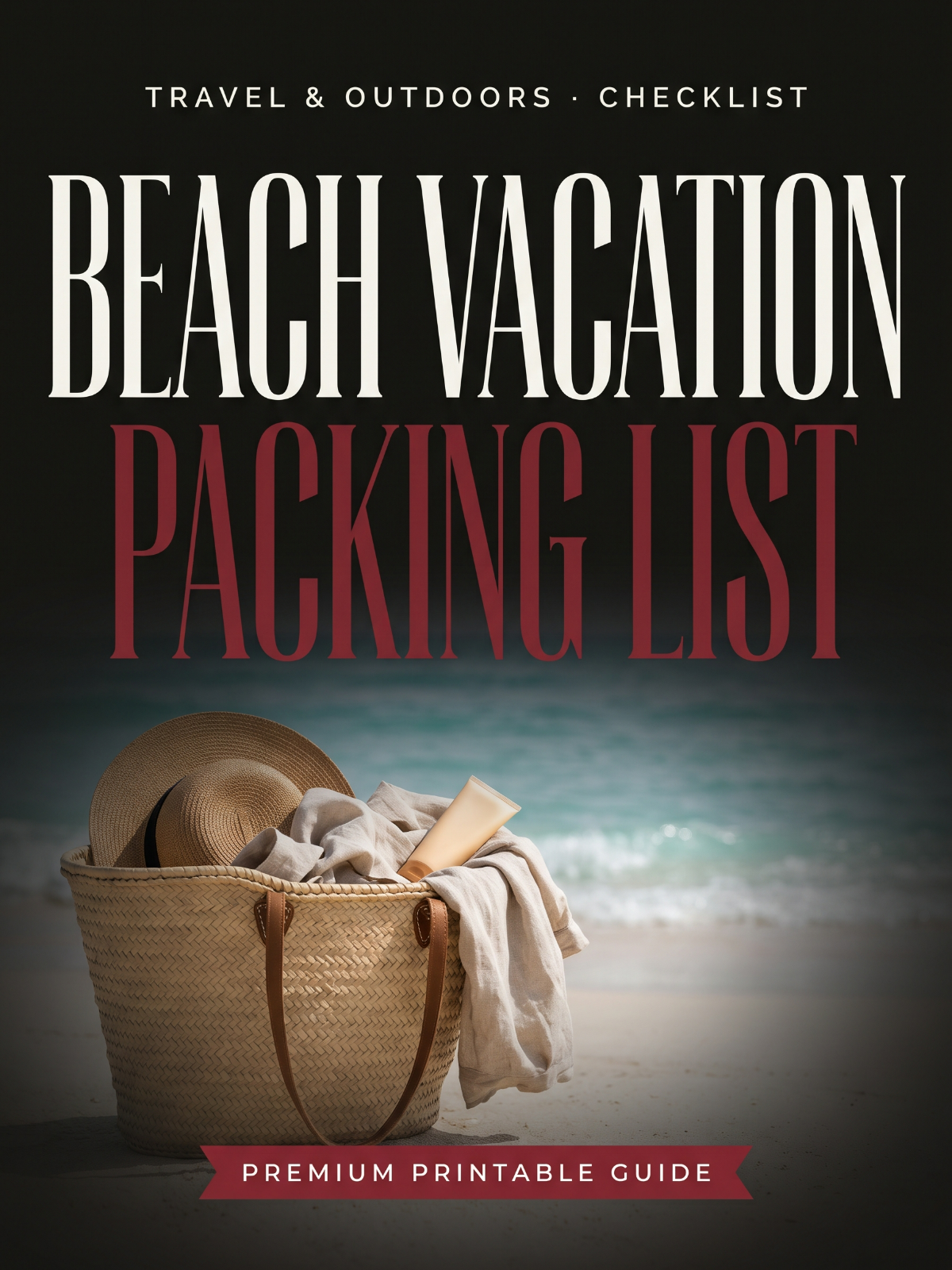
The full workbook, ready to print
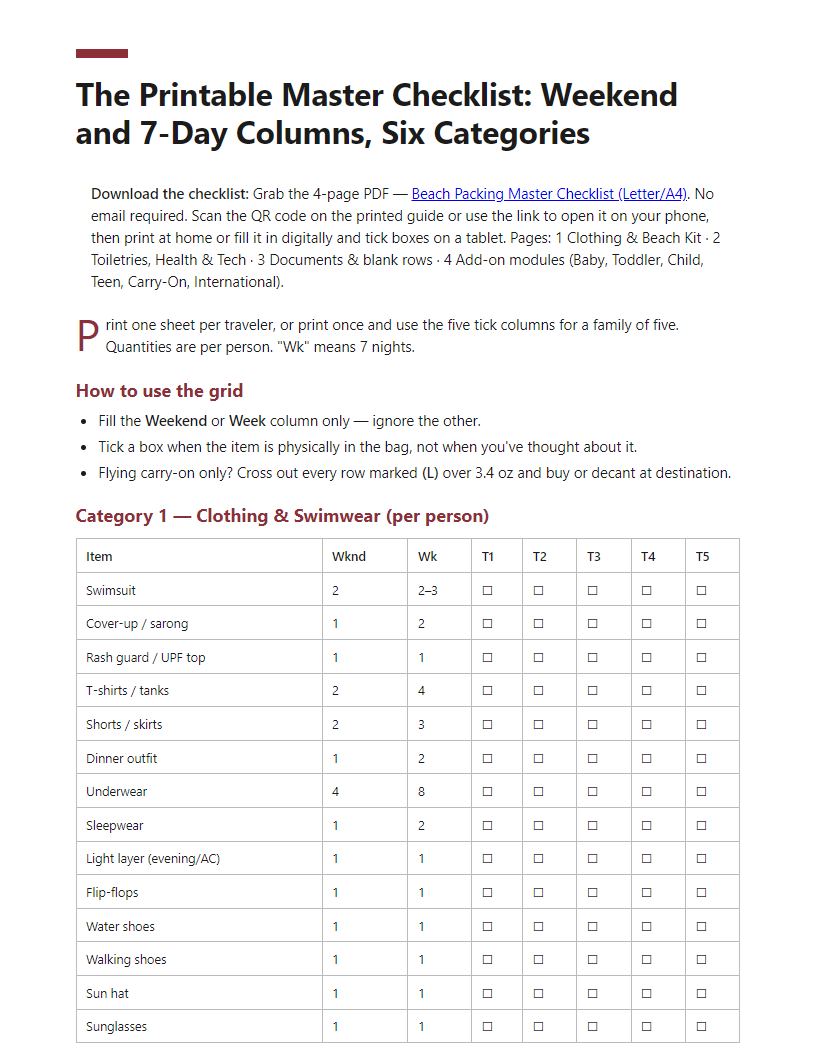
- ✓Printable master checklist with Weekend and 7-Day columns across six categories
- ✓Five-pass build system: clothing, beach kit, toiletries, tech, documents
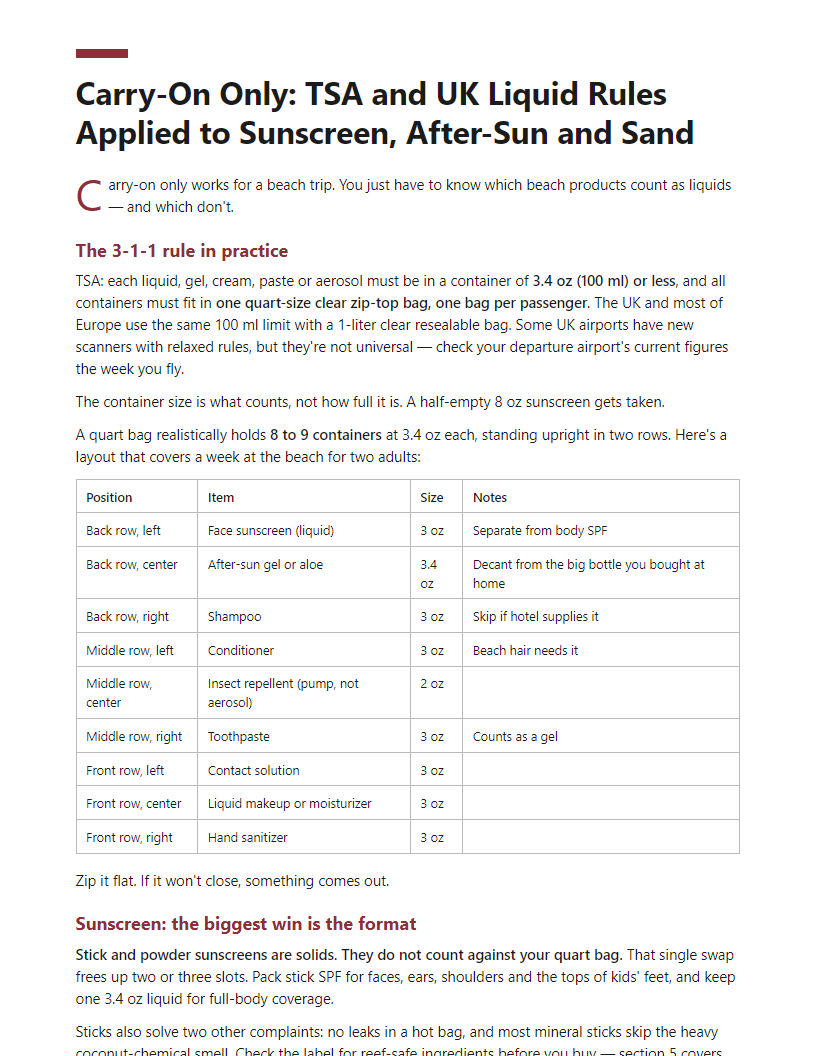
- ✓Carry-on liquids table applying TSA and UK limits to sunscreen and after-sun
- ✓Life-stage packing lists: baby, toddler, primary-school child, teen
- ✓Waterproof and theft-proof plan for phone, passport, cards and cash
- ✓Tick-box format designed to print and reuse for every trip
Hosted on FileJoker. Premium members download instantly; free download has a wait.
In a hurry? Free one-page checklist31 items to tick off · print-ready PDF, no sign-upDownload freeIncluded bonuses — free with the guide
3 extra guides from the same topic Free PDF · 15 pagesSki Vacation Packing List for First-Timers and FamiliesBuild a ski vacation packing list that works: exact layer combos, gloves vs mittens, plus printable checklists for day, weekend or week. Free download.
 Free PDF · 17 pagesDisney World Packing List: Comfort, Weather and Four ZonesA Disney World packing list built for sore feet, heat and Florida rain — plus a free four-zone checklist with season and family versions. Download it free.
 Free PDF · 13 pagesNational Park Checklist Map: Track All 63 US Parks on PaperTrack all 63 US national parks with a free national park checklist map: printable map, state-by-state checklist, notes space and progress counter. Download it.
A look inside the PDF
10 sections · 29 pages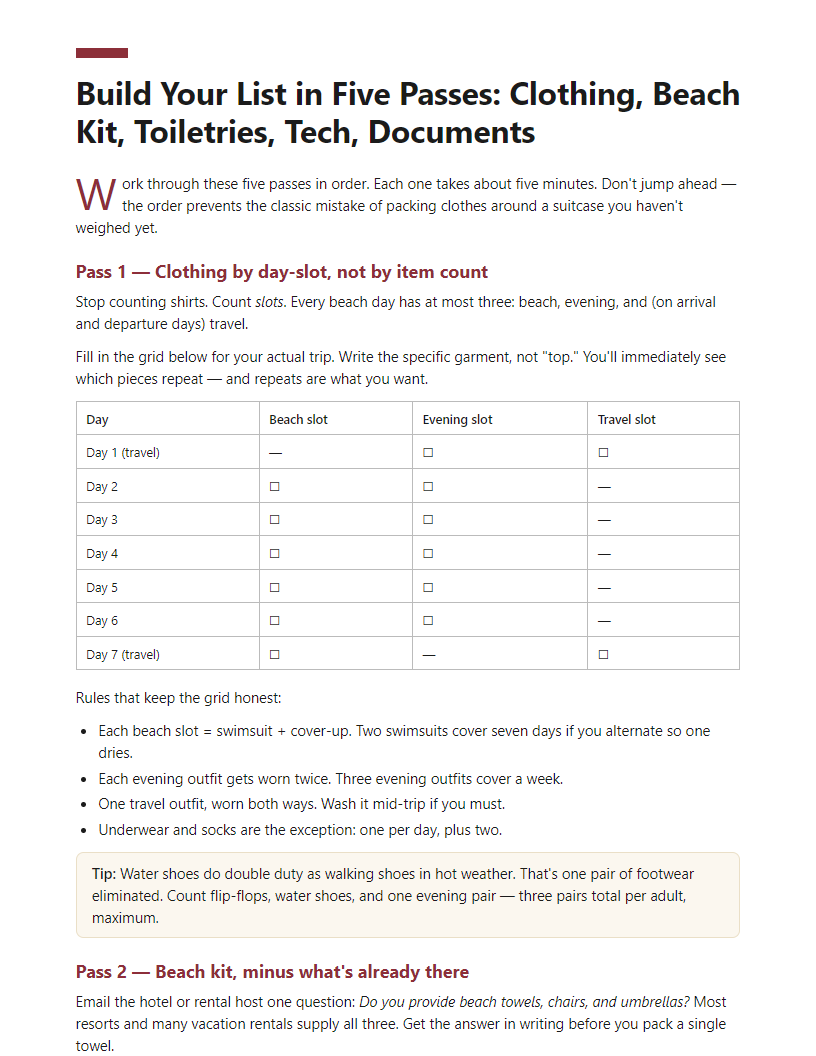
Full table of contents
- Why Most Beach Packing Lists Fail You at the Airport
- The 60-Second Answer: Core 25 Items Nobody Should Leave Without
- Build Your List in Five Passes: Clothing, Beach Kit, Toiletries, Tech, Documents
- Carry-On Only: TSA and UK Liquid Rules Applied to Sunscreen, After-Sun and Sand
- Reef-Safe Sunscreen: What the Label Must Say and Where It's the Law
- Packing by Life Stage: Baby, Toddler, Primary-School Child, Teen
- Waterproof and Theft-Proof: Phone, Passport, Cards and Cash at the Beach
- Sand, Wind and Salt: Gear Choices That Prevent Daily Annoyances
- Nine Packing Mistakes That Cost Families the Most Money and Time
- The Printable Master Checklist: Weekend and 7-Day Columns, Six Categories
In this article
- The short answer
- Why Most Beach Packing Lists Fail You at the Airport
- The 60-Second Answer: Core 25 Items Nobody Should Leave Without
- Reef-Safe Sunscreen: What the Label Must Say and Where It’s the Law
- Sand, Wind and Salt: Gear Choices That Prevent Daily Annoyances
- Nine Packing Mistakes That Cost Families the Most Money and Time
- Beach Packing Questions, Answered Briefly
“I don’t know what’s actually essential — and I don’t want to find out at the airport.” If that’s you, this beach vacation packing list is built to settle it. You get the core 25 items nobody should leave behind, plain-English rules on reef-safe sunscreen (including where it’s the law), and gear choices that stop sand, wind and salt from ruining day two. You’ll also see the nine packing mistakes that cost families the most money and time.
The premium PDF goes further: a printable master checklist with Weekend and 7-Day columns across six categories, carry-on liquid limits applied to sunscreen and after-sun, life-stage lists for babies through teens, and a waterproof, theft-proof plan for your phone, passport, cards and cash.
The short answer
Pack a beach vacation in this order:
- Documents: passport, insurance, boarding passes, printed copies.
- Sun protection: reef-safe SPF 30+ (stick for faces), after-sun gel, hat, UV sunglasses.
- Swim: two swimsuits per person so one is always dry.
- Clothing: light layers, one cover-up, one evening outfit, one warm layer.
- Beach kit: quick-dry towels, sand-free mat, pegs or weights, dry bag.
- Tech: waterproof phone pouch, power bank, adapter.
- Health: medication, rehydration salts, plasters, insect repellent.
- Money: local cash plus one backup card, stored separately.
Why Most Beach Packing Lists Fail You at the Airport
Most packing lists fail in three predictable places.
You over-pack clothes. Seven outfits for seven days, plus “just in case” layers. At the beach you live in two swimsuits and three cover-ups.
You under-pack logistics. Nobody forgets a T-shirt. People forget the dry bag, the sand-free mat, the outlet adapter, the zip-top bag for a wet swimsuit on the flight home.
You forget the one thing you can’t buy there. A passport. A prescription. Swim trunks.
Example: One traveler forgot swim trunks on a trip to Cuba, found no stores nearby, and cut up a pair of cargo pants. Funny later. Not funny on day one.
How this checklist is built
Six category blocks — Clothing, Beach Kit, Toiletries, Tech, Documents, Health & First Aid. Each block has two columns: Weekend (2–3 days) and 7+ days. Then bolt on the modules you need: Baby, Toddler, School-Age, Teen, Carry-On Only, International.
You print the blocks plus your modules. Nothing else.
What “checked off” actually means
Two passes, not one.
- Pack pass. Check items as they go into the bag. Do this the night before, not the morning of.
- Door pass. Five items only: passport/ID, wallet, phone, medication, swimsuits. Say each one out loud before you lock the door.
A printed sheet beats a notes app because you can hand it to your partner, mark it with a pen while your hands are full, and see all six categories at once. No scrolling, no dead battery.
Which pages to print
What’s on each page of the PDF:
- p.4–5 Core 25 plus Clothing and Beach Kit
- p.6 Toiletries and liquids
- p.7 Tech and Health & First Aid
- p.8–9 Life-stage modules (baby, toddler, school-age, teen)
- p.10 Documents
- p.11 Documents, international
- p.12 Carry-On Only module
| Trip length | Travel mode | Print these pages |
|---|---|---|
| Weekend, 2–3 days | Driving, couple | 4–5 (Weekend column only) |
| Weekend, 2–3 days | Driving, with kids | 4–5 + 8–9 |
| 7+ days | Driving, family | 4–7 + 8–9 |
| 7+ days | Flying, checked bag | 4–7 + 10 |
| Any length | Carry-on only | 4–7 + 12 |
| Any length | International | Add page 11 |
Print one-sided on Letter or A4 so you can spread pages across the bed. Or fill the PDF digitally and check boxes on your tablet.
The 60-Second Answer: Core 25 Items Nobody Should Leave Without
Pack these 25 first. Everything else in this guide is refinement.
On your body or in the beach bag (12): two swimsuits, reef-safe sunscreen (SPF 30+), after-sun or aloe, sunglasses, wide-brim or ball cap, flip-flops, quick-dry towel, refillable water bottle, dry bag or dry pouch, sunscreen stick for faces, lip balm with SPF, a cover-up.
In the suitcase (13): three cover-ups or light tops, two pairs of shorts, one dinner outfit, underwear and socks, sneakers or sandals you can walk in, a light rain or evening layer, prescription meds in original bottles, basic first-aid (bandages, ibuprofen, antihistamine), phone charger and a multi-port plug, travel adapter, passports or IDs, insurance card or travel insurance details, $40–$60 in small local bills.
The packing rules — and where they break
5-4-3-2-1: five tops, four bottoms, three pairs of shoes, two dresses, one swimsuit. 3-3-3: three tops, three bottoms, three pairs of shoes.
Both are built for city trips. On a beach trip the ratios flip. You need fewer bottoms (you’ll live in swim shorts and one pair of shorts) and more swimwear. One swimsuit is wrong — a wet suit takes 6–12 hours to dry in humid air, and putting on a cold, damp one at 8 a.m. is miserable. Two minimum. On shoes, both rules overshoot: pack 2 pairs of shoes (flip-flops and one walkable pair).
Weekend vs 7 days: less changes than you think
| Per person | Weekend (2–3 nights) | Week (7 nights) |
|---|---|---|
| Swimsuits | 2 | 2–3 |
| Tops / cover-ups | 3 | 5 |
| Shorts or skirts | 2 | 3 |
| Dinner outfit | 1 | 2 |
| Underwear | 4 | 8 (or 5 + one laundry run) |
| Shoes | 2 pairs | 2 pairs |
| Towels | 1 quick-dry | 1 quick-dry |
| Sunscreen | 3 oz travel size | 1 large bottle, bought there |
The laundry math: one sink wash on day 4 turns a 7-day list into a 4-day list. Pack a travel detergent sheet and you cut your suitcase by a third.
Buy there, not here
Skip these at home and buy on arrival: beach toys (buckets, shovels, inflatables), the big sunscreen bottle, snacks, bottled water, cheap flip-flops, and a styrofoam cooler. They’re heavy, bulky, and sold within walking distance of almost every beach.
The three people forget most
- A swimsuit. It sounds impossible. It happens constantly, because swimwear lives in a different drawer than everything else. Pack it first.
- A waterproof phone pouch. You will want photos in the water, and you will want your phone off the sand.
- Small local cash. Beach chair rentals, parking, tips and ice cream carts are often cash-only.
Tip: Lay all 25 items on the bed before anything goes in the bag. A visual count catches gaps faster than a list on your phone.
Reef-Safe Sunscreen: What the Label Must Say and Where It’s the Law
Some beaches will turn you away at the gate if your sunscreen has the wrong two ingredients. Others won’t check, but the reef still pays. Either way, the fix is the same and it’s cheap.
Where it’s actually the law
These destinations ban or restrict sunscreens containing oxybenzone and octinoxate:
- Hawaii — statewide ban on sale of sunscreens with oxybenzone and octinoxate
- Key West, Florida — local ban on the same two filters
- US Virgin Islands — banned, and enforced at ports
- Palau — the strictest list in the world; sunscreen can be confiscated on arrival
- Bonaire and Aruba — bans in place
- Mexico’s eco-parks (Xcaret, Xel-Há, cenotes) — staff check bottles at the entrance and will make you shower and buy theirs
Rules change. Check the current rules for your specific destination before you fly.
Reading the label in 10 seconds
Flip the bottle to Active Ingredients. If you see oxybenzone or octinoxate, leave it home. What you want instead: zinc oxide or titanium dioxide, ideally as the only actives. “Non-nano” is the phrase most eco-parks look for.
Warning: “Reef safe” and “reef friendly” are not regulated terms. A bottle can say it on the front and still list oxybenzone on the back. The ingredient list is the only thing that counts.
Format comparison
| Format | Carry-on status | Kid tolerance | Coverage quality | Mess | Reef-safe options |
|---|---|---|---|---|---|
| Stick | Solid — not a liquid, no bag limit | High: kids apply it themselves on faces | Good on face, ears, nose; slow for backs | Low | Widely available |
| Lotion | Counts toward your 3-1-1 quart bag | Medium: cold, slow, arguments | Best overall, easiest to see missed spots | Medium | Widest selection |
| Spray | Aerosol — counts as a liquid, and wind wastes half of it | High: fast | Poor; patchy and hard to verify | Low on hands, high on towels | Fewer mineral options |
| Powder | Solid — no bag limit | High for touch-ups over makeup | Top-up only, not a base layer | Low | Limited |
Pack sticks for the carry-on, lotion in checked bags. That’s the whole trick to flying carry-on only with a week of sun protection.
Smell and white cast
The classic coconut-vanilla beach smell comes from added fragrance, not from the sunscreen working. Buy fragrance-free if anyone in the group gets headaches or has sensitive skin. Mineral formulas do leave a white cast — tinted versions cut it on faces, and for kids a visible white layer is actually useful because you can see what you missed.
How much to buy
A full-body adult application takes about 1 ounce. By the book, four people reapplying three times a day for seven days works out to 84 ounces — 4 people × 1 oz × 3 applications × 7 days. Almost nobody uses that much, because you’re not on the sand twelve hours a day and kids cover less skin. Plan on 6 to 8 ounces per person per week of real beach time, so 24 to 32 ounces for a family of four.
Don’t fly that in. The split that works:
- Bring: one 3-ounce travel bottle per adult plus one stick per person — enough for day one, the flight home, and face top-ups.
- Buy on arrival: the big bottles, 16 to 24 ounces total for a family of four. They’re sold at every beach and cost less than the baggage weight.
Check the ingredient list on the bottle you buy abroad too — in ban destinations the stores stock compliant brands, but tourist shops don’t always.
The three items everyone skips
- Lip balm with SPF 30 — lips burn and peel fast, and nobody packs it
- Scalp protection — a part line burns badly; use a powder SPF or a hat
- After-sun with aloe — buy it before you go; resort prices are triple
Sand, Wind and Salt: Gear Choices That Prevent Daily Annoyances
Sand is the tax you pay for a beach day. Six small items cut the bill to almost nothing.
Get sand off your feet in ten seconds
Baby powder or plain cornstarch pulls the moisture off your skin, and dry sand won’t stick. Sprinkle it on wet, sandy feet, rub once, brush off. Powders aren’t liquids — decant 2 oz only to save space, and keep total powders under 12 oz to avoid extra US screening.
Two alternatives that work nearly as well: rinse your feet in the sea first, then dry with a microfiber towel. A sea rinse tends to carry off more sand than a quick pass under the beach shower, because you can rub your feet underwater. Microfiber sheds sand when you shake it. Cotton holds it.
Bags that don’t become sandboxes
Pick a mesh-bottom tote. Sand falls through on the walk back instead of settling into the seams. A lined cooler keeps drinks cold but traps every grain, so it needs a shake-out at the car, not in your room.
Tip: Pack a second cheap tote as your wet bag — swimsuits, used towels and sandy toys go in it, so wet kit never touches dry kit.
Turn every bag inside out and shake it before it goes in the car. Thirty seconds now saves a vacuum later.
Electronics and salt air
Never let a phone sit loose in the tote. Sealed pouch first, then a hard case or a zipped pocket inside the bag. Salt air corrodes charging ports and speaker grilles over a week, and salt crystals inside a port can stop a cable from seating.
Keep bags and electronics off the sand — on your cooler lid or a folded towel, not on the ground. Blow out charging ports with a dry puff of air at night before you plug anything in.
Towels that stay put
A stiff breeze is enough to lift a dry towel, so weight the corners from the start. Four options, cheapest first:
| Method | Cost | Best for |
|---|---|---|
| A pebble or shell in each corner | Free | Light breeze, any beach with stones |
| Shoes, cooler, water bottles on corners | Free | You already have them |
| Towel clips to a chair | $8–$15 | Loungers and chairs |
| Screw-in sand anchors or weight bags | $15–$30 | Windy, open beaches |
Planting an umbrella that holds
Set it in wet sand, not dry. Dry sand gives nothing to grip.
- Pick a spot where the sand is damp 6 inches down.
- Twist the pole in — don’t push straight down — until 12 to 16 inches are buried.
- Pack wet sand around the base with your heel.
- Tilt the canopy into the wind, about 20 degrees, so the wind presses it down instead of under it.
A screw-anchor base or a mini rubber mallet makes this a one-minute job and stops you bending the pole.
The set-up, sketched: umbrella at the back, tilted toward the breeze, pole sunk past the wet line. Towels in front, each corner pinned by a shoe, stone or anchor. Cooler at one towel corner doing double duty as a weight and a shelf — bag and phone on the lid, never on the sand.
Shoes and the car
Keep a drawstring shoe bag for sandy flip-flops and water shoes. Lay a rubber trunk liner or an old towel in the cargo area. At the end of the day: rinse feet, rinse shoes, shake towels, bag the wet stuff, powder the kids.
Nine Packing Mistakes That Cost Families the Most Money and Time
1. One swimsuit per person
A wet swimsuit takes 6–12 hours to dry in humid beach air. Put it on damp at 9 a.m. and you’re uncomfortable all day. Apply the 2× rule: two swimsuits per swimmer, minimum. Kids who swim twice a day need three.
2. Buying sunglasses at the resort
Resort gift shops charge steep prices for basic sunglasses, and you’ll pay it because squinting all day is worse. Pack a $5 backup pair from a discount store for every person. Add a retainer cord for anyone going in the water, and store the good pair in a hard case — sunglasses die at the bottom of a beach bag, not on your face.
3. Over-packing evening clothes and shoes
Three dinner outfits and two pairs of dress shoes eat half a carry-on. Most beach restaurants are casual. One nice outfit per adult, one pair of sandals that works for dinner and daytime, done.
4. Under-packing quick-dry layers
The flip side of mistake 3. Cotton tees stay damp and smell. Pack two or three quick-dry shirts or rash guards per person — they rinse in the sink and dry overnight, which cuts your total clothing count.
5. A beach bag that’s too big, unlined, or zip-less
A huge open tote means you carry everything and lose things in the sand. A practical beach bag has: a zip or drawstring top, a wipeable or mesh bottom that lets sand fall out, one inside pocket for keys and phone, and enough room for two towels and a water bottle — no more.
Tip: A flat nylon drawstring backpack or a foldable grocery bag takes up almost no suitcase room and works fine as a second beach bag for the kids’ gear.
6. All liquids in one checked bag
If that bag is delayed, you’re buying sunscreen, toothpaste and shampoo at resort prices on day one. Split your liquids: one travel-size sunscreen and a stick in your carry-on, the rest checked. Same with medication — never check it.
7. Treating the room safe as the only copy
Room safes get jammed, forgotten, and occasionally opened by staff codes. Keep a photo of each passport on your phone, a photo in your email, and one paper photocopy in a different bag than the originals. Keep one backup card separate from your wallet.
8. Forgetting swimwear entirely
It happens more than you’d think — and small beach towns may not sell your size, or anything at all. Pack swimsuits first, before anything else goes in the bag. Lay them on the bed and count heads.
9. Ignoring shared-space etiquette
Three rules save arguments. Keep speakers off or use earbuds — plenty of people came for the sound of the waves, not your playlist. Plant your umbrella at least 10 feet from the next group’s setup, and don’t block anyone’s water view. Check local rules before you pack: many beaches ban glass containers and smoking outright, and a glass bottle can cost you a fine.
Tip: If someone’s music is too loud, ask once, friendly and specific: “Would you mind turning it down a bit? We’re right next to you.” It works most of the time.
Beach Packing Questions, Answered Briefly
What about the 5-4-3-2-1 and 3-3-3 packing rules?
Both are city-trip formulas, and both break at the beach — one swimsuit is never enough, and the shoe count is off. See the full breakdown in the Core 25 section above. Short version: 2 swimsuits minimum per swimmer, fewer bottoms than the rules suggest, and more swimwear.
What should I pack for a 7-day beach vacation?
Per person: 2–3 swimsuits, 2 cover-ups, 1 rash guard, 4 T-shirts or tanks, 3 bottoms, 2 dinner outfits, 8 pairs of underwear, 2 sets of sleepwear, 1 light layer for air conditioning and evenings, 1 sun hat, 1 pair of sunglasses. Shoes: flip-flops, water shoes and one walkable pair. Most beach rentals have a washer — one mid-week load cuts the underwear count to 5 and saves you a packing cube.
What goes in the beach day bag versus the suitcase?
The day bag carries what you need between 10 a.m. and 4 p.m.: sunscreen, water, hat, sunglasses, towel, phone in a dry pouch, a small amount of cash, and snacks. The suitcase holds backups and anything you only use once a day — after-sun, chargers, full-size toiletries, extra swimsuits. If you’re carrying it to the sand and back every day, it has to fit in one bag per adult.
Can I take sunscreen in hand luggage?
Yes, if it’s 3.4 oz (100 ml) or less and fits in your one quart-size bag. Anything bigger goes in checked luggage or gets bought at your destination. Stick sunscreen is the workaround — solids don’t count toward your liquids allowance, so a stick plus a travel-size lotion covers a family without eating the whole quart bag.
Tip: Sticks also solve the smell complaint. Mineral sticks smell like almost nothing compared to spray.
Is reef-safe sunscreen required by law where I’m going?
In some places, yes. Hawaii, Key West and Palau ban or restrict oxybenzone and octinoxate, and some marine parks check at the entrance. Rather than tracking each rule, just buy one that lists zinc oxide or titanium dioxide as the active ingredient and no oxybenzone or octinoxate. It’s legal everywhere and costs about the same.
How much cash should I carry on a beach day abroad?
Enough for lunch, drinks, a chair rental and tips — usually $40–60 equivalent, in small local bills. Order local currency from your bank a couple of weeks ahead and ask for small denominations. Pay and tip in local currency everywhere; it’s cleaner for the vendor and you avoid bad on-the-spot exchange rates. Leave the rest in the room safe.
What’s the one thing people forget most?
Swimwear. It lives in a different drawer than the rest of your clothes, so it misses the packing pass entirely. Put swimsuits in the bag before anything else, then work through the checklist. A close second is a waterproof phone pouch — you’ll want photos in the water, and you’ll want your phone off the sand.
- ✓Printable master checklist with Weekend and 7-Day columns across six categories
- ✓Five-pass build system: clothing, beach kit, toiletries, tech, documents
- ✓Carry-on liquids table applying TSA and UK limits to sunscreen and after-sun
- ✓Life-stage packing lists: baby, toddler, primary-school child, teen
- ✓Waterproof and theft-proof plan for phone, passport, cards and cash
- ✓Tick-box format designed to print and reuse for every trip
Frequently asked questions
What is the 5-4-3-2-1 packing rule?
It caps your clothing: five tops, four bottoms, three pairs of shoes, two dresses or sets, one hat or accessory. For a beach trip, swap one bottom for a second swimsuit and one shoe pair for flip-flops. It fits a carry-on comfortably for a week if you do one laundry stop or wash quick-dry items in the sink.
What should I pack for a 7-day beach vacation?
Seven days needs roughly five tops, four bottoms, two swimsuits, one cover-up, one evening outfit, flip-flops plus walking shoes, and a light layer for air conditioning or evening breeze. Add 200ml or more of reef-safe sunscreen per adult, after-sun gel, two quick-dry towels, a dry bag and a power bank. The PDF's 7-Day column counts quantities for you.
What are the essential items for a beach trip?
Reef-safe sunscreen, a wide-brim hat, UV sunglasses, two swimsuits, a quick-dry towel, a sand-free mat with pegs, a waterproof phone pouch, a refillable water bottle, after-sun gel, basic first aid, and a dry bag for passports and cards. Everything else is comfort. Those items prevent sunburn, theft, dehydration and wet-electronics disasters.
What is the 3-3-3 rule for packing?
Three tops, three bottoms, three pairs of shoes — a minimalist formula for short trips or strict carry-on limits. It works for a beach weekend if the three shoes are flip-flops, water shoes and one walking pair. Build around one colour family so everything mixes, and add swimwear and sunscreen outside the count.
How do I keep my phone, passport and cash safe at the beach?
Carry only what the day needs: one card, small local cash, and a photo of your passport rather than the original. Use a sealed waterproof pouch for your phone and a flat dry bag buried in a bag, not a visible pouch. Leave the passport in the hotel safe. The PDF covers theft-proof setups in detail.
Can I take sunscreen in hand luggage?
Yes, in containers of 100ml or less, all fitting in one clear resealable bag of about one litre per passenger — the rule applies in both the US and UK. A stick sunscreen counts as a solid and avoids the limit entirely. Buy larger bottles at your destination or pack them in checked baggage.
We collected 131 real questions and comments about "beach vacation packing list" (52 from YouTube comments, 4 from People Also Ask, 75 from search suggestions), grouped them into 13 recurring problems, and built this guide to resolve the 7 that block people most. The top-ranking pages were reviewed for gaps; 7 of those gaps became dedicated sections.
Edited by Alex Hirn · Last updated November 1, 2026 · How we make our guides
More in Travel & Outdoors
 premium+3 bonuses
 free
 premium+3 bonuses
 free