Checklist · 15-page PDF · Free
Ski Vacation Packing List for First-Timers and Families
Build a ski vacation packing list that works: exact layer combos, gloves vs mittens, plus printable checklists for day, weekend or week. Free download.
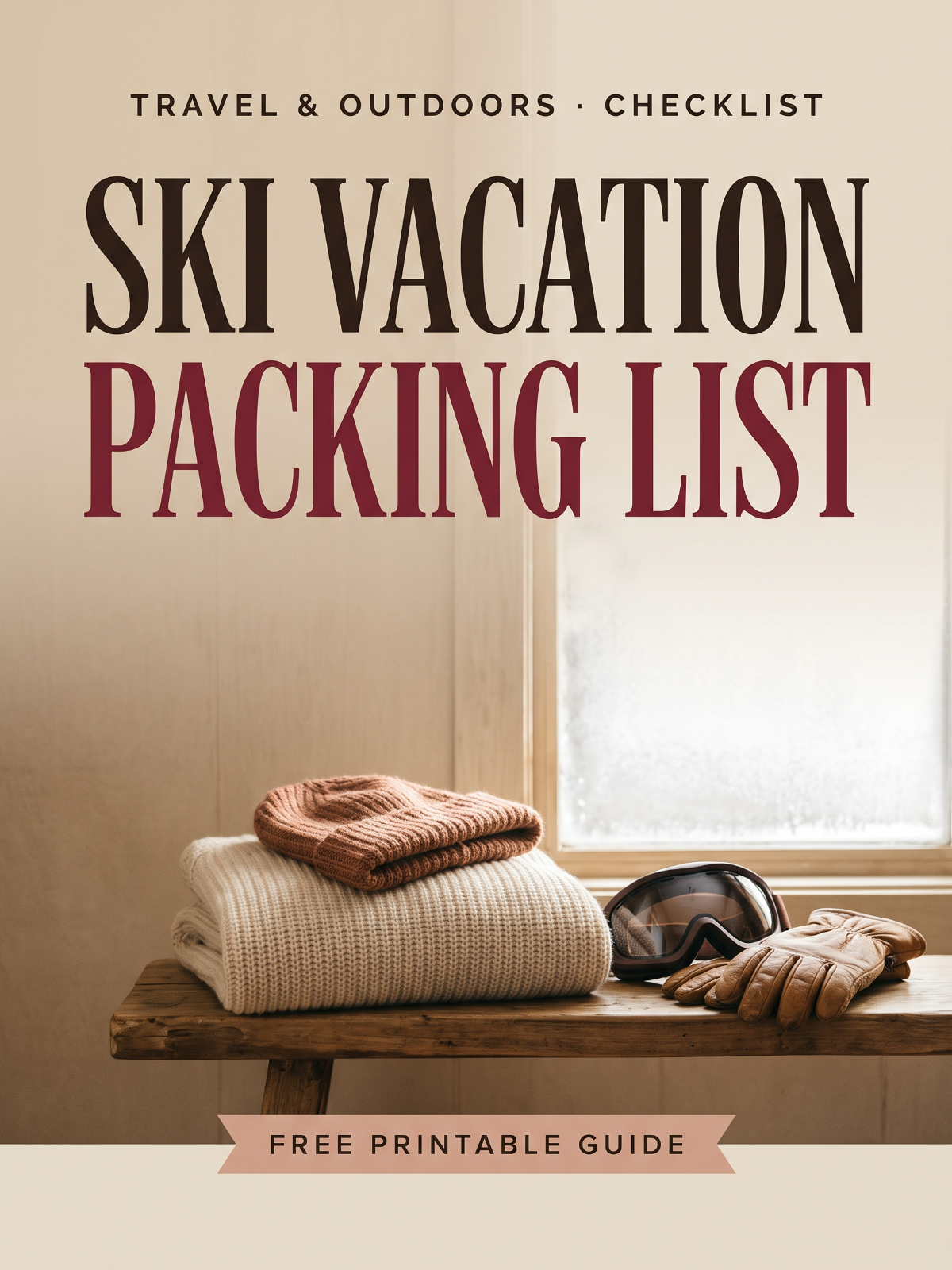
The full guide as a PDF
- ✓Rent-or-buy decision tree with cost breakpoints for skis, boots and helmets
- ✓Printable day-trip checklist (car, locker and lunch essentials)
- ✓Weekend checklist with a 2-day layer rotation plan
- ✓Full-week checklist with laundry and drying schedule
- ✓Family add-on list: kids' sizing, spare mittens, nap and snack kit
- ✓Couple and solo add-on lists, including apres-ski outfit planner
- ✓International flight add-on: carry-on boots, baggage limits, insurance and documents
Hosted on FileJoker. Free download, no sign-up.
A look inside the PDF
7 sections · 15 pages


Full table of contents
- Legs Sorted: Ski Pants, Base Layers and the Leggings Question
- Feet, Hands, Head: The Small Items That Ruin Days
- Midlayers and Looking Good Without Freezing
- Rent or Buy: A Decision Tree for Beginners and Families
- The Printable Checklists: Day Trip, Weekend, Full Week
- Traveller-Type Add-Ons: Family, Couple, Solo, International Flight
- Nine Packing Mistakes First-Timers Make
In this article
- The short answer
- Why Most Ski Packing Lists Fail First-Timers
- The 60-Second Answer: What Everyone Actually Needs
- Legs Sorted: Ski Pants, Base Layers and the Leggings Question
- Feet, Hands, Head: The Small Items That Ruin Days
- Midlayers and Looking Good Without Freezing
- Nine Packing Mistakes First-Timers Make
- Ski Packing FAQ
“Do I wear leggings under ski pants? Will two pairs of socks keep my feet warm? Should we rent boots or buy them?” If you’re staring at an empty suitcase a week before your first trip, this ski vacation packing list answers the questions that generic lists skip. You get exact leg-layer combos for mild and freezing days, a straight answer on sock layering, gloves versus mittens, goggles that fit over prescription glasses, and apres-ski clothing that looks good without leaving you cold.
The free PDF takes it further: a rent-or-buy decision tree for beginners, printable checklists for a day trip, weekend and full week, and add-on lists for families, couples, solo skiers and international flights.
The short answer
A working ski vacation packing list comes down to seven groups:
- Legs: one merino or synthetic base layer plus waterproof ski pants (10k+ waterproofing). No cotton leggings.
- Torso: base layer, fleece or light down midlayer, waterproof shell jacket.
- Feet: one pair of tall, thin ski socks per day — never two pairs.
- Hands and head: mittens for cold hands, gloves for dexterity, plus helmet, neck gaiter, goggles.
- Face: SPF 30+ and lip balm.
- Apres-ski: waterproof boots, warm layers, swimwear.
- Admin: passes, insurance, meds, chargers.
Why Most Ski Packing Lists Fail First-Timers
Most ski packing lists are written for one trip: someone else’s. They list 40 items with no quantities, no trip length, and no note on whether you’re driving two hours or flying nine.
You can spot a bad list by what it leaves you with:
- Cold feet by 11 a.m. Usually from two pairs of socks, or cotton ones, not from a lack of gear.
- A suitcase of unworn clothes. Five sweaters came, two got worn, and the lift ticket pocket you actually needed was in the coat you left home.
- A $400 receipt for boots you’d have rented for $35 a day.
Trip shape changes the list more than anything else. A 2-day drive-up weekend means you can throw in an extra bag, stop at a grocery store, and wear the same ski pants twice. A 7-day international flight means baggage limits, a boot bag that eats your allowance, and planning laundry on day 4 so you’re not packing seven of everything. If you live somewhere warm, you also have the opposite problem: almost nothing in your closet qualifies, so it’s tempting to buy wide and pack wider.
So use this guide in two passes. Read the layering rules once — legs, feet, hands, head, midlayers — then print the single checklist that matches your trip length and add the one traveller-type page that fits you.
Not covered here: backcountry touring, racing, and avalanche safety gear. Those need training, not a checklist.
The 60-Second Answer: What Everyone Actually Needs
Nine things go on your body every ski day: ski jacket, ski pants, base layer top, base layer bottom, midlayer, one pair of ski socks, gloves or mittens, goggles, helmet. Get those nine right and you can ski. Everything else is comfort.
The one-pair sock rule
One pair of ski socks. Nothing else in the boot — no cotton sock underneath, no base layer tucked in. Extra fabric squeezes your foot, cuts circulation, and makes your feet colder, not warmer. Pull your base layer bottoms over your socks, not under.
Rent or buy for your first trips
For trips one and two, rent skis, boots and poles. Boots especially — your feet will tell you what they like, and a $400 pair bought blind usually ends up in a closet. Buy the items that touch your skin: gloves, goggles, socks, base layers. Rent helmets if you like, but a bought helmet is cheap and you can check the fit at home with the beanie you’ll ski in.
| Item | Trip 1–2 | Typical cost (check current prices) |
|---|---|---|
| Skis | Rent | $30–55/day package |
| Boots | Rent | included in package |
| Poles | Rent | included |
| Helmet | Rent or buy | $10/day rent, $60–120 buy |
| Goggles | Buy | $40–150 |
| Ski jacket | Borrow or buy | $100–300 |
| Ski pants | Borrow or buy | $80–200 |
| Base layer top | Buy | $30–70 |
| Base layer bottom | Buy | $30–70 |
| Midlayer | Use what you own | $0–80 |
| Ski socks | Buy (2–3 pairs) | $15–25/pair |
| Gloves/mittens | Buy | $40–100 |
Spend on goggles, gloves and socks. Borrow the jacket and pants. Resist buying six warm layers if you live somewhere warm — you need one good set, not a cold-weather wardrobe.
Après-ski clothes, swimwear and kid spares depend on how long you’re going. The checklists handle those.
Legs Sorted: Ski Pants, Base Layers and the Leggings Question
Yes, you wear pants. Several, in fact. Legs work as a three-part system, and you rarely need all three at once.
- Base layer bottom — thin thermal legging worn against the skin. Merino or synthetic.
- Midlayer pant — an optional fleece or insulated legging. Cold days only.
- Outer ski pant — waterproof shell or insulated ski pant. This is the one that blocks snow and wind.
Shell or insulated?
Insulated ski pants have built-in padding and warmth. They’re simpler for beginners and better if you run cold or sit in the snow a lot — which, as a first-timer, you will. Shell pants are just a waterproof outer, so you control warmth with what’s underneath. Borrow or rent for your first trips; if and when you do buy, choose insulated for occasional skiing and a shell if you plan to ski in different climates.
Bibs beat regular pants when snow gets deep or when kids are involved. The high back stops snow going down the waistband during falls, and the straps mean nothing slides down on a 6-year-old who refuses a bathroom break until the last second.
Temperature-to-layer matrix
| Temperature | Base layer | Midlayer pant | Outer | Kids |
|---|---|---|---|---|
| Above 32°F (0°C) | Thin merino or synthetic legging | None | Shell or insulated pant, vents open | Base layer + insulated bib |
| 32°F to 20°F (0 to −7°C) | Thin or midweight merino or synthetic | None | Shell or insulated pant | Base layer + insulated bib |
| 20°F to 5°F (−7 to −15°C) | Midweight merino or synthetic | None for most people | Insulated pant | Base layer + fleece legging + insulated bib |
| Below 5°F (−15°C) | Midweight merino or synthetic | Fleece or insulated legging | Insulated pant | Base layer + fleece legging + insulated bib, plus a hand warmer in each boot cuff |
Kids feel cold faster and move less on a lift. Add one layer to whatever you’re wearing.
Cotton is the mistake
Cotton leggings hold sweat against your skin and stay wet for hours. Wet legs on a chairlift at 20°F is how people end a ski day at 11 a.m. Merino wool is warm, resists odor across multiple days, and still works damp. Synthetic (polyester, polypropylene) dries fastest and costs less. Either is fine. Cotton is not.
Fit and the boot rule
Base layers must be snug, not tight. A loose legging bunches and creates cold air pockets. A tight one, or a thick seam sitting on your knee or digging into your waistband, squeezes blood flow — and restricted circulation is exactly how you get a cold patch that no extra layer fixes. Check the seams before you buy.
Tip: Pull your leggings up above your ski socks, never tuck them into the boot. The only thing inside your boot is one pair of ski socks. Two pairs, or a base layer bunched under the sock, compresses your foot and makes it colder, not warmer.
Feet, Hands, Head: The Small Items That Ruin Days
Socks: one pair, that’s it
One pair of ski socks per foot per day. Thin-to-medium thickness, over-the-calf height, merino blend. No cotton — it holds sweat against your skin and goes cold.
Nothing else goes in the boot. Not a thin liner sock under the ski sock. Not your base layer legging tucked into the sock. Pull the base layer over the sock, so the fabric sits outside the boot cuff.
Warning: Thick socks and doubled socks are the top cause of cold feet. A ski boot is already insulated. Add bulk and you compress your foot, squeeze off circulation, and blood stops delivering warmth to your toes. Cold feet are usually a circulation problem, not an insulation problem.
Pack one pair per ski day plus one spare. Five ski days = six pairs.
Gloves, mittens, or lobster mitts
| Warmth | Dexterity | Kids | Price | |
|---|---|---|---|---|
| Gloves | Good | Best — lift pass, phone, kids’ zippers, buckles | Harder for small kids to get on | $40–$120 |
| Mittens | Warmest — fingers share one chamber, so they’re noticeably warmer | Poor — you’ll pull them off constantly | Easiest to put on, warmest for little hands | $40–$120 |
| Lobster mitts | Near-mitten | Middle — two finger pockets, usable grip | Fine for older kids | $50–$130 |
Price check current figures; ranges move by brand and season.
Parents, pick mittens for the kids and gloves for yourself — you’re the one zipping jackets and fishing out lift passes. If your hands run cold, carry both and swap at lunch. Battery-heated liners sit under either and fix the problem outright.
Tip: Buy gloves with a small zip pocket on the back of the hand. Lift gates read passes through the fabric, so you never dig through pockets in a line.
Head and neck
Helmet, always. Underneath it, a thin beanie only — a thick one changes the fit and loosens the shell. Check that your helmet still sits level with the beanie on before you leave home.
A neck gaiter (buff) handles most days. Below about 14°F (−10°C) or on windy, exposed lifts, a balaclava is better because it leaves no gap between goggle and collar.
Goggles over glasses
Yes, OTG goggles exist — “over the glasses.” Before buying, check three things: the frame cutouts at the temples, that your glasses’ arms sit flat inside, and that the vents aren’t blocked by the lenses (blocked vents mean fog).
Cheaper alternatives: prescription insert lenses that clip inside standard goggles, or contacts plus a spare set and your glasses for evenings.
Integrated-visor helmets
Visor helmets are quick, work well over glasses, and kids like them. The trade-offs: fewer lens options, more fog if you stop and sweat, and one broken part replaces two. Separate goggles are the safer first purchase.
Midlayers and Looking Good Without Freezing
The midlayer sits between your base layer and your jacket. Its job is trapping warm air without adding bulk you can’t move in.
Can you wear a hoody as a midlayer?
Yes — if it’s merino or fleece. A cotton hoodie is a bad midlayer: it soaks up sweat, stays wet, and chills you on the lift. A hood under a helmet also bunches at the back of your neck. Choose a thin merino hoody or a grid fleece with a quarter zip instead.
| Midlayer | Warmth | Packed bulk | When damp | Price band |
|---|---|---|---|---|
| Grid fleece (quarter-zip) | Medium | Low | Keeps warming, dries fast | $40–$90 |
| Light synthetic puffer | High | Very low (stuffs to a grapefruit) | Still insulates | $70–$150 |
| Light down puffer | Highest | Lowest | Loses loft, poor | $100–$250 |
| Merino hoody (190–250 g/m²) | Medium | Low | Warm when damp, slow to dry | $80–$160 |
| Cotton hoodie | Low | High | Cold and useless | — |
Grid fleece is the best all-rounder for most first-timers. Add the puffer only for very cold days or for standing around at the base.
The bulk trap
Two thin layers beat one thick one. Air gets trapped between them, and you can remove one when the sun comes out. One thick sweater gives you a single setting: too hot or too cold.
Test it before you fly. Put on base layer, midlayer and jacket, then raise both arms over your head and reach across your body. If the shoulders pull or your arms feel pinned, the midlayer is too thick for that shell.
Warning: Tight layers create pressure points that cut circulation, and that’s what makes fingers and toes go cold. Snug is fine. Squeezed is not.
Looking good in gear that’s built for cold
Looking cute in the cold is genuinely hard — the helmet and goggles cover most of your face, and the jacket hides your shape. A few things that work:
- Belt the jacket or pick a slightly fitted shell so you aren’t a rectangle.
- Color block: one bold piece (jacket or pants), everything else neutral.
- Match goggle strap to jacket — it’s the only visible accessory.
- Keep the silhouette balanced: slim pants with a roomier jacket, or vice versa.
The après-ski capsule
Five items cover every evening:
- One pair of warm pants or jeans
- Waterproof winter boots with real grip
- One nice knit sweater
- Swimwear for the hot tub or spa
- Thermal tights, if you want a dress
Travel day
Wear your bulkiest items on the plane or in the car: winter boots, jacket, and the heaviest knit. That’s three of the biggest items out of your suitcase for free.
Nine Packing Mistakes First-Timers Make
1. Two pairs of socks in the boot. The single most common cause of cold feet. A second sock compresses the liner, cuts circulation, and creates folds that rub. One ski sock per foot. Pull your base layer bottoms above the sock, never into the boot.
2. Cotton next to your skin. Jeans, cotton T-shirts, cotton leggings, gym socks. Cotton soaks up sweat and holds it cold against you for hours. Merino or synthetic for anything touching skin on the mountain.
3. Using a big puffy city coat as your ski jacket. A warm coat isn’t a ski jacket. You need waterproofing, taped seams, a hood that fits over a helmet, and a snow skirt for when you sit down in powder. A dry shell over a fleece beats a soaked parka every time.
4. Buying boots online before your first trip. Boots are a fit problem, not a shopping problem. Half a size off means bruised shins or numb toes for a week, and you can’t fix it on the mountain. Rent, get fitted in person, and buy later if you’re hooked.
5. No après footwear with grip. Resort sidewalks ice over by 4 p.m. Sneakers with worn soles put people on their backs, and a sprained wrist ends the trip. Pack one pair of waterproof boots with real lugs and wear them everywhere off the slopes.
6. Panic-packing sweaters, forgetting spares that matter. People from warm climates overpack knitwear — six sweaters for five nights — then bring one pair of gloves and one pair of goggles. Two sweaters is plenty indoors. A spare pair of gloves and a spare goggle lens matter far more.
7. No drying plan. Liners and gloves soak through on day one and are still damp at 8 a.m. on day two. Pull liners out of boots every night, open gloves wide, keep everything off the radiator — direct heat ruins liners. Boot dryers in the condo are worth asking about when you book.
8. Goggles that don’t fit your glasses or your helmet. If you wear prescription glasses, you need OTG (over-the-glasses) goggles with cut-outs in the foam. Try them on with your helmet, together, before you pay.
9. Assuming a helmet with built-in goggles is the easy option. It’s convenient, but you’re locked into that lens and that fit. Separate helmet and goggles gives you more choices and lets you replace one without the other.
Ski Packing FAQ
Do I wear normal pants or underwear under ski pants?
No jeans, no sweatpants, no leggings-plus-pants pile. Under your ski pants you wear one thin base layer bottom — merino or synthetic — and your usual underwear under that. Many people skip underwear entirely under merino base layers because the seams can rub. Nothing cotton touches your skin.
How many ski socks for a week, and can I wash them in the sink?
Pack five pairs for a seven-day trip and wash two midweek. Ski socks dry fast in a warm hotel room if you rinse them in the sink at night, squeeze them in a towel, and hang them over a radiator by morning. Pack seven if you hate sink laundry and have the bag space. One pair per foot per day, worn alone — your base layer legging goes over the sock cuff, not under.
Are OTG goggles enough, or do I need prescription inserts?
OTG (over-the-glasses) goggles work for most frames and cost nothing extra. Try them on with your actual glasses before you buy — small frames fit easily, wide arms can press on your temples. Inserts (a small prescription lens clipped inside the goggle) are worth it if you ski often or your glasses fog constantly. For trip one, OTG plus contacts as a backup is plenty.
Can I rent a helmet?
Yes, and for your first trip you should. It comes with the ski package for a few dollars a day. Buy once you’ve skied more than about five days a season — a helmet you own fits better and has no previous owner’s sweat in the lining.
What do I wear to dinner?
Jeans or cords, a sweater, and waterproof boots with grip. Resort restaurants are casual. Streets are icy — the boots matter more than the outfit.
Is a ski jacket enough at 5°F (−15°C)?
Not on its own. Add a fleece or light down midlayer, plus a balaclava or buff under your helmet. Down packs small and adds real warmth; fleece breathes better if you’re working hard.
- ✓Rent-or-buy decision tree with cost breakpoints for skis, boots and helmets
- ✓Printable day-trip checklist (car, locker and lunch essentials)
- ✓Weekend checklist with a 2-day layer rotation plan
- ✓Full-week checklist with laundry and drying schedule
- ✓Family add-on list: kids' sizing, spare mittens, nap and snack kit
- ✓Couple and solo add-on lists, including apres-ski outfit planner
- ✓International flight add-on: carry-on boots, baggage limits, insurance and documents
Frequently asked questions
What should I wear on my legs for skiing — leggings or ski pants?
Wear one thin base layer (merino or synthetic) under waterproof, breathable ski pants. Cotton leggings hold sweat and chill you. On mild spring days, ski pants alone are often enough; below about -10C, choose insulated ski pants or a thicker 200-weight base layer. Avoid stacking two bulky layers — it restricts movement and makes boots harder to fasten.
Should I wear two pairs of socks to ski?
No. Two pairs bunch, create pressure points and cut circulation, which is the main cause of cold feet in ski boots. Wear one pair of tall, thin, ski-specific socks in merino or synthetic blend, pulled smooth with no seams under the shin. Pack one clean pair per day — damp socks are far colder than thin ones.
Should beginners rent or buy ski boots and skis?
Rent skis and poles for your first few trips; they're bulky, expensive and need to match your evolving ability. Boots are the exception: if you ski more than about 7–10 days a year, buying boots fitted by a bootfitter solves most comfort and cold-foot problems. The PDF includes a rent-or-buy decision tree with cost breakpoints for families.
Can I wear ski goggles over prescription glasses?
Yes — look for OTG (over-the-glasses) goggles, which have deeper frames and temple notches. Choose a model with strong anti-fog coating and vents, and consider an anti-fog cloth. Alternatives include prescription goggle inserts (clip-in lenses) or daily contact lenses, which most skiers find more comfortable and far less prone to fogging on lift rides.
What do I pack for apres-ski and off-slope evenings?
Pack waterproof, grippy snow boots, a warm non-ski jacket, jeans or warm trousers, two or three cosy tops, thermal socks, swimwear for spas or hot tubs, and one smarter outfit if you'll eat out. Resort interiors are hot, so layer rather than relying on one thick sweater. Count one base layer and one pair of ski socks per ski day.
We collected 84 real questions and comments about "ski vacation packing list" (58 from YouTube comments, 26 from search suggestions), grouped them into 13 recurring problems, and built this guide to resolve the 7 that block people most. The top-ranking pages were reviewed for gaps; 7 of those gaps became dedicated sections.
Edited by Alex Hirn · Last updated November 1, 2026 · How we make our guides
More in Travel & Outdoors
 premium+3 bonuses
 premium+3 bonuses
 free
 premium+3 bonuses