Checklist · 19-page PDF · Free
Camping Gear Checklist: What to Pack, by Category and Trip Type
A camping gear checklist by category with per-person quantities, plus the 3-3-3 and 7 C's rules explained. Free printable checklist inside — download it.

The full guide as a PDF
- ✓Master checklist by category with tick boxes and per-person quantities
- ✓Trip-type variants: car camping, backpacking, family with kids
- ✓The five-pass packing method, step by step
- ✓Clean vs. dirty water bottle system with labelling setup
- ✓Sleeping bag rating, cookware and cooler guide with no brand hype
- ✓Full first aid kit list with the purpose of every single item
- ✓Printable, reusable format you can adapt and tick each trip
Hosted on FileJoker. Free download, no sign-up.
A look inside the PDF
10 sections · 19 pages
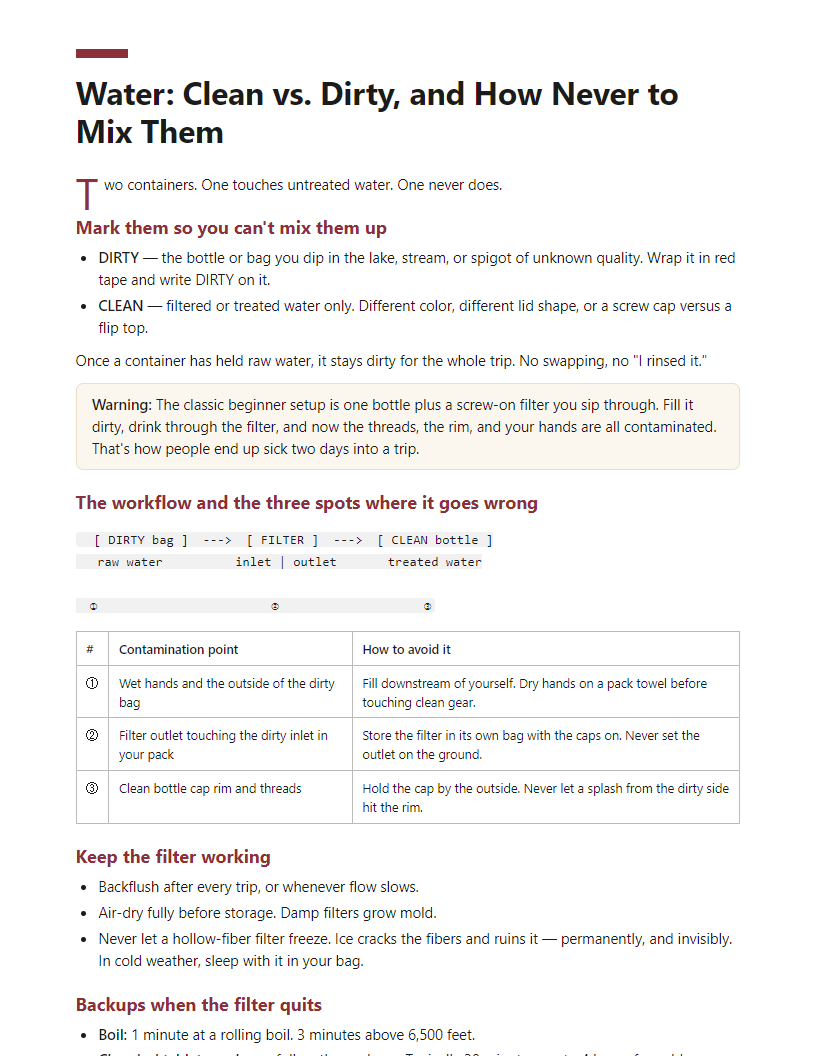

Full table of contents
- Why Most Camping Checklists Fail You
- How to Pack in Five Passes (Instead of One Panicked Sweep)
- The Master Checklist by Category with Per-Person Quantities
- Water: Clean vs. Dirty, and How Never to Mix Them
- Sleeping Bag Ratings, Cookware and Cooler Basics Without Brand Hype
- Storage That Makes the Next Trip Easy
- Eight Mistakes That Ruin First Camping Trips
- First Aid Kit: Every Item and What It's Actually For
- From Car Camping to Backpacking: Your Gear Evolution Path
- Print, Adapt, Reuse
In this article
“What if I forget something important?” That worry hits the night before every trip — and it gets worse when every camping gear checklist you find reads like a sponsored shopping list for gear you don’t need.
This page gives you the honest version: what the 3-3-3, 4-4-4, 10 Essentials and 7 C’s rules actually mean, the eight mistakes that wreck first trips, and how your kit evolves from car camping to backpacking.
The free PDF adds the part you can hold in your hand: a tick-box master checklist by category with per-person quantities, a five-pass packing method, a clean-versus-dirty water system, and a first aid kit list explaining what each item is for.
The short answer
A working camping gear checklist covers six categories:
- Shelter & sleep — tent, pegs, footprint, sleeping bag rated below expected night temps, sleeping pad.
- Kitchen — stove, fuel, pot, utensils, cooler, washing-up kit.
- Water — clean and dirty bottles kept separate, filter or purification tablets.
- Clothing — layers, rain shell, spare socks, camp shoes.
- Light & navigation — headtorch per person, spare batteries, map, compass.
- Safety & hygiene — first aid kit, fire starter, knife, toilet kit, sunscreen, insect repellent.
Scale quantities per person, then adjust for trip type.
Why Most Camping Checklists Fail You
Most checklists are just a list of nouns. “Tent. Sleeping bag. Flashlight.” You pack, you drive, and you find out at 9 p.m. that two people are sharing one headlamp.
Three things go wrong:
- No quantities. The list says “socks,” not “2 pairs per person per night.”
- No trip-type variation. A car camping list will sink a backpacker. A backpacking list leaves a family with kids short on everything.
- No storage logic. Gear scattered across the garage means you repack from scratch every time.
No brands, just functions
You will not find a single product name here. You need a stove, not a specific stove. Most beginners already own a pot, a cooler, a blanket, and a flashlight that work fine for a weekend. Buy only what you’re truly missing, after your first trip tells you what that is.
How to read the quantities
| Notation | Means |
|---|---|
| /p | Per person |
| /g | Per group (one for the whole camp) |
| /n | Per night |
| /p/n | Per person, per night |
So “socks 1 pair /p/n +1” means one pair per person for each night, plus a spare.
Each checklist row has three columns: Car, Pack (backpacking), and Kids (family). Tick the column that matches your trip and ignore the rest.
Tip: Work backward from departure. Three weeks out, test gear and fill gaps. Three days out, shop food and charge batteries. Three hours out, load the car and do a final tick-through.
The Camping Rules Decoded: 3-3-3, 4-4-4, 10 Essentials and the 7 C’s
You’ll see these “rules” repeated on every camping forum. Here’s what each actually does — and which one belongs in your planning.
3-3-3: a trip-planning rule
Drive no more than 3 hours. Arrive by 3 p.m. Stay at least 3 nights.
Nothing here tells you what to pack. It protects your first evening. Three hours of driving keeps the day short. A 3 p.m. arrival leaves daylight to pitch the tent, find the bathrooms, and cook before dark. Three nights means day one is setup, day two is the trip, day three is winding down.
4-4-4: the family version
Four hours max in the car, arrive by 4 p.m., stay four nights. The longer stay is the point. With young kids, the first night is usually rough — new sounds, late bedtime, overtired everyone. Four nights gives you two good days after the bumpy start.
Some families flip it the other way: arrive by noon on the first day. Kids need more setup time than adults, not less.
The 10 Essentials: systems, not objects
Think of these as ten functions you must cover, however you cover them:
- Navigation — map, compass, or downloaded offline maps
- Illumination — headlamp per person, plus spare batteries
- Sun protection — sunscreen, hat, sunglasses
- First aid
- Knife or multi-tool, plus repair tape
- Fire — lighter, matches, tinder
- Emergency shelter — tarp, bivy, or space blanket
- Extra food — one day’s worth
- Extra water — plus a way to treat more
- Extra clothes — one insulating layer beyond forecast
The 7 C’s
A memory hook for a minimal kit: cutting tool, combustion, cover, container, cordage, cotton cloth, compass. Good for a solo day hike. It says nothing about diapers, sunscreen, snacks, or a second headlamp, so it falls short for family camping.
| Rule | What it governs | Best for | Skip it if |
|---|---|---|---|
| 3-3-3 | Trip logistics: drive time, arrival, length | Adults, first few car camping trips | You’re camping 20 minutes from home |
| 4-4-4 | Same, with buffer | Families with kids under 8 | Your kids are older and travel well |
| 10 Essentials | Safety gear coverage | Every trip, every type | Never |
| 7 C’s | Minimalist packing recall | Solo hikes, bushcraft | You’re packing for a group |
Tip: Use 3-3-3 or 4-4-4 to plan the trip. Use the 10 Essentials to check the packed car. They answer different questions.
Eight Mistakes That Ruin First Camping Trips
1. Buying everything before your first trip
You don’t know what you like yet. Borrow a tent, rent a sleeping bag, use the pots in your kitchen. After two trips you’ll know which $200 purchase is worth it and which one sits in the garage. Nobody’s paying us to tell you to buy anything — and you don’t need much.
2. Trusting the big number on the sleeping bag
The lowest temperature on the tag is a survival rating, not a comfort rating. Pair it with a pad that has an R-value suited to the ground temperature. Cold seeps up from below. A warm bag on a thin pad still means a cold night.
3. Cotton as your main layer
Cotton holds water and pulls heat out of you. In spring and fall, that’s how a damp shirt turns into shivering. Wool or synthetic next to skin; save cotton for the drive home.
4. One headlamp for the group
One headlamp per person, plus a spare set of batteries in the go-box. Camp chores at 9 p.m. don’t share well.
5. One bottle for both dirty and clean water
Once a bottle or bladder holds untreated water, it stays a dirty container. Never fill it with treated water later. Label both, keep them apart, and don’t drink from the dirty threads.
Warning: Squeeze bags and bladders are the usual mix-up. Mark the dirty one with tape you can feel in the dark.
6. Guessing at fuel
Plan by liters boiled, not by feel. On a canister stove in mild weather, figure about 0.5 oz (15 g) of fuel and 4 minutes per liter of water.
| Item | Planning figure |
|---|---|
| Fuel per liter boiled | 0.5 oz (15 g) |
| Time per liter | ~4 minutes |
| 8 oz (230 g) canister | ~16 liters boiled |
Count the liters you’ll boil per day for meals and hot drinks, then add 25%. That margin covers cold weather and wind, which both burn more. One 8 oz canister covers roughly two people for a weekend — the same figure used earlier in this guide.
Example: Two people, 3 liters a day, two days = 6 liters. Add 25% to get 7.5 liters, or about 4 oz of fuel. One 8 oz canister is plenty.
7. Citronella candles as your whole bug plan
Candles do little in a breeze. Long sleeves at dusk, a screened shelter, and staying inside during the worst hour do more.
8. Packing from memory
Memory forgets the same three items every time. Print the checklist. Check it off. Keep it in the go-box.
From Car Camping to Backpacking: Your Gear Evolution Path
You don’t need backpacking gear to start backpacking. You need three or four car camping trips first, then a plan for what to replace and in what order.
Trips 1–3: borrow, rent, stay close
Camp within an hour of home. Borrow a tent. Rent a sleeping bag from an outfitter or a college outdoor program. Cook with the pots already in your kitchen.
After three trips you’ll know which items you used every night and which stayed in the bag. That’s your real list — not one written by someone paid to mention a brand.
What transfers unchanged
These work the same on a trail as in a campground. Don’t rebuy them:
- Headlamp (one per person) and spare batteries
- First aid kit
- One cook pot and one spoon per person
- Layers: base layer, insulating layer, rain shell
- Water filter and your clean/dirty bottle pair
Upgrade order: weight saved per dollar spent
Replace gear in this order. The first three items are the heaviest things you carry.
| Order | Item | Why first |
|---|---|---|
| 1 | Shelter | Biggest single weight drop; a car camping tent can run 8–12 lb |
| 2 | Sleep system | Bag and pad together are your second-heaviest load |
| 3 | Pack | Buy last, once you know the volume your gear actually fills |
Buying the pack first is the common mistake. You end up sizing it for gear you’re about to replace.
What stays home
Camp chairs. Two-burner stoves. Anything glass. Full-size toiletries — decant into 1 oz bottles.
Tip: Do a shakedown hike before any real trail trip. One night, under an hour from home, full pack on your back. Anything you didn’t touch comes out of the pack next time.
Camping Gear Questions Answered
What is the 3-3-3 rule when camping?
Drive no more than 3 hours, arrive by 3 p.m., and stay at least 3 nights. It’s a trip-planning rule, not a packing rule. The family version (4-4-4) and the reasoning behind both are covered in “The Camping Rules Decoded.”
What are the 10 must-haves for camping?
Ten systems, not ten objects: navigation, illumination, sun protection, first aid, knife or repair kit, fire, emergency shelter, extra food, extra water, extra clothes. One headlamp per person, not per tent. See “The Camping Rules Decoded” for what counts under each system.
Tip: The fastest cure for “did I forget something?” is a labeled go-box you keep packed year-round. Setup details are in “Storage That Makes the Next Trip Easy.”
What are the 7 C’s of camping?
Cutting tool, combustion, cover, container, cordage, cotton cloth, compass. It’s a minimalist recall list for a solo day hike, and it leaves out most of what a family needs — see “The Camping Rules Decoded.”
A second version circulates online: clothing, comfort, cooking gear, cleaning supplies, camp tools, communication, cash. This guide uses the first list everywhere. If you see the second one elsewhere, treat it as a different memory aid with the same name.
How much water and fuel per person per day?
| Item | Per person, per day |
|---|---|
| Drinking water | 1 gallon |
| Extra for cooking and washing | 0.5–1 gallon |
| Canister stove fuel (boiling only) | About 1 oz |
Cold weather burns more fuel. Butane canisters lose pressure in the cold, so carry a spare or run a liquid-fuel stove on freezing nights.
Warning: Never mix dirty and clean containers. Once a bottle or bladder holds untreated water, it stays the “dirty” one for the whole trip. Label both with tape and keep the dirty one’s threads and cap away from your mouth.
Do red or green lights keep bugs away?
Mostly no. Insects are drawn to bright white and blue-toned light, so a dim red headlamp attracts fewer moths and preserves your night vision. That’s a side benefit, not bug protection. Use repellent and a screened shelter.
Can I refill a small propane canister myself?
Disposable 1 lb canisters are built for single use, and refilling them is restricted and risky. Use a refill or exchange program, or a refillable tank with an adapter — details in “Sleeping Bag Ratings, Cookware and Cooler Basics.”
Tip: Freeze meals flat and use block ice instead of cubes. The same section explains how to stretch a cooler to the end of the trip.
- ✓Master checklist by category with tick boxes and per-person quantities
- ✓Trip-type variants: car camping, backpacking, family with kids
- ✓The five-pass packing method, step by step
- ✓Clean vs. dirty water bottle system with labelling setup
- ✓Sleeping bag rating, cookware and cooler guide with no brand hype
- ✓Full first aid kit list with the purpose of every single item
- ✓Printable, reusable format you can adapt and tick each trip
Frequently asked questions
What is the 3-3-3 rule when camping?
The 3-3-3 rule is a trip-rhythm guide, not a gear rule: drive no more than 300 miles (or 3 hours), arrive by 3pm, and stay at least 3 nights. Arriving in daylight means you pitch the tent, find water and cook without rushing — the single biggest cause of forgotten or badly packed gear is a late, dark arrival.
What are the 10 must-haves for camping?
The classic ten: navigation (map and compass), headtorch, sun protection, first aid kit, knife or multi-tool, fire starter, emergency shelter, extra food, extra water plus a filter, and extra insulation layers. These are the survival core. Tent, stove, cooler and chairs are comfort items — important, but pack the ten first so a delay or wrong turn never becomes an emergency.
What are the 7 C's of camping?
Commonly listed as cutting tool, combustion device, cover (shelter), container (for water), cordage, cotton material and compass. It's a bushcraft memory aid for the seven functions you can't improvise easily in the field. Use it as a sanity check after packing: if any of the seven has no item assigned, something essential is missing from your kit.
What is the 4-4-4 rule for camping?
A slower variant of 3-3-3 for longer trips: drive no more than 4 hours, arrive by 4pm, stay 4 nights. It suits families with young children, who need extra time for setup, naps and meltdowns. Both rules exist because time pressure — not missing gear — is what turns a first camping trip into a bad memory.
How do I keep filtered water from mixing with dirty water?
Use a strict two-bottle system. Assign one container permanently as "dirty" (collecting from streams or taps you don't trust) and another as "clean" (filtered or treated only). Mark them with coloured tape, never swap roles, and never let the dirty bottle's mouth or cap touch the clean one. Filter into the clean bottle, then store them in separate pockets.
How should I store camping gear between trips?
Store by category in labelled clear bins — shelter, kitchen, sleep, hygiene — so packing means loading boxes, not hunting the loft. Dry everything fully before storage, especially tents and sleeping bags, and keep bags loose in a large cotton sack rather than compressed. Keep a restock note in each bin listing consumables used up, so the next trip starts stocked.
We collected 123 real questions and comments about "camping gear checklist" (119 from YouTube comments, 4 from People Also Ask), grouped them into 5 recurring problems, and built this guide to resolve the 4 that block people most. The top-ranking pages were reviewed for gaps; 7 of those gaps became dedicated sections.
Edited by Alex Hirn · Last updated September 24, 2026 · How we make our guides
More in Travel & Outdoors
 premium+3 bonuses
 premium+3 bonuses
 premium+3 bonuses
 free