Workbook · 23-page PDF · Premium
RV Trip Planner App: Picking One (and Planning Offline)
Compare RV trip planner apps on routing safety, free tiers and cost — plus a printable workbook with route sheets, campground checklist and budget. Download it.
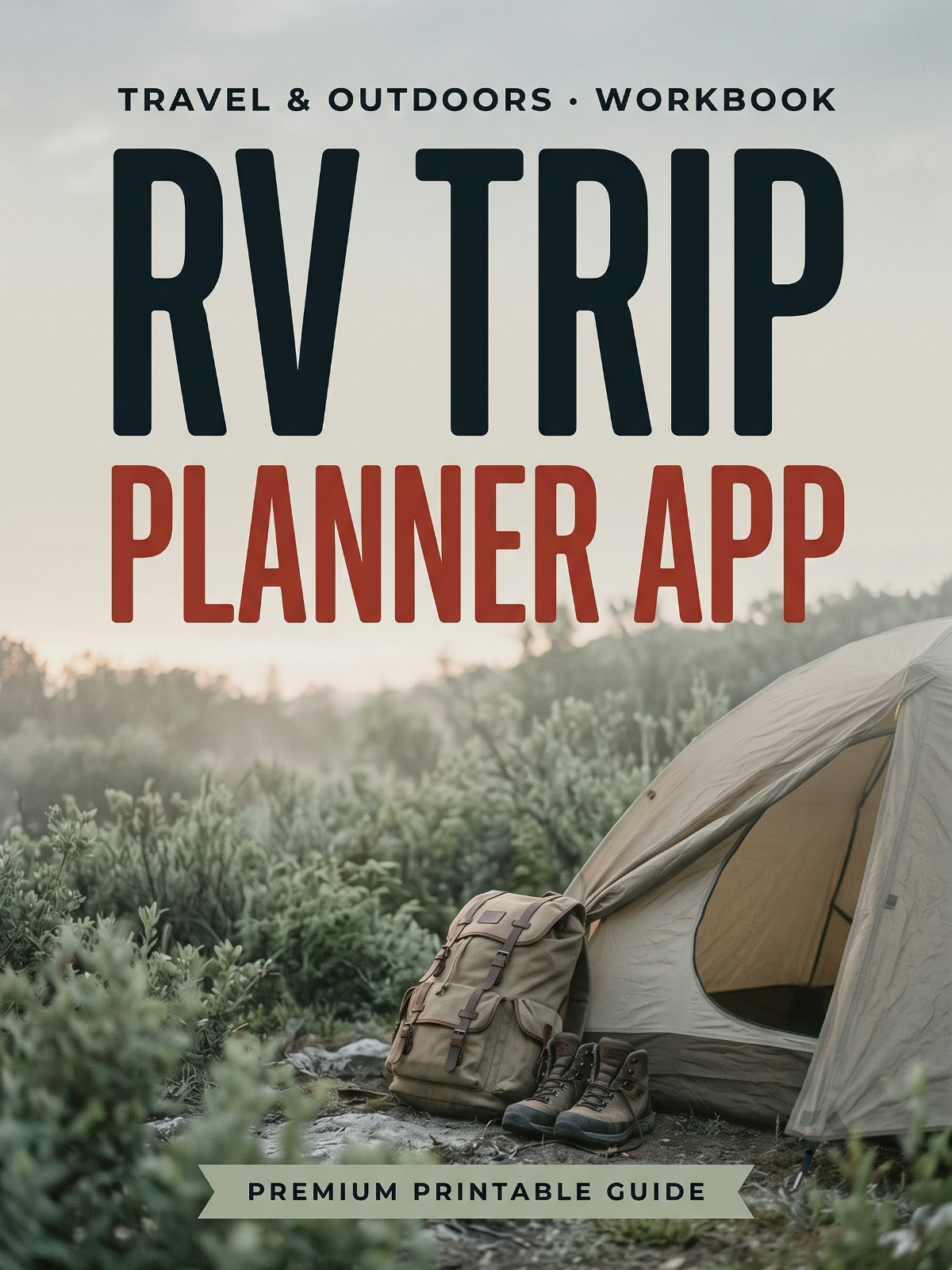
The full workbook, ready to print
- ✓Leg-by-leg route verification sheet with low-clearance and grade checkpoints
- ✓3-3-3 driving-day planner with arrival-time and mileage limits
- ✓Flex Frame booking grid: must-book anchors vs open nights
- ✓Campground vetting checklist plus membership/network accuracy cross-check (Escapees, Passport America)
- ✓Reservation tracker with confirmation numbers, cancellation deadlines and deposits
- ✓Fuel math worksheet, trip budget table and breakdown contingency fund planner
- ✓Offline-ready pre-departure checklist for printing before you lose signal
Hosted on FileJoker. Premium members download instantly; free download has a wait.
In a hurry? Free one-page checklist32 items to tick off · print-ready PDF, no sign-upDownload freeIncluded bonuses — free with the guide
3 extra guides from the same topic Free PDF · 13 pagesNational Park Checklist Map: Track All 63 US Parks on PaperTrack all 63 US national parks with a free national park checklist map: printable map, state-by-state checklist, notes space and progress counter. Download it.
 Free PDF · 16 pagesCruise Packing List Carnival: The First-Timer's ChecklistA cruise packing list for Carnival built around their rules: banned items, ID musts, forgotten essentials, plus a free printable checklist. Download yours.
 Free PDF · 17 pagesRoad Trip Packing List: Car, Food, Kids and Gadgets SortedA road trip packing list that covers car, food, kids and gadgets — plus 12 essentials, the 3-3-3 rule and a free printable checklist. Download it free.
A look inside the PDF
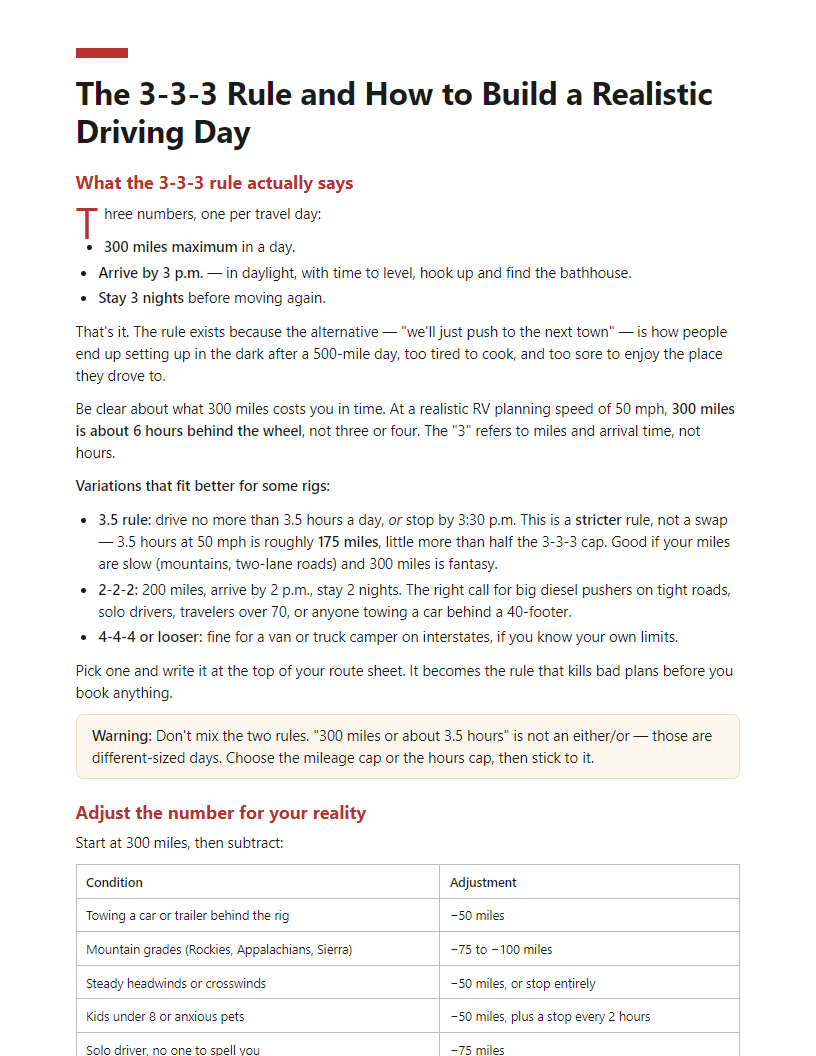
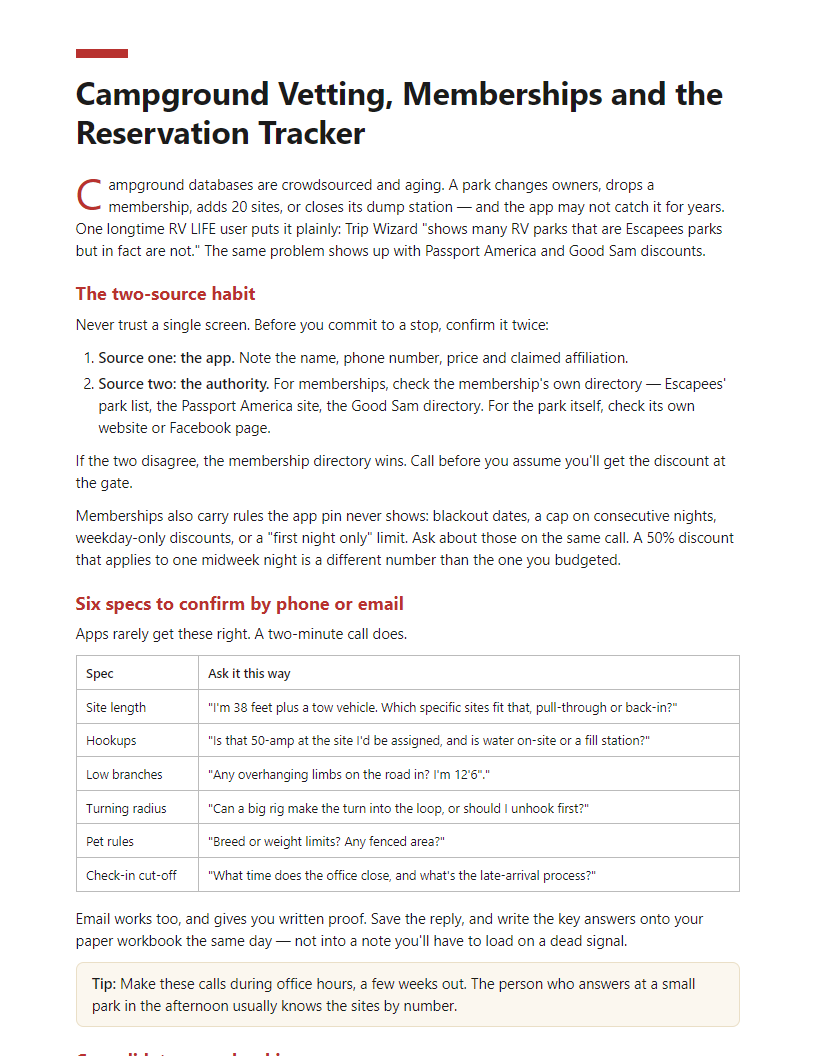
10 sections · 23 pages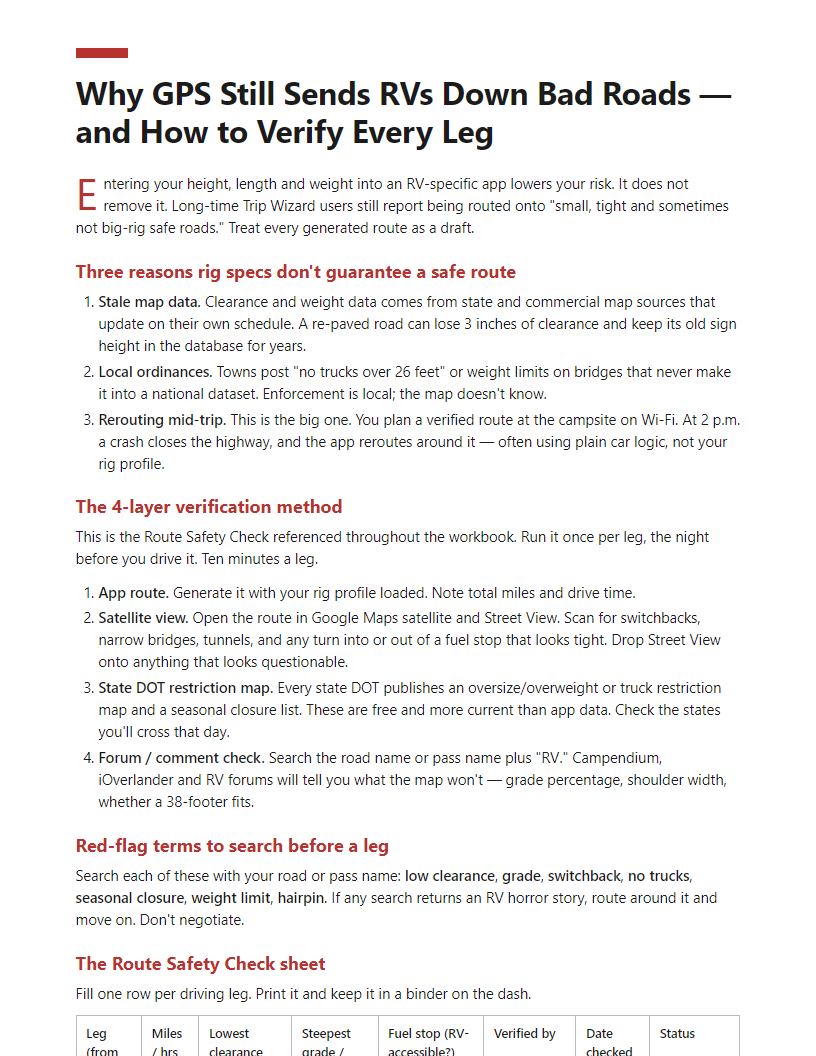
Full table of contents
- Why Your Trip Plan Shouldn't Live Only Inside One App
- Short Answer: Which RV Trip Planner Is Worth Paying For in 2025
- Head-to-Head: RV LIFE Trip Wizard vs Roadtrippers vs Google Maps vs Free Tools
- Why GPS Still Sends RVs Down Bad Roads — and How to Verify Every Leg
- The 3-3-3 Rule and How to Build a Realistic Driving Day
- The Flex Frame: Booking What Must Be Booked, Winging the Rest
- Campground Vetting, Memberships and the Reservation Tracker
- Trip Budget, Fuel Math and the Breakdown Contingency
- Seven Mistakes That Wreck RV Trip Plans
- Offline-Ready Pre-Departure Checklist
In this article
You’ve typed in your rig height, weight and length — and the app still routed you under a 10-foot bridge. Or you built a whole trip inside a free tier, then found your itinerary locked behind a higher subscription. You’re not sure whether RV LIFE Trip Wizard, Roadtrippers or plain Google Maps is actually best, and you still don’t know how many miles a day is sane.
This page compares the main options honestly, explains what RV-specific routing really does, and shows where every rv trip planner app falls short once you lose signal. The premium PDF workbook goes further: printable route legs, a 3-3-3 driving-day planner, campground vetting sheets, a reservation tracker and a fuel-and-budget worksheet you can use with no internet at all.
The short answer
Choosing an RV trip planner app, in order:
- Pick routing first. RV LIFE Trip Wizard gives the strongest rig-aware routing (height, weight, propane, grades) — worth paying for if you tow or drive tall.
- Use Roadtrippers for scenic stops and points of interest, not for clearance safety.
- Use Google Maps as a cross-check only; it has no true RV mode.
- Test free tiers before trusting them — many lock exports or trip data.
- Verify every leg against low-clearance and road-ban sources.
- Keep a printed copy for dead zones.
Why Your Trip Plan Shouldn’t Live Only Inside One App
“What is the best RV road trip planner app?” is the wrong first question. The better one: what happens to my trip when the app stops working for me?
Three things break app-only planning.
Paywalls. Features you used last season can move behind a higher tier. Roadtrippers subscribers report paying the annual fee and then finding a finished trip locked behind an upgrade (the full story is in the head-to-head section). Another user watched a tutorial only to learn that half the clicks shown were paid-tier features. You can lose access to a trip you already built.
Dead zones. Plenty of good campgrounds sit where your phone shows zero bars. Offline maps help, but your notes, confirmation numbers and backup plan often live in a cloud sync that won’t load.
Bad RV routing. Even after you enter your height, weight and length, GPS still sends rigs under low bridges and down roads that shouldn’t carry a 35-foot motorhome. An app’s route is a suggestion, not a guarantee.
Why full-timers still keep paper on the dash
Experienced RVers write the day’s route on a card and clip it where the co-pilot can read it: exits, fuel stop, low-clearance warnings, tonight’s campground and its phone number. It takes four minutes. It works with a dead battery, a dead zone and a lapsed subscription.
This workbook works with your app
The usual alternative — Google Maps, pen and paper — works, but it eats hours. Verifying clearances by hand runs about 10 minutes per leg, and that adds up fast across a multi-week route. The templates here cut that work down. Use whichever app you choose for discovery and routing. Use the paper for the parts that must survive.
Inside you’ll find:
- Side-by-side comparison tables for RV LIFE Trip Wizard, Roadtrippers, Google Maps and free tools
- Seven printable templates: route cards, driving-day planner, campground vetting, reservation tracker, fuel and budget math, contingency plan
- A pre-departure checklist you can run offline
Short Answer: Which RV Trip Planner Is Worth Paying For in 2025
The one-line answer
If your rig is over 11 feet tall or over 30 feet long, and you travel more than a couple of weeks a year, pay for RV LIFE Trip Wizard. Everyone else can start on the free trial — 7 days at the time of writing, so check current terms — and upgrade only if free tools fail them.
Best for RV-safe routing and campground data: RV LIFE Trip Wizard
You enter height, length, weight and propane status once, and routing avoids low clearances and restricted roads. It bundles with the RV LIFE GPS app, so the route you plan on a laptop follows you in the cab. Campground data pulls from Campground Reviews, with thousands of user reviews, site-level notes and big-rig friendliness flags.
It sells as an annual bundle subscription rather than a one-time purchase, and the tiers move — check current pricing before you buy. It is worth it if you’re doing long cross-country routes in a big rig, booking ahead, and want one place for route, stops and reservations.
Best for discovery: Roadtrippers
Roadtrippers is built for finding the weird diner, the overlook, the roadside attraction. It’s the better tool if the point of the trip is what’s between the campgrounds.
Where it bites: the free tier caps your stops per trip, and RV-specific routing sits behind the paid tier. Basic runs around $30/year with a higher Premium tier above it — check current pricing. Its campground depth doesn’t match RV LIFE.
Best free stack
Google Maps + Campendium + a printed workbook covers more than people expect.
| Tool | Does well | Doesn’t do |
|---|---|---|
| Google Maps | Offline map downloads, real traffic, fuel stops, Street View for campground entrances | No RV dimensions, no height/weight routing |
| Campendium | Free and paid sites, cell signal reports, rig-size notes | No routing |
| Printed workbook | Works at zero bars, no subscription | No live updates |
The gap is real: Google Maps does not know your rig is 13’2”. You close that gap manually — Street View every unfamiliar turn, and a low-clearance list taped to the dash.
Who genuinely doesn’t need to pay
- Weekenders driving under 200 miles to familiar parks
- Anyone repeating the same route each season
- Class B vans, truck campers and small trailers under 10 feet tall that fit normal car routing
The 60-second decision rule
- Rig specs. Over 11’ tall, over 30’ long, or over 26,000 lbs? Lean paid.
- Trip length. Under 5 nights or all familiar roads? Free stack is fine.
- Reservation habits. Booking six-plus campgrounds in advance? A paid planner’s tracker earns its fee in avoided double-bookings.
Tip: Already settled in one app’s ecosystem and dreading the switch? Don’t migrate. Run your next single trip in the new tool while keeping the old one. Compare once, then decide.
Head-to-Head: RV LIFE Trip Wizard vs Roadtrippers vs Google Maps vs Free Tools
The four options, side by side
| RV LIFE Trip Wizard + RV LIFE GPS | Roadtrippers (Free / Premium) | Google Maps | Free tools (Campendium, iOverlander, FreeRoam, state DOT maps) | |
|---|---|---|---|---|
| RV-specific routing | Yes. Enter height, length, weight, propane. Routes avoid low clearances and restricted roads | Premium adds basic rig-size routing; weaker on low-clearance data | No. Car routing only | None route for you. They show sites and road notes, not turn-by-turn |
| Campground database | Large, with RV LIFE Campgrounds reviews attached to each pin | Campgrounds plus quirky roadside stops, diners, trailheads | Everything Google has ever indexed — including small county and city parks apps miss | Deep on boondocking, dispersed and overnight parking |
| Offline use | GPS app caches routes; plan offline is limited | Weak. Mostly needs a signal | Download map areas in advance; no live traffic | Varies; Campendium needs a signal, iOverlander caches |
| Export | PDF, GPX/Garmin and TomTom export, calendar export | Export to Google Maps/GPX on paid tiers | Share link, print directions | Copy coordinates by hand |
| Free tier limits | Trial period only, then full paywall | Free plan caps stops per trip and locks most planning features | Unlimited, no account needed for basics | Free, ad-supported or donation-funded |
| Price (ballpark) | Bundle subscription, annual — check current pricing | Around $30/year basic; higher Premium tier — check current pricing | $0 | $0 |
| Data collected | Account, trips, location | Account, trips, location, partner stops | Extensive location history unless you turn it off | Minimal to moderate |
| Lock-in risk | Low-moderate: you can export before you cancel | High — trips can become read-only behind a higher tier | Low | Low |
RV routing: who actually avoids the 11-foot bridge
Trip Wizard is the only one of the four that treats your rig dimensions as hard constraints across the whole route, then hands that route to a companion GPS app for the drive. Roadtrippers Premium takes rig size but is less reliable on clearances and bridge data. Google Maps has no RV mode at all.
The honest Google workaround: set the destination, switch to satellite view, drop into Street View at every ramp, tunnel and small-town main street, and cross-check your height against state DOT low-clearance lists. It works. It takes about 10 minutes per leg.
Warning: No app, paid or free, is accurate enough to skip verification. Section 4 covers the 4-layer check — app route, satellite view, state DOT restrictions, forum search — that catches what the routing engine missed. Budget 10 minutes per leg for it, whichever app you use.
Campground coverage: why you still need two tabs
A common complaint from long-time Trip Wizard users: it doesn’t find every campground in an area, and a plain Google search turns up city parks, fairgrounds and county campgrounds the app never listed. That’s not a defect you can fix by paying more. App databases depend on listings and user submissions; Google indexes anything with a web page.
Plan on two tools. Use the RV app for filtered, rig-aware search and reviews. Use Google Maps or a plain web search for the final sweep of the town you’re stopping in.
The free tier reality check
Yes, free RV route planners exist — but “free” means different things.
- Roadtrippers Free: caps stops per trip. Many of the planning clicks you see demonstrated in videos are paid features. Expect to hit the wall fast.
- RV LIFE: trial only. After it ends, planning stops.
- Campendium, iOverlander, FreeRoam: genuinely free, genuinely useful — for finding places, not for routing.
- Google Maps: free forever, no RV safety.
Lock-in: export before you cancel
Several Roadtrippers users report paying the basic annual fee, building a trip, then logging back in to find it locked behind a higher tier. Treat that as the baseline risk for any subscription planner.
The rule: the week you finish planning, export. Pull a GPX or Garmin file, print the PDF itinerary, and copy addresses and confirmation numbers into the paper workbook. Then the subscription is a convenience, not a hostage situation.
Seven Mistakes That Wreck RV Trip Plans
1. Trusting one app’s route without a second source
RV-specific routing lowers your risk; it doesn’t remove it. Experienced Trip Wizard users with 40-foot rigs still report being sent down “small, tight and sometimes not big rig safe roads.” The fix costs five minutes per leg: pull the same route in satellite view, scan for switchbacks and low bridges, and check the state DOT site for restrictions. Two sources agreeing is a route. One source is a guess.
2. Buying the annual subscription before you’ve tested it
Plan your actual next trip on the free tier or trial first. Build the real route, with your real rig specs and your real campgrounds. If the free version does what you need, keep the $30 to $90. One Roadtrippers buyer paid the $30 annual fee, built one retirement trip, then found the trip locked behind a higher tier on the next login. Test before you pay, and screenshot what each tier actually includes on the day you buy.
3. Letting your only copy live in someone’s cloud
If the trip exists solely inside a subscription account, you’re renting your plan. Lapsed payment, tier changes, a dead phone, or no bars — any of these can take it away. Export to PDF or GPX, print the route and reservation pages, and keep one copy in the glovebox.
4. Planning by map distance, not RV drive hours
A 420-mile day looks fine on a map. In a 12,000-lb rig with fuel stops, dog walks and a 62-mph cruise, it’s nine hours. Convert every leg to hours using your own average speed, not the app’s estimate. Cap days at 300 miles or around 3.5 hours of driving when you want the afternoon free.
5. Booking every single night
Over-booking feels safe until plans change. Then you’re eating cancellation fees, or driving tired to make a reservation you no longer want. Anchor only the nights that genuinely sell out — holiday weekends, national park gateways, popular coastal parks. Leave the in-between nights open so you can stop at the quirky place 30 minutes off the highway.
6. Ignoring arrival time
Setting up in an unfamiliar park after dark is how awnings get torn and backing-in goes wrong. Build your day around a 3 p.m. arrival, not a departure time. If a leg can’t land by 3, split it or shorten it.
7. Installing without reading the privacy label
Before you install any trip planner, open its app store privacy label and look for three things: location data, contacts, and advertising identifiers. Labels change between versions, so check the one showing on the day you download. Then set location permission to “while using the app,” deny contacts unless a feature you actually use needs them, and turn off ad personalization in your phone settings. If an app won’t route without always-on location, that’s a reason to look at alternatives.
Tip: Run through these seven before every trip, not just your first. Apps change tiers, parks change owners, and your tolerance for long driving days changes with age.
Frequently Asked Questions
What is the best RV road trip planner app?
There isn’t one winner for everyone. Match the tool to the rig:
- Big rig (over 11 ft tall or 30+ ft), several trips a year: RV LIFE Trip Wizard with RV LIFE GPS. The height- and length-aware routing is the reason to pay.
- Small van, truck camper or towable under 10 ft tall: Google Maps plus a free campground app covers most of it.
- Scenic stops and roadside oddities: Roadtrippers, if the discovery features are what you actually want.
Pay for routing safety, not for pretty maps.
What is the 3-3-3 rule for RV travel?
Three limits per travel day: no more than 300 miles, arrive by 3 p.m., and stay at least 3 nights when you stop. Some RVers prefer the 3.5 version — drive 3.5 hours or stop by 3:30. Either way, the point is the same: shorter days, daylight arrivals, fewer moves. Cramming seven stops into ten days is how a vacation turns into a shift at work.
Is there a genuinely free RV route planner?
Yes, if you accept a two-app setup. Google Maps handles routing. Campendium, iOverlander and FreeRoam handle campgrounds and reviews, free. State DOT sites list bridge heights and construction closures at no cost. What you don’t get free is automatic rig-dimension routing — you verify clearances yourself. That’s a real time cost, not a money cost.
Is there an RV mode for Google Maps?
No. Google Maps has no setting for your height, length, weight or propane. It won’t route you around a 10’6” underpass or a weight-limited bridge. Use it for traffic, satellite view and street-level scouting of campground entrances. Don’t use it as your only routing source in a tall rig.
What happens to my saved trips if I cancel my subscription?
Assume you lose access. Multiple Roadtrippers users report paying the annual fee, building a trip, then returning to find it locked behind a higher tier. Cancel, and your itinerary may sit on a server you can’t reach. The fix is boring and reliable: export or print every planned trip while your subscription is active. A printed route sheet never expires and never asks you to upgrade.
How do I plan without internet while on the road?
Three layers. Download offline map tiles for your whole route before you leave — Google Maps and RV LIFE GPS both allow it. Print your route sheets, campground list, reservation tracker and budget pages. Keep paper copies of confirmation numbers, phone numbers and your rig’s height written on a card on the dash. Cell service dies in exactly the places you most need directions.
- ✓Leg-by-leg route verification sheet with low-clearance and grade checkpoints
- ✓3-3-3 driving-day planner with arrival-time and mileage limits
- ✓Flex Frame booking grid: must-book anchors vs open nights
- ✓Campground vetting checklist plus membership/network accuracy cross-check (Escapees, Passport America)
- ✓Reservation tracker with confirmation numbers, cancellation deadlines and deposits
- ✓Fuel math worksheet, trip budget table and breakdown contingency fund planner
- ✓Offline-ready pre-departure checklist for printing before you lose signal
Frequently asked questions
Which RV road trip planner app is the best?
For safety-critical routing, RV LIFE Trip Wizard leads because it routes around low clearances, weight limits and steep grades using your rig profile. Roadtrippers is better for discovering stops and scenic detours. Google Maps is fine for general navigation and traffic. Most experienced RVers run two: one rig-aware router plus one campground finder, then verify tricky legs manually.
What is the 3-3-3 rule for RV travel?
Drive no more than 300 miles a day, arrive by 3 p.m., and stay at least 3 nights. It prevents exhausted setups in the dark and endless one-night stands. Some travellers prefer 3-3-3-3 (leave by 3 hours of driving blocks) or the gentler 3.5 variation. Treat it as a planning ceiling, not a target — mountains, wind and towing all shrink it.
Is there a genuinely free RV route planner?
Free tiers exist — Google Maps, Roadtrippers' basic plan, Campendium and iOverlander for campgrounds. They work for casual trips. What free tools rarely give you is rig-aware routing, clearance warnings and unlimited saved itineraries. If a free plan holds your planned trip behind an upgrade prompt, export or print it early so your work is never hostage to a subscription.
Does Google Maps have an RV mode?
No. Google Maps has no RV or truck profile, so it won't avoid low bridges, weight-restricted roads, tunnels banning propane or steep mountain grades. You can manually avoid tolls, highways and ferries, and drop custom waypoints, but clearance safety is on you. Use it for traffic and final-mile directions, and a rig-aware planner for the route itself.
Why does my GPS still send me down unsafe roads after entering rig specs?
Rig-aware apps rely on third-party road data that is incomplete, outdated or wrong about rural bridges and seasonal restrictions. They also default to shortest or fastest routing when data is missing. Always cross-check each leg: scan satellite view at turns, read recent campground reviews for access notes, and note low-clearance points on a printed leg sheet before you set off.
Should I plan every stop or leave room to be spontaneous?
Book only what genuinely sells out — national parks, holiday weekends, coastal and festival towns — and leave the connecting nights flexible. A workable split is firm anchors every three to five days, with open travel days between them. Keep a shortlist of two backup campgrounds per flexible night so spontaneity never turns into a midnight parking-lot search.
We collected 83 real questions and comments about "rv trip planner app" (32 from YouTube comments, 4 from People Also Ask, 47 from search suggestions), grouped them into 16 recurring problems, and built this guide to resolve the 6 that block people most. The top-ranking pages were reviewed for gaps; 7 of those gaps became dedicated sections.
Edited by Alex Hirn · Last updated October 18, 2026 · How we make our guides
More in Travel & Outdoors
 premium+3 bonuses
 premium+3 bonuses
 free
 premium+3 bonuses