Checklist · 17-page PDF · Free
Road Trip Packing List: Car, Food, Kids and Gadgets Sorted
A road trip packing list that covers car, food, kids and gadgets — plus 12 essentials, the 3-3-3 rule and a free printable checklist. Download it free.
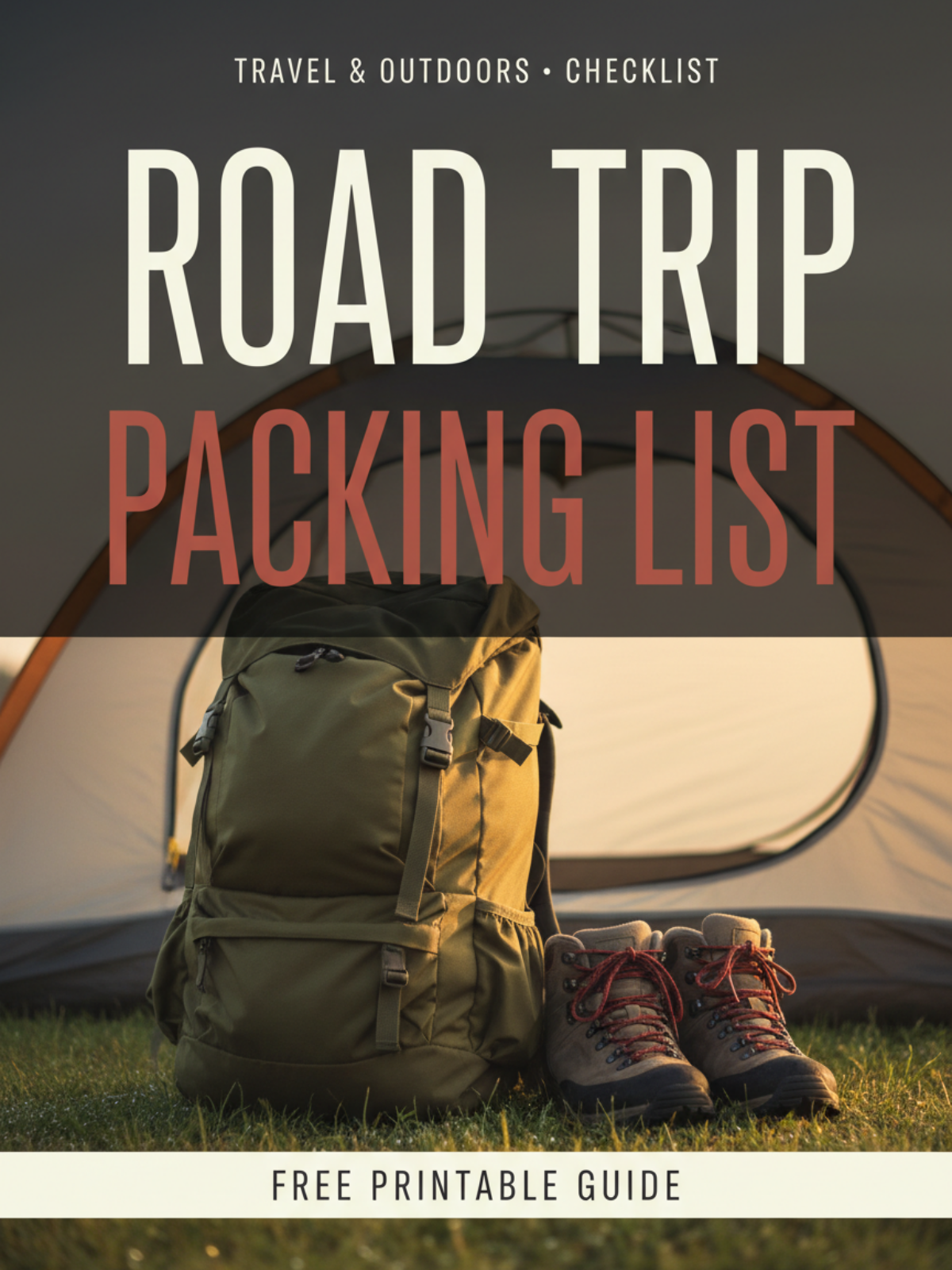
The full guide as a PDF
- ✓Master checklist with 4 trip-type modules: kids, pets, couple, week-long
- ✓Pack-the-car timeline in 6 steps, from two days out to ignition
- ✓Cooler layout and snack plan to cut petrol-station spending
- ✓Cabin-control system for trash, small items and valuables at rest stops
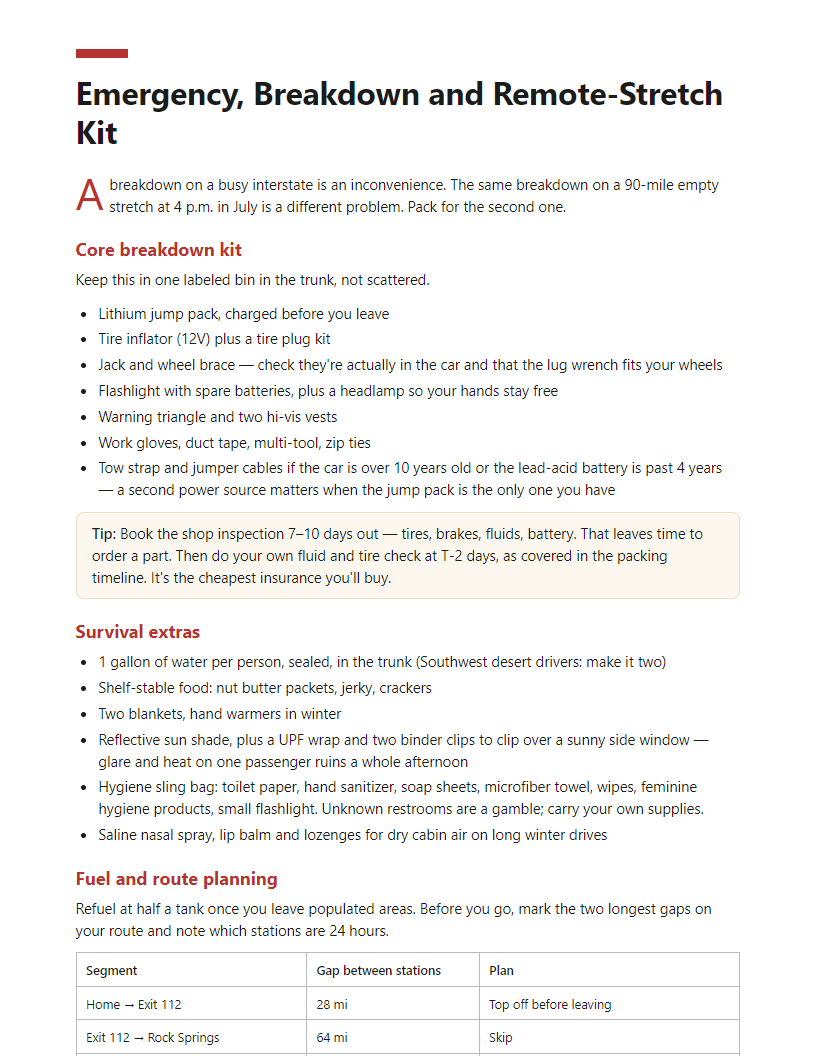
- ✓Emergency and breakdown kit list, plus a remote-stretch fuel-stop planner
- ✓Printable one-page version for the glovebox
Hosted on FileJoker. Free download, no sign-up.
A look inside the PDF
9 sections · 17 pages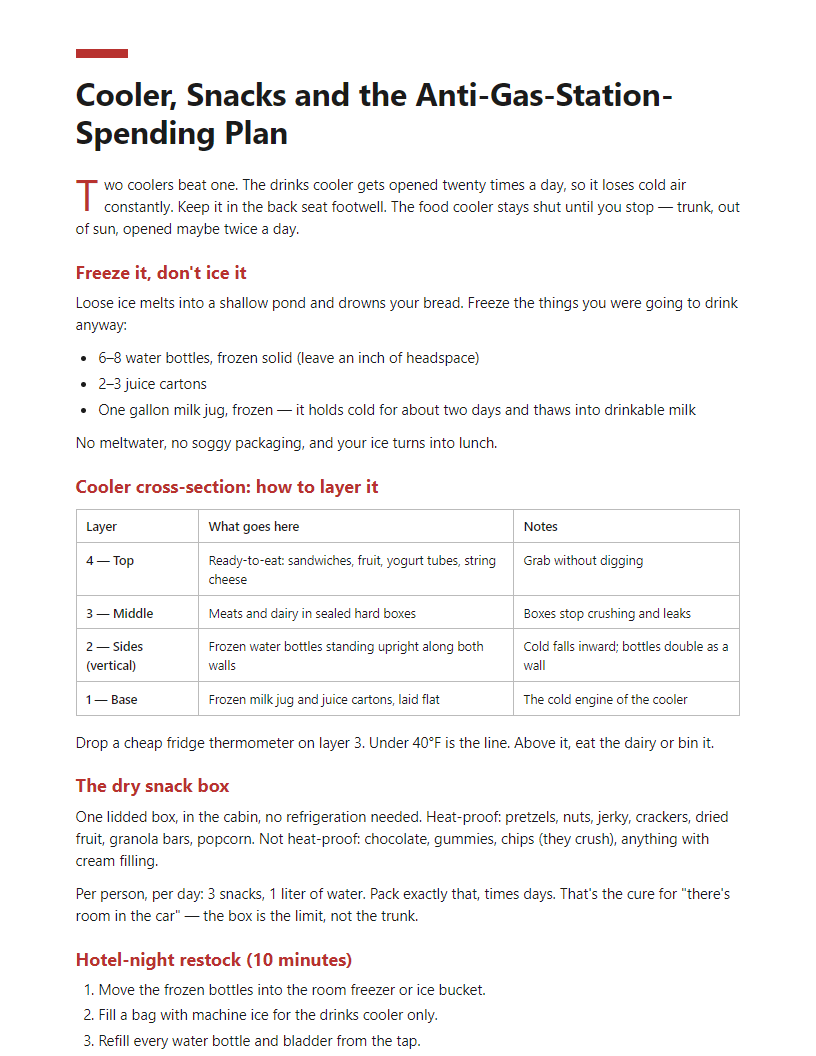
Full table of contents
- Why Generic Packing Lists Fail on the Road
- What the 5-4-3-2-1 and 3-3-3 Rules Actually Mean for a Car Trip
- Packing the Car in 6 Steps (Two Days Before to Ignition)
- Cooler, Snacks and the Anti-Gas-Station-Spending Plan
- Cabin Control: Trash, Small Items and Valuables
- Emergency, Breakdown and Remote-Stretch Kit
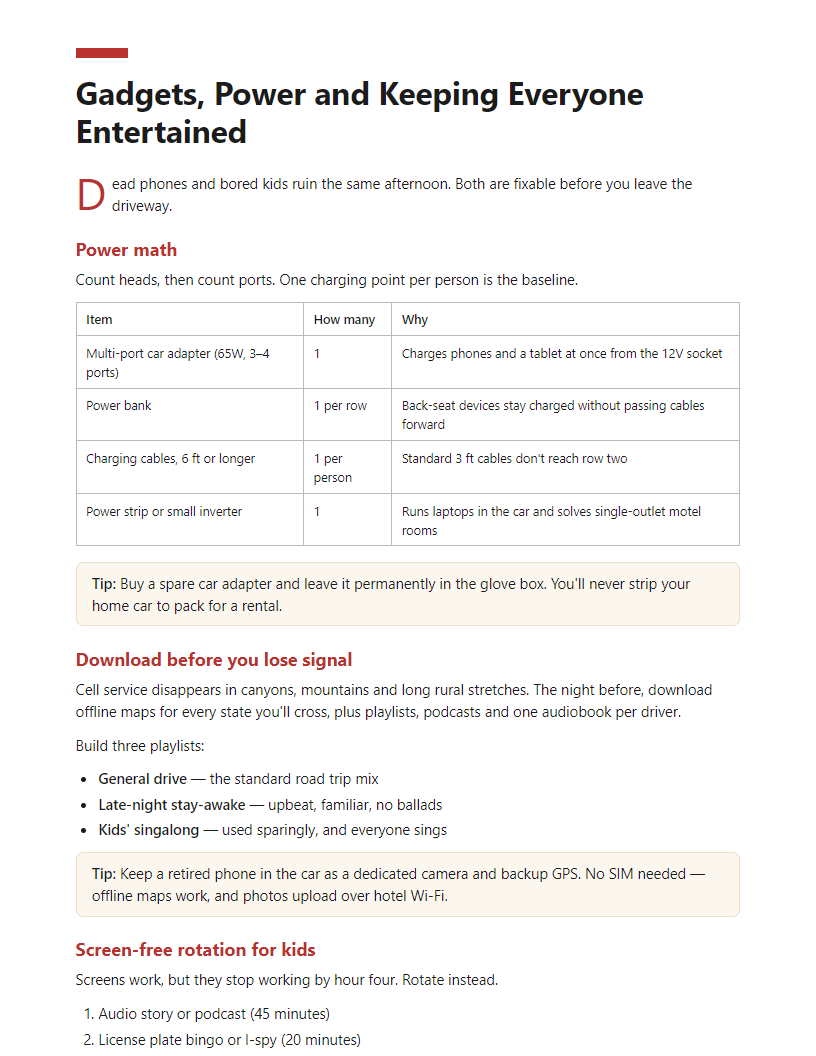
- Gadgets, Power and Keeping Everyone Entertained
- The Master Checklist + 4 Trip-Type Modules
- 9 Packing Mistakes That Ruin Day One
In this article
You know the feeling: it’s the night before, the boot is half full, and you have no idea what you’ve forgotten. Then day one hits — wrappers piling up in the footwell, warm drinks, £9 petrol-station sandwiches, phones and keys sliding under the seats, and kids asking “are we there yet?” before the first junction.
This page gives you a road trip packing list that actually fits a car: the 12 non-negotiables, what the 5-4-3-2-1 and 3-3-3 rules really mean when you’re driving rather than flying, gadget and power planning, and the nine mistakes that wreck the first day.
The free PDF adds the master checklist, four trip-type modules (kids, pets, couples, week-long), a cooler and snack plan, cabin-control system and a breakdown kit.
The short answer
A working road trip packing list has six layers — pack in this order:
- Documents & money: licence, insurance, breakdown cover, ID, cards, cash.
- Car kit: tyre inflator, jump pack, fluids, torch, first aid, hi-vis, warning triangle, chains if required.
- Cooler & food: water, cold drinks, protein snacks, fruit, wipes.
- Cabin control: bin bags, seat organiser, phone mount, charging cables.
- People: clothing by day, meds, toiletries, sunglasses.
- Entertainment: downloaded playlists, audiobooks, games, headphones.
Pack the car two days out, then do a final walk-through the morning you leave.
Why Generic Packing Lists Fail on the Road
Most packing lists fail for two reasons.
First, they’re one-size-fits-all. A list built for a two-night getaway doesn’t cover a week of multi-stop driving, and neither covers a car with a toddler and a diaper bag. You end up scrolling past “unnecessary, expensive stuff” and still blanking on what you actually need.
Second, they stop at the trunk. They tell you what to bring, but nothing about life inside the car once you’re moving — where the trash goes, where the snacks live, how to find the phone charger without pulling over.
This checklist fixes both. Everything sits in five core categories:
| # | Category | What it covers |
|---|---|---|
| 1 | Car & Emergency | Documents, fluids, jumper cables, breakdown kit |
| 2 | Food & Cooler | Drinks, snacks, meals, the anti-gas-station plan |
| 3 | Cabin Organization | Trash system, small items, valuables |
| 4 | People | Clothes, health, hygiene, medications |
| 5 | Gadgets & Entertainment | Power, cables, audio, screens, games |
Then you layer on one of four trip-type modules: Weekend (2–3 days), Week-long multi-stop, With kids, or Couple’s trip. Each module is a short add-on list, not a whole new checklist.
How to use the printable pages
- Pack by category, one at a time. Finish Food before you start People.
- Tick your trip-type module.
- Run the 10-minute departure check (Section 4) before you turn the key.
Warning: The extra space in the car is a trap. “We overpack for road trips because we CAN — there’s room” is how you end up unloading four bags at every motel. Pack to the list, not to the size of the trunk.
The Short Answer: 12 Things Nobody Should Leave Without
Leaving tomorrow? Pack these 12 first. Everything else is optional.
| # | Item | Why it earns its space |
|---|---|---|
| 1 | License, registration, insurance, roadside assistance number | Five seconds of stress instead of an hour |
| 2 | Phone mount + multi-port car charger | One cable per person, no arguing |
| 3 | Jump pack | Beats waiting for a stranger with cables |
| 4 | Tire inflator | Fixes a slow leak at the roadside |
| 5 | First-aid kit | Bandages, pain relief, motion sickness pills |
| 6 | Flashlight | Phone light dies when you need it most |
| 7 | 1 gallon of spare water | Non-negotiable on desert or remote stretches |
| 8 | Cooler + frozen water bottles | Ice packs that turn into cold drinks |
| 9 | Trash bag system | A bag in the front, a bag in the back |
| 10 | Car caddy or console bin | Stops phone, keys, snacks, purse from sliding around |
| 11 | Paper map or printed directions | For the 30 miles with no signal |
| 12 | Wet wipes + a roll of paper towels | Spills, hands, windshields |
The night before
- Fill the tank tonight, not in the morning.
- Freeze 4–6 water bottles overnight.
- Pull snacks and drinks from your own kitchen and set them by the door — that’s the gas-station overspending fixed.
- Pack one small overnight bag with pajamas and tomorrow’s clothes so the big suitcase stays in the trunk.
The 30-minute morning list
- Check oil, coolant, washer fluid and tire pressure (including the spare).
- Stand the frozen bottles in the cooler and add the food and drinks.
- Load the trunk zone first, then the reach zone.
- Do a last walk-around: lights, wipers, nothing left on the roof.
Tip: If your car is due for service, a quick trip-check at the shop before a long drive is worth more than any gadget on this list.
What to leave home
The trunk lies to you. It looks huge empty, then swallows two suitcases and nothing else fits. Leave the “just in case” third pair of shoes, the full-size toiletries and the books you won’t open.
Where each item lives
- Reach zone (console, seat-back, caddy): phone, charger, wipes, trash bag, snacks, map.
- Trunk zone: jump pack, inflator, water, first-aid kit, cooler, luggage.
- Never-visible zone (locked glovebox or under a seat): documents, cash, spare keys.
What the 5-4-3-2-1 and 3-3-3 Rules Actually Mean for a Car Trip
Pack to a formula, not to the space you have. A formula stops the guessing.
5-4-3-2-1, decoded
Per person, per week: 5 tops, 4 bottoms, 3 layers or dresses, 2 pairs of shoes, 1 extra. The “1 extra” is a single trip-specific item — a hat, a swimsuit, or a packable rain shell. Pick the one your trip actually needs and leave the other two home. That’s 15 clothing items. It fits one carry-on-size bag and covers seven days with one laundry stop.
3-3-3, the tighter version
3 tops, 3 bottoms, 3 pairs of shoes. Good for a two- or three-night trip with no messy activities. It’s too tight for a road trip when you have kids (spills), hiking or beach days, or one nice dinner. Three pairs of shoes is also generous while three tops is stingy — flip it: 5 tops, 3 bottoms, 2 shoes.
For kids, count outfits instead. One outfit is one top plus one bottom, and kids get 1.5 outfits per day, rounded up. Adults don’t.
| Trip length | Scaled from 5-4-3-2-1 (adult) | 3-3-3 (adult) | Child at 1.5 outfits/day |
|---|---|---|---|
| 3 days | 3 tops, 2 bottoms, 2 layers, 2 shoes, 1 extra | 3 tops, 3 bottoms, 3 shoes | 5 tops, 5 bottoms, 2 shoes, 5 underwear |
| 5 days | 4 tops, 3 bottoms, 2 layers, 2 shoes, 1 extra | Too tight — skip | 8 tops, 8 bottoms, 2 shoes, 8 underwear |
| 7 days | 5 tops, 4 bottoms, 3 layers, 2 shoes, 1 extra | Too tight — skip | 11 tops, 11 bottoms, 2 shoes, 11 underwear |
The other 3-3-3: how you drive
The driving rule is no more than 300 miles a day, arrive by 3 p.m., stay at least 3 nights. It changes packing. Three-night stops mean you can unpack properly and run laundry, so you pack less. Arriving by 3 p.m. means fewer late-night hotel fumbles, so you need one small overnight bag, not the whole trunk hauled inside.
Two road-trip adjustments
- Add one laundry day per 5 days. Pack detergent pods. Five days of clothes covers ten days.
- Pack a “car outfit” that lives in the cabin. Comfortable pants, a clean t-shirt, socks, slip-on shoes, one hoodie. Spills, temperature swings and gas-station bathrooms all get handled without opening the trunk.
Example: 4 people, 7 days, one bag each. Two adults: 5-4-3-2-1 (15 items each). Two kids with a laundry stop on day 4, so count 4 days each: 6 tops, 6 bottoms, 6 underwear, 2 shoes. Total: four bags, no roof box.
Gadgets, Power and Keeping Everyone Entertained
Dead phones and bored kids ruin the same afternoon. Both are fixable before you leave the driveway.
Power math
Count heads, then count ports. One charging point per person is the baseline.
| Item | How many | Why |
|---|---|---|
| Multi-port car adapter (65W, 3–4 ports) | 1 | Charges phones and a tablet at once from the 12V socket |
| Power bank | 1 per row | Back-seat devices stay charged without passing cables forward |
| Charging cables, 6 ft or longer | 1 per person | Standard 3 ft cables don’t reach row two |
| Power strip or small inverter | 1 | Runs laptops in the car and solves single-outlet motel rooms |
Tip: Buy a spare car adapter and leave it permanently in the glove box. You’ll never strip your home car to pack for a rental.
Download before you lose signal
Cell service disappears in canyons, mountains and long rural stretches. The night before, download offline maps for every state you’ll cross, plus playlists, podcasts and one audiobook per driver.
Build three playlists:
- General drive — the standard road trip mix
- Late-night stay-awake — upbeat, familiar, no ballads
- Kids’ singalong — used sparingly, and everyone sings
Tip: Keep a retired phone in the car as a dedicated camera and backup GPS. No SIM needed — offline maps work, and photos upload over hotel Wi-Fi.
Screen-free rotation for kids
Screens work, but they stop working by hour four. Rotate instead.
- Audio story or podcast (45 minutes)
- License plate bingo or I-spy (20 minutes)
- Sticker books, magnetic games, notebook and colored pencils
- Screen time (45 minutes)
- Surprise bag — one small wrapped item opened every two hours
Paper maps and the scenic detour
GPS gets you there fast and tells you nothing about what you drove past. Keep a road atlas in the seat pocket.
The night before each driving day, open the atlas and pick one detour worth 30–60 minutes: a lookout, a lake road, a small town main street. Add it to the route as a waypoint. One per day is enough to make the drive feel like part of the trip, not just transit.
9 Packing Mistakes That Ruin Day One
Most day-one disasters trace back to a decision you made in the driveway.
1. Stacking weight high and far back. Heavy bags piled above the seat backs or crammed behind the rear axle raise the center of gravity and make the car wander in crosswinds. Heavy first, low, and pressed against the back seat. Light and bulky goes on top of that, never above the headrests — anything higher blocks the mirror and becomes a projectile in a hard stop.
2. Not re-checking tire pressure once the car is loaded. Your tire pressure from last month was set for an empty car. Find the placard in the driver’s door jamb — many list a higher pressure for a full load — and set it with the tires cold, before you drive. An underinflated tire under a full load runs hot, and heat is what turns a slow leak into a blowout on hour four.
Warning: Set the spare too. A spare at half pressure is a decoration.
3. Loading the cooler with the drain plug open. It happens more than you’d think: the plug is left loose from the last trip, meltwater runs out into the trunk carpet, and the food sits in a warm box. Check the plug is screwed shut before you pack a single item. Then reverse it at the hotel — plug out, tip, drain, wipe, leave the lid cracked overnight so it doesn’t sour.
4. Filling the extra space “just in case.” The car looks roomy, so the bags multiply. Then you’re unpacking the trunk at every stop to find one charger. Pack to the list, then stop. The snack box and the bag count are the limit — not the cubic feet.
5. Cabin items with no home. Sunglasses, keys, a water bottle and a phone loose on the seat slide into the footwell on the first hard brake. One caddy per row fixes it, and it fixes the arguments about who lost what.
Tip: Do a 30-second walk-around before you pull out. Tires look even, hatch latched, nothing above the headrests, mirror view clear. It’s the last chance to catch a loading mistake while you’re still on flat ground.
Road Trip Packing FAQ
What is the 5-4-3-2-1 rule, and does it work for a family car trip?
Per person, per week: 5 tops, 4 bottoms, 3 layers or dresses, 2 pairs of shoes, 1 hat or swimsuit. It works fine for adults and teens. For kids under 5, add two extra tops and bottoms per child — spills and accidents burn through outfits fast.
What is the 3-3-3 rule for road trips?
There are two of them. The driving rule: drive no more than 300 miles a day, stop by 3 p.m., and stay at least 3 nights before moving on. The clothing rule: 3 tops, 3 bottoms, 3 pairs of shoes per person — fine for two or three nights, too tight for a family road trip. For anything longer, scale 5-4-3-2-1 instead, and count snacks at 3 per person per day, times the number of days.
Tip: Pack a small weekender with pajamas and the next two days of clothes. You carry one bag into the hotel instead of dragging the big suitcase in every night.
If I can only pack ten things, what are they?
License and insurance, roadside assistance number, phone plus car charger, water, snacks, first aid kit, jumper cables or a jump pack, flashlight, medications, and a phone mount. Everything else is comfort.
How much food and water should I carry per person per day?
| Item | Per person, per day |
|---|---|
| Drinking water in the cabin | 1 gallon (hot weather), ½ gallon (mild) |
| Emergency water in the trunk | 1 extra gallon, untouched |
| Snacks | 3 small portions (fruit, nuts, crackers) |
| Meals from the cooler | 1 lunch, to skip one restaurant stop |
Two gallons in the trunk for the car is standard in desert states. Leave it there even if you don’t think you’ll need it.
Is it safe to leave luggage in the car overnight at a hotel?
Not really — but you don’t have to unload everything. Take overnight bags, electronics, and anything with your address on it inside. Cover what’s left with a dark sheet or a blanket so nothing is visible through the glass.
Warning: Thieves watch hotel lots and rest stops for bags in the trunk. An empty-looking back seat is the goal, not a neat pile of bags.
How do I keep drinks cold past 24 hours without buying ice?
Freeze six to eight water bottles solid and pack them at the bottom. They chill the cooler, then become cold drinking water. Pre-chill the cooler overnight, pack it full, and keep it in the trunk out of direct sun.
- ✓Master checklist with 4 trip-type modules: kids, pets, couple, week-long
- ✓Pack-the-car timeline in 6 steps, from two days out to ignition
- ✓Cooler layout and snack plan to cut petrol-station spending
- ✓Cabin-control system for trash, small items and valuables at rest stops
- ✓Emergency and breakdown kit list, plus a remote-stretch fuel-stop planner
- ✓Printable one-page version for the glovebox
Frequently asked questions
What does the 5-4-3-2-1 packing rule mean?
It's a capsule-wardrobe formula for a short trip: 5 sets of underwear and socks, 4 tops, 3 bottoms, 2 pairs of shoes, 1 hat, jacket or dress. On a road trip you have more space than a flight, so treat it as a minimum clothing core, then add one laundry-free spare outfit per person for spills and weather changes.
What is the 3-3-3 rule for road trips?
The driving version means: drive no more than 300 miles a day, arrive by 3pm, and stay at least 3 nights in one place. It keeps driver fatigue down and gives you daylight to find fuel, food and parking. The packing version is simpler: 3 tops, 3 bottoms, 3 pairs of shoes per person.
What are the must-haves for a road trip?
Water, snacks and a cooler; phone mount, charger and power bank; offline maps and downloaded playlists; a car kit with tyre inflator, jump pack, torch and first aid; bin bags and wipes; documents and breakdown cover details; a cash reserve; sunglasses; medication; and one comfort item per passenger — blanket, neck pillow or headphones.
How do I stop trash and small items taking over the car?
Hang a lined bin bag from a headrest or gearstick and empty it at every fuel stop. Give every small item a home: phone mount for phones, a caddy or door pocket for keys and wallets, one snack box between the front seats. Do a 60-second reset each time you stop — it takes less time than one clean-out later.
How do I prepare for a breakdown on a remote stretch?
Carry a tyre inflator or sealant, jump pack, coolant, oil, torch, hi-vis vests and a warning triangle, plus water and a blanket. Before a remote leg, check the distance between fuel stations and refuel at half a tank, not a quarter. Save your breakdown number offline, download the map area, and tell someone your route and arrival time.
We collected 195 real questions and comments about "road trip packing list" (116 from YouTube comments, 4 from People Also Ask, 75 from search suggestions), grouped them into 14 recurring problems, and built this guide to resolve the 7 that block people most. The top-ranking pages were reviewed for gaps; 7 of those gaps became dedicated sections.
Edited by Alex Hirn · Last updated October 1, 2026 · How we make our guides
More in Travel & Outdoors
 premium+3 bonuses
 premium+3 bonuses
 free
 premium+3 bonuses