Checklist · 28-page PDF · Premium
International Travel Checklist Packing: A Modular System
Pack for any international trip with a modular checklist by duration, climate and traveller type. Core 12 list, 8-week document countdown. Get the worksheets.
The full workbook, ready to print
- ✓Fill-in planning grids for 3-day, 7-day and 14-day+ trips
- ✓Climate layer tables: hot, cold, tropical and multi-climate itineraries
- ✓Traveller-type modules: business, family, hiking, beach and solo
- ✓Carry-on weight worksheet plus a bag-loss insurance layer list
- ✓Plug type, voltage and electronics restrictions by destination region
- ✓Home, pets and personal safety lock-up checklist
- ✓The three-pass method for beating packing anxiety, with blank master checklist
Hosted on FileJoker. Premium members download instantly; free download has a wait.
In a hurry? Free one-page checklist32 items to tick off · print-ready PDF, no sign-upDownload freeIncluded bonuses — free with the guide
3 extra guides from the same topic Free PDF · 16 pagesCruise Packing List Carnival: The First-Timer's ChecklistA cruise packing list for Carnival built around their rules: banned items, ID musts, forgotten essentials, plus a free printable checklist. Download yours.
 Free PDF · 17 pagesRoad Trip Packing List: Car, Food, Kids and Gadgets SortedA road trip packing list that covers car, food, kids and gadgets — plus 12 essentials, the 3-3-3 rule and a free printable checklist. Download it free.
 Free PDF · 19 pagesCamping Gear Checklist: What to Pack, by Category and Trip TypeA camping gear checklist by category with per-person quantities, plus the 3-3-3 and 7 C's rules explained. Free printable checklist inside — download it.
A look inside the PDF
11 sections · 28 pages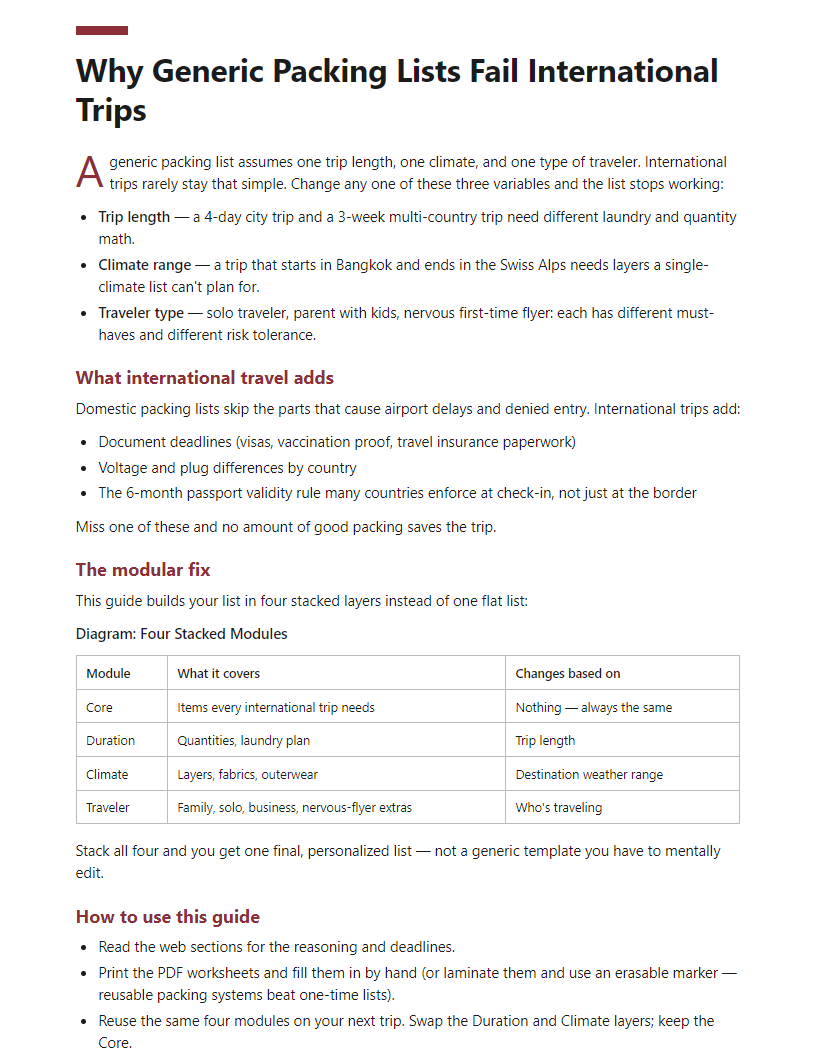
Full table of contents
- Why Generic Packing Lists Fail International Trips
- The 60-Second Answer: Core 12, Then Layers
- Documents and Deadlines: The 8-Week Countdown
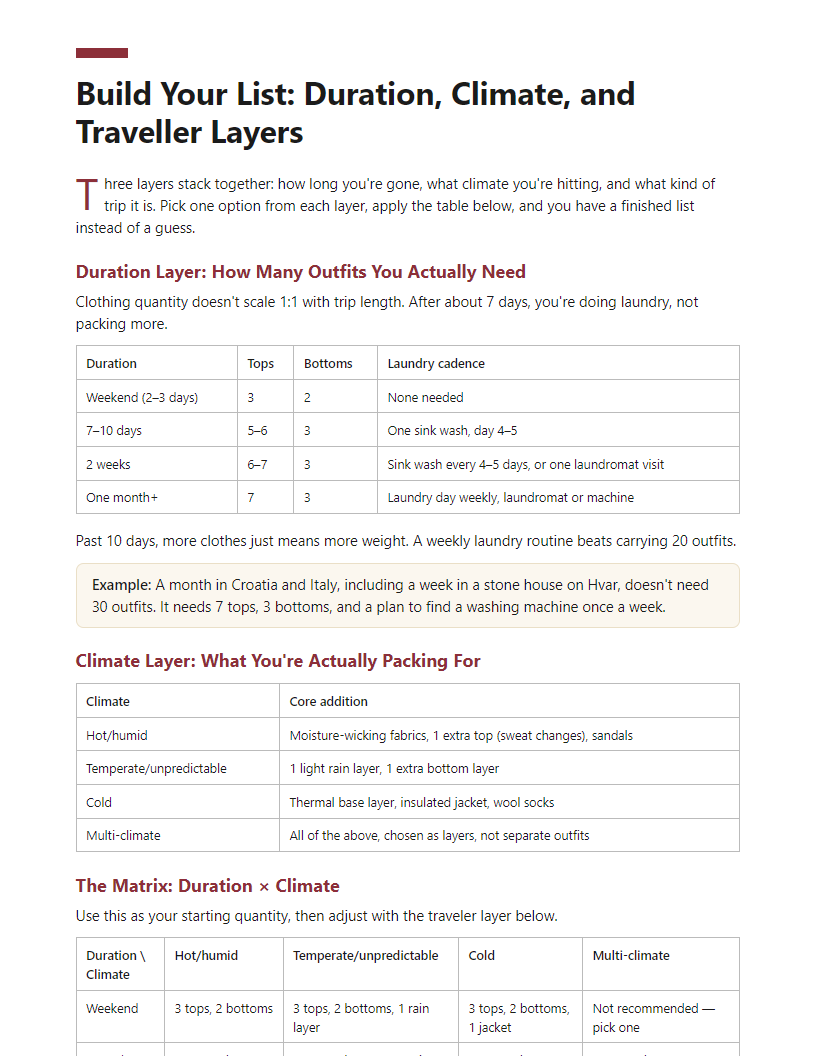
- Build Your List: Duration, Climate, and Traveller Layers
- Carry-On Only: Compression, Weight, and the Bag-Loss Insurance Layer
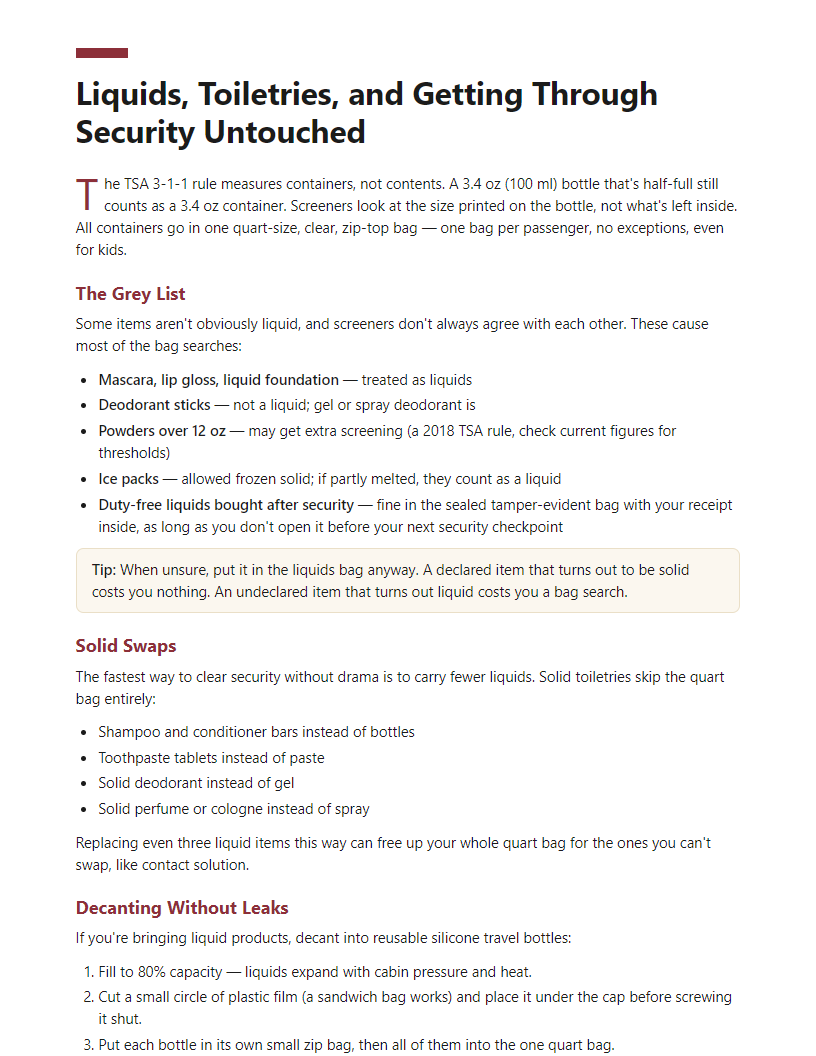
- Liquids, Toiletries, and Getting Through Security Untouched
- Electronics, Plugs, and Power by Destination
- Before You Lock the Door: Home, Pets, and Personal Safety
- Five Packing Mistakes That Cost Money or Time at the Airport
- Beating Packing Anxiety: A Three-Pass Method
- The Master Checklist and Blank Worksheets
In this article
You stare at an open suitcase and think, “I have no idea where to start — and I know I’ll forget something important.” Maybe you’re worried your passport expiry will fail the six-month rule, that security will open your bag and spill your toiletries, or that nothing will fit in carry-on. This international travel checklist packing guide replaces generic lists with a modular system: a Core 12 you always take, then layers you add for trip length, climate and the kind of traveller you are.
On this page you get the 60-second answer, an 8-week document countdown and the five airport mistakes that cost money. The premium PDF adds the fill-in worksheets, climate and duration tables, and the full master checklist you can reuse for every trip.
The short answer
Build your packing list in five steps:
- Documents first — check passport validity (six months beyond return for many countries), visas, insurance and printed copies.
- Pack the Core 12 — items every trip needs: passport, cards, phone, charger, adapter, meds, glasses, toothbrush, underwear, one warm layer, reusable bottle, day bag.
- Add a duration layer — clothing for 5 days, then plan a laundry point for longer trips.
- Add a climate layer — rain, heat or cold items only.
- Add a traveller layer — business, family, hiking or beach extras.
- Weigh, compress, re-check against your list.
Why Generic Packing Lists Fail International Trips
A generic packing list assumes one trip length, one climate, and one type of traveler. International trips rarely stay that simple. Change any one of these three variables and the list stops working:
- Trip length — a 4-day city trip and a 3-week multi-country trip need different laundry and quantity math.
- Climate range — a trip that starts in Bangkok and ends in the Swiss Alps needs layers a single-climate list can’t plan for.
- Traveler type — solo traveler, parent with kids, nervous first-time flyer: each has different must-haves and different risk tolerance.
What international travel adds
Domestic packing lists skip the parts that cause airport delays and denied entry. International trips add:
- Document deadlines (visas, vaccination proof, travel insurance paperwork)
- Voltage and plug differences by country
- The 6-month passport validity rule many countries enforce at check-in, not just at the border
Miss one of these and no amount of good packing saves the trip.
The modular fix
This guide builds your list in four stacked layers instead of one flat list:
Diagram: Four Stacked Modules
| Module | What it covers | Changes based on |
|---|---|---|
| Core | Items every international trip needs | Nothing — always the same |
| Duration | Quantities, laundry plan | Trip length |
| Climate | Layers, fabrics, outerwear | Destination weather range |
| Traveler | Family, solo, business, nervous-flyer extras | Who’s traveling |
Stack all four and you get one final, personalized list — not a generic template you have to mentally edit.
How to use this guide
- Read the web sections for the reasoning and deadlines.
- Print the PDF worksheets and fill them in by hand (or laminate them and use an erasable marker — reusable packing systems beat one-time lists).
- Reuse the same four modules on your next trip. Swap the Duration and Climate layers; keep the Core.
Tip: Keep one blank worksheet as your master copy. Fill in a new one per trip so you always have a clean template.
This guide does not cover gear shopping or brand reviews. It covers what to pack, when to pack it, and how to not forget the one thing that stops you at security.
The 60-Second Answer: Core 12, Then Layers
If your flight is tomorrow, do this: build the Core 12, apply the clothing math, and check three dates. That’s the whole baseline.
The Core 12
These 12 items go on every international trip, regardless of destination or length. Pack them first, then add layers for climate and duration.
| Item | Where it goes |
|---|---|
| Passport (+1 photocopy) | Personal item |
| Boarding pass (digital + printed) | Personal item |
| Credit/debit card (2 sources) | Personal item |
| Cash in local currency | Personal item |
| Phone + charger | Personal item |
| One full change of clothes | Carry-on |
| Prescription medication | Personal item |
| Travel insurance info | Personal item |
| Universal power adapter | Carry-on |
| Toiletry bag (3-1-1 compliant) | Carry-on |
| Earplugs/eye mask | Personal item |
| Portable charger | Personal item |
Tip: Photograph your passport, boarding passes, and insurance card before you leave. Email them to yourself and save them to your phone’s photo album. If you lose wifi, you still have access.
The 5-4-3-2-1 Clothing Rule
For a one-week trip: 5 tops, 3 bottoms plus a pair of socks per day, 3 pairs of underwear beyond what you wear, 2 pairs of shoes, 1 jacket. It works for single-climate trips under 10 days. It breaks down for multi-climate trips or anything over two weeks — you’ll need the duration-based layers in Section 4 instead.
The 3-1-1 Liquids Limit, Plainly
Containers 3.4 oz (100ml) or under, in 1 quart-size clear bag, 1 bag per passenger, in your carry-on. Three common misreadings:
- “3.4 oz” means the container size, not how full it is. A half-empty 8 oz bottle still gets confiscated.
- Solids that melt or spread count as liquids. Peanut butter, lip balm, and some deodorants count.
- The bag must be visible on its own, not inside a pouch. Pull it out at the checkpoint before your bin goes through the scanner.
Passport Validity
Most destinations require your passport to be valid 6 months beyond your return date — check this now, not at the airport.
Your Personal Item: Airline Loss Insurance
If your checked bag never shows up, your personal item should carry you for 48 hours: medication, one change of clothes, chargers, and copies of every document above.
Documents and Deadlines: The 8-Week Countdown
Documents don’t fail you at the airport. They fail you eight weeks earlier, when you didn’t check them. Do this work before you pack a single sock.
The 6-Month Passport Rule
Many countries require your passport to stay valid for 6 months past your return date. Some also require at least two blank visa pages. Airlines check this at the gate — not just border officials.
Check yours today:
- Find the expiration date and the travel date for your last day abroad.
- Count forward 6 months from that return date. If your passport expires before that point, you need a renewal, not just a conversation about it.
- Count your blank pages. Stamps and visas eat pages fast if you’re visiting multiple countries.
Warning: Passport renewals can take weeks longer than official estimates. If you’re inside that window, expedite it now.
Visas, eTAs, and Entry Fees
Entry rules change by country and by your passport’s nationality. Don’t rely on travel blogs or forum posts for this — check the destination country’s official government or embassy website, or your own government’s travel advisory page. Some entry systems (eTAs, e-visas, tourist taxes) must be done online before departure, not on arrival.
Check this per destination, even for connecting countries you’ll only transit through.
Your Digital and Emailed Copy Set
Build a photo album on your phone with pictures of:
- Passport photo page
- Visas or entry approvals
- Travel insurance policy and emergency number
- Boarding passes
- Hotel confirmations
Then email the same set to yourself. If your phone dies or you lose wifi, you can still log into email from any device. This one habit solves most “I forgot my documents” panic.
Health Records and Prescriptions
Carry vaccination records if your destination requires them. For prescriptions, get a doctor’s letter and list medications by generic drug name, not brand name — brand names vary by country and customs officers may not recognize the brand you know.
Banks, Phones, and Backup Cards
- Notify your bank and card issuer of travel dates and countries, so they don’t freeze your card mid-trip.
- Notify your phone carrier and confirm international roaming or buy a local SIM/eSIM plan.
- Pack a second payment card, stored in a separate bag from your main wallet.
The Printed Fallback Pack
Phones die, break, or get stolen. Print and carry:
- Hotel address and confirmation
- Return flight ticket
- Emergency contacts written in the local language
Tip: If flying makes you anxious, this paper pack is worth it beyond the practical use. Knowing you have a physical backup, even if you never touch it, lowers the stress of “what if my phone dies at customs.”
The Timeline
| Timeframe | Document tasks |
|---|---|
| 8 weeks before | Check passport expiration and blank pages; apply for renewal if needed; check visa/eTA requirements |
| 4 weeks before | Submit visa or eTA applications; book required vaccinations; request doctor’s letter for prescriptions |
| 1 week before | Notify bank and phone carrier; build phone photo album; email copy set to yourself |
| 24 hours before | Print fallback pack; pack backup card separately; confirm boarding passes are downloaded and emailed |
Five Packing Mistakes That Cost Money or Time at the Airport
Each of these mistakes is specific, cheap to avoid, and expensive to fix once you’re standing at a gate.
1. Packing to the bag size, not the itinerary
You buy a 40-liter bag, then fill it to the zipper because it fits. The bag isn’t the plan — your itinerary is. A 3-city trip through three climates needs different items than a week at one beach resort. Most “just in case” items — travel-size shampoo, extra phone cables, a backup umbrella — are a 10-minute purchase at your destination.
- Pack for the itinerary first, ignoring the bag.
- Lay everything out.
- Remove 20%. You won’t miss it.
- Keep only what you can’t replace quickly (prescriptions, specific electronics adapters). Skip what any pharmacy or convenience store sells.
Tip: If you can’t remove 20% on the first pass, you haven’t packed with the itinerary in mind yet — you’ve packed with your closet in mind.
2. Treating the passport as “checked this month”
A passport that’s valid doesn’t mean it’s valid for travel. Many countries require at least 6 months of validity remaining past your return date, not your departure date. A passport expiring 4 months from now can get you denied boarding, even with a confirmed ticket.
Check this 8 weeks out, not the night before.
3. Assuming US carry-on rules travel with you
US carriers mostly check size. European and budget carriers check size and weight, and they weigh bags at the gate.
| Region | What’s checked | Typical limit |
|---|---|---|
| US major carriers | Dimensions | ~22 x 14 x 9 in |
| Europe / budget carriers | Dimensions + weight | 8–10 kg (check current figures) |
| Asia / regional carriers | Dimensions + weight | Varies by airline |
A bag that’s fine in Chicago can cost you a $50+ gate fee in Lisbon. Weigh your packed bag on a kitchen scale the night before you leave, then re-weigh it an hour before departure. The night-before check gives you time to fix overpacking; the departure-day check catches anything added at the last minute, like a souvenir or a extra charger.
4. Putting essentials in the checked bag
If the airline loses the bag, you lose what’s inside. Never check:
- Medication (full course, in original packaging)
- Chargers and cables
- One change of clothes
Example: Pack a change of clothes in your personal item, not just your carry-on. If the airline force-checks your rolling bag at the gate, your personal item is the one thing guaranteed to stay with you.
5. Buying gear the week before vs. doing a trial run
New packing cubes, a new bag, new shoes — bought days before departure, never tested. Do a full packed-bag trial run at least a week out: pack it, carry it, wear the shoes for an hour.
Frequently Asked Questions
What is the 5-4-3-2-1 rule for packing, and does it work for two weeks?
The 5-4-3-2-1 rule means: 5 tops, 4 bottoms (or pairs of socks), 3 pairs of underwear beyond what you wear, 2 pairs of shoes, 1 jacket. It’s built for a one-week carry-on trip with mixed activities. For two weeks, it still works if you plan to do laundry once mid-trip. Without laundry, double the tops and bottoms instead — underwear, shoes, and jacket count stay the same regardless of trip length.
What is the 3-3-3 rule for travel packing, and how does it differ from 5-4-3-2-1?
The 3-3-3 rule is simpler: 3 tops, 3 bottoms, 3 pairs of shoes (one on your feet). It’s a minimalist version for short trips or travelers who mix and match aggressively. 5-4-3-2-1 gives you more variety and planned layers; 3-3-3 gives you a lighter bag and fewer decisions. Pick 3-3-3 for trips under five days or warm, single-climate destinations.
What should you not pack when flying internationally?
- Liquids over 3.4 oz (100 ml) in carry-on, even half-empty bottles — screeners go by the container size, not the contents
- Sharp objects, including some multitools and full-size scissors
- Spare lithium batteries or power banks in checked luggage (see below)
- Anything you can’t confirm is legal at your destination (certain medications, CBD products, some foods)
Tip: If you’re unsure whether something counts as a liquid, gel, or paste, treat it as a liquid. That rule alone stops most bag searches.
What are the five biggest packing mistakes to avoid?
- Packing to your bag size instead of your itinerary
- Assuming checked luggage will arrive when you do
- Guessing at voltage instead of checking the device label
- Skipping document copies — physical and digital
- Leaving passport expiry unchecked until a week before departure
Can I bring a power bank, and does it go in carry-on or checked?
Yes, but it must go in carry-on, not checked luggage. Airlines restrict power banks from checked bags because lithium batteries are a fire risk in the cargo hold. Most allow power banks up to 100Wh without approval; larger ones may need airline sign-off — check current figures with your carrier before you fly.
Tip: Charge your power bank and headphones the night before, and physically attach them to your bag or purse strap so you see them on your way out the door.
How early should I check my passport expiry date?
Check it today, and again at the 8-week mark before departure (see Section 3). Many countries require at least six months of validity beyond your travel dates, not just validity through your return. If you’re inside that six-month window, start expedited renewal immediately — don’t wait to book flights first.
- ✓Fill-in planning grids for 3-day, 7-day and 14-day+ trips
- ✓Climate layer tables: hot, cold, tropical and multi-climate itineraries
- ✓Traveller-type modules: business, family, hiking, beach and solo
- ✓Carry-on weight worksheet plus a bag-loss insurance layer list
- ✓Plug type, voltage and electronics restrictions by destination region
- ✓Home, pets and personal safety lock-up checklist
- ✓The three-pass method for beating packing anxiety, with blank master checklist
Frequently asked questions
What does the 5-4-3-2-1 packing rule mean?
It's a one-week capsule formula: 5 sets of underwear and socks, 4 tops, 3 bottoms, 2 pairs of shoes and 1 hat, dress or jacket. It forces a mix-and-match wardrobe in a carry-on. Treat it as a starting point, then adjust with your climate and traveller layers — a winter city break needs fewer tops and more insulation.
What should you never pack when flying internationally?
Keep out of hand luggage: liquids over 100ml/3.4oz, sharp items, lighters beyond one, and loose lithium batteries (those go in carry-on, never checked). Never check passports, medication, keys, electronics or valuables. Also leave behind restricted foods, meats, plant matter, counterfeit goods, drones and surge protectors, which many countries and cruise lines ban outright.
What are the biggest packing mistakes travellers make?
Five repeat offenders: ignoring passport validity and visa rules until the last week; overpacking clothes you'll never wear; leaving liquids buried so security unpacks your bag; checking a bag that contains your medication, chargers or valuables; and bringing the wrong plug adapter or voltage. Each costs money, time at the airport, or both.
What is the 3-3-3 rule for travel packing?
Pack three tops, three bottoms and three pairs of shoes — all in a coordinated colour palette so every combination works. It suits short trips of three to five days and carry-on-only travel. For longer trips, keep the same ratio and add one laundry stop every five days rather than doubling the clothing.
How do I get through security without my bag being opened?
Put all liquids in one clear resealable bag of 100ml/3.4oz containers, placed at the top of your carry-on so it comes out in two seconds. Decant toiletries into leak-proof bottles, tape the openings and bag them. Keep laptops and tablets in an outer sleeve, and avoid packing dense clusters of cables or snacks that look opaque on the scanner.
How can I fit everything into carry-on only?
Start from a 5-day clothing base regardless of trip length, choose one colour palette, and plan laundry. Use compression cubes to flatten soft items, wear your bulkiest shoes and jacket on the plane, and decant toiletries. Weigh the bag at home against your airline's limit — most carry-on failures are weight, not size.
We collected 176 real questions and comments about "international travel checklist packing" (136 from YouTube comments, 4 from People Also Ask, 36 from search suggestions), grouped them into 14 recurring problems, and built this guide to resolve the 7 that block people most. The top-ranking pages were reviewed for gaps; 7 of those gaps became dedicated sections.
Edited by Alex Hirn · Last updated October 5, 2026 · How we make our guides
More in Travel & Outdoors
 premium+3 bonuses
 premium+3 bonusesfree
 premium+3 bonuses