Workbook · 27-page PDF · Premium
Diabetic Food Planner: A Practical 7 and 14-Day Meal Grid
Use a diabetic food planner to map 14 days of meals, carb counts and groceries. Starter plan, mistakes to avoid and FAQs — plus a printable workbook inside.
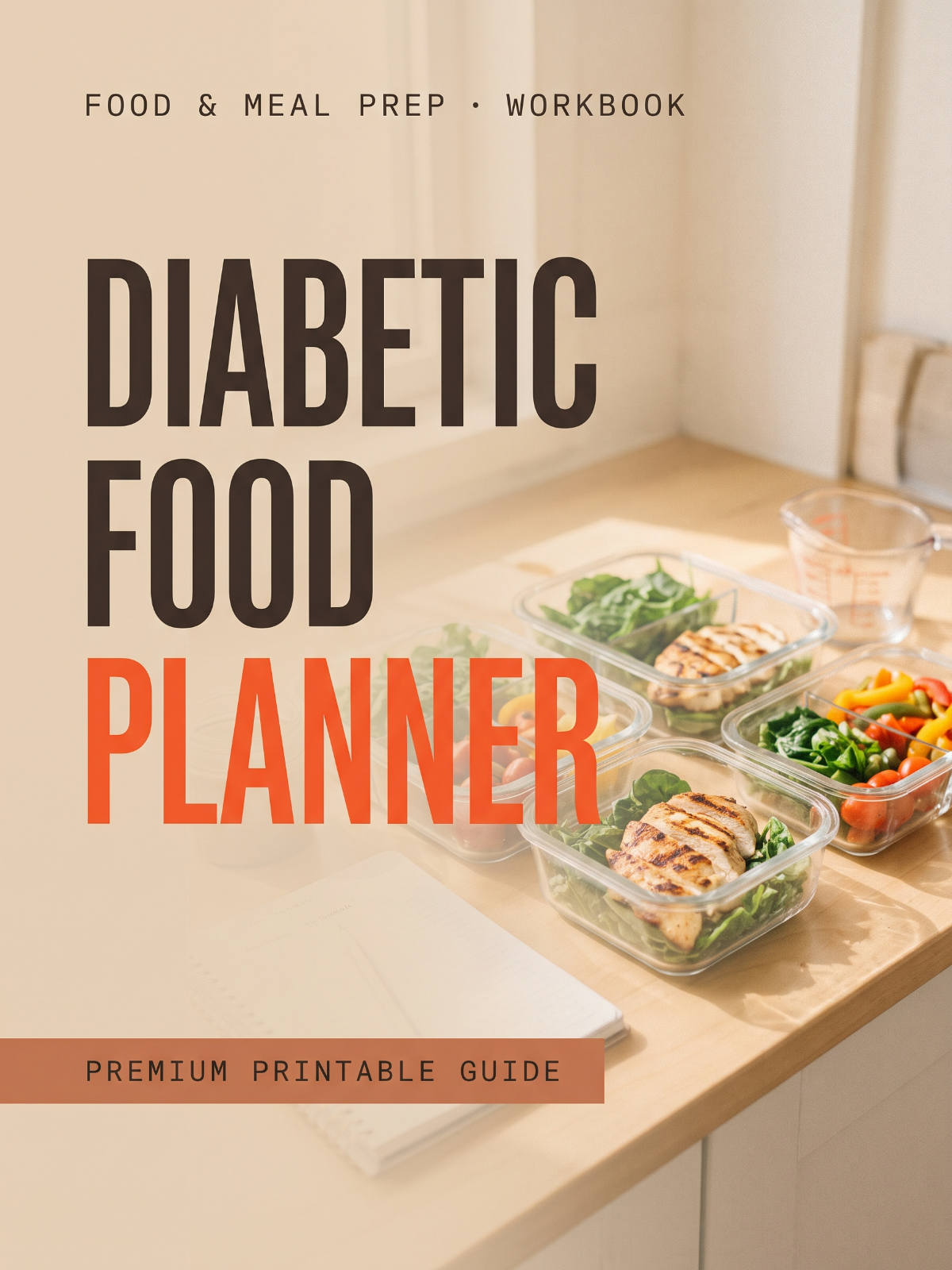
The full workbook, ready to print
- ✓Full 14-day planner grid with day-by-day build instructions
- ✓Carb count reference tables and printable portion cards
- ✓Grocery lists with budget columns and low-cost swap suggestions
- ✓Borderline foods worksheet: potatoes, oats and bread on the plan
- ✓Shift-work, vegetarian and dairy-free adaptation sheets
- ✓Five base cooking methods plus a weekend batch session plan
- ✓Weekly review and tracking sheets with a pre-shop checklist
Hosted on FileJoker. Premium members download instantly; free download has a wait.
In a hurry? Free one-page checklist22 items to tick off · print-ready PDF, no sign-upDownload freeIncluded bonuses — free with the guide
2 extra guides from the same topic Free PDF · 18 pagesThanksgiving Meal Checklist: From 14 Days Out to LeftoversBuild a Thanksgiving meal checklist that works: menu, guest count, shopping quantities and an hour-by-hour oven plan. Free printable checklist inside.
 Free PDF · 16 pagesBest Meal Prep Recipes: A 5-Day No-Repeat Plan That Holds UpBest meal prep recipes without the Day 3 boredom: a 5-day no-repeat framework, storage timelines, verified macros, plus a free planner and shopping list.
A look inside the PDF
11 sections · 27 pages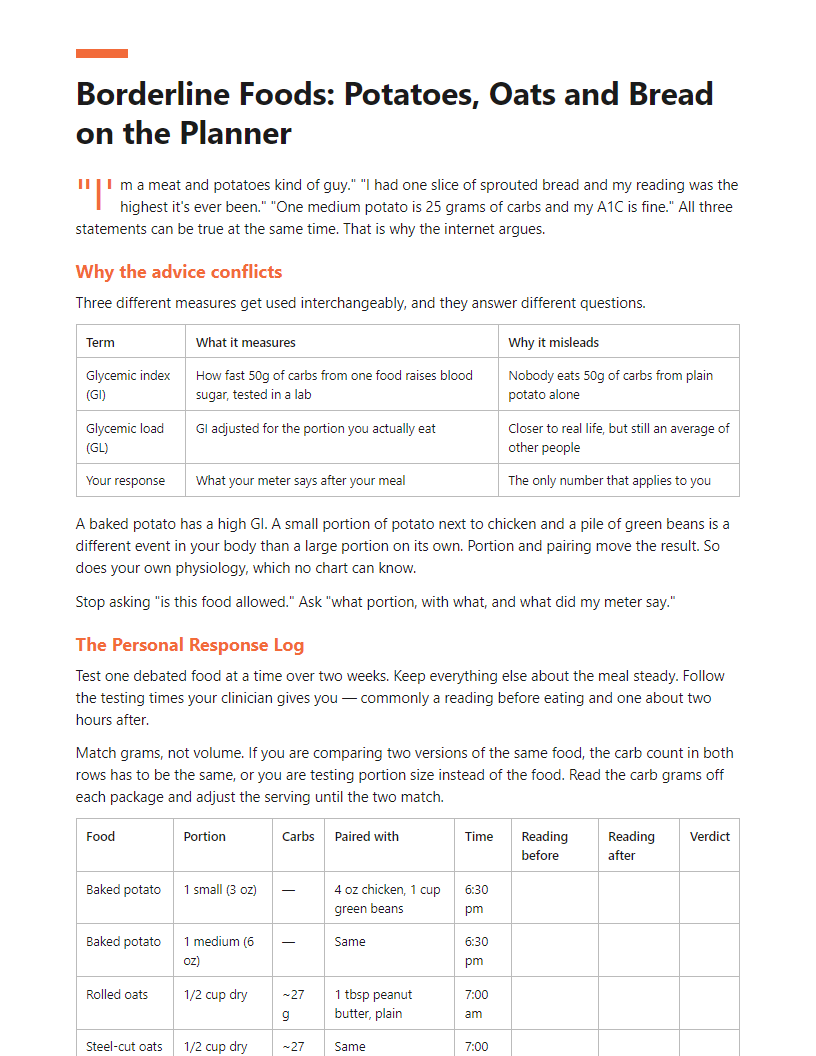
Full table of contents
- How to Use This Workbook (and What It Is Not)
- The 15-Minute Starter Plan for Week One
- Borderline Foods: Potatoes, Oats and Bread on the Planner
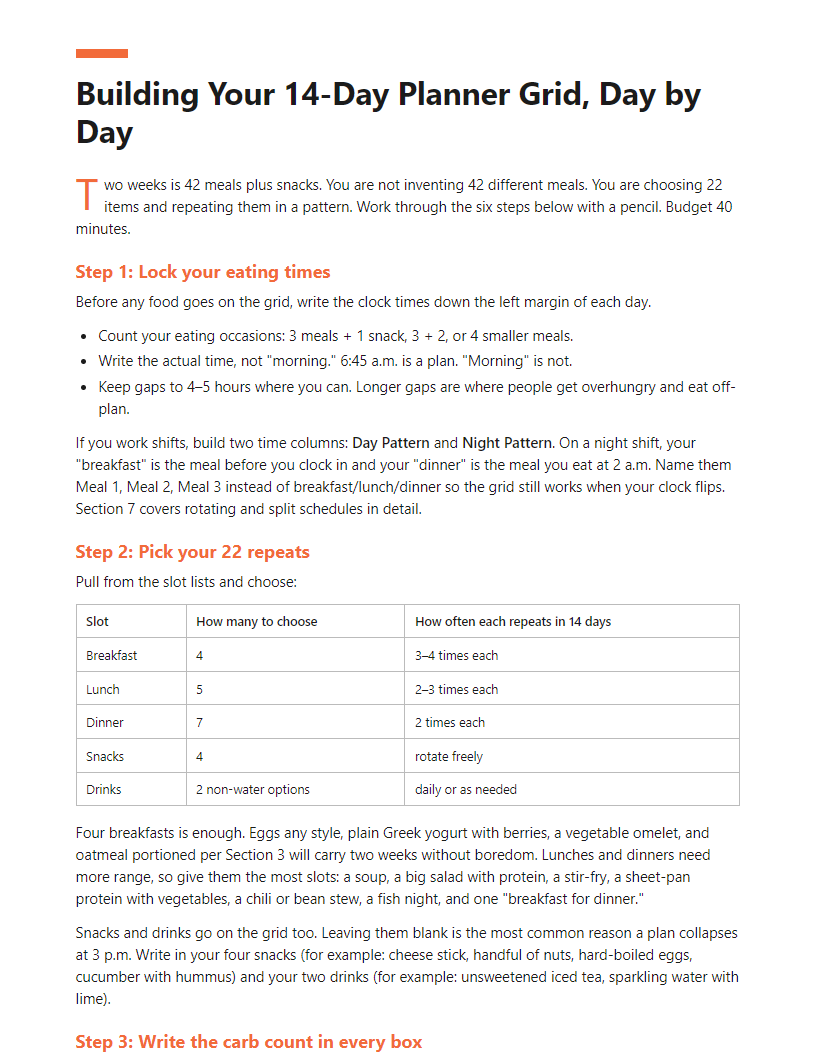
- Building Your 14-Day Planner Grid, Day by Day
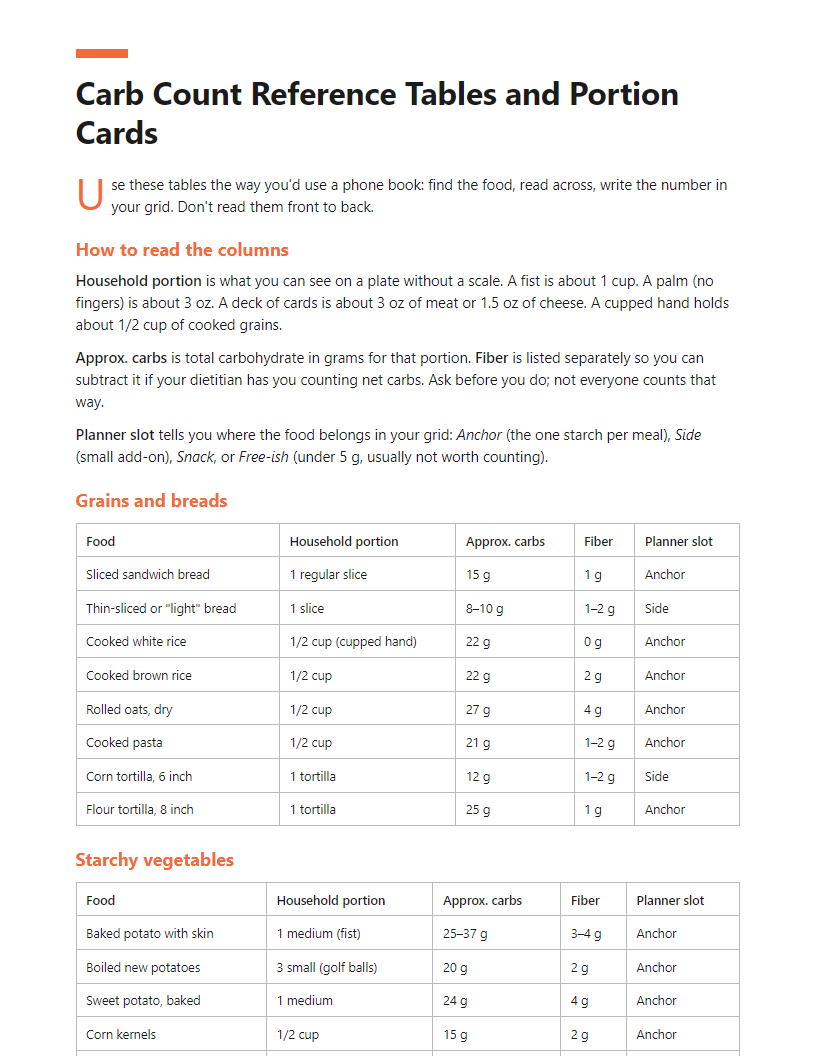
- Carb Count Reference Tables and Portion Cards
- Grocery Lists, Budget Columns and Low-Cost Swaps
- Adapting the Plan: Shift Work, Hunger, Vegetarian and Dairy-Free
- Cooking the Plan: Five Base Methods and a Batch Session
- Planning Mistakes That Break the Grid
- Weekly Review and Tracking Sheets
- Pre-Shop and Pre-Week Checklist
In this article
“I was just diagnosed and I still don’t know what to put on the plate tonight.” If that’s you, a diabetic food planner is the organizational tool that turns conflicting advice into a written grid you can shop from and cook from. One creator says potatoes are fine, another says never; meanwhile you still need breakfast, lunch, dinner, snacks and drinks that fit shift work and a real budget.
On this page you get a 15-minute starter plan for week one, the planning mistakes that break a grid, and straight answers to the questions readers ask most. The premium workbook adds the full 14-day planner, carb count tables, portion cards, grocery lists with budget columns and weekly tracking sheets. It organizes food decisions — it does not replace your doctor or dietitian.
The short answer
A diabetic food planner works best when you build it in this order:
- Pick 5–7 repeatable meals you already like and can cook fast.
- Write carb counts per portion next to each meal, using one reference table.
- Set meal times around your real schedule, including shifts and gaps.
- Fill a 7-day grid first, then duplicate and vary it into 14 days.
- Build the grocery list straight from the grid, with cheaper swaps noted.
- Review weekly — keep what worked, replace what you skipped.
Share the finished plan with your doctor or dietitian before changing medication or portions.
How to Use This Workbook (and What It Is Not)
If you were diagnosed last month and still can’t answer “so what do I actually eat tonight,” this workbook is built for you. It does not tell you what to eat. It gives you a structure to write down what you plan to eat, count the carbs in it, price it, and show it to someone qualified.
What this is not
This is an organizational planning tool. It is not medical advice, nutrition therapy, or a prescription. It does not replace your doctor, your diabetes educator, or a registered dietitian. Carb targets, medication timing, and blood sugar goals are theirs to set — bring this workbook to them and ask.
If fear of complications is driving you right now, that fear is doing its job: it got you here. But a planner cannot fix a number. It can only make your next two weeks predictable enough to discuss with your care team.
The three-part system
| Part | What it does |
|---|---|
| Carb Reference Tables (s5) | Gives you carb counts per standard portion, so you stop guessing |
| 14-Day Planner Grid (s4) | Holds breakfast, lunch, dinner, snacks and drinks for 14 days |
| Grocery & Budget Sheets (s6) | Turns the grid into a shopping list with a cost column |
Work in that order. Look up the carbs, write the meal, build the list.
Print map
| Print once (keep in a binder) | Print weekly |
|---|---|
| Carb Count Reference Tables | 14-Day Planner Grid, both weeks |
| Portion Cards (cut and keep in the kitchen) | Grocery & Budget Sheet |
| Five Base Methods page | Weekly Review and Tracking Sheet |
| Pre-Shop and Pre-Week Checklist | Questions for My Care Team |
Page numbers are printed in the footer of each sheet. If you only print two things this week, print the Planner Grid and the Grocery & Budget Sheet.
Bring these to your appointment
Take your filled planner grid, your tracking sheet, and the Questions for My Care Team page. A dietitian can read fourteen days of real meals in about two minutes and tell you more than a general conversation ever will.
Tip: A blank day on the grid is still useful information. Write “ate out, unsure” and move on.
Perfect eating is not the goal
The grid is a record, not a verdict. You will have days you eat potatoes, days you work a double, days you order pizza. Write them down anyway. A plan with honest gaps is worth more to your care team than a clean page you filled in from memory.
The 15-Minute Starter Plan for Week One
You don’t need to read this whole workbook before dinner tonight. Three days of eating is enough to start. Set a timer for 15 minutes and work through the four steps below.
Step 1: Learn the three-slot meal structure
Every meal on this planner has three slots, plus flavor.
- Carb slot — the food that raises blood sugar most. Rice, bread, potato, fruit, oats, beans.
- Protein slot — eggs, chicken, fish, tofu, cheese, Greek yogurt.
- Volume slot — non-starchy vegetables. Salad, broccoli, peppers, green beans, zucchini.
One from each slot, every meal. That’s the whole system.
Step 2: Get your carb number from your care team, not the internet
Before you fill anything in, write down one number: grams of carbohydrate per meal. Ask your doctor, diabetes educator, or dietitian for your target. Many adults are given somewhere in the 30–60 g per meal range, but your number depends on your medication, weight, and activity. Don’t guess it from a forum post. If your appointment is weeks away, call the office and ask the nurse — this is a reasonable phone question.
Tip: Write your carb target at the top of every planner page so you’re not doing math from memory at 11 p.m.
Step 3: Use the pick-one-from-each-column grid
No recipes needed. Pick one item from each column and you have a meal.
| Carb slot (check your gram target) | Protein slot | Volume slot | Flavor slot |
|---|---|---|---|
| 1 slice whole-grain bread | 2 eggs | Spinach, handful | Olive oil + lemon |
| 1/2 cup cooked oats | 3 oz chicken | Mixed salad greens | Salsa |
| 1/3 cup cooked rice | 3 oz canned tuna | Broccoli, 1 cup | Mustard |
| 1 small potato (fist-size) | 1/2 cup black beans | Bell peppers, sliced | Hot sauce |
| 1 small apple or orange | 3/4 cup plain Greek yogurt | Green beans, 1 cup | Garlic + herbs |
| 1 small corn tortilla | 3 oz ground turkey | Cucumber + tomato | Vinegar + black pepper |
Step 4: Copy these nine meals and three snacks
Breakfasts: (1) Two eggs, spinach, one slice whole-grain toast. (2) Half cup oats, Greek yogurt stirred in, cinnamon. (3) Two eggs scrambled with peppers, one small corn tortilla.
Lunches: (1) Tuna salad over greens, one slice bread. (2) Chicken, one-third cup rice, broccoli. (3) Black beans, salsa, cucumber salad, one tortilla.
Dinners: (1) Baked fish, green beans, one small potato. (2) Ground turkey with peppers, one-third cup rice. (3) Chicken, big salad, one slice bread.
Snacks: Small apple with cheese. Plain yogurt. Hard-boiled egg with cucumber.
Drinks: Water, unsweetened coffee or tea, plain sparkling water.
The one rule that stops day-one confusion
Plan the carb portion first. Lock in the carb and its size, then add protein, then pile on the vegetables. If you build the plate backward — meat first, carbs last — the carb portion always ends up whatever fits in the empty space.
Planning Mistakes That Break the Grid
Plans most often fail in the second week, usually for one of these seven reasons. Check your grid against each.
1. Planning 14 different meals instead of repeating four
A newly diagnosed reader wrote, “I’m still struggling to understand what I can and cannot eat.” Fourteen unique dinners makes that worse, not better. Four dinners on rotation means four carb counts to learn instead of 42. Variety comes from the side vegetable and the sauce, not a new recipe every night.
Fix: Count the unique dinners on your grid. More than five? Cross some out and repeat a winner.
2. Counting carbs per package instead of per serving
A soup can often holds two servings. A bagel package lists the number for half a bagel in some cases. You write down 22 grams and eat 44.
Fix: Before you copy a number into your grid, read the “servings per container” line, then read what you actually plan to eat.
3. Leaving drinks and extras out of the carb column
Coffee creamer, orange juice, ketchup, barbecue sauce, teriyaki, a sports drink on a night shift. These carry carbs and they rarely make it onto the grid.
Fix: Add a “drinks and extras” line to every day. Write a number there even if it’s zero.
Tip: A single tablespoon of some barbecue sauces carries more carbs than a slice of bread. Look at your own bottle’s label and write that number on the bottle in marker.
4. Planning food your household won’t eat
If you’re the meat-and-potatoes type and the plan is built on quinoa and lentils, you’ll be ordering pizza by Wednesday. The same goes for the person who shops and cooks for you.
Fix: Every item on the grid must pass this test: someone in the house already eats it, or will after one try.
5. Treating one high reading as a failed plan
One surprising post-meal number is data about one food, eaten in one portion, on one day. It isn’t proof the plan is broken. Section 3 covers how a single food can produce very different readings in different people, and how to test it properly.
Fix: Circle the meal, note the reading, and swap that one food. Keep the other 41 meals.
6. Changing four things at once
You cut bread, add a walk, change your coffee, and start skipping breakfast — all on Monday. Your numbers move. You have no idea which change did it, and the conflicting advice about potatoes, oats and bread stays unresolved for you personally.
Fix: Change one variable per week. Write the change at the top of the week’s page.
7. Shopping without the list
You improvise in the aisle, buy what looks good, then improvise the week. The grid becomes decoration.
Fix: Photograph the completed list before you leave. If an item isn’t on it, it goes back.
Warning: If a meal leaves you hungry an hour later, that’s a protein, fat and volume problem, not a willpower problem. Use the five levers in Section 7 before you blame the plan.
Questions Readers Ask About Diabetic Meal Planning
What is the best meal plan for a diabetic?
There isn’t one menu. The best plan is a structure you fill with food you already eat and can afford. A repeatable frame — protein, non-starchy vegetable, measured carb, fat — beats a printed menu of 42 meals you’ll abandon by day nine.
If you were diagnosed six weeks ago and still feel lost, start with three days, not fourteen. Pick four dinners you already know how to cook. Repeat them.
Is there a free meal plan app for diabetics?
Three are free to use, available on both iPhone and Android, and cost nothing without insurance:
- MyFitnessPal — the biggest food database and a barcode scanner. Best for fast carb lookups on packaged food at the store.
- Cronometer — more accurate nutrient data, and the free version shows fiber separately from total carbs. Best if you want net carbs.
- mySugr — blood sugar logging with a printable or emailable report. Best for the chart you hand your doctor.
Free tiers and features change, so check what’s included before you rely on one.
Paper is better at planning. A grid on the fridge gets seen by whoever cooks. An app doesn’t.
Use both. App for lookups and logs, paper grid for the week’s decisions.
What is a good food chart for a diabetic patient?
The useful chart is the one you build from your own readings. Generic charts tell you a slice of bread is around 15 grams of carbs. They can’t tell you what your body does with that slice.
Make four columns: food, portion, grams of carb from the label, and your reading two hours after. Add a line every time you test a new food. After three weeks you have a personal chart worth more than any printed list.
What are the 10 best foods for a diabetic to eat?
These lists mislead because the same food behaves differently in different people. One reader with three years of diet-controlled type 2 had their highest-ever post-meal reading after one slice of sprouted bread. Another eats a medium potato — 25 grams of carbs — with no problem and good A1C results.
Both are telling the truth. Instead of a best-foods list, use portion size, pairing, and your own meter. Test the food, write the number down, and decide from your data.
Do meal plans actually lower A1C?
A planner changes what’s in the house, what’s on the plate, and how big the portion is. Those are the things food affects. It cannot control your medication, sleep, stress, illness, or activity — all of which move blood sugar too.
Readers do report real drops. One posted a 5.6 A1C after three years of higher numbers. That’s one person’s self-reported result, not a typical outcome, and you have no way to know what else changed for them.
Your result will be your own. Ask your doctor what A1C target fits you and how often to retest.
Warning: If you take insulin or a sulfonylurea, cutting carbs quickly can cause low blood sugar. Talk to your prescriber before you change portion sizes.
Can my whole family eat from this plan?
Yes. The protein and vegetable portions are normal food. Serve the carb portion separately so everyone else can take more rice, bread, or potatoes while you take your measured amount.
- ✓Full 14-day planner grid with day-by-day build instructions
- ✓Carb count reference tables and printable portion cards
- ✓Grocery lists with budget columns and low-cost swap suggestions
- ✓Borderline foods worksheet: potatoes, oats and bread on the plan
- ✓Shift-work, vegetarian and dairy-free adaptation sheets
- ✓Five base cooking methods plus a weekend batch session plan
- ✓Weekly review and tracking sheets with a pre-shop checklist
Frequently asked questions
What does a good meal plan for someone with diabetes look like?
A workable plan is written, repeatable and specific: fixed meal slots, a named meal in each slot, a carb count per portion, and a grocery list that matches. Most people do better rotating 5–7 reliable meals than chasing variety every day. Your targets for carbs, calories and timing should come from your doctor or dietitian; the planner organizes them.
Is there a free meal plan app for people with diabetes?
Several apps offer free tiers for logging meals and carbs, though the useful planning and export features are usually paid. A printed grid still beats an app for kitchen use and for sharing with family or a clinician. Many readers use both: the app for daily logging, the paper planner for deciding what to shop for and cook.
What should a diabetic food chart include?
A useful chart lists each food, a household portion (cup, slice, palm), the carb grams in that portion, and a column for a lower-carb swap. Group it by meal type — breakfasts, lunches, dinners, snacks, drinks — so you can build a day by picking one line from each group instead of recalculating every time.
Are potatoes, oats and bread safe on a diabetic meal plan?
These are the foods advice conflicts most about, because response depends on portion, variety, cooking method, what's eaten alongside them and the individual. The practical approach is to treat them as planned, counted portions rather than yes/no foods, and to check your own readings with your care team. The PDF covers these borderline foods on the planner in detail.
How do I plan meals on shift work or when I'm still hungry?
Build the grid around your waking hours, not the clock: label slots as meal 1, 2, 3 and snack, then anchor them to your shift pattern. For hunger, add protein and volume — eggs, beans, yogurt, broth-based soups, salads with fat — rather than cutting portions further. The workbook includes shift-work and higher-satiety adaptations.
We collected 143 real questions and comments about "diabetic food planner" (130 from YouTube comments, 4 from People Also Ask, 9 from search suggestions), grouped them into 11 recurring problems, and built this guide to resolve the 6 that block people most. The top-ranking pages were reviewed for gaps; 7 of those gaps became dedicated sections.
Edited by Alex Horn · Last updated November 7, 2026 · How we make our guides
More in Food & Meal Prep
 premium+2 bonusesfree
 premium+2 bonuses
 premium+2 bonuses