Workbook · 21-page PDF · Premium
Breakfast Meal Prep That Keeps: 7-Day Plan, Macros and Storage
Prep 7 breakfasts from 4 base batches, know how long each keeps, reheat without sogginess. Macro calculator and Sunday prep checklist included. Start now.
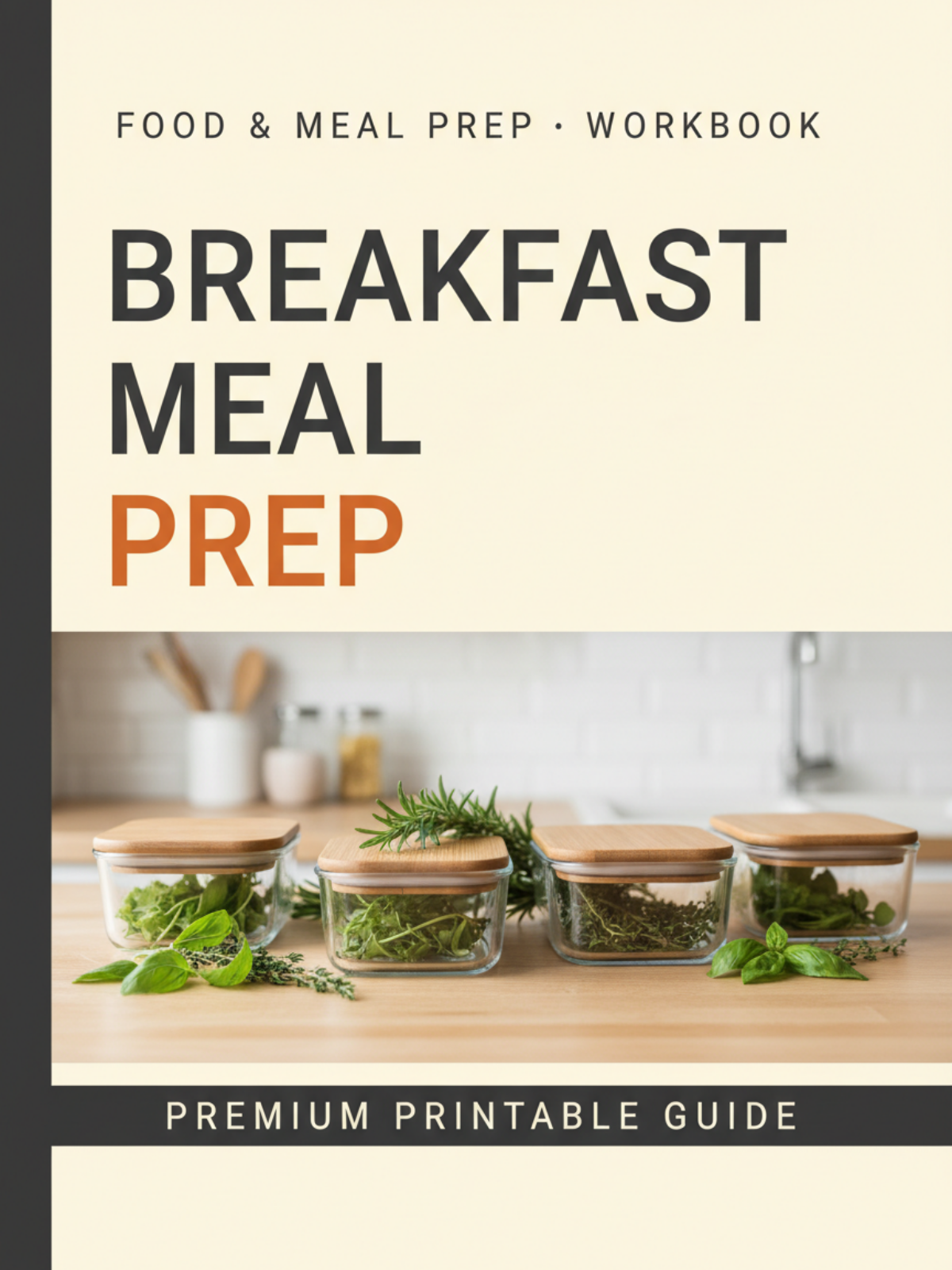
The full workbook, ready to print
- ✓7-day plan: seven named breakfasts built from four base batches
- ✓Portion and macro calculator for solo eaters and families
- ✓Shopping list sorted by store section, not by recipe
- ✓Fridge and freezer storage table with day-by-day limits
- ✓Reheating matrix: microwave vs oven vs air fryer by dish
- ✓No-cook and minimal-equipment breakfasts for beginners
- ✓90-minute Sunday prep checklist with a timed running order
Hosted on FileJoker. Premium members download instantly; free download has a wait.
In a hurry? Free one-page checklist30 items to tick off · print-ready PDF, no sign-upDownload freeIncluded bonuses — free with the guide
2 extra guides from the same topic Free PDF · 18 pagesThanksgiving Meal Checklist: From 14 Days Out to LeftoversBuild a Thanksgiving meal checklist that works: menu, guest count, shopping quantities and an hour-by-hour oven plan. Free printable checklist inside.
 Free PDF · 16 pagesBest Meal Prep Recipes: A 5-Day No-Repeat Plan That Holds UpBest meal prep recipes without the Day 3 boredom: a 5-day no-repeat framework, storage timelines, verified macros, plus a free planner and shopping list.
A look inside the PDF
8 sections · 21 pages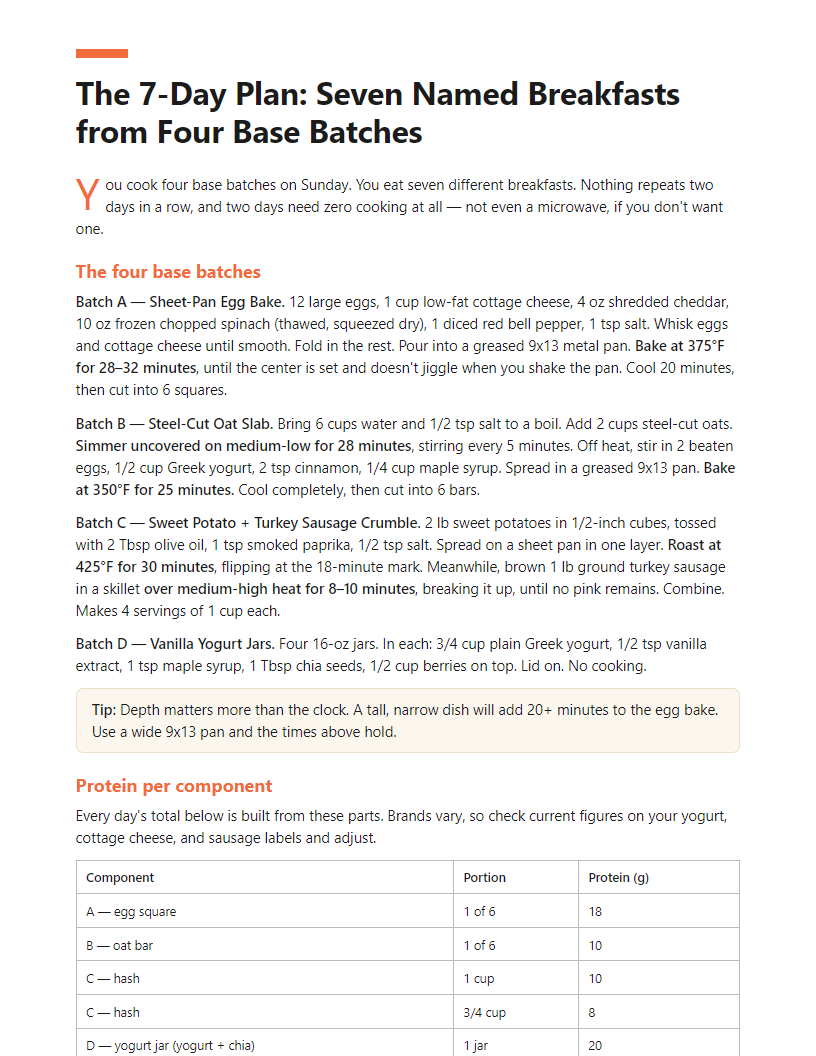


Full table of contents
- Why Breakfast Prep Fails (and What This Workbook Fixes)
- The 7-Day Plan: Seven Named Breakfasts from Four Base Batches
- The Portion & Macro Calculator
- Shopping List Organized by Store Section
- Storage, Freezing, and Reheating Without Dryness or Sogginess
- Troubleshooting: Rubbery Eggs, Runny Batter, and Undercooked Centres
- No-Cook and Minimal-Equipment Breakfasts for Beginners
- The 90-Minute Sunday Prep Checklist
In this article
You opened the fridge on Wednesday, looked at Sunday’s egg cups and thought: is this still safe to eat? Or you wanted to start breakfast meal prep and stalled because you had no idea what to actually make, how long to bake it, or whether it would survive reheating.
This page gives you the straight answers: how many days each type of breakfast holds in the fridge versus the freezer, and how to fix rubbery eggs, runny batter and undercooked centres before you waste another tray.
The premium workbook goes further. You get a seven-day plan built from four base batches, a portion and macro calculator, a shopping list sorted by store aisle, and a 90-minute Sunday prep checklist you can tick off.
The short answer
- Pick four base batches, not seven recipes: baked eggs, overnight oats, a freezer burrito or muffin, and a yoghurt or chia jar.
- Fridge limits: cooked egg dishes 3–4 days, overnight oats 4–5 days, cut fruit 3 days.
- Freezer limits: egg bites, burritos and muffins keep 1–3 months, sealed airtight.
- Yes, 4 days is safe if food cooled within two hours and stays at or below 40°F / 4°C.
- Reheat properly: microwave egg dishes covered at 50% power; crisp burritos in an oven or air fryer.
Why Breakfast Prep Fails (and What This Workbook Fixes)
Most breakfast prep doesn’t fail on Sunday. It fails on Wednesday, when the eggs taste rubbery and you grab a pastry instead.
The three failure points
- No plan. You cook three random recipes, then run out of food by Thursday.
- No portion math. You don’t know if that jar holds 12 grams of protein or 30, so you can’t tell if breakfast is doing its job.
- No storage rules. You guess how long things keep, then throw out food you paid for — or eat something you shouldn’t.
Recipe roundups fix none of this. They hand you 25 ideas and zero system.
What one 90-minute Sunday looks like
You cook four base components, not seven separate meals. Then you assemble those bases into seven named breakfasts, each portioned into a container you can grab with one hand on the way out the door.
| You cook | You get |
|---|---|
| 4 base batches | 7 labeled, grab-and-go breakfasts |
| ~90 minutes, once | 5–10 minutes of weekday effort total |
The skill floor is low on purpose
If cooking feels intimidating, start here. Every recipe in this workbook carries one of three tags:
- No-Cook — stir, layer, refrigerate. No heat at all.
- One-Pan — one skillet or pot, one burner.
- Oven-Only — mix, pour, bake, walk away.
No knife skills required beyond chopping an onion. If you’ve never batch-cooked before, go to Section 8 first and build from there.
How to use this workbook
- Read Section 2 for the safety timelines.
- Pick your week in Section 3.
- Run your numbers on the calculator in Section 4.
- Shop with the store-section list in Section 5.
- Log your cook date on the storage sheet in Section 6.
Print the fill-in pages. Write on them. The system works because it’s written down, not memorized.
Warning: This is general guidance on cooking, portioning, and food storage — not medical or dietetic advice. If you have a health condition, food allergies, or specific protein targets, talk to a doctor or registered dietitian first.
Quick Answer: What to Prep, How Long It Keeps, and Is 4 Days Safe?
Yes, breakfast prep for 4 days is safe — if you cool it fast and keep it cold. Get cooked food into the fridge within 2 hours of cooking. Hold the fridge at or below 40°F (4°C). Those two rules do most of the work.
Fridge baseline
- Egg bakes, egg muffins, cooked grains: 3–4 days
- Overnight oats: 4–5 days
- Cut fruit: 3 days
- Yogurt jars: to the use-by date on the tub you opened
Yes, you can prep the night before. Overnight oats and yogurt jars are built for it.
Freezer baseline
Freezing is about quality, not safety. Frozen food stays safe indefinitely at 0°F (-18°C); the numbers below are when texture and flavor start to slide. Vacuum sealing or double-wrapping buys you more time — a layer of wax paper or plastic wrap inside a freezer bag is the cheap version.
| Food | Fridge | Freezer | Reheat |
|---|---|---|---|
| Egg muffins | 3–4 days | 2–3 months | Microwave 45–60 sec at 50% power from fridge, wrapped in a paper towel |
| Egg bake (sliced) | 3–4 days | 2 months | Microwave 60–90 sec at 50% power, or 325°F oven 12 min |
| Breakfast burritos | 3–4 days | 3 months | Microwave 2–3 min from frozen, foil in oven 20 min |
| Pancakes / waffles | 4 days | 2 months | Toaster from frozen |
| Cooked grains (oats, quinoa) | 3–4 days | 2 months | Microwave with a splash of milk or water |
| Overnight oats | 4–5 days | Not recommended | Eat cold |
| Yogurt jars | Tub’s use-by | Not recommended | Eat cold |
| Smoothie packs | — | 3 months | Blend from frozen |
| Cut fruit | 3 days | 3 months (smoothies only) | Eat cold |
The fastest answer to “what should I actually make?”
Pick one of each. That’s the whole system:
- One egg-based protein — egg muffins or a sheet-pan egg bake
- One grain or oat base — overnight oats or baked oatmeal
- One no-cook yogurt option — layered Greek yogurt jars
- One freezer backup — burritos or pancakes for the week you run long
Warning: Throw it out regardless of the chart if you see any of these — off or sour smell, slimy surface on eggs or grains, or condensation pooling in the container. Pooled water means it went in warm. Don’t taste-test to decide.
Troubleshooting: Rubbery Eggs, Runny Batter, and Undercooked Centres
Most batch-cooking failures come from three things: too much heat, too much liquid, or too much air. Once you can name which one you’re dealing with, the fix takes thirty seconds.
One egg standard for the whole guide
Every egg dish in this guide cooks at 325–350°F and comes out at 160°F internal. That’s the rule. Ignore any timer that conflicts with the thermometer.
The one deliberate difference is depth:
| Dish | Temp | Doneness | Notes |
|---|---|---|---|
| Egg muffins / egg bites (Section 4) | 325–350°F | 160°F internal | 22–28 min at 325°F; closer to 22 at 350°F |
| Deep egg bake, 9x13 pan (Section 3) | 350°F | 160°F internal | Start checking at 30 minutes |
A deep bake needs the higher end of the range and more time because heat has farther to travel. Small muffins set fast, so the lower end protects them. Same finish temperature either way.
Rubbery, weeping egg muffins
This is the number one complaint, and it’s almost always the oven. At 400°F the egg proteins tighten fast, squeeze out water, and you get a rubbery puck sitting in a puddle. Then you microwave it on Wednesday and it tightens again.
Three fixes, all easy:
- Drop to 325°F. Bake 22–28 minutes instead of 15 at high heat. Low and slow keeps the curd soft.
- Add fat and dairy. Use 1 tablespoon of whole milk, half-and-half, or cottage cheese per egg. For a 12-egg batch that’s about ¾ cup. Fat coats the proteins so they can’t bind into rubber.
- Pull them at 160°F internal. They carry over a few degrees out of the oven. A slight wobble in the center is correct.
Tip: If you’d rather eat four hard-boiled eggs than one more dry egg muffin, try the 325°F version with cottage cheese once before you give up. It’s a different texture entirely.
Sunken centers
Egg muffins puff in the oven and settle as they cool — a little dip is normal. A crater is not. Fill cups no more than three-quarters full, and don’t open the oven door in the first 15 minutes. Cold air hits the rising egg and it collapses.
For oat squares and baked-oat batters, a sunken middle usually means too much liquid or an undercooked center. Which brings up pan shape.
Warning: Pan depth changes cook time more than recipe amounts do. One reader halved a recipe but baked it in a tall, narrow dish — it took almost an hour instead of 30 minutes. Wide and shallow cooks faster and more evenly. If you scale a recipe down, keep the depth the same and shorten the time.
Doneness cues that beat any timer
Timers assume your oven, your pan, and your altitude. They’re a starting point. These tell you the truth:
- Internal temp: egg dishes 160°F, baked oats 200–205°F. An instant-read thermometer costs about $15 and ends the guessing.
- The wobble test: shake the pan gently. Set-with-a-jiggle is done. Liquid sloshing is not.
- Edge pull-away: oat squares and pancakes shrink slightly from the pan edge when cooked through.
- Clean-ish toothpick: moist crumbs are fine for baked oats. Wet batter means 5 more minutes.
The fix table
| Symptom | Cause | Fix now | Prevent next time |
|---|---|---|---|
| Rubbery egg muffins | Oven too hot, overbaked | Chop into a breakfast hash | Bake at 325–350°F, pull at 160°F |
| Water pooling in cups | Wet vegetables, high heat | Blot and eat; freeze the rest | Sauté spinach/mushrooms first, squeeze dry |
| Dry after reheating | Microwave too long | Add a splash of salsa or hot sauce | Reheat 60–75 seconds at 50% power |
| Sunken muffin centers | Overfilled cups, door opened early | Eat as is — taste is fine | Fill ¾ full, no peeking for 15 min |
| Soggy-bottom oat squares | Sealed warm, moisture trapped | Toast cut squares 5 min at 350°F | Cool fully on a rack before storing |
| Freezer-burned pancakes | Air in the bag | Blend into a smoothie | Press air out, double-wrap, use in 1 month |
| Watery overnight oats | Too much liquid, or juicy fruit mixed in | Stir in 1 tbsp chia, rest 20 min | 1:1 oats to liquid; fruit on top, not mixed |
| Separated yogurt jars | Normal whey, or fruit at the bottom | Stir it back in | Layer yogurt first, fruit and granola last |
Nothing gets thrown out
Overcooked eggs become hash with potatoes and hot sauce. Undercooked oat squares go back in a skillet with butter. Ugly pancakes plus milk, banana, and protein powder make a smoothie. You lose the presentation, not the protein or the money.
Frequently Asked Questions
Is it okay to meal prep breakfast?
Yes. Cool it within 2 hours, store it airtight in portion-sized containers, and reheat until it steams all the way through.
Prepping the night before works too. Overnight oats and yogurt jars are actually better on day two — the oats soften and the flavors settle.
Is meal prepping for 4 days safe?
Four days is the working limit for cooked eggs, meat, and grains held at or below 40°F (4°C). Make three days your habit if your fridge door opens twenty times a day, since every opening warms the shelves.
To cover a full seven days, freeze the back half of the batch on Sunday. Burritos, egg bites, and muffins hold about 3 months wrapped tight. Move Thursday’s portion from the freezer to the fridge on Wednesday night so it thaws slowly and is ready to reheat.
Warning: Freezer time is imprecise. Food stays safe indefinitely at 0°F, but quality drops once ice crystals and freezer burn set in. Wrapping is what buys you the three months, not the freezer itself.
What’s a good breakfast meal prep?
Use a four-component formula instead of hunting recipes:
| Component | Target | Examples |
|---|---|---|
| Protein | 25–35 g | Eggs, egg whites, cottage cheese, Greek yogurt, turkey sausage |
| Fiber carb | 25–40 g | Oats, whole-grain tortilla, berries, beans |
| Fat | 10–15 g | Cheese, nut butter, avocado, whole eggs |
| Flavor | free | Hot sauce, cinnamon, herbs, citrus zest |
Hit all four and it works for keto, vegetarian, or plain high-protein. Swap within a column, not across it.
What breakfast foods support steadier energy?
General wellness guidance, not medical advice: protein and fiber slow gastric emptying, so the meal leaves your stomach more gradually. That smooths out the blood sugar spike and crash that has you hungry again by 10 a.m.
A breakfast built on the four components above covers both. If you have a diagnosed condition, talk to your doctor.
Can I prep for two people with different calorie targets?
Yes — cook one batch, scale the portion. Keep the protein base identical and adjust the carb and fat add-ons at serving.
Example: Same two egg muffins for both. One person gets a full tortilla and avocado; the other gets half a tortilla and skips the avocado. Roughly a 200-calorie gap from one pan.
Do I need a vacuum sealer?
No. It buys freezer quality, not food safety. Vacuum-sealed frozen burritos may hold texture 6+ months instead of 3. Plastic wrap plus a freezer bag, air pressed out, gets you most of the way there.
- ✓7-day plan: seven named breakfasts built from four base batches
- ✓Portion and macro calculator for solo eaters and families
- ✓Shopping list sorted by store section, not by recipe
- ✓Fridge and freezer storage table with day-by-day limits
- ✓Reheating matrix: microwave vs oven vs air fryer by dish
- ✓No-cook and minimal-equipment breakfasts for beginners
- ✓90-minute Sunday prep checklist with a timed running order
Frequently asked questions
What makes a good breakfast meal prep?
The best options hold texture for days: baked egg cups or a sheet-pan frittata, overnight oats, freezer breakfast burritos, protein muffins, and layered yoghurt jars. Aim for 20–30g protein per serving so you stay full until lunch. Build from four base batches rather than seven separate recipes, then vary toppings and sauces so the week doesn't taste repetitive.
Which breakfast foods help keep cortisol in check?
Cortisol tends to spike on an empty stomach or after a sugar-only breakfast. A balanced plate helps: protein (eggs, Greek yoghurt), slow carbs (oats, wholegrain bread), healthy fats (nuts, avocado) and magnesium-rich foods like pumpkin seeds and dark leafy greens. Eating within an hour or two of waking and limiting coffee on an empty stomach also steadies the morning.
Is it actually okay to meal prep breakfast in advance?
Yes, and it's one of the easiest meals to prep because portions repeat. The rules are simple: cool cooked food within two hours, store in shallow airtight containers, label with the cook date, and keep the fridge at or below 40°F / 4°C. Freeze anything you won't eat within the fridge window. Reheat egg dishes to steaming hot throughout.
Is meal prepping for four days safe?
For most breakfasts, yes. Cooked eggs, egg cups and breakfast sausages are safe 3–4 days refrigerated. Overnight oats and chia puddings hold 4–5 days. Cut melon and berries are best within 3 days. If you want a five-day run, cook two batches on different days or freeze days 4 and 5 immediately and thaw overnight.
How do I stop meal-prepped eggs going rubbery when reheated?
Rubbery eggs come from overcooking twice. Bake egg cups at 350°F / 175°C for 18–22 minutes and pull them when the centres are just set and barely jiggly. Reheat covered at 50% microwave power for 45–60 seconds, or 10 minutes in a 300°F / 150°C oven. A splash of cottage cheese or cream in the mix keeps them tender.
We collected 143 real questions and comments about "breakfast meal prep" (113 from YouTube comments, 4 from People Also Ask, 26 from search suggestions), grouped them into 11 recurring problems, and built this guide to resolve the 7 that block people most. The top-ranking pages were reviewed for gaps; 7 of those gaps became dedicated sections.
Edited by Alex Hirn · Last updated September 26, 2026 · How we make our guides
More in Food & Meal Prep
free premium+2 bonuses
 premium+2 bonuses
 premium+1 bonus