Workbook · 25-page PDF · Premium
Chicken Meal Prep: A System for Juicy, Safe, 7-Day Meals
Chicken meal prep that stays juicy and safe: exact fridge and freezer limits, breast vs thigh, plus a premium PDF with worksheets and a Sunday checklist.
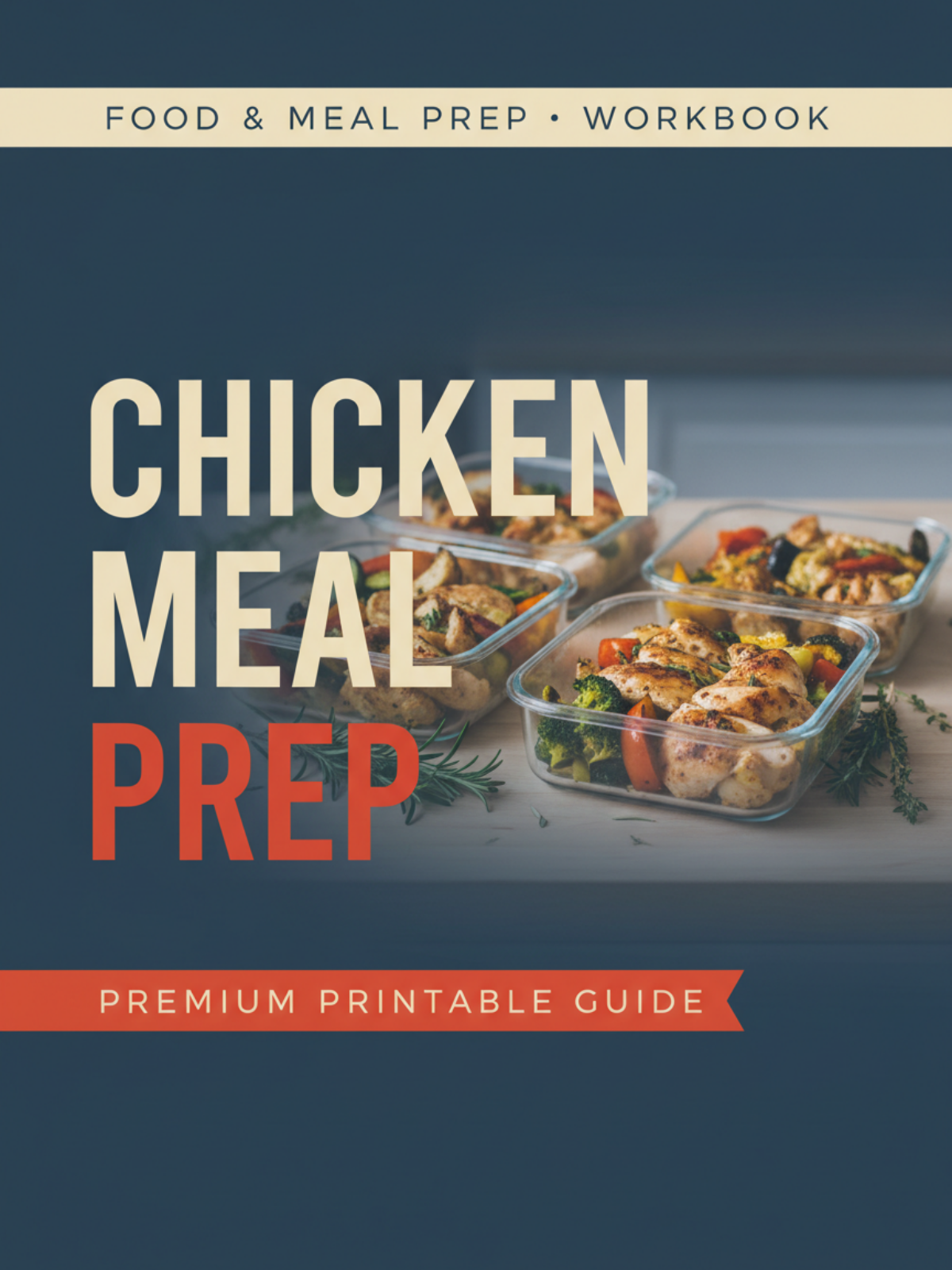
The full workbook, ready to print
- ✓Worksheet 1: pounds-of-chicken calculator for bulking, cutting or maintenance
- ✓90-minute Sunday batch method with a timed cooking order
- ✓Storage, freezing and reheating table with exact days and temperatures
- ✓12 flavour bases mapped so no week repeats itself
- ✓Worksheet 2: printable 7-day plan and shopping list template
- ✓The Sunday session checklist, from thawing to labelling
- ✓Temperature references and food-safety sources in one place
Hosted on FileJoker. Premium members download instantly; free download has a wait.
In a hurry? Free one-page checklist30 items to tick off · print-ready PDF, no sign-upDownload freeIncluded bonuses — free with the guide
2 extra guides from the same topic Free PDF · 18 pagesThanksgiving Meal Checklist: From 14 Days Out to LeftoversBuild a Thanksgiving meal checklist that works: menu, guest count, shopping quantities and an hour-by-hour oven plan. Free printable checklist inside.
 Free PDF · 16 pagesBest Meal Prep Recipes: A 5-Day No-Repeat Plan That Holds UpBest meal prep recipes without the Day 3 boredom: a 5-day no-repeat framework, storage timelines, verified macros, plus a free planner and shopping list.
A look inside the PDF
11 sections · 25 pages


Full table of contents
- Why Chicken Meal Prep Fails — And What a System Fixes
- How Long Is Meal-Prepped Chicken Actually Safe? The Straight Answer
- Breast vs Thigh: Choosing the Right Cut for the Way You Eat
- Worksheet 1: How Many Pounds of Chicken Do You Actually Need?
- The 90-Minute Sunday Cook: Step-by-Step Batch Method
- Storage, Freezing and Reheating Without Texture Loss
- Flavour Rotation: 12 Chicken Bases That Never Repeat a Week
- Worksheet 2: Your 7-Day Plan and Shopping List Template
- Nine Mistakes That Ruin Chicken Meal Prep
- The Sunday Session Checklist
- Sources, Temperature References and Next Steps
In this article
You cooked a tray of chicken on Sunday and by Tuesday it is dry, rubbery and boring — and you are quietly wondering whether Thursday’s portion is still safe to eat. That is the part most recipe lists skip. This chicken meal prep guide treats the week as a system, not a pile of recipes: how long cooked chicken really keeps, how to pick breast or thigh for the way you eat, and the nine mistakes that turn good chicken into cardboard.
The premium PDF goes further. It hands you the batch math (how many pounds you actually need), a 90-minute Sunday cook order, a storage, freezing and reheating table, 12 flavour bases, and a printable 7-day plan with shopping list.
The short answer
Yes, you can meal prep chicken — but plan the week in two halves:
- Cook to 165°F / 74°C, then cool and refrigerate within two hours.
- Eat refrigerated cooked chicken within 3–4 days, not 7.
- Freeze days 5–7 on cooking day, not later in the week.
- Store in sauce or broth to keep breast moist.
- Reheat gently — covered, with a splash of liquid, to 165°F.
- Rotate two or three flavour bases per week to avoid meal fatigue.
Why Chicken Meal Prep Fails — And What a System Fixes
Most chicken meal prep doesn’t fail on Sunday. It fails on Wednesday, when you open the container, see gray dry chicken, and order takeout instead.
Five things cause almost every failure:
- Wrong cut. Breast reheats poorly if you cook it like thigh. Thigh feels heavy if you wanted lean.
- Overcooked protein. Chicken pulled at 185°F instead of 165°F is dry before it ever hits the fridge.
- Guessed quantities. You buy “a few packs,” then run out by Thursday or throw out two pounds.
- Unclear safety window. You don’t know if Sunday’s chicken is still fine on Friday, so you eat it nervously or toss it.
- Flavor fatigue. Seven identical containers. By day three you can’t face another bite.
Why recipe lists don’t fix this
A recipe tells you what to cook tonight. It doesn’t tell you how many pounds to buy, how the chicken holds up on day four, or what to do so Thursday doesn’t taste like Monday. Running a week is a different skill from cooking a meal. That’s what this workbook builds.
How you’ll use this workbook
One session a week, 60–90 minutes, usually Sunday. You’ll fill in four tools:
| Tool | What it answers |
|---|---|
| Quantity math (Worksheet 1) | How many pounds to buy |
| Batch cook method | How to cook breast and thigh so they stay juicy |
| Storage chart | How long each meal is safe, fridge and freezer |
| Flavor rotation | How to get seven different meals from one cook |
No cooking experience needed. If you’ve never cooked from scratch, start with the sheet pan method in Section 5 — it’s one pan, one temperature, one thermometer check.
Tip: If your evenings are gone to shifts, kids or a commute, the whole point is that you cook once and make zero weeknight decisions.
Quick search note
If you searched “chicken meal,” you may have landed on pet food pages. In dog and cat food, chicken meal is a rendered, dried ingredient — a different thing entirely. This guide is about cooked chicken for human meal prep. Nothing here refers to pet food.
What you need before you start
- One or two rimmed sheet pans
- An instant-read thermometer (non-negotiable — this is how you stop overcooking)
- 6–10 containers with tight lids
- A box of freezer bags
- Fridge space cleared before you shop
How Long Is Meal-Prepped Chicken Actually Safe? The Straight Answer
Cooked chicken is safe in the fridge for 3 to 4 days at 40°F/4°C or below. That’s the USDA number. Not five days. Not seven. If you cooked Sunday afternoon, the last safe fridge meal is Wednesday — Thursday at the outside if your fridge runs cold and you packed it fast.
So is it okay to meal prep chicken for a week? Yes — but only if days 5, 6 and 7 go into the freezer on cooking day, not on Wednesday when you notice you won’t get through it. Freezing already-old chicken doesn’t reset the clock. Move those containers to the fridge the night before you eat them and thaw for 24 hours.
The 2-hour rule
Chicken sitting on the counter is the number one spoilage mistake. Cooked chicken must be in the fridge or freezer within 2 hours of coming off the heat — 1 hour if your kitchen is above 90°F/32°C.
Cool it fast so you hit that window:
- Slice or chop the chicken; whole breasts hold heat for ages.
- Spread it on a sheet pan in a single layer for 15–20 minutes.
- Pack into shallow containers, no more than 2 inches deep.
- Lid on, label with the cook date, straight into the fridge.
Warning: Don’t stack hot containers in the fridge. They insulate each other and the centers stay warm for hours.
Fridge and freezer limits at a glance
| What’s in the container | Fridge (at 40°F/4°C) | Freezer (0°F/-18°C, for quality) | Best reheat |
|---|---|---|---|
| Cooked chicken, plain (no sauce) | 3–4 days | 2–3 months | Microwave covered with 1 tbsp water or broth, 60–90 sec |
| Raw chicken, uncooked | 1–2 days | 9–12 months | n/a — cook from thawed |
| Chicken + rice bowl | 3–4 days | 2–3 months | Microwave covered, stir halfway, splash of water |
| Chicken in sauce, curry or chili | 3–4 days | 4–6 months | Stovetop over low heat, or microwave covered |
Yes, you can freeze chicken and rice meal prep. Sauce protects texture; dry cuts dry out faster, which is why sauce-free chicken tops out around 2–3 months for quality. It stays safe indefinitely at 0°F/-18°C — it just won’t taste good.
Reheat everything to 165°F/74°C internal. Use a thermometer, not a guess.
Throw it out, no questions asked
- Day 5 or later in the fridge, whatever it smells like.
- Left on the counter more than 2 hours (1 hour in a hot kitchen).
- Slimy, sticky, gray, or sour-smelling.
- Thawed on the counter or in hot water.
- You can’t remember when you cooked it.
Tip: Smell and slime are late signals. Bacteria that make you sick often leave no smell at all. The date label is your safety test — not your nose.
Breast vs Thigh: Choosing the Right Cut for the Way You Eat
Breast isn’t automatically the “healthy” choice. It’s the least forgiving one. If your prepped chicken keeps coming out dry, tough and bland, the cut is often the reason — not your seasoning.
The numbers, side by side
| Boneless breast | Boneless thigh | Ground chicken | Store rotisserie | |
|---|---|---|---|---|
| Protein / 100g cooked | ~31g | ~26g | ~23–25g (varies by fat %) | ~25g (mixed meat) |
| Calories / 100g | ~165 | ~209 | ~150–230 | ~190 |
| Fat / 100g | ~3.6g | ~11g | ~8–15g | ~11g |
| Cost per lb | Usually highest | Usually cheaper | Mid | Cheapest per pound of cooked meat |
| Cook time (batch) | 18–22 min | 25–30 min | 8–10 min | Zero — already done |
| Forgiveness if overcooked | Low — 5°F past done and it’s chalky | High — stays juicy 10–15°F past done | High | High |
| Reheat / day-4 tolerance | Poor | Excellent | Excellent | Good |
Macros are approximate for cooked, skinless meat — check the label on what you actually buy.
Why thigh survives Wednesday
Thigh is a working muscle. It carries more fat and more connective tissue, and that collagen melts into gelatin as it cooks. That gelatin holds water in the meat through cooling, storage, freezing and one more trip through the microwave. Breast has almost none of that insurance, so every reheat pulls moisture straight out.
The 70/30 mix
You don’t have to pick one. Most people do best buying both.
- Breast for days 1–3. Highest protein per calorie, best when it’s freshest.
- Thigh for days 4–6 and anything you freeze. These are the meals that get reheated hardest.
- Cutting or tracking tight macros? Go 70% breast, 30% thigh. Bulking or cooking for a family? Flip it.
Tip: Cook them separately. Thigh needs 5–10 more minutes, and chasing one temperature for both is how breast dries out.
Shortcuts when time beats budget
- Bone-in, skin-on thighs: cheapest real cut, hardest to ruin. The bone slows heat and the skin bastes the meat. Pull the skin after cooking if you want the calories down.
- Rotisserie chicken: $6–$8 buys about 2 to 3 cups of shredded meat with zero cook time. Pull it off the bone the day you buy it and it counts as cooked chicken for storage timing.
The specialty cuts
- Thin-sliced breast or cutlets: cook in 6–8 minutes, so there’s less time to overshoot. If yours are thick, press them flatter with the heel of your hand before cooking — no mallet needed.
- Tenders: fast and portion-friendly, but they dry out fastest. Use them for day 1 and 2 only.
- Ground chicken: the best answer to “bland and boring.” It takes on chili, curry paste or taco spice completely, freezes well, and cooks in under 10 minutes.
Nine Mistakes That Ruin Chicken Meal Prep
Each of these is fixable in one Sunday. Find yours, correct it, repeat.
1. Cooking to 175°F “to be safe”
Chicken is safe at 165°F. Breast pulled at 175°F has already squeezed out its juice. Pull breast at 160–162°F and rest it 5–10 minutes — carryover heat carries it past 165°F while the juices settle back in. This single change fixes most dry chicken.
Tip: Thighs are different. They’re better at 175–185°F, where connective tissue softens. Same batch, two target temps.
2. Sealing hot chicken in containers
Hot chicken in a closed container steams itself gray and cools slowly. Food sitting between 40°F and 140°F is where bacteria multiply. Cool chicken on a sheet pan for 20–30 minutes, then lid and refrigerate within two hours of cooking.
3. Seasoning only the outside
Salt on the surface of a thick breast seasons the surface only. Brine (3 tablespoons table salt per 4 cups water, 30 minutes) or marinate with contact time. Pounding or pressing the breast to an even thickness helps too — it cooks evenly instead of drying out at the thin end while the thick end catches up.
4. Seven identical meals
You will not eat your seventh identical container. You’ll order takeout on Wednesday. Cook neutral chicken, then change the sauce daily — that’s the rotation system in Section 7. Bland and boring is a sauce problem, not a chicken problem.
5. Storing chicken pre-mixed with crisp or dressed food
| Store together | Store separate |
|---|---|
| Chicken + rice, grains, roasted veg | Salad greens, dressing |
| Chicken + sauce (wet dishes) | Tortilla chips, crackers, nuts |
| Chicken + beans, stew bases | Avocado, fresh herbs, cucumber |
Dressed greens are slime by Tuesday. Pack crisp components in a small side container.
6. Overfilling the fridge
A packed fridge blocks airflow and drifts above 40°F/4°C. That shortens your safe window and you won’t know it happened. Leave gaps between containers. Put a $5 fridge thermometer on the middle shelf and check it once.
7. Microwaving on full power, dry
Full power drives moisture out fast and turns breast to rubber. Add a tablespoon of water, broth or sauce, cover loosely, and heat at 50–70% power. Go in 60-second bursts and stop at hot, not steaming.
8. Freezing on day 3
Freezing doesn’t reverse aging — it pauses it. Chicken frozen on day 3 comes out of the freezer already three days old, with one day of fridge life left after thawing. Decide on cook day: meals 1–4 to the fridge, meals 5–7 straight to the freezer.
9. Buying 20 lbs with no plan
Bulk chicken is only cheap if you eat it. Run Worksheet 1, buy that number, and know which meals each pound becomes before you leave the store. Anything beyond four days of meals gets portioned and frozen the same day.
Chicken Meal Prep FAQ
Is it okay to meal prep chicken for a week?
Yes — if you split it. Cook once, eat four days from the fridge (cook day plus three), and freeze the rest the same day you cook. Frozen cooked chicken holds good quality for about 3 months. Pulling a container from the freezer Thursday morning is not the same as eating Sunday’s chicken on day seven.
Is meal prepping for 7 days safe?
Seven days of eating is safe. Seven days in the fridge is not. What makes it safe:
- Chicken cooked to 165°F, checked with a thermometer
- Cooled and in the fridge within 2 hours of cooking (1 hour if your kitchen is above 90°F)
- Fridge running at 40°F or below
- Days 5, 6 and 7 come out of the freezer, not the back of the fridge
Can I prep chicken raw and cook it later in the week?
Yes, and it’s a good option if you hate reheated chicken. Raw chicken keeps 1–2 days in the fridge. Beyond that, portion it raw into freezer bags with marinade, freeze flat, and move one bag to the fridge the night before you cook it. The marinade works on the chicken while it thaws.
Can I freeze chicken and rice meal prep together?
Yes. Rice freezes better than most people expect — the problem is usually reheating it dry.
| Rice | Freezes | Note |
|---|---|---|
| Jasmine / long-grain white | Well | Best all-around choice |
| Basmati | Well | Stays separate after thawing |
| Brown rice | Well | Slightly firmer texture |
| Short-grain / sushi rice | Poorly | Turns gummy |
| Cauliflower rice | Poorly | Releases water, goes soggy |
Tip: Add a tablespoon of water or broth before microwaving, and cover the container. That steam is what brings both rice and chicken back.
What can I make with chicken besides bowls?
Shredded or sliced chicken drops into almost anything: wraps and burritos, chicken tortilla or noodle soup, cold chicken salad with yogurt and celery, pasta with pesto, tacos, grain salads, quesadillas, fried rice, chicken and greens on flatbread.
Does reheating chicken more than once cause problems?
Reheat only the portion you’re eating. Each reheat dries the meat and adds another cooling cycle where bacteria can grow. Heat to 165°F, eat it, don’t put it back.
How do I know chicken went bad if it looks fine?
Go by the cook date, not your nose. Label every container with the day you cooked it. Anything past day four in the fridge goes in the trash, even if it looks and smells perfect — unsafe chicken often does.
Smell and texture are backup checks, not the test. A sour, sulfur or ammonia smell, a slimy or sticky surface, or gray-green color all mean throw it out. Those signs show up late, so a container that passes them can still be past its date.
Warning: “Chicken meal” on a pet food label is a dried, ground poultry ingredient. It has nothing to do with cooking chicken for your own week.
- ✓Worksheet 1: pounds-of-chicken calculator for bulking, cutting or maintenance
- ✓90-minute Sunday batch method with a timed cooking order
- ✓Storage, freezing and reheating table with exact days and temperatures
- ✓12 flavour bases mapped so no week repeats itself
- ✓Worksheet 2: printable 7-day plan and shopping list template
- ✓The Sunday session checklist, from thawing to labelling
- ✓Temperature references and food-safety sources in one place
Frequently asked questions
Is it safe to meal prep chicken for a whole week?
Not all in the fridge. Cooked chicken is safe refrigerated for 3–4 days at or below 40°F / 4°C. For a seven-day plan, portion days 1–4 into the fridge and freeze days 5–7 immediately after cooling, then move each container to the fridge the night before you eat it. Freezing on day four defeats the purpose — the clock already ran.
Can chicken be meal prepped without going dry?
Yes, if you fix three things: thickness, temperature and storage. Pound breasts to an even thickness so they cook uniformly, pull them at 165°F rather than guessing, and store each portion with a spoon of sauce, marinade or broth. Undercook slightly if you know you will reheat. Thighs forgive all three mistakes and stay juicy longer.
What meals can I make with prepped chicken?
Cook the chicken plainly, then flavour it in portions: burrito bowls, teriyaki with rice, Greek-style with lemon and cucumber, chicken and pesto pasta, curry with chickpeas, Cajun with sweet potato, or shredded chicken for wraps and salads. One batch, three sauces and two carb bases already give you six distinct meals without cooking six times.
Is meal prepping for 7 days safe in general?
Seven days of prepping is safe; seven days of refrigeration is not. Use the 4-day fridge rule for cooked proteins, the freezer for anything beyond that, and keep raw and cooked containers separate. Cool food quickly in shallow containers rather than stacking hot trays in the fridge, which raises the internal temperature of everything around them.
Should I use chicken breast or thigh for meal prep?
Breast is leaner and cheaper per gram of protein, but it dries out fast on reheating and needs precise timing. Thigh costs a little more, has more fat and calories, and stays tender for days — ideal if you reheat in a microwave at work. Many people split the batch: breast for cold salads, thigh for reheated hot meals.
We collected 158 real questions and comments about "chicken meal prep" (113 from YouTube comments, 4 from People Also Ask, 41 from search suggestions), grouped them into 12 recurring problems, and built this guide to resolve the 7 that block people most. The top-ranking pages were reviewed for gaps; 7 of those gaps became dedicated sections.
Edited by Alex Hirn · Last updated October 1, 2026 · How we make our guides
More in Food & Meal Prep
free premium+2 bonuses
 premium+2 bonuses
 premium+1 bonus