Checklist · 28-page PDF · Premium
Spring Cleaning Checklist: A 7-Day Plan You Can Actually Finish
A spring cleaning checklist that splits the whole house into 7 days, with time estimates, room checkboxes and a progress tracker. See what's inside.

The full workbook, ready to print
- ✓7-day plan with day-by-day time blocks and realistic minute estimates
- ✓Room-by-room master checklist with printable checkboxes
- ✓Progress tracker sheet to tick off rooms and days
- ✓Before Day 1 prep sheet: supply list and 30-minute declutter pass
- ✓Gross-jobs walkthrough: ice maker, lint trap, fridge top, under-appliance
- ✓Technique fixes for ceiling fans, cabinets, stovetop gap and fridge
- ✓15-minutes-a-week maintenance rota for the rest of the year
Hosted on FileJoker. Premium members download instantly; free download has a wait.
In a hurry? Free one-page checklist32 items to tick off · print-ready PDF, no sign-upDownload freeIncluded bonuses — free with the guide
1 extra guide from the same topicA look inside the PDF
11 sections · 28 pages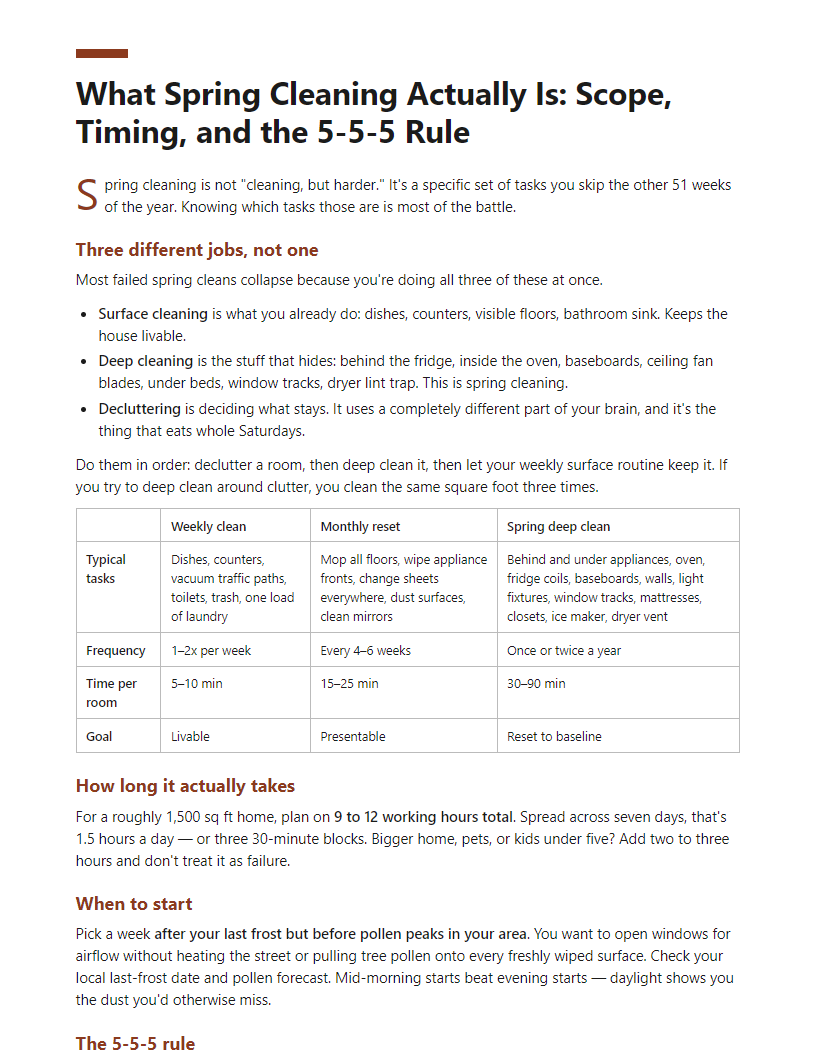

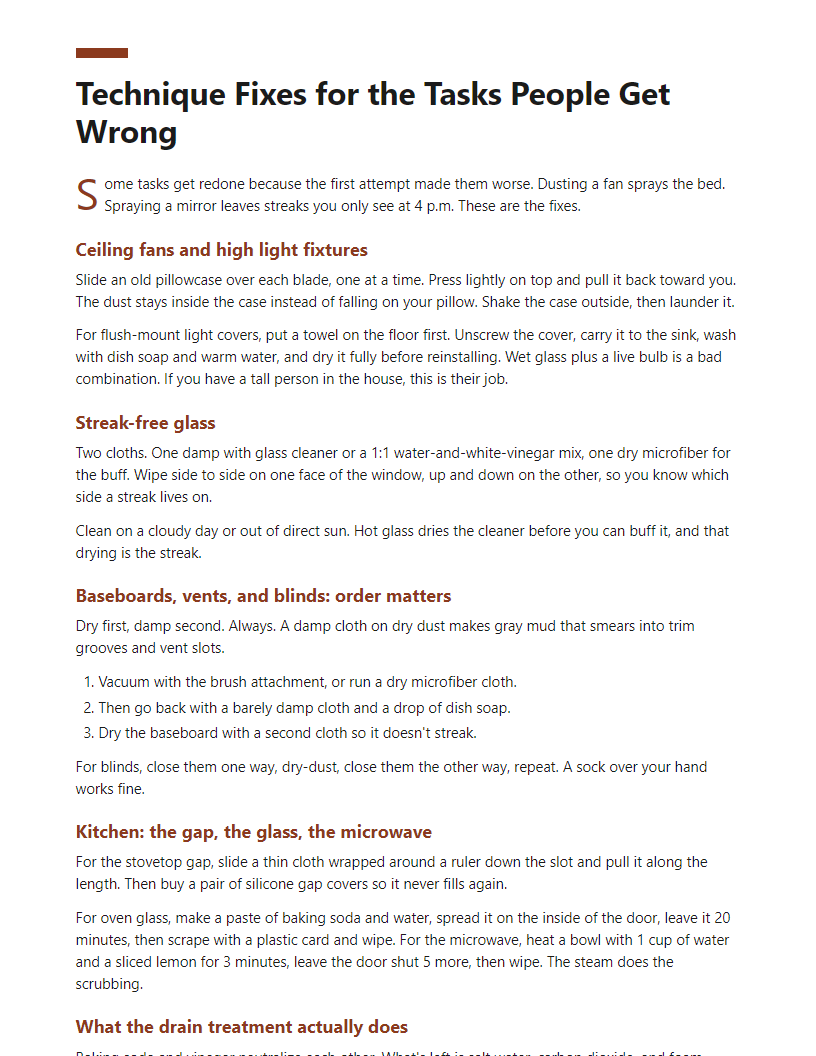
Full table of contents
- Why Spring Cleaning Feels Impossible (And Why That's Normal)
- What Spring Cleaning Actually Is: Scope, Timing, and the 5-5-5 Rule
- Before Day 1: Supplies, Declutter Pass, and Setting Up the Tracker
- The 7-Day Plan: Day-by-Day Blocks With Time Estimates
- Room-by-Room Master Checklist With Checkboxes
- The Gross Jobs: Ice Makers, Lint Traps, Fridge Tops and Under-Appliances
- Technique Fixes for the Tasks People Get Wrong
- Staying Motivated: Momentum Tricks That Hold Up Mid-Week
- Seven Mistakes That Turn a Spring Clean Into a Three-Week Project
- The Maintenance Plan: 15 Minutes a Week So Next Spring Is Easy
- Printables and Where to Go Next
In this article
You open a cupboard, see the state of it, and think: I don’t even know where to start. Or you start strong on Saturday, run out of steam by the hallway, and the half-done piles sit there for three weeks. A spring cleaning checklist only helps if it tells you what counts as spring cleaning, how long each job really takes, and what to do on the day you can’t face it.
This page covers the scope, the 5-5-5 rule, momentum tricks that survive midweek, and the mistakes that stretch a weekend job into a month. The premium PDF turns all of it into a printable working document: a 7-day plan with time blocks, room-by-room checkboxes, a progress tracker, and a 15-minute weekly maintenance plan.
The short answer
A spring cleaning checklist works best when it’s split by day, not dumped in one list:
- Prep day — gather supplies, do a 30-minute declutter pass, set up your tracker.
- Kitchen — appliances inside and out, fridge top, cabinet fronts, stovetop gap.
- Bathrooms — grout, extractor fan, under-sink, shower head descale.
- Bedrooms — mattresses, under-bed, wardrobe cull.
- Living spaces — ceiling fans, skirting boards, upholstery, windows.
- Utility and hidden jobs — lint trap, ice maker, under appliances.
- Floors, finish and reset — then 15 minutes a week to hold it.
Why Spring Cleaning Feels Impossible (And Why That’s Normal)
You start Saturday morning with coffee and good intentions. By 11 a.m. you’re sitting on the bedroom floor sorting old chargers, three rooms are worse than when you began, and the whole thing is dead by lunch. That’s not a discipline problem. It’s a planning problem.
Three reasons deep cleaning stalls
No defined scope. “Clean the house” isn’t a task. It’s a mood. Without a list, every room expands until you’re washing baseboards you didn’t plan to touch.
No end point. If there’s no line that says done, your brain keeps finding more. That’s exhausting, and exhaustion looks a lot like laziness from the inside.
No visible progress. You can clean for four hours and feel like you accomplished nothing, because the only proof is the absence of dirt. Checkboxes fix this. Ticking a box is small, but it’s real evidence.
What’s behind your fridge is behind everyone’s fridge
Here’s the part nobody posts about: there is gray fuzz under your refrigerator, a gummy ring in your ice maker, and a layer of grease on top of your cabinets right now. There’s also something under the couch cushions you’d rather not identify.
That’s not a sign you’re a bad housekeeper. It’s a sign you live in a house and use it. Dust lands, grease travels, pet hair migrates. Nobody — not your neighbor, not the person in the cleaning video — has a clean fridge coil by default. You’re not behind. You just haven’t gotten to it yet, which is exactly what spring cleaning is for.
Why “I’ll do it all Saturday” fails
A full-house deep clean is roughly 9 to 12 hours of real work for an average home. Nobody does that in one day while also eating, parenting, and answering the door. One long day also means you hit decision fatigue early, start cutting corners by hour three, and quit with half the house torn apart.
Seven short days beats one long one. Every time.
How this planner works
- 7 days. Each day has a theme and a defined stopping point.
- 30-minute blocks. Nothing takes longer than half an hour before you get a break or a checkbox.
- Checkboxes for every task. You’ll know exactly what to do, not just where to go.
- A progress tracker. One page, date-stamped, so you can see the week filling in.
Who this is for
Houses, apartments, condos, rentals. Pet owners who vacuum daily and still find hair. Parents cleaning around nap schedules. Anyone with 30 free minutes a day and no more.
If you can only give three days, use three. The system doesn’t break.
What Spring Cleaning Actually Is: Scope, Timing, and the 5-5-5 Rule
Spring cleaning is not “cleaning, but harder.” It’s a specific set of tasks you skip the other 51 weeks of the year. Knowing which tasks those are is most of the battle.
Three different jobs, not one
Most failed spring cleans collapse because you’re doing all three of these at once.
- Surface cleaning is what you already do: dishes, counters, visible floors, bathroom sink. Keeps the house livable.
- Deep cleaning is the stuff that hides: behind the fridge, inside the oven, baseboards, ceiling fan blades, under beds, window tracks, dryer lint trap. This is spring cleaning.
- Decluttering is deciding what stays. It uses a completely different part of your brain, and it’s the thing that eats whole Saturdays.
Do them in order: declutter a room, then deep clean it, then let your weekly surface routine keep it. If you try to deep clean around clutter, you clean the same square foot three times.
| Weekly clean | Monthly reset | Spring deep clean | |
|---|---|---|---|
| Typical tasks | Dishes, counters, vacuum traffic paths, toilets, trash, one load of laundry | Mop all floors, wipe appliance fronts, change sheets everywhere, dust surfaces, clean mirrors | Behind and under appliances, oven, fridge coils, baseboards, walls, light fixtures, window tracks, mattresses, closets, ice maker, dryer vent |
| Frequency | 1–2x per week | Every 4–6 weeks | Once or twice a year |
| Time per room | 5–10 min | 15–25 min | 30–90 min |
| Goal | Livable | Presentable | Reset to baseline |
How long it actually takes
For a roughly 1,500 sq ft home, plan on 9 to 12 working hours total. Spread across seven days, that’s 1.5 hours a day — or three 30-minute blocks. Bigger home, pets, or kids under five? Add two to three hours and don’t treat it as failure.
When to start
Pick a week after your last frost but before pollen peaks in your area. You want to open windows for airflow without heating the street or pulling tree pollen onto every freshly wiped surface. Check your local last-frost date and pollen forecast. Mid-morning starts beat evening starts — daylight shows you the dust you’d otherwise miss.
The 5-5-5 rule
When a room feels unstartable, do this before you touch a cleaning product:
- Put away 5 things that belong in that room but aren’t where they live.
- Throw out 5 things — trash, expired items, dead pens, broken things.
- Relocate 5 things to the room they actually belong in. One trip, one basket.
Fifteen items. Usually under five minutes. It clears enough surface area that real cleaning becomes possible, and it gives you a finish line instead of an open-ended mess.
If 5-5-5 doesn’t fit you
- The 30-minute block. Set a timer, clean until it rings, stop. Good if you have short attention or constant interruptions. This guide’s plan is built on these.
- One room per day. Finish a whole room, close the door, move on tomorrow. Good if you need visible completion to stay motivated.
What to skip this year, guilt-free
Garage, attic, basement storage, filing cabinets, photo boxes, and the “someday” craft bin. These are decluttering projects wearing a cleaning costume. Put them on a separate list with their own weekend in June.
Staying Motivated: Momentum Tricks That Hold Up Mid-Week
Day 1 is easy. Day 7 is easy — you can see the end. Days 4, 5, and 6 are where plans die. Not because you’re lazy. Because the novelty is gone and the house still looks like a house.
Color in the bar, not the room
Photos lie to you mid-week. A before-and-after of a clean oven doesn’t feel like much when the living room is still a disaster. A tracker doesn’t care. You did a block, you fill in a bar. That’s it.
Print this page and tape it to the fridge where you walk past it.
| Day | Date | Block 1 | Block 2 | Block 3 | Zone |
|---|---|---|---|---|---|
| Day 1 | ____ | ☐ | ☐ | ☐ | ______ |
| Day 2 | ____ | ☐ | ☐ | ☐ | ______ |
| Day 3 | ____ | ☐ | ☐ | — | ______ |
| Day 4 | ____ | ☐ | ☐ | ☐ | ______ |
| Day 5 | ____ | ☐ | ☐ | — | ______ |
| Day 6 | ____ | ☐ | ☐ | ☐ | ______ |
| Day 7 | ____ | ☐ | ☐ | — | ______ |
Blocks completed: ____ / 18
Each day gets two or three boxes, matching the 60–90 minutes that day’s zone actually needs. Color each box in solid when the 30 minutes are up. The running counter at the bottom is the part that works — “12 of 18” pulls harder than “three rooms left.”
The 10-minute entry rule
On days you genuinely don’t want to start: set a timer for 10 minutes, do the easiest task in the block, and give yourself full permission to quit when it rings. You’ll usually keep going. If you don’t, you still did 10 minutes, and that counts as a half-block on the tracker.
Make the block less lonely
- Body-doubling. Video-call a friend who’s also cleaning, or just leave them on speaker. You both work. Nobody talks much.
- One playlist, one block. Build a 30-minute playlist. When the music stops, the block is over. No clock-watching.
- Watch one, do one. Watch a single cleaning video — the funny, chaotic kind where someone breaks a vacuum attachment and finds something unspeakable behind the dryer — then do one block before watching another. Those videos exist because everyone’s house has this stuff. Confusion about how to clean something is the default, not a personal failing.
Rewards attach to blocks
Tie the reward to the block, not the day. Finished a block, get the coffee. Day-based rewards punish you for a slow Thursday.
Broke something? Normal. Deep cleaning finds the cracked shelf and the hose that won’t reattach. Write it on a “deal with later” list and keep moving — do not start a repair project mid-block.
Permission slips
Take any of these without renegotiating the whole plan:
- Skip a room entirely. Cross it off the tracker and reduce your total.
- Pay someone for one job — carpets, windows, oven. One line item, done.
- Split the seven days across two weekends. Same blocks, more calendar.
Seven Mistakes That Turn a Spring Clean Into a Three-Week Project
Each of these turns a 7-day plan into a three-week slog. Most are planning errors, not effort errors.
1. Decluttering and cleaning in the same pass
You wipe a shelf, find a shoebox of cords, and forty minutes vanish. Sorting uses a different part of your brain than scrubbing, and switching between them kills your pace. Keep the pre-Day-1 declutter pass separate. During the seven days, anything that needs a decision goes in one labeled box and gets dealt with after Day 7.
2. Cleaning bottom to top
Mop the floor, then dust the blinds, and you’ve just mopped for nothing. Dust falls. Work ceiling fan, then light fixtures, then shelves, then counters, then baseboards, then floor — in that order, every room, every time. This single habit saves you from redoing rooms.
3. Emptying every closet at once
Three closets dumped on the bed at 2 p.m. means you’re still sorting at 9 p.m. with nowhere to sleep. Do one closet per session, and only pull out what you can put back before your timer ends.
Tip: Set a rule: nothing comes out of a storage space unless it can go back in within 30 minutes.
4. Buying storage bins before you know what stays
You can’t size containers for stuff you haven’t sorted. Bins bought early become clutter that holds clutter. Finish the declutter pass, measure the shelf, count what’s left, then shop. Most people need half of what they thought.
5. Starting with an unbounded room
The garage, the basement, the storage room — these have no clear finish line, and a first session with no finish line ends in burnout. A hard, open-ended start teaches you that spring cleaning is miserable, and you won’t show up on Day 2.
The kitchen is a big room, but it’s a bounded one. Day 1 gives it three 30-minute blocks with a defined task list in each: surfaces and small appliances, then fridge, then floor and under-appliances. You know what “done” looks like, and the timer ends the session whether or not you got there. Unbounded spaces get their own day later in the week, after you’ve built the habit of stopping on time.
6. No stop rule
“I’ll just finish this one drawer” is how a 30-minute block becomes two hours and tomorrow becomes a rest day. Set a timer. When it rings, stop mid-task if you have to, note where you stopped on your tracker, and walk away. Finishing seven sessions beats perfecting two.
Warning: In our testing, the most common quitting point is Day 5, and it usually traces back to a session earlier in the week that ran long. The plan only works if the sessions stay short.
7. Treating it as a once-a-year event
If nothing changes after Day 7, you’ll be in the same spot next March, dreading it the same way. The deep clean resets the house; a weekly routine holds it. Attach the routine to something you already do — wipe the fridge shelves before the grocery run, clean the fridge door while the microwave runs.
That’s the model: small, attached to an existing habit. Section 10 gives you a 15-minute weekly list so this doesn’t rebuild into a three-week job. Build the habit during the week you still have momentum, not in June when you’ve forgotten how bad the ice maker was.
Spring Cleaning Questions, Answered
What is the 5-5-5 rule for cleaning?
Put away five things that belong in that room but aren’t where they live. Throw out five things — trash, expired items, dead pens, broken things. Relocate five things to the room they actually belong in, in one trip with one basket. Fifteen decisions, one room, usually under five minutes.
It’s a decluttering rule, not a cleaning rule — it clears surfaces so you can actually wipe them. It works for a whole house only if you run it room by room as a separate pass before you start cleaning. Fifteen items per room; in a six-room pass that’s 90 items off your surfaces. Try to mix it into your cleaning blocks and you’ll stall out sorting a drawer.
What should I include if I live in a small apartment?
Same categories, fewer blocks. A one-bedroom usually runs three or four 30-minute sessions instead of seven.
- Kitchen: inside the fridge, behind and under it if it rolls, oven, range hood filter, cabinet fronts, under the sink
- Bathroom: grout, shower head soak, exhaust fan cover, behind the toilet
- Living/bedroom: baseboards, window tracks, light fixtures, under the bed, mattress flip
- Everywhere: door frames, switch plates, vents, closet floors
Skip anything you don’t have. No dryer means no lint trap. Shared laundry means that block disappears.
What actually saves the most time?
- Declutter first, in a separate pass.
- Work top to bottom in every room so you never clean the same surface twice.
- Carry one caddy instead of walking back to the cabinet.
- Let products sit — spray the oven and the shower, then clean something else for 10 minutes.
- Set a timer and stop when it goes off.
- Keep a box by the door for anything that belongs in another room.
- Do the dirtiest job first while you have energy.
What’s the secret, and how long should it take?
The secret is that it’s scheduled, not inspired. People who finish aren’t more motivated — they put dates on a page and broke the house into pieces small enough to start.
For a roughly 1,500 sq ft home, plan on 1 to 1.5 hours a day across seven days — two or three 30-minute blocks daily, about 9 to 12 working hours total. Add 90 minutes of prep the night before Day 1. A large house, pets, kids under five, or a year of deferred jobs can push it to 14 or 15 hours. If you’re going past three weeks, the plan is too big, not you.
Do I need to move the fridge and stove every year?
Behind the fridge, yes — the coils collect dust and the floor collects things you’d rather not identify. Once a year is enough.
Moving it is the hard part, and plenty of people give up here. Most fridges have front rollers: open the door, find the toe grille, and look for leveling feet you can raise with a wrench so the rollers take the weight. Pull straight out, slow, on a towel or cardboard if you have hard floors. If it won’t budge, use a yardstick wrapped in a microfiber cloth and clean what you can reach. That’s a legitimate finish.
How do I do this with kids, pets, or a full-time job?
Move the blocks, not the tasks. Three blocks on a weekend day and one or two on each weeknight still finishes in seven days. Give kids the low jobs — baseboards, switch plates, under-bed boxes. Put pets in a closed room during vacuuming and chemical work. If you miss a day, shift the whole grid forward one day and keep the order intact.
- ✓7-day plan with day-by-day time blocks and realistic minute estimates
- ✓Room-by-room master checklist with printable checkboxes
- ✓Progress tracker sheet to tick off rooms and days
- ✓Before Day 1 prep sheet: supply list and 30-minute declutter pass
- ✓Gross-jobs walkthrough: ice maker, lint trap, fridge top, under-appliance
- ✓Technique fixes for ceiling fans, cabinets, stovetop gap and fridge
- ✓15-minutes-a-week maintenance rota for the rest of the year
Frequently asked questions
What is the 5-5-5 rule for cleaning?
The 5-5-5 rule means you set a timer and do three quick rounds: five minutes picking up items that belong elsewhere, five minutes on surfaces, and five minutes on floors. It's a 15-minute reset, not a deep clean. Use it on days when motivation is low, or as your weekly maintenance habit once the spring clean is done.
What should I put on my spring cleaning to-do list?
Include only jobs you skip during normal weekly cleaning: inside the oven and fridge, dryer lint trap, ice maker, window tracks, skirting boards, ceiling fans, light fittings, mattresses, under and behind appliances, cabinet interiors, grout and extractor fans. Add one declutter pass per room. Keep routine tasks like dishes and laundry off the list entirely.
What are the top tips for spring cleaning?
Declutter before you clean, work top to bottom and dry to wet, finish one room before starting another, set a timer per block, keep a single caddy of supplies with you, do the grossest job first while energy is high, leave floors until last, and book the rubbish or charity run in advance so the bags actually leave the house.
What's the secret to getting a spring clean finished?
Small, scheduled blocks beat one heroic weekend. Assign each room to a day, give every task a realistic time estimate, and tick items off visibly so progress is obvious. Most people stall because the list is open-ended. A finishing line per day — plus a short reward — keeps momentum through midweek, when quitting is most likely.
How do I deal with really gross, neglected areas without panicking?
Assume every home has them — ice makers, lint traps, fridge tops and under-appliance gaps are neglected in most houses because they're invisible. Tackle them with gloves, a bin bag ready, and a strict ten-minute cap each. Soak or spray first, walk away, then wipe. Doing them first, on day one, removes the dread that stalls the rest of the week.
How do I keep the house clean after a deep clean?
Pick one 15-minute slot a week and rotate a short list: one 5-5-5 reset, one rotating deep task (fridge shelf, one cupboard, one appliance filter), and one 10-item declutter. Rotating means every deep job gets touched a few times a year, so next spring you're topping up rather than starting from zero.
We collected 60 real questions and comments about "spring cleaning checklist" (43 from YouTube comments, 4 from People Also Ask, 13 from search suggestions), grouped them into 11 recurring problems, and built this guide to resolve the 7 that block people most. The top-ranking pages were reviewed for gaps; 7 of those gaps became dedicated sections.
Edited by Alex Hirn · Last updated November 2, 2026 · How we make our guides
More in Home & Organizing
 free
 premium+1 bonus
 premium+1 bonus
 premium+1 bonus