Workbook · 31-page PDF · Premium
Home Remodel Checklist: Correct Order, Real Budget, Fewer Surprises
A home remodel checklist that sets task order, contingency budget math and permit steps — plus a room-by-room worksheet and contractor comparison sheet. Start here.
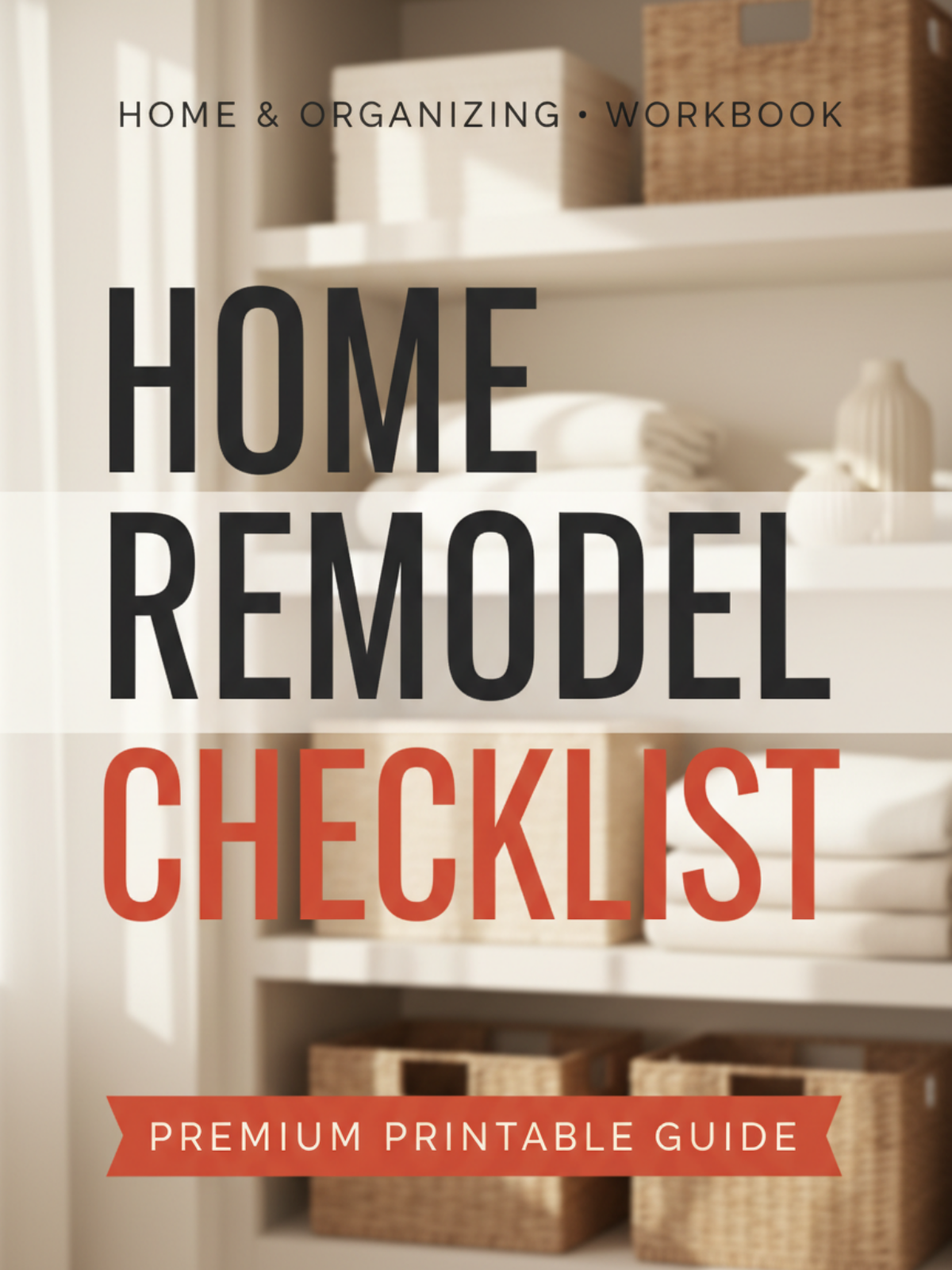
The full workbook, ready to print
- ✓Room-by-room scope worksheet that turns "everything" into priced line items
- ✓Trade sequencing chart with the reason each step precedes the next
- ✓Budget tracker with contingency math and overrun-trigger list
- ✓Permit checklist split by kitchen, bath and structural projects
- ✓DIY-or-hire decision flowchart by trade and risk level
- ✓Contractor comparison grid plus bid and change-order management sheets
- ✓Week-by-week timeline template for a whole-floor remodel
- ✓Local ROI research method and true profit-margin formula
Hosted on FileJoker. Premium members download instantly; free download has a wait.
In a hurry? Free one-page checklist31 items to tick off · print-ready PDF, no sign-upDownload freeIncluded bonuses — free with the guide
1 extra guide from the same topicA look inside the PDF
11 sections · 31 pages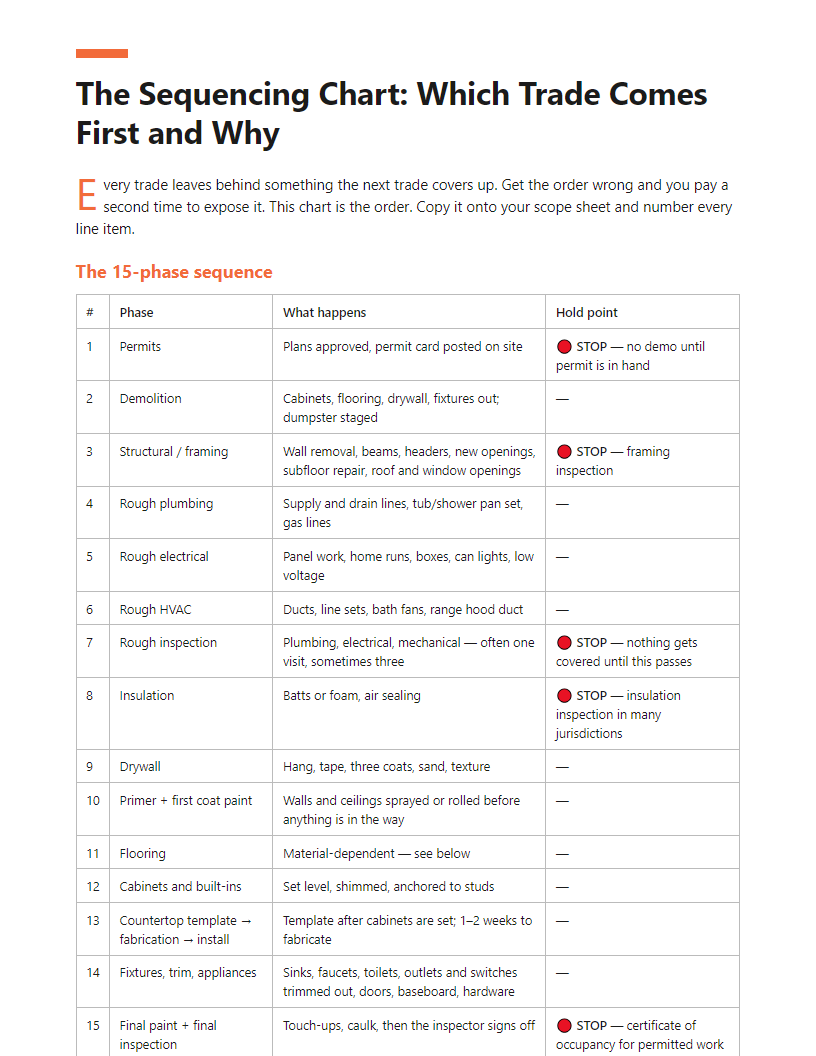
Full table of contents
- Why Most Remodel Checklists Fail You
- Scope Definition: Turning 'Everything' Into a Line-Item List
- The Sequencing Chart: Which Trade Comes First and Why
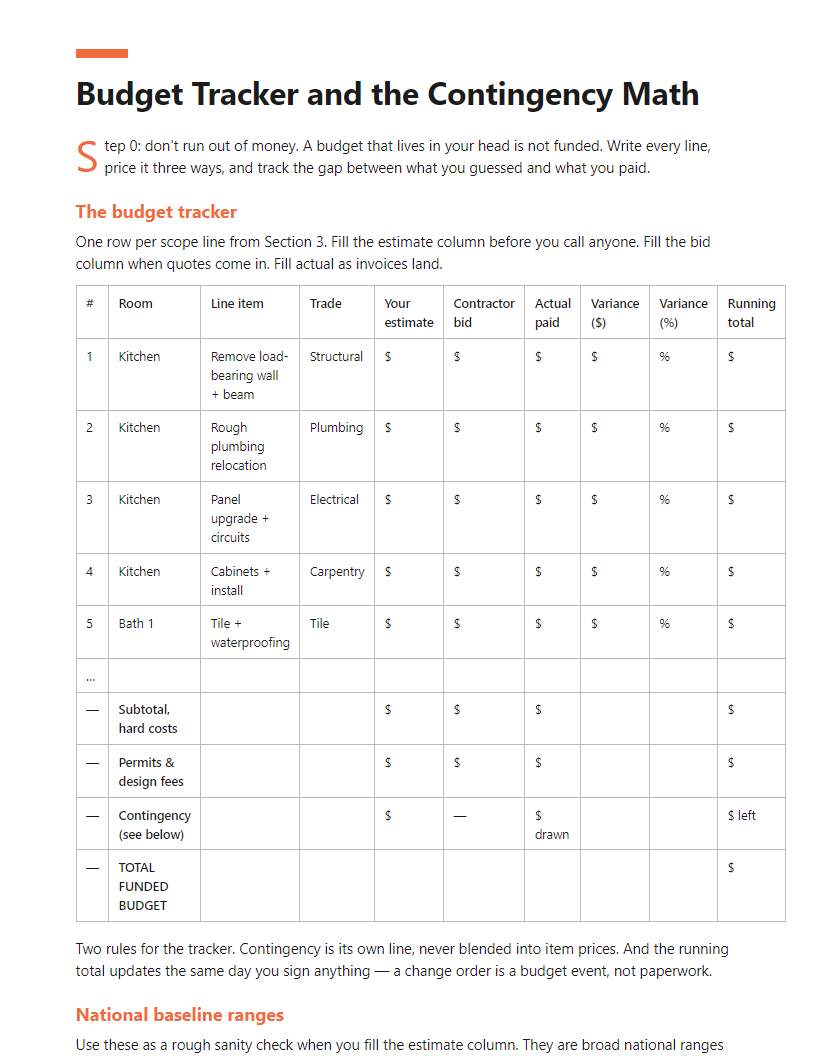
- Budget Tracker and the Contingency Math
- Permit Checklist by Project Type
- DIY or Hire a Pro: The Decision Framework
- Contractor Comparison and Management Sheets
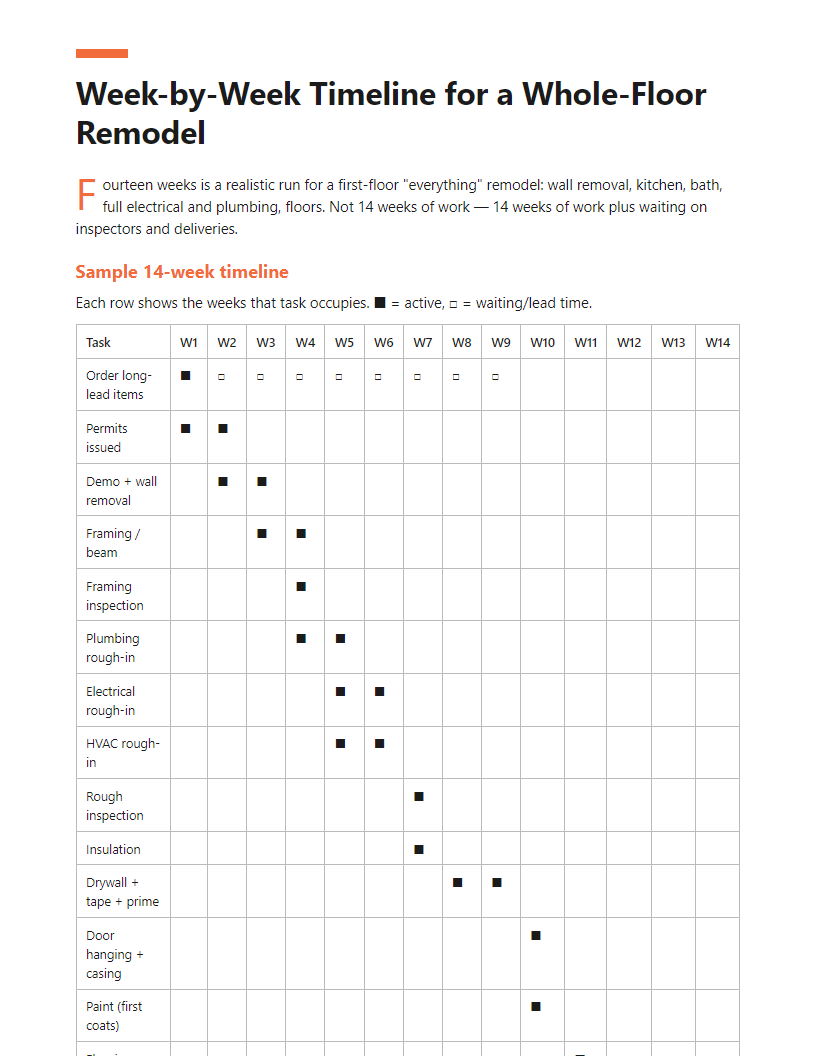
- Week-by-Week Timeline for a Whole-Floor Remodel
- Resale Value and True ROI for Your Local Market
- Ten Remodel Mistakes That Cost the Most Money
- Master Pre-Demolition Checklist
In this article
“We want to redo everything, but we don’t know what happens first — or whether the money will last.” If that sounds like your kitchen-table conversation, this home remodel checklist is built for you. Most lists tell you to “set a budget” and “hire a contractor” and stop there. Here you get the actual sequence of trades, why plumbing comes before drywall and cabinets after flooring, a contingency rule that survives contact with reality, and a plain-English view of when permits get pulled.
The premium PDF workbook goes further: room-by-room line items, a budget tracker with contingency math, a permit checklist by project type, contractor comparison sheets, and a week-by-week timeline you can hand to your crew.
The short answer
Work a home remodel in this order:
- Plan and scope — line-item every room, set a budget with 20–30% contingency.
- Permits and design — apply before demolition, not after.
- Demolition and structural work.
- Rough-in — framing, plumbing, electrical, HVAC, then inspection.
- Insulation and drywall, then paint primer.
- Flooring, then cabinets and trim.
- Fixtures, countertops, appliances and final electrical.
- Final paint, punch list, final inspection.
Rule of thumb: anything hidden inside walls or floors gets done before anything that covers it.
Why Most Remodel Checklists Fail You
Most remodel checklists are a list of rooms with a box next to each. That’s not a plan. Three things break them.
1. Scope says “everything.” One line item reading “kitchen” hides demo, wall removal, rough plumbing, electrical, drywall repair, cabinet install, counter template, flooring, and paint. You can’t budget or schedule a word like “everything.”
2. Tasks have no order. “In what order should home renovations be done?” is the question that stalls jobs. Flooring before cabinets or after? Paint before or after trim? Guess wrong and you pay to redo work.
3. The contingency isn’t funded. A number written in a margin is not money. Unfunded, the first opened wall stops the job.
What replaces the checklist
| Worksheet | Section | What it settles |
|---|---|---|
| Sequencing chart | 4 | Which trade comes first, and why |
| Budget tracker + contingency math | 5 | Real dollars set aside, not a guess |
| Contractor scorecard | 8 | A ranked shortlist, scored the same way |
| Week-by-week timeline | 9 | Dates per trade, not “spring” |
One bathroom or a whole first floor
The system scales. For one room, fill out one scope sheet, one sequence column, one budget tab. For a whole floor before move-in, copy the sheets per room, then stack them on the single timeline in Section 9. The trade order does not change — only how many times you run it.
Who is the boss
Write this down before you hire anyone. You own the scope, the budget ceiling, and the change-order approvals. The general contractor owns the schedule, the subs, the site, and the permits they pull. Blurred lines cause most billing disputes.
15-minute setup
Before Section 2, put these in one folder:
- Closing documents or deed, plus any HOA rules
- A floor plan or a hand sketch with measured room dimensions
- Your current savings figure available for this project
- Recent utility bills (helps size electrical and HVAC questions later)
The Short Answers: Order of Work, the 30% Rule, and the Biggest Cost
In what order should renovations be done?
Work from the bones out. Every trade you run in the wrong order gets torn out and paid for twice.
- Structural — foundation, framing, wall removal, roof, windows, exterior envelope.
- Rough-in trades — HVAC ducts first (biggest, least flexible), then plumbing, then electrical.
- Insulation and drywall — after rough-in passes inspection, not before.
- Finishes on walls and trim — primer, first coats, door casings.
- Flooring — after the dusty work, before cabinets in most kitchens.
- Cabinets, counters, fixtures, appliances — counters get templated after cabinets are set.
- Paint touch-up and punch list — last, once everything else has stopped scratching things.
Tip: The rule underneath the order is simple: dirty before clean, hidden before visible, heavy before delicate.
What is the 30% rule?
It means two different things, and you need both.
| Version | What it says | How to use it |
|---|---|---|
| Contingency | Add 20–30% on top of contractor bids | Money in the account, untouched, before demo day |
| Spending ceiling | Don’t sink more than ~30% of your home’s value into a remodel | A limit on total scope, not a target |
Use 20% for cosmetic work in a newer house. Use 30% when you’re opening walls in an older home, where you don’t know what’s behind the plaster until it’s down.
Warning: Running out of money mid-project is worse than not starting. A stalled remodel with open walls costs you in storage, rent, re-mobilization fees, and a contractor who moved to another job.
What’s the most expensive part?
The kitchen, per square foot. It packs cabinets, counters, appliances, plumbing, electrical, and ventilation into a small footprint. Bathrooms come second for the same reason.
The most expensive line items, in any room:
- Structural changes — removing a load-bearing wall, adding a beam, changing the roofline
- Moving plumbing — a relocated toilet, sink, or drain line means opening floors
- New window and door openings in exterior walls
Keep sinks and toilets where they are and you protect your budget more than any other single decision.
Do you need a permit?
Fast rule: moving walls, wires, pipes, or windows = permit. Swapping like-for-like finishes — paint, flooring, a new faucet in the old spot, cabinet doors — usually doesn’t. Verify with your local building department; rules vary by city.
When should you move in?
Move in after the job is 100% complete: final inspection passed, punch list closed, final paint done. That’s the last phase of the sequence for a reason. Trim, counters, tile, and fixture trim-out all come after drywall, and all of them need open floors, clear rooms, and crews who aren’t working around your furniture.
Moving in early is a fallback, not a plan. If the rent-plus-storage math doesn’t work, know what you’re buying:
- Slower finish work, because crews protect and work around your things
- Dust in everything you own — finish sanding, tile cutting, and flooring all still produce it
- Punch-list items you live with instead of fix, because nobody wants to move the couch twice
- No full-house shutoffs for water or power without planning around your schedule
Warning: Don’t move in before the final inspection on permitted work. Occupying ahead of a certificate of occupancy can stall your sign-off and complicate insurance claims.
If you have to do it, move into finished rooms only, seal the doorways with plastic and zippers, and put your move-in date in writing with the contractor so the schedule accounts for it.
Ten Remodel Mistakes That Cost the Most Money
Each of these is common, expensive, and avoidable on paper.
1. Ordering finishes before rough-in passes inspection
Cabinets and tile get ordered off the plan. Then the plumber moves a drain 4 inches to clear a joist, and the vanity no longer fits. Order finishes after the rough-in inspection sticker is on the wall, not before.
2. Skipping the permit
Unpermitted work surfaces twice: when you sell, and when you file an insurance claim. A buyer’s agent pulls the permit history. An adjuster asks who did the wiring. Then you’re opening finished walls to show an inspector what’s behind them.
Warning: Permits follow the house, not the contractor. If your contractor offers to skip one to save time, you carry that problem, not them.
3. No contingency — or spending it on upgrades
Step 0: don’t run out of money. A contingency is for rot, old wiring, and bad subfloor. It is not for the upgraded faucet. Once you spend it on a want, the next surprise stops the job.
4. Verbal change orders
“We’ll figure it out later” becomes a line on the final invoice you can’t argue with. Every change gets written: what changed, the price, the new completion date, both signatures. A text message counts. A conversation doesn’t.
5. Paying too much up front
Use the draw schedule from Section 5: 10% at signing, the bulk in progress draws tied to completed phases, 10% held until the punch list is closed.
Never pay in full before that last walkthrough. The final 10% is the only leverage you have to get the trim caulked and the outlet cover on. A contractor who wants half the job’s cost on day one is telling you they’re funding someone else’s project with your money.
6. Measuring once
A 24-inch clearance and a 24-foot clearance are one typo apart. Measure the appliance box, not the spec sheet. Check door swing against drawer fronts, refrigerator depth against the counter overhang, and the path from the front door to the room.
Tip: Walk the delivery route with a tape before you order anything larger than a dishwasher. Stairwell turns kill more appliances than tight kitchens do.
7. Picking trend finishes your buyers don’t want
The classic version: taking a small third bedroom and turning it into a walk-in closet or a home gym. You love it for five years. Then your house lists as a 2-bedroom and never shows up in the searches buyers actually run. Same square footage, smaller pool of buyers, lower price. Check what sold near you in the last six months before you delete a room.
8. Hiring out what you could do, or DIYing what you can’t
Gas, structure, and service panels go to a licensed pro. Painting and demo are yours if you have the time.
9. Living in the house without a plan
Decide up front where you cook, shower, and sleep in weeks 4 through 10. Hotel nights are a budget line.
10. Forgetting you’re the boss
You write the checks and you live there. Ask for the schedule, ask what’s behind the delay, and ask for it in writing.
Frequently Asked Questions
What is the 30% rule of home renovation?
It means two things — a contingency rule and a value ceiling — and both are answered in full in Section 2: The Short Answers. The short version: don’t sink more than about 30% of your home’s current value into a remodel, and set your contingency by scope risk using the table in Section 5, repeated here:
| Scope type | Contingency |
|---|---|
| Cosmetic only — paint, flooring, fixtures, no walls opened | 15% |
| Kitchens and bathrooms — wet walls opened, plumbing moved | 20–25% |
| Home over 40 years old, or any structural change | 30%+ |
Keep that money in a separate account and only move it out with a written change order.
Warning: Running out of money mid-project is the expensive failure. A stalled job means demobilized crews, expired permits, and higher prices when you restart.
In what order should home renovations be done?
Bones first, finishes last: structure, exterior dry-in, rough mechanicals, inspection, drywall, paint, flooring, cabinets, fixtures. The full ordered list is in Section 2 — run the trades out of order and you pay to expose the same work twice.
What is the most expensive part of a house to remodel?
Kitchens, per square foot, with bathrooms second, because both stack the most trades into the smallest space. Section 2 breaks down the priciest line items, and structural work can beat both as a one-time surprise.
Do I need a permit for a bathroom refresh?
Usually not for cosmetic swaps — paint, a new vanity top, a mirror, a towel bar, a toilet replaced in the same spot with the same drain. You usually do need one the moment you move a drain, add a circuit, change the shower valve, relocate a fan vent, or open a wall.
The trap is scope creep. A “refresh” that starts as new tile often turns into a new valve and a moved supply line once the wall is open, and that’s permit work. Decide before demo, not after.
Rules vary by city and county. Call your building department and describe the job in one sentence before you start. It’s a five-minute call, and it’s cheaper than a stop-work order or a failed inspection at resale.
Tip: Ask two questions on that call: what needs a permit, and which inspections are required at which stages. Write the answers into your timeline.
What is the ultimate checklist for home renovation?
There isn’t one list that fits every house, and any checklist claiming otherwise is a list of rooms with boxes next to them. Your 1920s bungalow has knob-and-tube wiring and no subfloor insulation. A 2005 build has neither problem and a different set of them.
What transfers is the system: line-item scope, trade order, funded contingency, permit list, scored contractors, and a week-by-week timeline. Build your own list from those six parts, in that order, and revise it after every inspection. That’s what the workbook pages are for.
Should I move in before or after the remodel?
After, if you can. Finish to 100%, then move. Punch-list items stall for months once furniture is in the way, and living in dust with no working kitchen wrecks both the schedule and your patience.
Budget for a storage unit and temporary housing as real line items in the tracker, not as an afterthought you cover with contingency cash. Price them for the full timeline plus two weeks. Then stay out of the crew’s way.
- ✓Room-by-room scope worksheet that turns "everything" into priced line items
- ✓Trade sequencing chart with the reason each step precedes the next
- ✓Budget tracker with contingency math and overrun-trigger list
- ✓Permit checklist split by kitchen, bath and structural projects
- ✓DIY-or-hire decision flowchart by trade and risk level
- ✓Contractor comparison grid plus bid and change-order management sheets
- ✓Week-by-week timeline template for a whole-floor remodel
- ✓Local ROI research method and true profit-margin formula
Frequently asked questions
What is the 30% rule in home renovation?
The 30% rule says you should hold roughly 30% of your project budget in reserve for surprises — or, in the resale version, avoid spending more than 30% of your home's value on one renovation. For older homes, budget the full 30% contingency: rot, outdated wiring, failed subfloor, asbestos tile and code upgrades are the usual triggers. Newer homes can often work with 15–20%.
In what order should home renovations be done?
Structural and hidden work first, finishes last. Sequence: planning and permits, demolition, structural repairs, roof and windows, rough plumbing/electrical/HVAC, inspection, insulation and drywall, primer, flooring, cabinets, trim, countertops, fixtures and appliances, final paint, punch list. The reason is simple: every step should not be damaged or removed by the step that follows it.
What is the most expensive part of a house to remodel?
Kitchens are typically the costliest room per square foot, driven by cabinets, countertops, appliances and combined plumbing, electrical and ventilation work. Bathrooms cost more per square foot but are smaller overall. Structural changes — moving load-bearing walls, foundation repair, re-roofing or a full rewire — can outrun both, because they add engineering fees, permits and inspections.
How do I know which tasks are safe to DIY?
Use a risk test: if failure can cause fire, flooding, collapse or a failed inspection, hire a licensed pro. That means electrical panels, gas lines, load-bearing changes and main drain work. Demolition, painting, tiling, trim, landscaping and fixture swaps are realistic DIY. Also check whether your jurisdiction allows homeowner permits — some work must be signed off by a licensed trade.
Which permits will my remodel need?
Most US jurisdictions require permits for structural changes, new or relocated plumbing and electrical, HVAC replacement, window enlargement, decks and additions. Like-for-like cosmetic work — paint, flooring, cabinet replacement without moving utilities — usually does not. Apply before demolition. Unpermitted work commonly surfaces at resale and can force you to open finished walls for inspection.
How do I stop the budget from running out mid-project?
Price a line-item scope instead of a room total, get three written bids on the same specification, and lock a contingency of 20–30% before you sign anything. Pay on a milestone schedule tied to completed, inspected work — never a large deposit up front. Track actual versus estimated spend weekly, and freeze the scope once demolition starts; change orders are the biggest single overrun.
We collected 40 real questions and comments about "home remodel checklist" (36 from YouTube comments, 4 from People Also Ask), grouped them into 10 recurring problems, and built this guide to resolve the 6 that block people most. The top-ranking pages were reviewed for gaps; 7 of those gaps became dedicated sections.
Edited by Alex Hirn · Last updated September 25, 2026 · How we make our guides
More in Home & Organizing
 free
 premium+1 bonus
 premium+1 bonus
 premium+1 bonus