Workbook · 25-page PDF · Premium
Protein Meal Prep: A Weekly System for Hitting Your Protein Target
Protein meal prep as a system: daily protein maths, source-by-source gram tables, safe storage windows, plus a fill-in planner and shopping list. Get the guide.

The full workbook, ready to print
- ✓Fill-in weekly portion planner with grams of protein per meal and daily totals
- ✓The 90-minute Sunday cook session, timed step by step
- ✓Weighing and portioning methods for precise macros — with and without a scale
- ✓High-protein breakfast formats (sandwiches, oats, pancakes, bowls) with prep-ahead instructions
- ✓Storage, reheating and container charts: fridge and freezer windows per food type
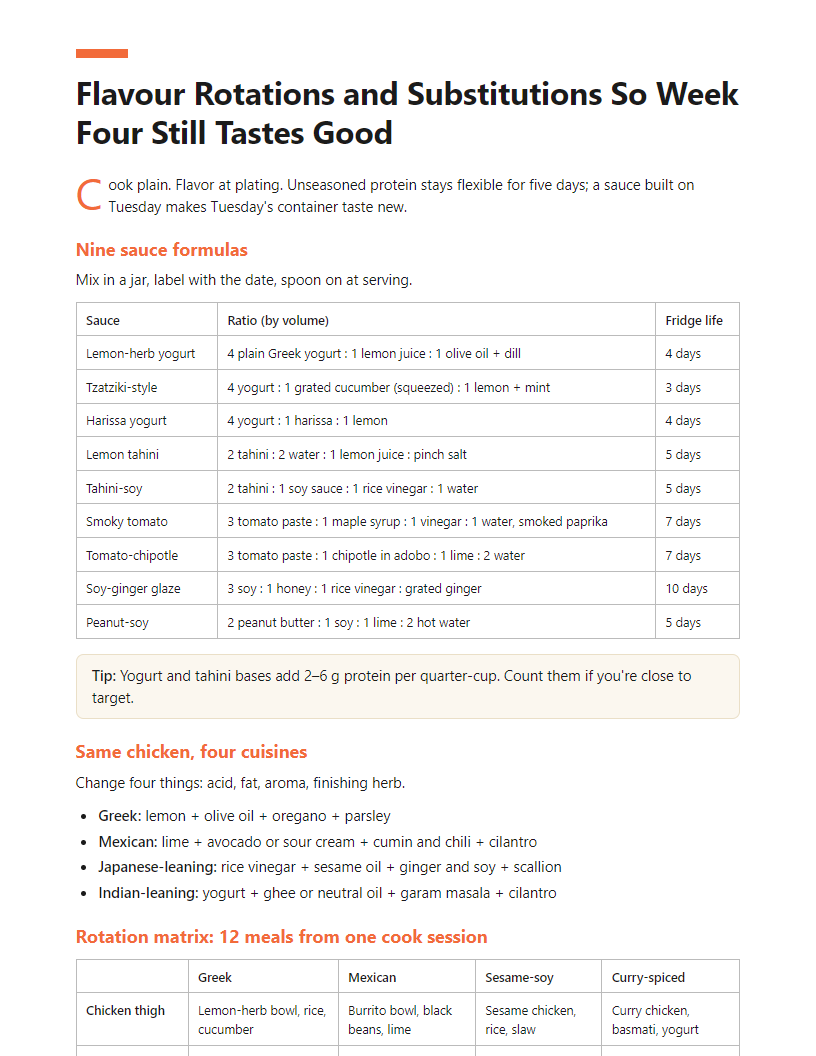
- ✓Four-week flavour rotation and substitution tables (low-spice, IBS-friendly, allergy swaps)
- ✓Sunday prep checklist and printable shopping list template
Hosted on FileJoker. Premium members download instantly; free download has a wait.
In a hurry? Free one-page checklist30 items to tick off · print-ready PDF, no sign-upDownload freeIncluded bonuses — free with the guide
2 extra guides from the same topic Free PDF · 18 pagesThanksgiving Meal Checklist: From 14 Days Out to LeftoversBuild a Thanksgiving meal checklist that works: menu, guest count, shopping quantities and an hour-by-hour oven plan. Free printable checklist inside.
 Free PDF · 16 pagesBest Meal Prep Recipes: A 5-Day No-Repeat Plan That Holds UpBest meal prep recipes without the Day 3 boredom: a 5-day no-repeat framework, storage timelines, verified macros, plus a free planner and shopping list.
A look inside the PDF
11 sections · 25 pages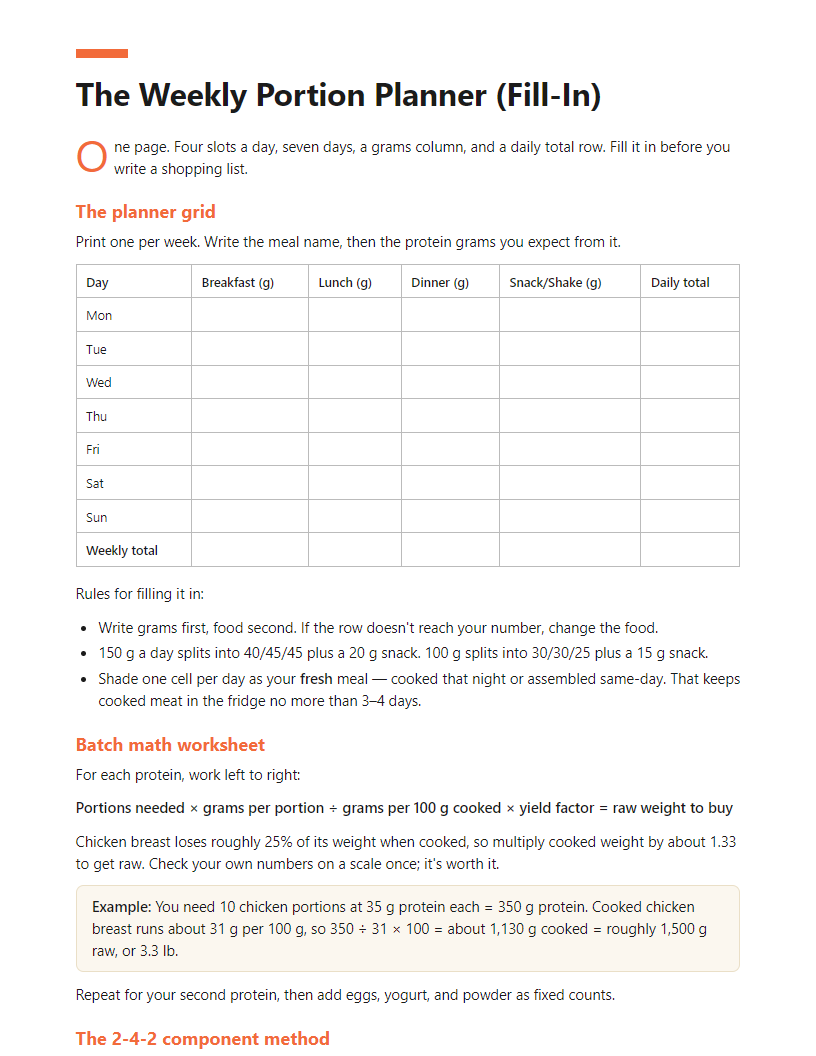

Full table of contents
- Your Daily Protein Number — and How to Split It
- Protein Source Ledger: Grams, Cost and Prep Suitability
- The Weekly Portion Planner (Fill-In)
- The 90-Minute Cook Session, Step by Step
- Weighing and Portioning Without Guesswork
- High-Protein Breakfast Formats You Can Prep Ahead
- Shakes, Smoothies and Powder Mixes Prepped Ahead
- Storage, Reheating and Container Charts
- Flavour Rotations and Substitutions So Week Four Still Tastes Good
- Nine Mistakes That Wreck a Protein Prep Week
- Sunday Prep Checklist and Shopping List Template
In this article
“I cook all Sunday and still land 40g short by dinner.” If that sounds familiar, the problem usually isn’t willpower — it’s that protein meal prep built on a pile of saved recipes has no maths behind it, no portion plan, and no answer for week three when every container tastes the same.
This page gives you the thinking: how to set your daily number, split it across meals, compare protein sources by grams and cost, and store shakes and cooked meat safely.
The premium PDF turns it into paperwork you can actually use — a fill-in weekly portion planner, a timed 90-minute cook session, weighing methods that work without scale expertise, storage and reheating charts, and flavour rotations that keep week four edible.
The short answer
Protein meal prep works when you treat it as arithmetic, not recipes:
- Set your daily number — roughly 1.6–2.2g per kg of body weight, or 100–150g for most adults.
- Divide by meals — four eating occasions at 30–40g each hits 120–160g.
- Anchor each meal with one measured protein source (chicken thigh, lean beef, salmon, eggs, Greek yoghurt, tofu, lentils).
- Cook once, portion immediately into weighed containers while food is hot.
- Cool fast, refrigerate 3–4 days, freeze the rest.
- Rotate sauces and spices, not the base proteins, to stay interested.
Why Recipe Lists Fail and Systems Don’t
You cooked five containers of chicken and rice on Sunday. By Wednesday you were buying a burrito. That’s not a willpower problem — it’s a missing system.
The three failure points
- No gram target. “More protein” isn’t a number. Without a daily gram figure, you can’t tell if six containers is enough or twice what you need.
- No variety plan. Same meat, same sauce, same texture, five days running. Your palate quits before your discipline does.
- No storage plan. Cooked chicken doesn’t last the week in the fridge. When day-five food smells off, you throw it out and order in.
Why identical boxes burn out
Five identical meals is a batch, not a system. One flavor, one cooking method, zero flexibility. Change your training day, work late, or get invited out, and the whole stack collapses. A system assumes those things will happen.
The four parts
| Part | What it answers |
|---|---|
| 1. Target | How many grams per day, split across how many meals |
| 2. Portion Planner | Which protein, what weight, which day |
| 3. Shopping List | Exact pounds and ounces to buy, once |
| 4. Storage & Flavor Rotation | How long it keeps, how to reheat, how to make week four taste different |
How to use this workbook
Work through the fill-in pages in order. Sections 2 and 3 set your numbers. Sections 4 through 12 are the repeatable part: one 90-minute cook session, plus a short second prep day midweek to cover the back half.
Warning: Figures here follow published dietary guidance for general healthy adults. Kidney disease, pregnancy, or any prescribed medical diet means your protein target is a conversation with your clinician, not a worksheet.
Your Daily Protein Number — and How to Split It
Your target is a number, not a feeling. Calculate it once, write it down, and plan every container against it.
Pick your range
For trained people, the commonly cited range is 1.6–2.2 g of protein per kg of bodyweight (roughly 0.7–1.0 g per pound). Where you land depends on your goal:
- Fat loss (cut): top of the range, 2.0–2.2 g/kg. Eating in a calorie deficit raises your protein need — it protects muscle while you lose weight and keeps you full on fewer calories.
- Maintenance: 1.6–1.8 g/kg.
- Muscle gain: 1.8–2.0 g/kg. Extra calories do the building; you don’t need to push protein higher.
Your number, by bodyweight and goal
| Bodyweight | Goal | Daily protein | Per meal (3 meals) | Per meal (4 meals) |
|---|---|---|---|---|
| 132 lb (60 kg) | Cut | 130 g | 43 g | 33 g |
| 132 lb (60 kg) | Maintain | 110 g | 37 g | 28 g |
| 132 lb (60 kg) | Gain | 120 g | 40 g | 30 g |
| 165 lb (75 kg) | Cut | 165 g | 55 g | 41 g |
| 165 lb (75 kg) | Maintain | 135 g | 45 g | 34 g |
| 165 lb (75 kg) | Gain | 150 g | 50 g | 38 g |
| 209 lb (95 kg) | Cut | 210 g | 70 g | 53 g |
| 209 lb (95 kg) | Maintain | 170 g | 57 g | 43 g |
| 209 lb (95 kg) | Gain | 190 g | 63 g | 48 g |
Split it across three meals plus a snack
Even splits are easier to prep than a huge dinner. Here’s the arithmetic for three common totals:
- 100 g/day: 30 + 30 + 25 breakfast/lunch/dinner, plus a 15 g snack.
- 130 g/day: 40 + 40 + 35, plus a 15 g snack.
- 150 g/day: 40 + 45 + 45, plus a 20 g snack.
The anchor + booster rule
Forty grams in one sitting sounds like a lot until you stack it. Build every meal from one anchor (25–35 g) plus one booster (8–15 g).
- Anchors: 5 oz chicken breast, 6 oz ground turkey, 1 cup cottage cheese, a scoop of whey, 6 oz salmon.
- Boosters: 2 whole eggs, ¾ cup Greek yogurt, ½ cup cooked lentils, 1 oz hard cheese, 2 tbsp hemp seeds.
Anchor plus booster gets you to 38–45 g almost every time, without counting each ingredient.
Tip: Cutting? Pick lean anchors and low-calorie boosters — egg whites, nonfat Greek yogurt, white fish. Same grams, fewer calories per container.
Timing: what actually matters
Daily total comes first. Even distribution across meals comes second. Everything else is noise.
You don’t need to eat within 30 minutes of training. “Pre-meal” simply means before you eat; “post-meal” means after. If you train fasted, eat a normal protein meal within a couple of hours. Spacing meals 3–5 hours apart hits distribution without any clock-watching.
Protein Source Ledger: Grams, Cost and Prep Suitability
Pick sources on four axes: grams per 100 g cooked, cost per 20 g of protein, how they taste on day 4, and whether they freeze. Raw numbers on the package will lie to you — meat loses water in the pan, so cooked weight is what lands in your container.
Master ledger
Cost bands are rough U.S. supermarket ranges — check current prices in your store and write your own numbers in the margin. Reheat score is 1 (goes rubbery fast) to 5 (tastes the same on day 4).
| Source (cooked) | Protein /100 g | Cost per 20 g protein | Reheat | Freezer |
|---|---|---|---|---|
| Chicken breast, skinless | ~31 g | $0.60–1.00 | 2 | Yes |
| Chicken thigh, skinless | ~26 g | $0.45–0.80 | 5 | Yes |
| Ground beef, 95% lean | ~27 g | $1.00–1.50 | 4 | Yes |
| Ground beef, 85% lean | ~26 g | $0.80–1.20 | 5 | Yes |
| Pork loin | ~30 g | $0.55–0.90 | 2 | Yes |
| Salmon | ~25 g | $1.50–2.50 | 3 | Yes |
| Canned tuna, drained | ~25 g | $0.60–1.00 | 5 (eat cold) | No |
| Eggs, hard-cooked | ~13 g | $0.50–0.90 | 3 | No |
| Greek yogurt, nonfat | ~10 g | $0.70–1.10 | n/a (cold) | No |
| Cottage cheese, 2% | ~11 g | $0.55–0.90 | n/a (cold) | No |
| Firm tofu | ~15 g | $0.60–1.00 | 4 | Yes (texture changes) |
| Tempeh | ~19 g | $0.90–1.40 | 5 | Yes |
| Lentils | ~9 g | $0.20–0.40 | 5 | Yes |
| Edamame, shelled | ~11 g | $0.50–0.80 | 4 | Yes |
Best protein-per-dollar for bulk buying
Lentils, eggs, canned tuna, bone-in chicken thighs, and store-brand tofu. Buy chicken thighs in family packs and trim them yourself. For cutting, lean on nonfat Greek yogurt, cottage cheese, 95% lean beef, and white fish — high grams, low calories.
Raw-to-cooked yield factors
Multiply raw weight by these to get cooked weight:
- Chicken breast and thigh: ×0.75
- Ground beef: ×0.70
- Pork loin: ×0.75
- Salmon: ×0.80
- Dry lentils: ×2.4 (they absorb water)
Example: You want 6 oz cooked chicken. Buy 8 oz raw (6 ÷ 0.75). At 31 g per 100 g cooked, that container holds about 53 g of protein.
The rubbery-by-Wednesday fix
Chicken breast and pork loin are the two that fail. Both are lean, so reheating drives out the last of their water. The fix is not a lower temperature — it’s what you do after the probe reads done.
- Pull poultry at 165°F measured in the thickest part (pork loin 145°F + 3-min rest). Don’t let it ride to 180°F.
- Rest the meat 5 minutes before you touch it, so the juices stay in the muscle instead of on the cutting board.
- Slice across the grain, in slabs no thinner than ½ inch. Thin shreds dry out by day 2.
- Store sliced, with 2 tablespoons of broth or sauce per container, so the meat sits in liquid rather than air.
- Reheat at 50% power, covered, in 60-second bursts, to 165°F.
- Or just swap to thighs and 85% lean beef for days 3 and 4.
Regional equivalents
- Mexican chorizo is raw, soft, and crumbles like ground meat. Spanish chorizo is cured and sliceable. They are not interchangeable in a recipe.
- British-style chorizo in a recipe? Smoked andouille sausage is the closest U.S. match.
- Ground beef labeling: UK “5% fat” = U.S. “95% lean.” UK “15% fat” = U.S. “85% lean.”
- Quark is hard to find in U.S. stores. Substitute nonfat Greek yogurt, or blend low-fat cottage cheese smooth for a closer texture.
Shakes, Smoothies and Powder Mixes Prepped Ahead
Yes, you can prep shakes ahead. How far ahead depends on the base liquid, and the safest version isn’t liquid at all.
Mixed shake in the fridge
A shake mixed with water and kept cold is fine for about 24 hours. A dairy base — milk, kefir, yogurt — is a shorter window: drink it the same day, within about 12 hours, and keep it below 40°F the whole time. Never leave either sitting out; a shake is a food, not a bottle of water.
Separation is normal. Whey settles, the liquid looks layered, and the top goes watery. Shake it hard for five seconds and it comes back. Separation is physics, not spoilage.
Decision tree: how to prep each base
| Base | Safe fridge window | Texture after that window | Better move |
|---|---|---|---|
| Water + whey/isolate | ~24 hrs, lid on, cold | Thin, separated, fixable by shaking | Fine to prep 1 day ahead |
| Milk or kefir | ~12 hrs, same day | Thickens, can go sour-tasting | Dry-prep the powder, add milk at drinking time |
| Yogurt-based (drinkable) | ~12 hrs | Gets gluey, hard to drink | Make it a spoonable bowl instead |
| Any base, 2+ days out | Not recommended | — | Freezer pack or dry jar |
Dry-scoop jars and baggies
This is the zero-risk method, and it takes four minutes for the whole week.
- Line up seven jars or snack bags.
- Scoop powder into each — write the grams of protein on the lid in marker.
- Add any dry extras: cocoa, instant coffee, cinnamon, powdered peanut butter.
- Keep one jar in your gym bag. Add 10–12 oz of liquid and shake.
Smoothie freezer packs
Portion fruit, spinach, and oats into freezer bags. Add liquid and powder at blend time, not before. Banana, mango, berries, and pineapple freeze and blend well. Watermelon, cucumber, and fresh apple turn to gray sludge — skip them.
Warning: Discard if you smell sour or yeasty, if the cap hisses or fizzes when you open it, or if a water-based shake has thickened into pudding. Dairy mixes sour faster and more obviously. When in doubt, pour it out — it’s $1.50 of powder.
Where shakes fit
Use a shake as a booster, not a default meal. A 25 g scoop turns a 15 g snack into a 40 g meal, or closes the gap between 120 g and your 150 g target. Chew most of your protein; drink the remainder.
Nine Mistakes That Wreck a Protein Prep Week
Nine specific errors account for most blown prep weeks. Find yours, apply the fix, move on.
1. Counting raw weight as cooked
Log 8 oz raw as 8 oz cooked and you’ve inflated that meal’s protein. Pick cooked or raw, label the container that way, and stay with it all week — see the raw-to-cooked yield factors in the protein source ledger.
2. Planning meals before you count grams
You pick recipes, then shop, then run out of protein by Thursday. Reverse it. Multiply your daily target by 7 first — at 150 g a day that’s 1,050 g for the week — then buy to that number.
3. Part-cooking meat to “finish later” with no thermometer
A reader pointed this out on a recipe: the chicken went in at the end for only a minute or two. That’s a real risk. If you pull meat early, it has to reach a safe internal temperature in the second cook — use an instant-read thermometer, not color or timing.
Warning: Cut thick pieces smaller before the finish cook, or they’ll be brown outside and under-temp in the middle.
4. Packing food while it’s still warm
Warm food in a sealed lid steams itself and holds the container in the danger zone. Spread it on a sheet pan, cool it fast, then lid and refrigerate.
5. Cooking lean protein to death
Skinless breast and 93/7 ground turkey have almost no fat to protect them. Pull them at temperature, rest them, then slice. Dry prep food isn’t a meal prep problem — it’s an overcooking problem.
6. Seven identical lunches and no breakfast
You solved one meal and left three. Mornings then default to toast and cereal at 8 g. Build breakfast containers first — that’s 30–40 g banked before you leave.
7. Dressing salads and grains on Sunday
Dressing wilts greens and grains soak it up by Tuesday. Pack sauce in a 2 oz cup or jar and add it at the plate. Same food, five different days.
8. Freezing things that don’t freeze
| Freezes fine | Doesn’t |
|---|---|
| Chili, stews, cooked ground meat, soups | Cottage cheese, yogurt, boiled eggs, raw greens, cream sauces |
9. Ignoring sauce calories
Two tablespoons of a mayo- or oil-based sauce can run 150–200 calories. Four meals a day and your deficit is gone. Weigh sauces into the same log as the protein, or build yours on Greek yogurt, mustard, vinegar, hot sauce and citrus.
Questions Readers Ask Most
What is a good protein for meal prep?
Judge on three things: grams per 100 g cooked, cost per 20 g, and how it tastes on day 4. The top three for most people:
| Source | Protein per 100 g cooked | Why it preps well |
|---|---|---|
| Chicken thigh | ~26 g | Fat keeps it moist after reheating; forgiving if you overcook |
| Lean ground beef or turkey (90/10) | ~26 g | Reheats evenly, freezes well, takes any sauce |
| Greek yogurt / cottage cheese | ~10 g | Zero cooking, portion straight from the tub |
Chicken breast is cheaper per gram but dries out fastest. Use it for days 1–2 and thighs for days 3–5.
How do I get 40 g at every meal?
Use an anchor plus a booster. The anchor is 5–6 oz cooked meat or fish. The booster closes the gap.
- 5 oz cooked chicken thigh (~37 g) + 2 tbsp grated parmesan (~6 g) = 43 g
- 1 cup cooked lentils (~18 g) + 1 cup cottage cheese (~24 g) = 42 g
- 4 eggs (~24 g) + ½ cup egg whites (~13 g) + 1 oz cheddar (~7 g) = 44 g
How do I get 100 g a day? And 150 g?
Example — 100 g in three meals:
| Meal | Food | Running total |
|---|---|---|
| Breakfast | 3 eggs + ¾ cup cottage cheese (~36 g) | 36 g |
| Lunch | 4 oz chicken thigh (~30 g) + rice | 66 g |
| Dinner | 4 oz ground beef (~30 g) + ½ cup beans (~7 g) | 103 g |
Example — 150 g in four: add a shake (1 scoop whey, ~24 g) mid-afternoon, swap the beef for a 6 oz salmon fillet (~38 g), and add 1 cup Greek yogurt (~18 g) at night. That lands near 153 g.
Can I prep protein shakes ahead?
Yes, with limits, and the limit depends on the liquid. A shake mixed with water keeps about 24 hours in a sealed bottle in the fridge. A dairy base — milk, kefir, drinkable yogurt — is a same-day job: drink it within about 12 hours and keep it below 40°F the whole time. Never prep either one 2 or more days out.
Shake it again before drinking, because powder settles. Separation is normal, not spoilage.
The safer version: pre-portion dry powder into small jars or bags for the week, add liquid when you drink it. Dry powder keeps until its label date.
Is it safe to cook chicken part-way and finish it later?
No. Partially cooking meat, chilling it, then finishing it days later leaves the meat in the temperature danger zone long enough for bacteria to multiply. Cook chicken fully to 165°F at the center, chill it fast, then reheat to 165°F when you eat it.
Warning: The “cook it 70% and finish in the pan” trick only works inside one cook session, with no cooling in between. It is not a prep-week method.
Do I need protein right after training?
Total daily grams matter far more than the clock. If you hit your number across the day, a meal within a couple hours of training is fine. Pre-meal and post-meal simply mean before and after eating — not a rule you need to build your prep around.
How far ahead can I prep?
Four days in the fridge. Cook Sunday, eat through Wednesday. Freeze Thursday and Friday portions on Sunday — ground meat, chili, cooked beans, shredded chicken and cooked rice all freeze well. What doesn’t: cottage cheese, yogurt, hard-boiled eggs, dressed salad and cooked potatoes. Keep those for the first few days.
- ✓Fill-in weekly portion planner with grams of protein per meal and daily totals
- ✓The 90-minute Sunday cook session, timed step by step
- ✓Weighing and portioning methods for precise macros — with and without a scale
- ✓High-protein breakfast formats (sandwiches, oats, pancakes, bowls) with prep-ahead instructions
- ✓Storage, reheating and container charts: fridge and freezer windows per food type
- ✓Four-week flavour rotation and substitution tables (low-spice, IBS-friendly, allergy swaps)
- ✓Sunday prep checklist and printable shopping list template
Frequently asked questions
Which proteins hold up best for meal prep?
Chicken thighs, lean minced beef and turkey, pork loin, salmon, firm tofu, lentils, eggs and Greek yoghurt all prep well. Thighs and mince stay moist after reheating; chicken breast and white fish dry out unless sauced or undercooked slightly. Yoghurt, cottage cheese and tinned fish need no cooking at all and add 20–25g per portion in seconds.
How do I get 40g of protein in one meal?
Build it from one anchor plus one booster. A 150g cooked chicken breast gives about 45g. Otherwise: 120g cooked beef mince (30g) plus 30g grated cheese (7g); or 200g Greek yoghurt (20g) with a scoop of whey (24g). Weigh the anchor raw, aim for 150–180g raw meat per portion, and check labels rather than guessing.
How can I reach 100–150g of protein a day?
Spread it over four occasions rather than chasing it at dinner. Breakfast 30g (eggs, yoghurt, high-protein oats), lunch 40g (prepped bowl), snack 25g (shake, cottage cheese, jerky), dinner 40g (meat or fish plus beans). That's 135g. For 150g, add a second scoop or 100g more cooked meat. Prep the lunch and snack ahead — those are the meals people miss.
Can protein shakes and smoothies be prepped in advance?
Yes, within limits. A shaken whey or casein drink keeps 24–48 hours in a sealed bottle in the fridge; it may thicken or separate, so shake again before drinking. Never leave mixed shakes at room temperature for more than two hours. Better: pre-portion dry powder into small containers, or freeze smoothie bags and blend fresh each morning.
Is it safe to part-cook meat and finish it later?
Not in the fridge. Partially cooking meat, chilling it and finishing days later leaves it in the bacterial danger zone twice and is a known food-safety risk. Either cook fully to a verified internal temperature (75°C/165°F for poultry, 71°C/160°F for mince), cool within two hours and refrigerate — or sear and finish in one continuous session.
How do I stop prepped meals tasting bland by Wednesday?
Season the protein neutrally during cooking, then add flavour at serving. Keep three sauces in the fridge — a yoghurt-herb, a chilli-garlic and a soy-ginger — and swap them daily. Add acid (lemon, vinegar, pickles) and crunch (seeds, raw onion, slaw) after reheating. Reheat with a splash of stock or water so chicken and rice don't turn dry and rubbery.
We collected 69 real questions and comments about "protein meal prep" (28 from YouTube comments, 4 from People Also Ask, 37 from search suggestions), grouped them into 15 recurring problems, and built this guide to resolve the 7 that block people most. The top-ranking pages were reviewed for gaps; 7 of those gaps became dedicated sections.
Edited by Alex Hirn · Last updated October 2, 2026 · How we make our guides
More in Food & Meal Prep
free premium+2 bonuses
 premium+2 bonuses
 premium+2 bonuses