Workbook · 23-page PDF · Premium
How to Meal Prep: Plan, Shop and Cook a Week in 90 Minutes
Learn how to meal prep for 5 days in one 90-minute session: storage times, a budget shopping list and a flavour matrix. Get the full workbook PDF.

The full workbook, ready to print
- ✓Worksheet 1: a 5-day planning grid you fill in in 15 minutes
- ✓The Flavour Matrix: 20 meals from 6 base ingredients
- ✓Worksheet 2: costed shopping list, including a full £/$20 week
- ✓Worksheet 3: minute-by-minute 90-minute cooking schedule with one wash-up
- ✓Low-effort prep systems for ADHD, shift work and small kitchens
- ✓Mixed-taste household template for picky eaters
- ✓One-page prep day checklist to print and stick on the fridge
Hosted on FileJoker. Premium members download instantly; free download has a wait.
Included bonuses — free with the guide
1 extra guide from the same topicA look inside the PDF
11 sections · 23 pages
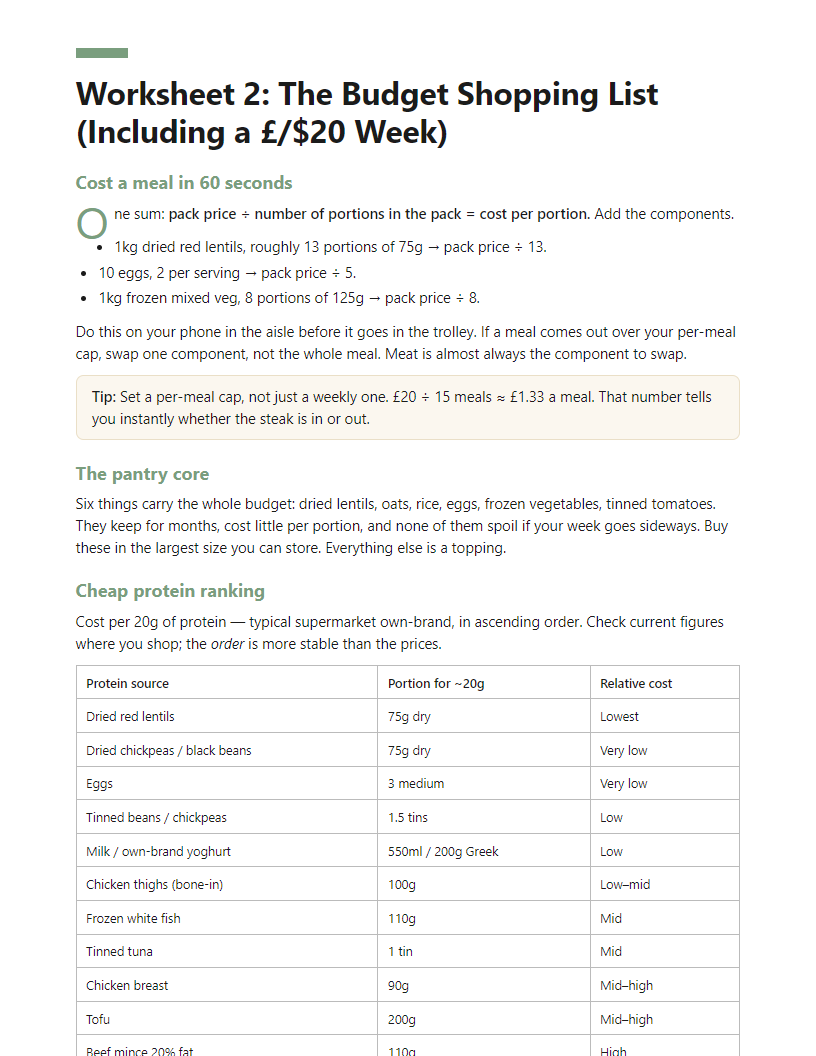

Full table of contents
- Why Meal Prep Collapses in Week Three (and What This Workbook Does Differently)
- The Short Answer: The 6-Step Weekly Loop
- Worksheet 1: Build Your 5-Day Plan in 15 Minutes
- The Flavour Matrix: 20 Different Meals from 6 Base Ingredients
- Worksheet 2: The Budget Shopping List (Including a £/$20 Week)
- Worksheet 3: The Timed Cooking Schedule (90 Minutes, One Wash-Up)
- Low-Effort Systems for ADHD, Shift Work and Small Kitchens
- Storage, Food Safety and Reheating Without Ruining the Texture
- Feeding a Household With Different Tastes
- Eight Mistakes That Make Beginners Quit
- The One-Page Prep Day Checklist
In this article
By Wednesday you’re staring at the fourth identical container of chicken and rice, and the thought of another Sunday spent shopping, chopping and washing up makes you want to order takeaway instead. That’s not a willpower problem — it’s a system problem. This page shows you how to meal prep as a repeatable six-step loop: choose a small set of base ingredients, rotate sauces and spices for variety, cook in one timed block, and store food safely with real shelf-life numbers instead of vague “about a week” advice.
The downloadable workbook goes further, with fill-in planning grids, a costed shopping list (including a £/$20 week), a minute-by-minute cooking schedule and low-effort systems for ADHD, shift work and tiny kitchens.
The short answer
How to meal prep in six steps:
- Pick 3 bases — one protein, one grain or starch, one vegetable you’ll genuinely eat.
- Choose 3 sauces to turn those bases into different-tasting meals.
- Map 5 days on one page: breakfast repeats, lunch rotates, dinner flexes.
- Write one shopping list grouped by supermarket aisle, with a budget cap.
- Cook in one 90-minute block — oven first, hob second, cold prep last.
- Cool fast, label, refrigerate 3–4 days and freeze the rest.
Repeat weekly, swapping only the sauces until you’re bored — then swap one base.
Why Meal Prep Collapses in Week Three (and What This Workbook Does Differently)
Most people don’t quit meal prep because it doesn’t work. They quit in week three, when the novelty has gone and the system’s cracks show. There are five ways it breaks.
| Collapse point | What it sounds like | Fixed by |
|---|---|---|
| Boredom | “I can’t face another container of chicken and rice” | Section 4: The Flavour Matrix |
| Decision overload | “I can barely decide what I want in the next meal, let alone Thursday’s” | Worksheet 1 |
| Prep-day exhaustion | “Planning, shopping, soaking, washing, cutting, cooking — I’m wrecked” | Worksheet 3 + Section 7 |
| Budget blowouts | Four half-used jars and a £70 shop | Worksheet 2 |
| Household mutiny | “I’m fine eating the same thing. They’re not” | Section 9 |
Work out which one breaks first for you. That’s the worksheet to start with.
Why five identical containers isn’t a system
“Cook five of the same meal on Sunday” locks in every decision before you know how you’ll feel on Wednesday. It also assumes your appetite is a machine. It isn’t. One bad reheat and the whole week goes in the bin.
Component prep solves this. You cook parts — protein, grain, sauce, vegetables — and assemble on the day. You still decide, but you’re choosing from four things you already own instead of the entire internet.
Three styles — pick one
| Style | Best if | Fridge load |
|---|---|---|
| Component prep | You get bored fast, or can’t commit to Thursday’s dinner on Sunday | 5–6 containers |
| Full-meal prep | Mornings are chaotic, you want grab-and-go | 10 containers |
| Freezer batching | Shift work, small fridge, cooking every 2–3 weeks | Freezer space needed |
You can mix them. Most people land on component prep for lunches, freezer batching for two dinners.
How to use this workbook
- Fill in Worksheet 1 — your 5-day plan, 15 minutes.
- Price Worksheet 2 — the shopping list, one shop, no top-ups.
- Follow Worksheet 3 — the timed schedule, 90 minutes, one wash-up.
Repeat weekly. The thinking is done once.
Warning: This is an organisational system, not medical or dietary advice. For calorie targets, medical conditions or specific nutrition needs, see your GP or a registered dietitian.
The Short Answer: The 6-Step Weekly Loop
The whole system is six steps. Run them in order, same day each week, and the decisions stop being decisions.
Step 1: Pick 2 proteins, 2 carbs, 3 vegetables
Nothing more in week one. Two proteins (say chicken thighs and lentils), two carbs (rice and potatoes), three vegetables (broccoli, carrots, red onion). That’s seven shopping decisions instead of thirty-five. Variety comes from sauces and spices later, not from more ingredients.
Step 2: Write the 5-day grid before you shop
Never shop undecided. Ten minutes at the table with a grid beats forty minutes wandering the shop wondering what you fancy. If you can’t decide what you’ll want on Thursday, don’t try — plan components, not fixed meals, so Thursday-you still picks the combination.
Step 3: Shop once, from a single ordered list by aisle
One trip. One list, grouped by aisle so you walk the shop in a straight line. No mid-week top-ups, because that’s where the money and the time leak out.
Step 4: Cook in a fixed order
Oven first, stovetop second, cold assembly last.
| Stage | What goes in | Roughly |
|---|---|---|
| Oven | Protein, roasting veg, potatoes | 40–50 min, hands-off |
| Stovetop | Rice, lentils, sauces | 20–25 min |
| Cold | Salad, dressings, portioning | 15–20 min |
Doing all the raw meat at one point means one cutting board, one knife, one wash-up — not five across the week.
Step 5: Store labelled and dated, eat-first at eye level
Write the food and the date on every container. Put the things that spoil soonest on the middle shelf at eye level. You should never open the fridge and have to think.
Step 6: Wednesday refresh — 10 minutes, not a second cook
Wednesday is when food gets dull. Spend ten minutes adding something fresh: a new sauce, herbs, a fried egg, lemon and chilli. You’re changing the top note, not cooking again.
Tip: Benchmark for week one is roughly 90–120 minutes of prep for 10–12 portions. If you’re going over two hours, you picked too many ingredients in Step 1.
Storage, Food Safety and Reheating Without Ruining the Texture
How long it actually keeps
“Is meal prepping for 5 days safe?” Mostly yes — for the right foods. Cooked chicken sits comfortably at 3–4 days. Fish, cut salad and cooked rice do not. Plan your week so the short-life items get eaten Monday and Tuesday.
These are conservative working numbers based on standard public guidance (FSA in the UK, USDA in the US). Check current figures for your country and use your own judgement.
| Food (cooked/prepped) | Fridge days | Freezer months | Reheating note |
|---|---|---|---|
| Chicken breast or thigh | 3–4 | 3 | Low and slow, lid on, splash of water |
| Beef or turkey mince | 3–4 | 3 | Reheat in a pan with a little liquid |
| Pork shoulder, braised | 3–4 | 3 | Reheats well in its own juices |
| White fish | 1–2 | 2 | Eat cold or warm gently; overheats fast |
| Hard-boiled eggs | 5–7 (in shell) | Don’t freeze | Eat cold |
| Cooked rice | Up to 3, but only if cooled within an hour | 1 | Steaming hot throughout, no exceptions |
| Cooked pasta | 3–5 | 2 | Undercook by 2 minutes at prep |
| Potatoes, roasted | 3–4 | Poor texture | Oven or air fryer, not microwave |
| Roasted vegetables | 3–5 | 2–3 (soft) | Oven to keep edges |
| Steamed greens | 2–3 | 2 | Best eaten cold or barely warmed |
| Soups and stews | 3–4 | 3 | Freeze flat in bags; reheat to bubbling |
| Lentils and beans, cooked | 4–5 | 3 | Add water, they thicken |
| Chilli or bolognese | 3–4 | 3 | The best freezer meal there is |
| Cut salad and raw leaves | 2–3 | Don’t freeze | Never reheated; keep dressing separate |
| Sauces and dressings | 5–7 | 2 | Shake before use |
The rice figure in that table is the one to use everywhere, including the FAQ later in this guide. If the rice was not cooled fast, eat it the same day.
Cooling, labelling, and the fridge shelf rule
Get food from hot to fridge within two hours. Spread it out — shallow trays and open lids cool faster than a deep sealed tub. Then seal and date every lid with masking tape and a marker: contents plus the date cooked.
Cross-contamination is simpler than it sounds. One board for raw meat, a different one for everything else. Raw meat on the bottom shelf, cooked food above it, fruit and veg at the top — chicken drippings can’t drip upwards. Wash your hands between raw and cooked tasks.
Warning: Rice needs its own handling. Spread it on a tray, get it into the fridge inside an hour, and reheat it once until steaming hot all the way through. Never leave it on the hob overnight. See the table above for how many days that buys you.
Reheating without the sad texture
- Rice: add a tablespoon of water, cover with a lid or damp cloth, microwave. The steam brings it back. Pack rice on top of protein and veg so it steams from below.
- Chicken: low power, longer time. Lid on, splash of liquid. High heat turns it to rubber.
- Pasta: undercook by two minutes on prep day. It finishes cooking when you reheat it.
- Roast veg and potatoes: oven or air fryer, 5 minutes. A microwave steams them limp.
Freezer rotation
Freezes well: stews, chilli, mince, braised meat, soups, cooked lentils, bread. Freezes badly: cut salad, boiled potatoes, plain steamed greens, anything creamy.
Label with the date and put new bags at the back. Eat from the front. That one habit stops the archaeology of unlabelled beige blocks.
Eight Mistakes That Make Beginners Quit
1. Prepping seven days at once
Cooked chicken and rice hold 3–4 days. Cook five days’ worth and days five to seven are a gamble you usually lose. Prep three or four days, then either freeze the rest or run a short Wednesday top-up: 20 minutes, one protein, one carb.
Tip: Cook plain and flavour at the plate — see Section 4.
2. Saucing and dressing before storage
Dressed salad goes limp in hours. Sauced grains turn to paste. Store dressings in small jars or the corner of the container, and add them when you eat.
Tip: Keep three sauces in the fridge door at all times. That’s your whole variety system in three jars.
3. Shopping for a fantasy week
You buy for the week you wish you had — five home dinners, two gym days, zero social plans. Then Thursday’s dinner out turns £6 of vegetables into bin food. Open your calendar before the shopping list. Count the meals you’ll actually eat at home, and buy for that number only.
4. Over-portioning every box
Big portions feel generous on Sunday and cost you twice. You buy more food than you need, and you bin what you don’t finish. Fill one container, eat it, and see how you feel. If you leave food two days running, drop the portion; if you’re hungry an hour later, add carbs or veg, not a second box.
5. Buying perishables for the flex slot
The unplanned meal is the one you can’t shop for. Fresh fish, salad leaves and soft fruit bought “just in case” rot by Friday. Stock the flex slot with things that wait: eggs, frozen veg, tinned beans, frozen protein.
6. Containers that don’t stack or seal
Mismatched tubs waste fridge space and leak in bags. One set, one size, stackable, same lids.
| Problem | Fix |
|---|---|
| Nothing stacks | Buy 10 identical containers, one size |
| Lids go missing | Same lid fits every box |
| Sauce leaks in your bag | Small screw-top jars for wet things |
7. Skipping labels
You open a tub on Thursday, can’t remember if it’s Sunday’s or Tuesday’s, and throw it out. That’s money in the bin on a tight budget. Masking tape and a marker: contents, date cooked. Ten seconds per box.
8. Chasing complicated recipes
Ambitious recipes are why prep day feels like a hectic mission — the soaking, the washing, the cutting, the three pans. Run the same boring loop for four weeks until it’s automatic. Add one new recipe in week five, not five new recipes in week one.
Warning: Over two hours on prep day means you’ve added something — see Section 2. A missed week is a missed week, not failure; restart at the smallest version, see Section 7.
Meal Prep FAQ
What is the 3-3-3 rule for meal prep?
Three breakfasts, three lunches, three dinners on rotation. Nine meals total, repeated. You get variety without nine different shopping lists, and the plan fits on one sticky note.
Is meal prepping for 5 days safe?
Some of it. Cooked chicken, beef, rice, beans and roast vegetables are comfortable for 3–4 days in the fridge. Cooked fish, cut salad leaves and dressed grains fade faster.
The fix is to freeze on day one, not day four. Portion days four and five into the freezer while the food is fresh, then move them to the fridge the night before you eat them.
Warning: Your fridge should run at or below 5°C / 40°F. A cheap fridge thermometer is the only way to know. Reheat to steaming hot all the way through.
How to survive on $20 a week for food?
Staples first, flavour second. Dried lentils, rice, oats, eggs, frozen vegetables and whole chicken legs do most of the work. Buy the base carbohydrate and protein in the largest pack you can afford, then spend what’s left on vegetables and one or two sauces.
Cost each meal with one sum: pack price ÷ portions in the pack. Worksheet 2 in the workbook gives you a full costed £/$20 week you can copy.
What is the 5-4-3-2-1 rule for groceries?
A shortcut for a single shop:
| Number | What to buy |
|---|---|
| 5 | Vegetables |
| 4 | Fruits |
| 3 | Proteins |
| 2 | Sauces or condiments |
| 1 | Treat |
Fifteen items, one trip, no wandering. The treat is not optional — plans without one get abandoned.
How many containers do I actually need?
For one person, five days: 10 containers (lunch and dinner), plus two or three larger tubs for bulk carbs and vegetables. Buy one size, one brand, all stackable. Mismatched lids waste more fridge space than the food does.
Tip: No fridge room with four people in the house? Store components in shallow, wide containers instead of tall ones. Two 5cm-deep boxes stack in the space one tall tub wastes.
Can I meal prep without a freezer or an oven?
Yes. Run a short cycle: prep Sunday and Wednesday, three days each, so nothing needs freezing.
Without an oven, one large frying pan, a hob pot or a slow cooker covers everything. Truck drivers and small-kitchen cooks can build a whole week on a 12V cooler, a kettle and no-cook components: tinned fish, ready-cooked grain pouches, hummus, raw vegetables, cheese, wraps.
Do I need to weigh food or count calories?
No. Use the plate: half vegetables, a quarter protein, a quarter carbohydrate. If you want official portion and nutrient guidance, check your national health service’s current eating guidelines — NHS Eatwell Guide or MyPlate.
- ✓Worksheet 1: a 5-day planning grid you fill in in 15 minutes
- ✓The Flavour Matrix: 20 meals from 6 base ingredients
- ✓Worksheet 2: costed shopping list, including a full £/$20 week
- ✓Worksheet 3: minute-by-minute 90-minute cooking schedule with one wash-up
- ✓Low-effort prep systems for ADHD, shift work and small kitchens
- ✓Mixed-taste household template for picky eaters
- ✓One-page prep day checklist to print and stick on the fridge
Frequently asked questions
What is the 3-3-3 rule for meal prep?
The 3-3-3 rule means preparing three proteins, three carbohydrates and three vegetables, then mixing them into different combinations across the week. It gives you up to 27 plate variations from nine cooked items, so meals stop feeling repetitive without extra cooking time. Some people use a stricter version: three meals, three days, three containers each — useful if fridge space is limited.
Is it safe to meal prep five days in advance?
Cooked meals keep safely for 3–4 days in a fridge at or below 5°C/41°F, so a full five days of refrigerated food is pushing past guidance. The fix is simple: refrigerate days one to three and freeze days four and five, moving them to the fridge the night before. Cool food within two hours, store in shallow containers, and reheat to 75°C/165°F.
How can you eat on $20 a week?
Build around cheap, filling bases: dried lentils, rice, oats, eggs, frozen vegetables, tinned tomatoes and a single cheap protein like chicken thighs. Cook one large pot meal plus one tray bake, then vary them with spices you already own rather than new ingredients. Buy own-brand, weigh price per kilo, and skip anything pre-chopped. The workbook includes a full costed $20 list.
What is the 5-4-3-2-1 rule for groceries?
It's a shopping shortcut: buy five vegetables, four fruits, three proteins, two sauces or spreads and one treat. The structure stops aimless wandering, keeps your trolley balanced, and gives you enough variety to build a week of meals without overbuying fresh produce that rots before you use it. Adjust the numbers up for households of three or more.
How do you meal prep when you have ADHD or low energy?
Shrink the decision load first: use one fixed weekly plan for a month so there's nothing to choose. Then split the work — shop one day, cook another, and allow semi-prep (washed, chopped, portioned components) instead of finished meals. Keep frozen vegetables and pre-cooked grains as legitimate shortcuts, prep in one pan to cut washing-up, and set a timer rather than aiming for perfection.
We collected 264 real questions and comments about "how to meal prep" (10 from Reddit threads, 191 from YouTube comments, 4 from People Also Ask, 59 from search suggestions), grouped them into 11 recurring problems, and built this guide to resolve the 6 that block people most. The top-ranking pages were reviewed for gaps; 7 of those gaps became dedicated sections.
Edited by Alex Hirn · Last updated October 17, 2026 · How we make our guides
More in Food & Meal Prep
 free
 premium+2 bonuses
 premium+2 bonuses
 premium+2 bonuses