Checklist · 27-page PDF · Premium
Household Maintenance Checklist: Every Task and How Often
Know how often every home task is due. Household maintenance checklist with frequency table, fire-and-flood priorities and printable logs. See the list.

The full workbook, ready to print
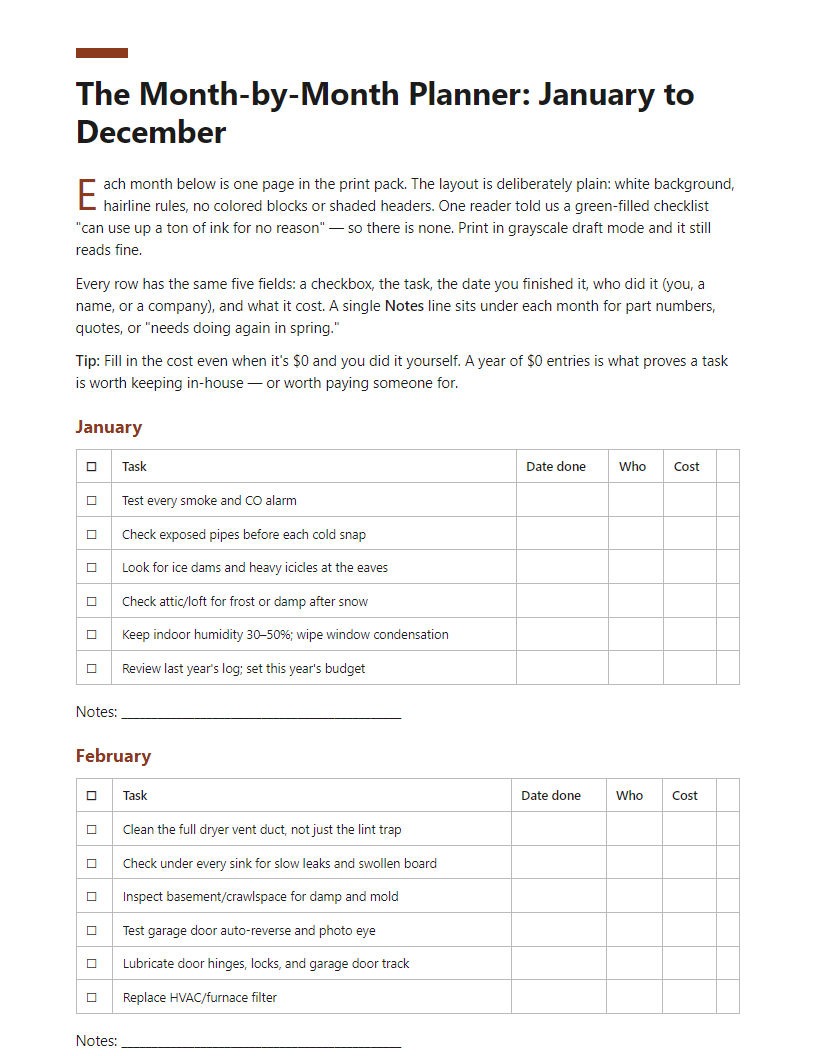
- ✓Month-by-month planner, January to December, with tick boxes for every due task
- ✓Log fields for contractor name, date completed and cost paid on each task line
- ✓The forgotten-tasks list: shut-off valves, wax rings, anode rods, chimney caps, hinges, attic leaks, vacuum filters
- ✓Catch-up protocol for fixer-uppers and long-neglected homes, in triage order
- ✓Adapted checklists for seniors, outsourcers and renters
- ✓Low-ink print pack: one-page seasonal checklists and a 10-year replacement log
Hosted on FileJoker. Premium members download instantly; free download has a wait.
In a hurry? Free one-page checklist30 items to tick off · print-ready PDF, no sign-upDownload freeIncluded bonuses — free with the guide
1 extra guide from the same topicA look inside the PDF
9 sections · 27 pages
Full table of contents
- Why 'On a Regular Basis' Is Useless — and What This Tracker Does Instead
- The Master Frequency Table: Every Task and Exactly How Often
- The Month-by-Month Planner: January to December
- The Five Tasks That Prevent Fires and Floods
- The Tasks Standard Checklists Forget
- Fixer-Uppers and Neglected Homes: The Catch-Up Protocol
- Adapted Versions: Seniors, Outsourcers and Renters
- Nine Mistakes That Turn Small Tasks Into Big Bills
- Print Pack: Low-Ink Checklists and Log Sheets
In this article
- The short answer
- Why ‘On a Regular Basis’ Is Useless — and What This Tracker Does Instead
- Maintenance vs. Inspection vs. Cleaning: Which List Do You Actually Need?
- The Master Frequency Table: Every Task and Exactly How Often
- The Five Tasks That Prevent Fires and Floods
- Nine Mistakes That Turn Small Tasks Into Big Bills
- Frequently Asked Questions
“Check it on a regular basis” tells you nothing. How often is the dryer vent actually a fire risk? When does a smoke alarm expire, not just need a battery? Nobody taught this in school, and a household maintenance checklist that just lists chores without dates leaves you guessing — until a slow leak under the sink shows up as a ruined cabinet floor.
This page gives you the frequency behind each task: what’s weekly, monthly, seasonal, annual and once-a-decade, plus the five jobs that genuinely prevent fires and floods and the nine mistakes that turn £20 tasks into four-figure repairs.
The premium PDF turns that into a tracker: a month-by-month planner, fields for contractor, date and cost, catch-up protocols for neglected homes, and low-ink print sheets.
The short answer
A working household maintenance checklist is organised by frequency, not by room:
- Monthly — test smoke and CO alarms, clean range hood filters, check under-sink plumbing for damp.
- Quarterly — change HVAC filters, flush drains, run unused taps and valves.
- Twice yearly — clear dryer vents and bathroom extractor fans, service heating and cooling, test the water heater pressure valve.
- Annually — clean gutters, inspect roof and chimney cap, reseal grout and caulk, drain water heater sediment.
- Every 5–10 years — replace smoke/CO detectors (they expire), water heater anodes, toilet wax rings, exterior paint and sealants.
Why ‘On a Regular Basis’ Is Useless — and What This Tracker Does Instead
“Check your gutters on a regular basis.” “Inspect plumbing regularly.” That advice tells you nothing. One person reads it and scrubs the faucet aerator every weekend. Another leaves a smoke alarm on the ceiling for 12 years, not knowing the whole unit expires after 10.
Vague frequency is the single biggest reason home maintenance fails. So every task in this guide carries a number: monthly, quarterly, annually, every 5 years, every 10 years. No guessing.
If you’ve only ever rented, none of this was taught to you. That’s normal. You’re not behind — you just need a list with dates on it.
Pick your entry point
- Week 1 in a new home. Start with Section 5, the five tasks that prevent fires and floods. Locate your main water shutoff, test every detector, clean the dryer vent. Then join the month-by-month planner in Section 4 at whatever month it is now.
- Mid-year catch-up. You’ve owned the place a while. Go straight to Section 3, the master frequency table, and mark anything you’ve never done. Those become this month’s jobs.
- Fixer-upper or neglected property. Most checklists assume everything already works. Yours may not. Section 7 is a catch-up protocol that triages a house where the last ten years of maintenance never happened.
How the tracker pages work
Every log sheet uses the same six columns:
| Task | Frequency | Due month | Date done | Who did it | Cost |
|---|---|---|---|---|---|
| Service furnace/boiler | Annual | September |
Fill in all six. The “who did it” and “cost” columns matter more than people expect. Two years from now you’ll want the name of the technician who serviced the water heater and what you paid, either to call them back or to prove the work happened when you sell.
What this guide does not cover
No gas work. No electrical rewiring. No structural repairs. No asbestos or lead paint disturbance. These are not DIY tasks, and a mistake kills people or voids your insurance.
In the US, call a licensed plumber, electrician, or HVAC contractor. In the UK, use a Gas Safe registered engineer for anything gas and an NICEIC (or equivalent) registered electrician for wiring.
US/UK terminology key
| US | UK |
|---|---|
| Furnace / HVAC | Boiler / central heating |
| Faucet | Tap |
| Crawl space | Underfloor void |
| Drywall | Plasterboard |
| Yard | Garden |
| Circuit breaker panel | Consumer unit |
Maintenance vs. Inspection vs. Cleaning: Which List Do You Actually Need?
Search “household maintenance checklist” and you get three different documents mixed together. They are not interchangeable. Downloading the wrong one is why people end up with a 40-item list that never mentions the water heater.
Here’s how they split.
| Maintenance checklist | Home inspection checklist | Cleaning checklist | |
|---|---|---|---|
| Purpose | Prevent equipment failure and damage before it happens | Assess the condition of a house at one moment in time | Keep the home hygienic and looking good |
| Who does it | You, or a contractor you hire and log | A licensed home inspector (US) or RICS surveyor (UK), paid by you | You, a family member, or a cleaning service |
| Frequency | Monthly, quarterly, semiannual, annual — each task has its own clock | Once, at purchase. Sometimes again before a big sale | Weekly or monthly, on a repeating loop |
| Example tasks | Replace HVAC filter, flush water heater, clear gutters, exercise shutoff valves, test GFCIs | Check roof age, test every outlet, look for foundation movement, flag active leaks | Mop floors, wipe baseboards, clean the oven, change bed linens |
| What skipping it costs | Money and safety | Negotiating power and nasty surprises after closing | Appearance and comfort |
The inspection checklist is a report, not a to-do list
“How to pass home inspection checklist” is a common search, and it points to a misunderstanding. You don’t pass or fail. An inspector produces a condition report. It tells you what’s wrong now — it does not tell you what to do every March for the next ten years. Use it as the starting input for your maintenance tracker, then retire it.
The overlap zone
A few tasks are all three at once. Cleaning the dryer vent removes lint (cleaning), prevents a fire and protects the machine (maintenance), and reveals a cracked or crushed hose (inspection). Same with the bathroom exhaust fan and the refrigerator coils. These belong on your maintenance tracker, not your cleaning list, because the stakes are higher.
The decision rule
Ask one question: if I skip this for a year, what does it cost me?
- Money or safety → maintenance. It goes on the tracker with a date and a cost line.
- Appearance or comfort → cleaning. It goes on a weekly loop and nobody needs to log it.
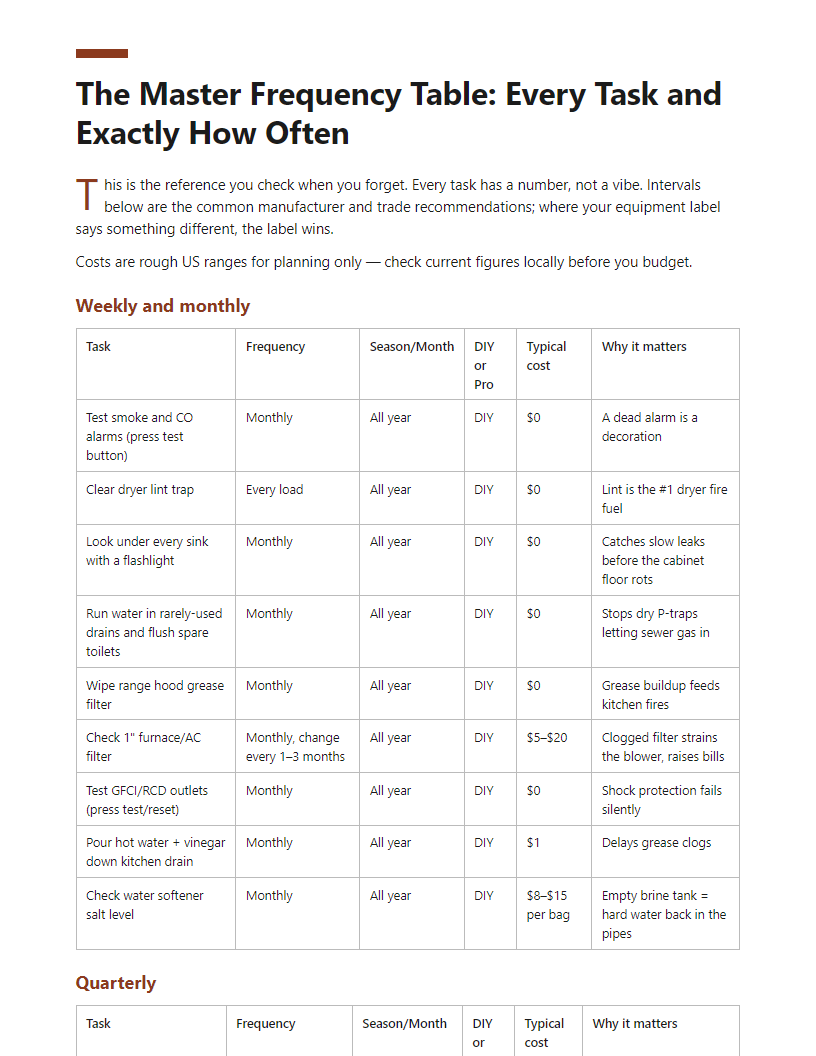
The Master Frequency Table: Every Task and Exactly How Often
This is the reference you check when you forget. Every task has a number, not a vibe. Intervals below are the common manufacturer and trade recommendations; where your equipment label says something different, the label wins.
Costs are rough US ranges for planning only — check current figures locally before you budget.
Weekly and monthly
| Task | Frequency | Season/Month | DIY or Pro | Typical cost | Why it matters |
|---|---|---|---|---|---|
| Test smoke and CO alarms (press test button) | Monthly | All year | DIY | $0 | A dead alarm is a decoration |
| Clear dryer lint trap | Every load | All year | DIY | $0 | Lint is the #1 dryer fire fuel |
| Look under every sink with a flashlight | Monthly | All year | DIY | $0 | Catches slow leaks before the cabinet floor rots |
| Run water in rarely-used drains and flush spare toilets | Monthly | All year | DIY | $0 | Stops dry P-traps letting sewer gas in |
| Wipe range hood grease filter | Monthly | All year | DIY | $0 | Grease buildup feeds kitchen fires |
| Check 1” furnace/AC filter | Monthly, change every 1–3 months | All year | DIY | $5–$20 | Clogged filter strains the blower, raises bills |
| Test GFCI/RCD outlets (press test/reset) | Monthly | All year | DIY | $0 | Shock protection fails silently |
| Pour hot water + vinegar down kitchen drain | Monthly | All year | DIY | $1 | Delays grease clogs |
| Check water softener salt level | Monthly | All year | DIY | $8–$15 per bag | Empty brine tank = hard water back in the pipes |
Quarterly
| Task | Frequency | Season/Month | DIY or Pro | Typical cost | Why it matters |
|---|---|---|---|---|---|
| Clean garbage disposal (ice + citrus peel) | Quarterly | All year | DIY | $0 | Odor and blade buildup |
| Test sump pump (pour bucket of water in pit) | Quarterly | Mar, Jun, Sep, Dec | DIY | $0 | The one thing between you and a flooded basement |
| Vacuum refrigerator condenser coils | Quarterly–twice yearly | Spring/fall | DIY | $0 | Dirty coils shorten compressor life |
| Clean faucet aerators and showerheads | Quarterly | All year | DIY | $0 | Restores pressure in hard-water areas |
| Check 4–5” pleated media filter | Quarterly, change every 6–12 months | Per label | DIY | $30–$60 | Thicker filters last longer — don’t swap monthly |
| Clear bathroom exhaust fan grille of dust | Quarterly | All year | DIY | $0 | Dust-clogged fan motors overheat |
Twice a year and annual
| Task | Frequency | Season/Month | DIY or Pro | Typical cost | Why it matters |
|---|---|---|---|---|---|
| Clean gutters and downspouts | Annually; twice if you have trees | Late spring + late fall | DIY or pro | $100–$250 pro | Overflow rots fascia and floods foundations |
| Clean full dryer vent duct | Annually | Spring | DIY or pro | $100–$180 pro | Fire risk; sooner if drying takes longer |
| HVAC/AC service | Annually | Spring (AC), fall (heat) | Pro | $80–$200 | Catches failing capacitors and refrigerant loss |
| Boiler service (UK) | Annually | Early fall | Pro (Gas Safe) | £80–£120 | Required for most warranties |
| Chimney sweep and inspection | Annually; more with heavy wood stove use | Late summer/fall | Pro | $150–$350 | Creosote fires |
| Exercise every shut-off valve — main, toilet stops, under-sink, washer, water heater, hose bibs (close fully, open fully, back off a quarter turn) | Annually | Any fixed month | DIY | $0 | Seized valves can’t be closed in an emergency |
| Flush water heater, check anode rod | Flush annually; anode check annually, replace every 3–5 years | Fall | DIY or pro | $0–$150 | Sediment and a spent anode kill the tank early |
| Roof and attic inspection from inside | Annually | After fall storms | DIY | $0 | Finds leaks while stains are still small |
| Check chimney cap and flashing | Annually | Fall | Pro | Included in sweep | Missing cap = water and animals in the flue |
| Reseal grout and tub caulk as needed | Annually | Spring | DIY | $10–$25 | Water behind tile is invisible until it isn’t |
| Lubricate garage door rollers, door hinges, window tracks | Annually | Spring | DIY | $10 | Prevents hardware failure |
| Drain and shut off outdoor faucets | Annually | Before first freeze | DIY | $0 | Burst pipes |
| Septic tank inspection | Every 1–3 years; pump every 3–5 | Any | Pro | $300–$600 pump | Backups are catastrophic |
Every few years, and replacement
| Task | Frequency | DIY or Pro | Typical cost | Why it matters |
|---|---|---|---|---|
| Replace smoke alarms | 10 years from date stamp | DIY | $15–$45 each | Sensors degrade; new batteries don’t fix that |
| Replace CO alarms | 5–7 years per model’s stamp | DIY | $25–$50 each | Most expired units still chirp and “pass” the test |
| Replace water heater anode rod | Every 3–5 years | DIY or pro | $25–$150 | The cheapest way to double tank life |
| Replace washing machine hoses | Every 5 years | DIY | $20–$40 | Burst hoses are a top water-damage claim |
| Replace toilet wax ring/seal | Whenever the toilet is removed | DIY or pro | $5–$15 part | Reusing one guarantees a leak |
| Repaint/reseal exterior wood | Every 5–7 years | Pro | $3,000+ | Paint is the siding’s waterproofing |
| Service or replace main appliances | Budget from year 8 | — | — | Plan, don’t panic-buy |
Flip every alarm over tonight and read the date stamp. If it’s older than the interval above, no battery will fix it.
Typical service life — start budgeting now
- Asphalt shingle roof: 20–30 years. Start saving at year 15.
- Water heater (tank): 8–12 years. Start saving at year 7.
- Furnace: 15–20 years. HVAC condenser: 10–15 years.
- Exterior paint: 5–7 years.
- Carpet: 8–10 years. Vinyl/laminate flooring: 10–20 years.
Tip: Write the install year on every appliance in marker, somewhere visible. Future you will thank present you.
Adjust the intervals for your house
- Hard water: halve anode rod intervals (check every 2 years), descale faucets and kettles quarterly, flush the water heater twice a year.
- Pets: change 1” filters monthly without exception, vacuum fridge coils quarterly, clean dryer ducts every 6 months.
- Wood stove or open fire: sweep twice per heating season if you burn most days.
- Coastal salt air: rinse exterior metal and AC condenser fins quarterly; expect paint and hardware to fail years sooner.
- Heavy tree cover: gutters twice a year minimum, sometimes three times; roof inspection after every major storm.
The Five Tasks That Prevent Fires and Floods
If you only do five things from this guide, do these. They cover the two failures that destroy homes: fire and water.
1. The dryer vent
Lint is kindling. Clean the lint trap after every single load — not every few loads.
Beyond the trap, lint builds up in three places most people never touch:
- The trap housing. Pull the screen out and vacuum down into the slot with a crevice tool or a narrow vent brush. Quarterly.
- The duct run. Disconnect the hose from the back of the dryer and clear the whole run to the outside vent flap once a year. Check the flap opens freely.
- Behind and under the dryer. Lint migrates. Vacuum it annually when you pull the machine out.
Replace any flexible foil or white plastic hose with rigid or semi-rigid metal duct. Plastic sags, traps lint, and burns. Keep the run as short and straight as you can — every 90° bend is a lint trap. A dryer that suddenly takes two cycles to dry a load is telling you the duct is blocked.
2. Bathroom exhaust fans
Dust packs around the motor, the motor overheats, and the housing is sitting in a ceiling full of framing and insulation. One homeowner told us their fan caught fire and the house was a total loss — eight months displaced during the rebuild.
Twice a year: switch off the circuit, pull the cover down (most unclip with spring clips), vacuum the cover and the fan housing, wipe the blades. While you’re up there, confirm the duct actually goes outside — through the roof or a wall cap. Fans that dump into the attic cause mold, rot, and frost damage, and that mistake is common in older and renovated homes.
3. Leak detection under every sink
A slow drip under a cabinet can rot the base, the subfloor, and the joists before you see a drop. Two cheap defenses, both passive:
- The tray trick. Put a shallow plastic storage box or boot tray under the kitchen sink, every bathroom sink, and the laundry sink. Water pools in the box instead of soaking the cabinet. Garbage disposals leak slowly and silently — this catches it.
- Battery leak alarms. Drop one in each tray, plus behind the washing machine, under the dishwasher, and at the base of the water heater. They cost a few dollars each and beep. Easier than remembering to check monthly.
4. Alarm expiration dates, not just batteries
Smoke alarms expire at 10 years. CO alarms expire at 5–7 years depending on model. Fresh batteries do not reset that clock — the sensor itself degrades.
Take each alarm off its bracket and read the manufacture date printed on the back. Write it on the unit in marker, and log the replacement year in your tracker. Inspections regularly find homes where every alarm is expired but batteries have been changed faithfully for a decade.
Tip: If your cooking sets off the kitchen alarm weekly, don’t remove the battery. Move the alarm farther from the stove, or swap that one for a photoelectric model, which is less twitchy about cooking smoke.
5. Appliance supply hoses
A burst washing machine hose delivers water at full pressure until someone shuts it off. Replace washer hoses with braided stainless every 5 years, and do the same for builder-grade sink and toilet supply lines. Replace the shut-off valves while you’re there if they’re the plastic builder-grade type.
| System | Failure mode | Check frequency | DIY or pro | Warning sign |
|---|---|---|---|---|
| Dryer vent | Lint ignition / blocked duct | Trap: every load. Housing: quarterly. Full duct: yearly | DIY; pro for long or roof runs | Clothes damp after a full cycle; hot dryer casing |
| Bathroom fan | Dust-clogged motor overheats | Vacuum twice a year | DIY | Fan noisy, slow, or hot; mirror still fogged |
| Under-sink plumbing | Slow drip rots cabinet and subfloor | Trays + alarms always on; eyeball quarterly | DIY | Musty smell, soft cabinet base, warped shelf |
| Smoke / CO alarms | Sensor expires regardless of battery | Test monthly; check date yearly | DIY | Date on back over 10 yrs (smoke) or 5–7 yrs (CO) |
| Appliance supply hoses | Burst under constant pressure | Inspect yearly; replace every 5 yrs | DIY; pro if valve is seized | Rust, bulging, stiffness, damp at the coupling |
The two-minute emergency card
Find these three things today, before you need them. Write the locations on a card and tape it inside a kitchen cabinet door.
- Main water shut-off — basement, crawlspace, garage wall, or a street-side stop tap. Turn it to confirm it moves.
- Gas shut-off — at the meter. Note which wrench it needs and keep that wrench nearby.
- Breaker panel — label the breakers if they aren’t already.
Nine Mistakes That Turn Small Tasks Into Big Bills
1. Changing the battery but never checking the alarm’s date
A fresh battery in a 14-year-old sensor buys you nothing. Alarms have expiration dates — see Section 5 for the exact limits and how to read the manufacture date.
2. Disabling the alarm that keeps “false-triggering”
Taking the battery out of a nuisance alarm and forgetting is one of the most common causes of a dead alarm in a real fire. Fix the cause instead — Section 5 covers placement and alarm type. Never leave a unit unpowered overnight.
3. Flexible foil or plastic dryer hose — and 90° bends
Thin accordion hose traps lint in every ridge and burns. Section 5 explains what to use instead and how to route the duct.
4. Venting a bathroom fan into the attic
A fan that dumps warm wet air into the attic rots sheathing and soaks insulation, and the dust-packed housing itself is a fire risk. Section 5 covers checking the duct run and cleaning the housing.
5. Pressure-washing shingles, stucco or old mortar
High pressure strips the mineral granules off asphalt shingles, drives water behind stucco, and blasts soft lime mortar out of old joints. Granule loss shortens roof life by years, and you won’t see the damage from the ground. Use a garden hose, a soft brush, and a cleaner made for the surface. Hire a roofer rather than aiming 2,000 psi at your own roof.
6. Blocking crawl space or attic vents to “save heat”
Those vents move moisture out. Seal them and you get condensation, mold and rotten framing instead of a lower heating bill. The savings are negligible; the repair is not. Insulate the floor of the attic and air-seal the ceiling below it — never the vents.
7. Chemical drain cleaner as routine maintenance
It eats older pipes, rarely clears the actual blockage, and makes the plumber’s job hazardous — caustic liquid sitting in a trap can splash when the pipe comes apart. Clear drains mechanically instead: a hair snake in the tub, a plunger on the sink, and remove and clean the sink trap once a year. If a drain backs up repeatedly, the problem is further down the line and a chemical won’t reach it.
8. Valves that have never been turned
Shut-off valves seize when they sit untouched for a decade — and you find out mid-flood. Section 6 lists every valve to exercise and the right way to do it.
9. Treating a one-time inspection report as a schedule
An inspection report is a snapshot of one day. It lists defects that existed that morning. It does not tell you when to clean the dryer vent again, when the water heater is due for a flush, or when your alarms expire.
Reports also go in a drawer and stay there. If you keep no written log, you can’t prove servicing for a warranty claim, an insurance payout, or a buyer’s questions at resale. Convert the report into dated tasks on your tracker, then log every job: the date, who did it, and what it cost.
Frequently Asked Questions
What are the 10 most common home maintenance issues?
These ten account for most of the repair calls and small disasters in an average home. They’re listed in no particular order — all ten are worth checking:
- Clogged gutters and downspouts
- Dryer vent lint buildup
- Slow leaks under sinks and at toilet bases
- Dirty or forgotten HVAC filters
- Expired smoke and CO alarms
- Failed caulk and grout in bathrooms
- Water heater sediment and worn anode rods
- Burst or bulging washing machine hoses
- Blocked bathroom exhaust fans
- Cracked exterior caulk and peeling paint letting water into siding and trim
Every one of these is on the master frequency table with a date attached.
What’s the best checklist format — and how do I pick one I’ll actually use?
The best one is the one you can see without opening an app. Pick by habit, not by features:
| If you… | Use |
|---|---|
| Forget unless it’s visible | Printed monthly page on the fridge or utility room door |
| Live by your phone calendar | Recurring calendar entries, one per task, with the interval in the title |
| Share the house with others | Printed page plus a shared digital list for who did what |
| Outsource most jobs | Log sheets only — dates, contractor, cost |
Whatever you pick, record the date done, not just a check mark. A check mark tells you nothing in eight months.
What are 10 things every new homeowner should know in the first month?
If you’ve only ever rented, nobody taught you this. Start here:
- Where the main water shut-off is — and that it turns
- Where the electrical panel is, with breakers labeled
- Where the gas shut-off is and how to turn it (US: shut-off wrench nearby)
- The age and model of your furnace/boiler, water heater, and AC
- The manufacture date on every smoke and CO alarm
- What size furnace filter you need, and how many to keep on hand
- Where the attic access and crawl space entries are
- Whether your water heater has a replaceable anode rod
- Who your previous owner used for HVAC, roofing and plumbing
- The roof’s approximate age
Write all ten on one page and keep it with your tracker.
What belongs on a 10-year checklist?
Big-ticket items with long intervals, tracked by year installed:
- Washing machine hoses: replace every 5 years
- CO alarms: replace every 5–7 years (check the unit’s stated life)
- Smoke alarms: replace at 10 years from manufacture date
- Water heater anode rod: inspect every 3–5 years, replace as needed
- Water heater: plan replacement around 8–12 years
- HVAC system: plan replacement around 15–20 years
- Exterior paint: repaint every 5–7 years, sooner on sun- and weather-exposed walls
- Roof: inspect yearly; budget replacement based on material and age
How much should I budget per year?
Use the same rule set as the catch-up protocol in section 7: 1% of the home’s value per year as a baseline, rising to 2%–3% for homes over roughly 30 years old or with deferred maintenance.
These percentages are long-standing rules of thumb used by real estate agents, lenders and home inspectors — not findings from a study. Treat them as a starting figure, then adjust against your own logged costs after a year or two. That’s one more reason to record what you actually spend.
Set up a separate savings account and move the money monthly, so a $600 water heater repair doesn’t land on a credit card.
Which jobs need a certified professional?
In the US, gas work, electrical panel work and most HVAC refrigerant work require licensed trades — rules vary by state and city. In the UK, gas appliance work must be done by a Gas Safe registered engineer, and electrical work in kitchens and bathrooms falls under Part P. Chimney sweeping, boiler servicing and roof work are practical pro jobs everywhere. Keep the certificate or invoice in your log.
- ✓Month-by-month planner, January to December, with tick boxes for every due task
- ✓Log fields for contractor name, date completed and cost paid on each task line
- ✓The forgotten-tasks list: shut-off valves, wax rings, anode rods, chimney caps, hinges, attic leaks, vacuum filters
- ✓Catch-up protocol for fixer-uppers and long-neglected homes, in triage order
- ✓Adapted checklists for seniors, outsourcers and renters
- ✓Low-ink print pack: one-page seasonal checklists and a 10-year replacement log
Frequently asked questions
What home maintenance problems come up most often?
The recurring ten: clogged gutters, blocked dryer vents, dirty HVAC filters, slow under-sink leaks, failed caulk and grout, water heater sediment and corroded anodes, running toilets from worn flappers or wax rings, seized shut-off valves, poor attic ventilation and roof flashing leaks, and expired or dead smoke/CO detectors. Each is cheap to catch early and expensive to ignore.
What makes a home maintenance checklist actually useful?
One that pairs every task with a frequency and a place to record when you last did it. Generic lists fail because "regularly" is unmeasurable. Look for a checklist that separates weekly, monthly, seasonal, annual and 5–10 year items, flags safety-critical tasks, and leaves space to log the date, who did it and what it cost.
What should a new homeowner learn first?
Locate the main water shut-off, gas shut-off and consumer unit/breaker panel. Learn your boiler or furnace type and filter size. Know your roof's age, water heater's age and detector manufacture dates. Keep a contractor list, budget roughly 1% of home value per year for upkeep, and start a maintenance log from day one rather than from the first emergency.
What belongs on a 10-year home maintenance plan?
Long-cycle items most lists skip: smoke and CO detector replacement (10 years), water heater anode rods (3–5 years) and tank replacement (8–12), toilet wax rings, exterior paint and caulk, deck sealing, garage door springs and rollers, chimney cap and liner inspection, sump pump replacement, and roof or gutter assessment. Put each on a dated schedule, not a vague "someday" list.
Do smoke and carbon monoxide alarms really expire?
Yes. Sensors degrade whether or not you change batteries. Most smoke alarms are rated for 10 years from the manufacture date printed on the back; CO alarms typically 5–10 years depending on model. Check the printed date, not the install date, and write the replacement year on the unit in marker so the next check takes five seconds.
What if I've bought a fixer-upper that's been neglected for years?
Don't start a normal annual cycle — run a catch-up pass first. Triage in this order: water intrusion (roof, gutters, flashing, plumbing), fire risk (dryer vent, extractor fans, electrics, detectors), then heating, structure and cosmetics. Record the condition and date of each system before you begin, so you know what's genuinely done versus what you inherited.
We collected 76 real questions and comments about "household maintenance checklist" (52 from YouTube comments, 4 from People Also Ask, 20 from search suggestions), grouped them into 12 recurring problems, and built this guide to resolve the 7 that block people most. The top-ranking pages were reviewed for gaps; 7 of those gaps became dedicated sections.
Edited by Alex Hirn · Last updated November 3, 2026 · How we make our guides
More in Home & Organizing
 free
 premium+1 bonus
 premium+1 bonus
 premium+1 bonus