Checklist · 30-page PDF · Premium
Grocery Shopping List Ideas: A Categorized Checklist That Fits Any Budget
Grocery shopping list ideas built on a 12-category spine, the 5-4-3-2-1 rule and waste-proof storage. Premium PDF adds quantities, budgets, checklist. See inside.
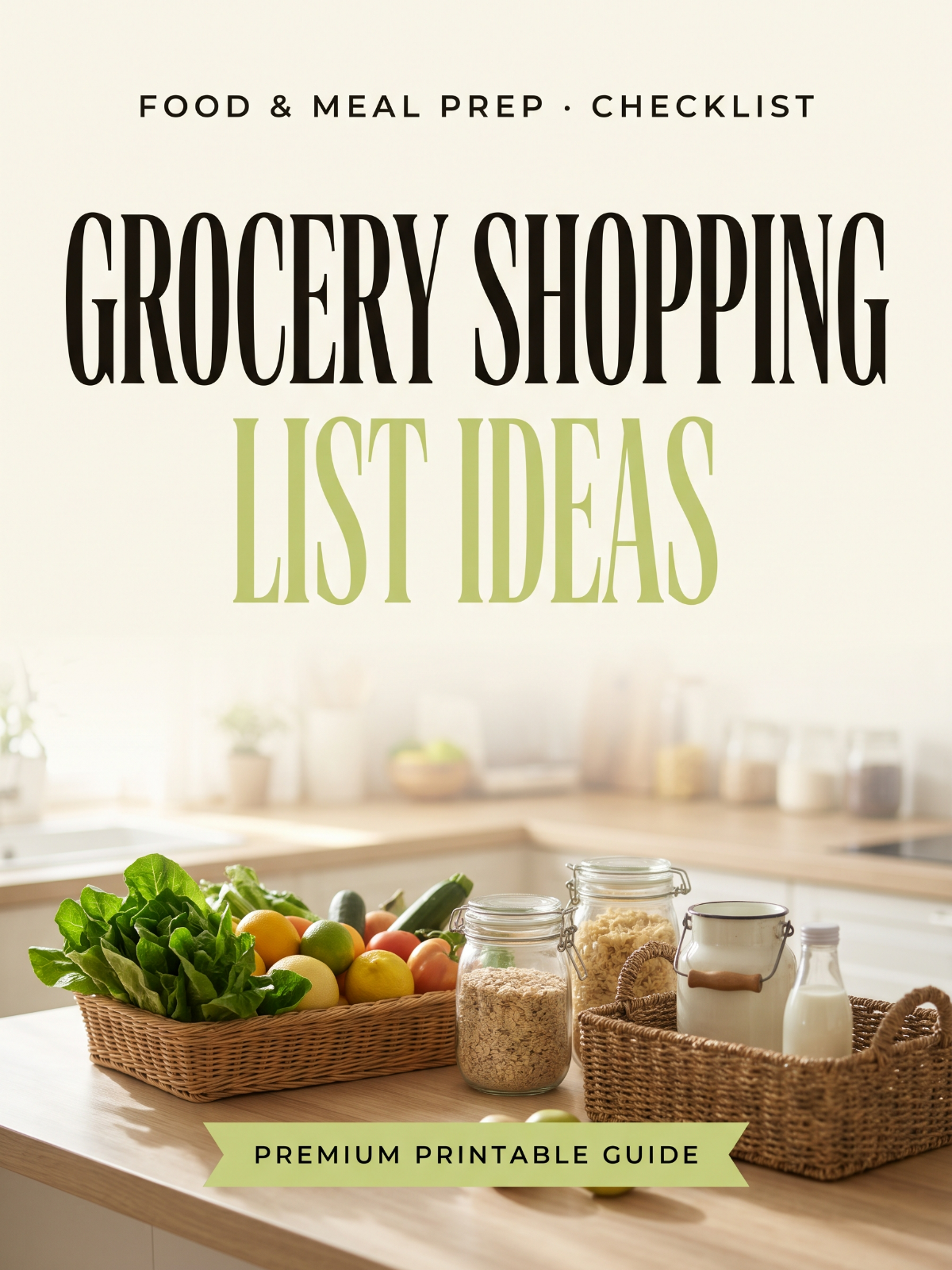
The full workbook, ready to print
- ✓Portion tables with exact weekly quantities for 1, 2, 4 and 6 people
- ✓Three budget tiers with real weekly and monthly cost targets
- ✓Seven-step system worksheet: kitchen audit to checkout
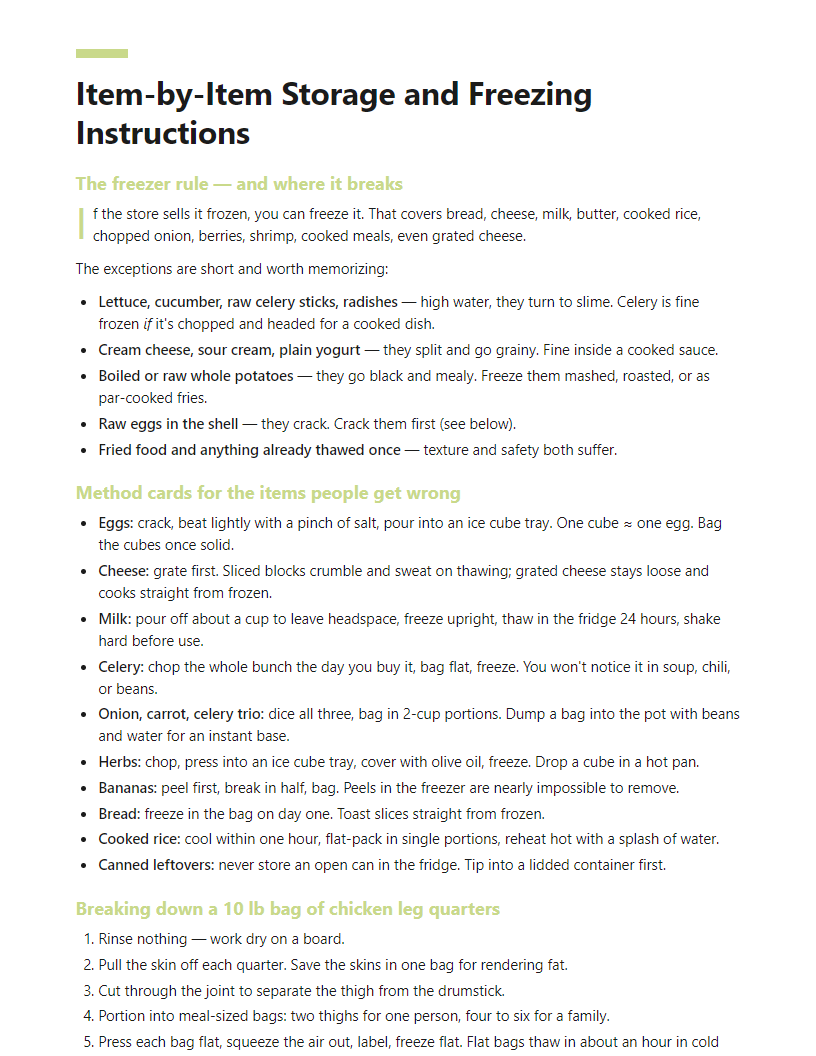
- ✓Item-by-item storage and freezing instructions, including eggs, celery and cheese
- ✓Swap sheets for keto, vegan, low-FODMAP, gluten-free and common allergies
- ✓Month-by-month seasonal rotation calendar
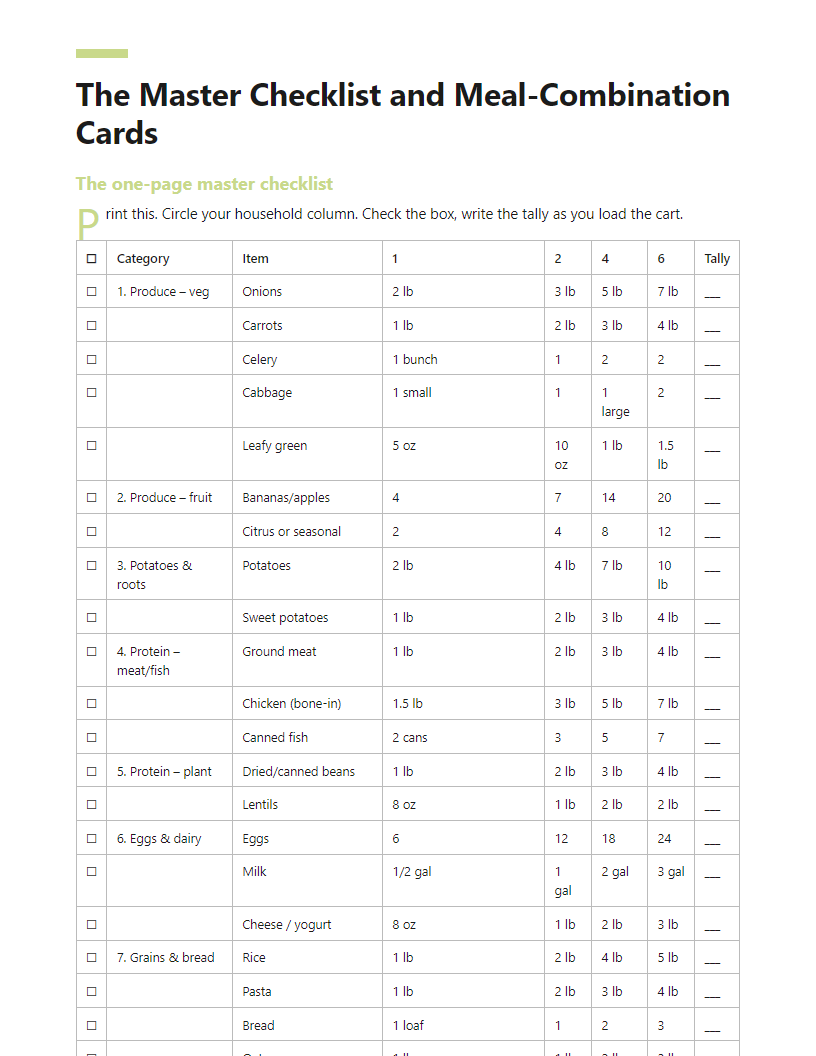
- ✓Printable master checklist plus meal-combination cards
Hosted on FileJoker. Premium members download instantly; free download has a wait.
In a hurry? Free one-page checklist30 items to tick off · print-ready PDF, no sign-upDownload freeIncluded bonuses — free with the guide
2 extra guides from the same topic Free PDF · 18 pagesThanksgiving Meal Checklist: From 14 Days Out to LeftoversBuild a Thanksgiving meal checklist that works: menu, guest count, shopping quantities and an hour-by-hour oven plan. Free printable checklist inside.
 Free PDF · 16 pagesBest Meal Prep Recipes: A 5-Day No-Repeat Plan That Holds UpBest meal prep recipes without the Day 3 boredom: a 5-day no-repeat framework, storage timelines, verified macros, plus a free planner and shopping list.
A look inside the PDF
11 sections · 30 pages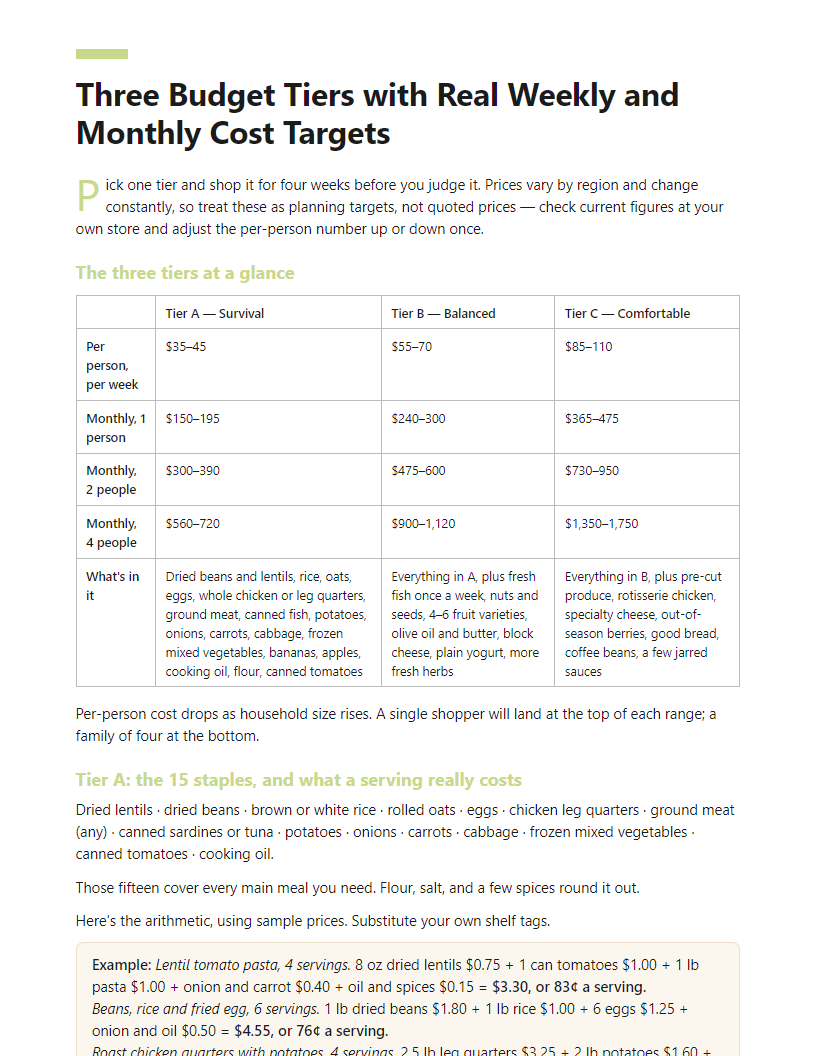
Full table of contents
- Why Every Generic Grocery List Fails You
- The Fast Answer: The 12-Category Spine and the 5-4-3-2-1 Rule
- Exact Quantities by Household Size: 1, 2, 4 and 6 People
- Three Budget Tiers with Real Weekly and Monthly Cost Targets
- Building the System: Seven Steps from Kitchen Audit to Checkout
- Item-by-Item Storage and Freezing Instructions
- Swapping the List for Keto, Vegan, Low-FODMAP, Gluten-Free and Allergies
- Conflicting Health Claims: Grains, Nightshades, Dairy and 'Inflammatory' Foods
- Seasonal Rotation: What Changes Month by Month
- The Master Checklist and Meal-Combination Cards
- Nine Mistakes That Waste Money and Food
In this article
You stand in the aisle thinking “what am I forgetting?” — and get home to find you bought three sauces and no onions. Or you cook for one and half the bag of spinach rots before Thursday. Most grocery shopping list ideas online are flat item dumps: no quantities, no budget, no plan for leftovers.
Here you get the 12-category spine that stops gaps, the 5-4-3-2-1 rule for balanced trips, a calm read on “inflammatory” food claims, and the nine habits that quietly drain your food budget.
The premium PDF goes further: exact portions for 1, 2, 4 and 6 people, three costed budget tiers, item-by-item freezing instructions, diet swaps and a printable master checklist with meal-combination cards.
The short answer
Build your list on a repeatable 12-category spine instead of memory:
- Produce — fresh plus frozen backup
- Protein — eggs, poultry, fish, beans
- Grains & starches — rice, oats, potatoes, pasta
- Dairy or alternatives
- Pantry staples — oils, vinegar, stock
- Spices & seasonings
- Canned & jarred goods
- Frozen items
- Baking basics
- Drinks
- Snacks
- Household & personal care
Then apply the 5-4-3-2-1 rule: 5 vegetables, 4 fruits, 3 proteins, 2 starches, 1 treat. Mark a line beside each item as you shop so nothing is missed twice.
Why Every Generic Grocery List Fails You
You’ve printed the list. “Milk, bread, eggs, chicken, apples.” You still stand in the aisle wondering what you’re forgetting, and you’re back in the store on Thursday.
Generic lists fail in three predictable ways.
- No quantities. “Rice” tells a single person and a family of six the same thing. One buys a 10-lb bag that goes stale; the other runs out on day four.
- No budget anchor. A list with no cost target can’t tell you whether your cart is on track until the register says so.
- No storage plan. You buy three bunches of celery on sale, two rot, and you decide bulk buying “doesn’t work for you.”
The missing staples problem
Most printables skip the cheapest, most useful foods in the store: dried and canned beans, white and sweet potatoes, cabbage, cooking oils, dried spices, frozen peas. These are the items that stretch a meal and hold for weeks. Leave them off and your list becomes a list of perishables, which is exactly why you end up shopping twice a week.
What “modular” means here
One spine, three swappable layers. The spine is 12 categories that never change — the order you walk the store in, so nothing gets forgotten. Then you set three dials:
- Household size (1, 2, 4, or 6 people) — sets the quantities.
- Budget tier — sets the weekly dollar target.
- Diet layer — swaps items for keto, vegan, low-FODMAP, gluten-free, or allergy needs.
Change one dial, keep the rest. That’s the whole system.
Who this is for
Solo shoppers who find single-portion planning harder than cooking for four. Widowed or newly single cooks rebuilding a routine around one person’s appetite. Fixed-income and pension households buying off the sale flyer. Families of two to six who want one list that scales instead of four separate ones.
If you already shop confidently and your problem is spoilage or cost, skip ahead to the storage instructions and the budget tiers. Come back to the quantity tables when your household size changes.
The Fast Answer: The 12-Category Spine and the 5-4-3-2-1 Rule
Every complete list runs on the same twelve categories, ordered the way you walk the store. Work top to bottom and you stop asking “what am I forgetting?” — the gaps show up as empty lines.
| # | Category | Example items | Weekly, 1 person | Monthly, 1 person |
|---|---|---|---|---|
| 1 | Produce – vegetables | Cabbage, carrots, onions | 5 types, ~5 lb total | — |
| 2 | Produce – fruit | Bananas, apples, oranges | 4 types, ~3 lb total | — |
| 3 | Proteins | Eggs, chicken thighs, dried lentils | 3 types, ~2 lb + 1 dozen eggs | — |
| 4 | Dairy / alternatives | Milk, plain yogurt, block cheese | 1/2 gal milk, 16 oz yogurt, 8 oz cheese | — |
| 5 | Dry goods | Rice, oats, pasta | 2 types, 2 lb total | — |
| 6 | Canned goods | Tomatoes, beans, tuna | 4 cans | — |
| 7 | Frozen | Peas, spinach, berries | 2 bags (10–16 oz each) | — |
| 8 | Oils & condiments | Vegetable oil, soy sauce, mustard | — | 1 item |
| 9 | Spices & dried herbs | Salt, black pepper, cumin | — | 1 refill |
| 10 | Baking & sweeteners | Flour, sugar, baking powder | — | 1 item |
| 11 | Drinks | Coffee, tea, juice | 1 item | — |
| 12 | Household & personal | Dish soap, toilet paper, toothpaste | 1–2 items | — |
The 5-4-3-2-1 rule
Per person, per week: 5 vegetables, 4 fruits, 3 proteins, 2 starches, 1 treat.
That’s it. Five different vegetables, not five pounds of one. Four fruits, including frozen. Three proteins — mix one cheap (beans, eggs) with one mid (ground turkey) and one you actually enjoy. Two starches: rice and potatoes, or oats and pasta. One treat, because a list with zero pleasure in it gets abandoned by Wednesday.
Scaling: keep the number of types the same and multiply the amounts. Four people don’t need 20 vegetables. They need the same 5, in larger quantities — start by multiplying the per-person baseline in section 3, then trim.
Two things let you trim. Pantry items are shared: one bottle of oil and one jar of cumin serve four people as easily as one. And bulk cooking cuts plate waste — a pot of chili scaled for four uses the onion and the half-can of tomatoes that a solo cook throws out. The scaling grid in section 3 shows where this lands: onions go from 2 lb to 5 lb for four people, not 8 lb.
The three anchors test
Before you leave the aisle, check your cart for three things:
- A legume — dried or canned beans, lentils, split peas. Cheapest protein per pound in the store.
- A root vegetable — potatoes, sweet potatoes, carrots, onions. They keep for weeks and fill plates for pennies.
- A cooking fat — oil, butter, lard. Without it you can’t cook anything you bought.
Missing one? The list is incomplete. This is exactly what generic printables skip.
The 10-item week
Eggs (1 dozen), dried beans (1 lb), rice (2 lb), oats (18 oz), potatoes (5 lb), onions (2 lb), carrots (2 lb), cabbage (1 head), canned tomatoes (2), cooking oil (1 bottle). That’s breakfast, lunch, and dinner for one person for seven days.
Price it at your own store — this is the Tier A basket in section 4, which plans at $35–45 per person per week.
Tip: Write quantities, never bare item names. “Carrots” makes you guess in the aisle and buy too many or too few. “Carrots – 2 lb” means you buy once, use it all, and waste nothing.
Conflicting Health Claims: Grains, Nightshades, Dairy and ‘Inflammatory’ Foods
Every grocery list draws the same comments: “No to the gut-destroying grains of any kind.” “Cottage cheese and yogurt cause inflammation in some people. What type of list is this?” Both sides are partly right, and that’s why the argument never ends. Here’s how to settle it for your own kitchen.
What the population evidence shows
Across large studies, whole grains and legumes track with lower inflammatory markers, not higher ones — mostly through fiber, which feeds gut bacteria that produce anti-inflammatory compounds. That’s the population average.
Averages don’t describe you. Celiac disease is a real autoimmune response to gluten, affecting roughly 1% of people. Non-celiac gluten or wheat sensitivity is reported by more. People with inflammatory bowel disease, IBS, or diagnosed autoimmune conditions often do feel measurably worse on certain foods. “Good for most people” and “bad for me” are both true statements.
Nightshades, lectins and seed oils
The nightshade claim (tomatoes, peppers, potatoes, eggplant) comes mainly from anecdote and small-scale arthritis reports. Controlled trials have not shown nightshades to raise inflammation in the general population.
Lectins are real proteins and raw or undercooked kidney beans genuinely make you sick. Cooking and canning destroy nearly all of it. The “lectin-free” diet rests on theory, not trial outcomes.
Seed oils are the loudest current fight. Human trials replacing saturated fat with vegetable oils have generally shown neutral or improved blood lipid and inflammatory markers. If you prefer olive oil, butter, or coconut oil for taste or cost, that’s a reasonable choice — just don’t expect it to fix a condition on its own.
Dairy and fermented foods
Lactose intolerance is common and rises with age and ancestry. That’s a digestive issue, not inflammation. Casein sensitivity is separate and less common.
Fermented foods — yogurt, kefir, sauerkraut, aged cheese — carry lower lactose and some evidence for gut benefit. Many people who react to milk handle them fine. Test, don’t assume.
Fruit sugar in context
Bananas, grapes and mangoes are higher in sugar per serving than berries. They also come with fiber, potassium and water. A medium banana has about 14 g of sugar; a can of soda has around 39 g with no fiber.
If you’re managing blood sugar, portion and pairing matter more than banning fruit. Half a banana with peanut butter behaves differently than a smoothie with three. Berries are a good default on a budget-and-blood-sugar list — frozen ones cost less than fresh.
The 6-week test instead of permanent avoidance
Cutting four food groups forever is expensive, especially on a fixed income. Test instead.
| Week | What you do |
|---|---|
| 1 | Baseline. Eat normally. Log symptoms, energy, sleep, digestion daily, 1–10. |
| 2–3 | Remove one suspect group only (e.g., all gluten grains). Keep everything else identical. |
| 4 | Reintroduce it. One normal portion, then two more over three days. Log. |
| 5–6 | Repeat with the next suspect — dairy, legumes, or nightshades. |
One variable at a time, or you learn nothing. Most reactions show within 72 hours of reintroduction. If nothing changes, put the food back on your list and keep the money.
Warning: See a clinician before you cut anything long-term if you have a diagnosed autoimmune condition, take blood thinners, diabetes or thyroid medication, or have lost weight you didn’t mean to lose. Ask for celiac testing before going gluten-free — the test needs gluten in your system to work.
Nine Mistakes That Waste Money and Food
1. Buying bulk with no portioning plan
A 10 lb bag of chicken quarters is only cheap if it gets eaten. Bulk spoils because it goes into the freezer whole, then thaws as one unusable block. Fix: portion before it goes in. Separate legs from thighs, bag in meal-sized amounts, date every bag.
2. Shopping before you check the freezer
You buy ground beef that’s already in there under two bags of bread. Fix: 60 seconds of freezer and fridge inventory before you write the list. Keep a running list taped to the freezer door and cross items off as you use them.
3. Assuming healthy food is expensive
Dried beans, oats, eggs, cabbage, carrots, potatoes, onions and frozen vegetables are among the cheapest items in the store and among the most nutritious. If your budget is tight, those staples are the backbone, not the compromise. Fix: fill the cheap-staple slots first, then spend what’s left on meat and fresh fruit.
4. Buying a full week of fresh produce
Half of it survives four days. Lettuce, berries, cucumber and herbs wilt early; cabbage, carrots, potatoes, onions and apples last two to four weeks. Fix: buy delicate produce for days 1–4 and hardy produce for days 5–7. Frozen vegetables cover the back half of the week with zero spoilage.
5. Letting the sale flyer write your menu
Flyer specials on meat and produce are a legitimate strategy — but only if the item fits something you actually cook. Fix: shop the flyer within your categories. If it’s a good price and freezes, buy it and portion it. If you won’t eat it, it isn’t a deal.
6. Cooking family-sized recipes solo, with no leftover plan
Cooking for one is the hardest size to plan. A four-serving pot for one person becomes four days of the same dinner, then garbage. Fix: cook the full batch, eat one, freeze three in single portions. You’re building a freezer of ready meals, not making leftovers.
7. Writing items with no quantities
“Chicken” at the shelf becomes a guess, and guesses run high. Fix: every line gets a number. Chicken thighs — 2 lb. Onions — 3 lb. Oats — 1 lb.
8. Letting trimmings and odds go in the trash
Dice several pounds of onion, carrot and celery at once and freeze the mix in baggies. Celery destined for cooking should always be chopped and frozen, not left to wilt.
9. Never checking the fridge mid-week
Food dies quietly on the back shelf. Fix: a Wednesday 2-minute scan. Anything close to turning goes into that night’s dinner, the freezer, or to someone who’ll use it.
Frequently Asked Questions
What is the 5-4-3-2-1 rule for shopping, and does it work for one person?
Per shopping trip: 5 vegetables, 4 fruits, 3 proteins, 2 starches, 1 treat or extra. It’s a minimum, not a cap. It works fine solo — you just buy smaller units of each slot: one head of cabbage instead of two, a half-dozen eggs, a single 1 lb bag of carrots. The point is variety across categories, not volume.
What is the 3-3-3 rule for groceries?
Three breakfasts, three lunches, three dinners, each repeated through the week. It’s useful when you’re overwhelmed, newly cooking for one, or rebuilding a routine after a life change. Nine meal ideas cover seven days with leftovers, and your list writes itself from those nine. Swap one meal a week so you don’t burn out on it.
What’s a genuinely complete basic grocery list?
A complete list has all twelve categories filled, not just the famous five. The items most often missing from printable lists are the cheapest ones: dried and canned beans, white and sweet potatoes, cabbage, onions, cooking oil, frozen peas, canned tomatoes, rice, oats, and vinegar. If your list has milk, bread, eggs, chicken, and apples on it and nothing else, you have a snack list.
What am I most likely forgetting?
In order: cooking fat (oil, butter), acid (vinegar, lemons), a dry aromatic (onions, garlic), and a frozen vegetable. These are the items you only notice at the stove. Run the twelve categories top to bottom before you leave — the empty lines are your answer.
How much should a single person spend per week?
Depends on your tier and region, so check current figures locally. The lean approach: build around dried beans, rice, oats, eggs, whole chicken or leg quarters, cabbage, carrots, onions, and potatoes, then let the sale flyer pick your meat and produce. Shop the flyer first, write the list second. That one reversal usually cuts more than coupon clipping ever will.
How long do meat, bread and cheese really last in the freezer?
| Item | Best quality within | Still safe after |
|---|---|---|
| Ground meat | 3–4 months | Yes, if kept at 0°F |
| Chicken pieces | 9 months | Yes |
| Whole chicken | 12 months | Yes |
| Bread | 3 months | Yes, may dry out |
| Hard cheese | 6 months | Yes, texture crumbles |
Frozen food stays safe indefinitely at 0°F. The dates are about flavor and texture, not safety. Portion before freezing, label with the date, and use oldest first.
- ✓Portion tables with exact weekly quantities for 1, 2, 4 and 6 people
- ✓Three budget tiers with real weekly and monthly cost targets
- ✓Seven-step system worksheet: kitchen audit to checkout
- ✓Item-by-item storage and freezing instructions, including eggs, celery and cheese
- ✓Swap sheets for keto, vegan, low-FODMAP, gluten-free and common allergies
- ✓Month-by-month seasonal rotation calendar
- ✓Printable master checklist plus meal-combination cards
Frequently asked questions
What does the 5-4-3-2-1 shopping rule mean?
It's a simple quantity guide for a single trip: 5 vegetables, 4 fruits, 3 proteins, 2 starches and 1 treat. It keeps your cart balanced without counting calories or planning seven full menus. Scale it up for larger households — a family of four typically doubles the vegetable and protein counts while keeping starches and treats the same.
What belongs on a good basic grocery list?
Start with eggs, chicken or another protein, dried or canned beans, rice, oats, potatoes, onions, garlic, carrots, cabbage, a leafy green, frozen vegetables, a cooking oil, vinegar, salt, pepper, canned tomatoes, milk or a dairy alternative, cheese, bread and fruit. Those twenty-odd items combine into dozens of meals and cover most cuisines cheaply.
What am I most likely forgetting on my grocery list?
The invisible staples: cooking oil, vinegar, stock, salt, baking soda, foil, bin bags, coffee filters, pet food and cleaning supplies. People also forget acid and aromatics — lemons, onions, garlic — which make cheap food taste good. Keep a running list on the fridge and add items the moment a container is half empty, not when it's gone.
What is the 3-3-3 rule for groceries?
It's a meal-planning shortcut: choose 3 breakfasts, 3 lunches and 3 dinners, then shop only for those. You rotate them across the week, so ingredients overlap and nothing is bought for a single use. It suits one-person households especially well, since it limits perishables while still giving variety.
How do I shop for one person without wasting food?
Buy frozen vegetables and fruit, portion fresh meat into freezer bags on the day of purchase, choose hard produce (cabbage, carrots, squash) over delicate greens, and cook in batches of three servings. Buy eggs, oats and beans in bulk — they store for months. Plan one "clear-out" meal each week, such as soup or fried rice, to use what's left.
Are grains, dairy and nightshades really inflammatory?
For most people, no. Evidence links whole grains and fermented dairy with lower inflammation markers; nightshades such as tomatoes and peppers show no general harm. Genuine issues are individual — coeliac disease, lactose intolerance, diagnosed sensitivities. If you suspect a trigger, remove one food group for three to four weeks and reintroduce it rather than cutting whole categories permanently.
We collected 235 real questions and comments about "grocery shopping list ideas" (188 from YouTube comments, 4 from People Also Ask, 43 from search suggestions), grouped them into 10 recurring problems, and built this guide to resolve the 7 that block people most. The top-ranking pages were reviewed for gaps; 7 of those gaps became dedicated sections.
Edited by Alex Hirn · Last updated November 4, 2026 · How we make our guides
More in Food & Meal Prep
free premium+2 bonuses
 premium+2 bonuses
 premium+2 bonuses