Checklist · 16-page PDF · Free
Tax Prep Checklist PDF for W-2, Self-Employed and Business Filers
Free tax prep checklist PDF with separate tracks for W-2, self-employed and small business filers — checkboxes, reasons and notes space. Download and tick off.
The full guide as a PDF
- ✓Track A: W-2 employee document checklist with a why-you-need-it line per item
- ✓Track B: self-employed and side-hustle checklist covering 1099-K, mileage and quarterly payments
- ✓Track C: small business owner checklist for entity type, payroll and fixed assets
- ✓State tax prep layer: residency, part-year moves and local filing prompts
- ✓Printable checkboxes plus a notes column for each line item
- ✓Post-filing record retention table: what to keep and for how long
Hosted on FileJoker. Free download, no sign-up.
A look inside the PDF
9 sections · 16 pages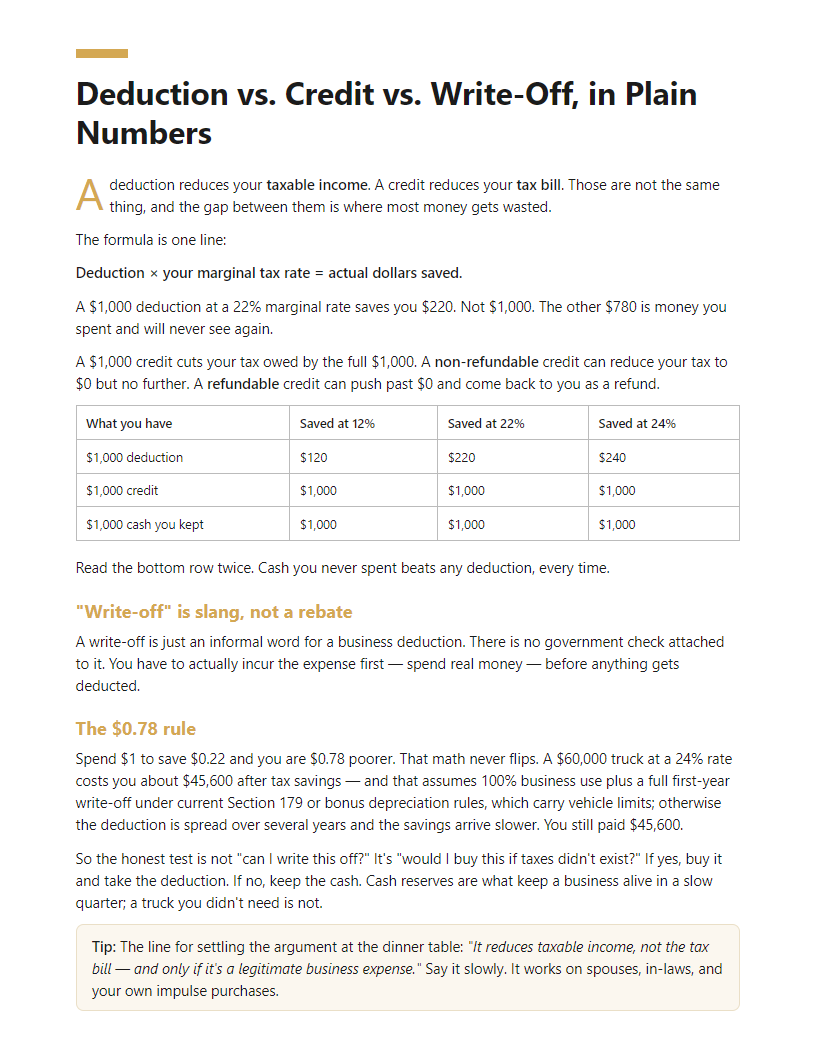
Full table of contents
- Start Here: Pick Your Filer Type Before You Gather Anything
- Deduction vs. Credit vs. Write-Off, in Plain Numbers
- The Six-Step Filing Sequence (What Order to Do Things In)
- Track A: W-2 Employee Document Checklist (with the Why)
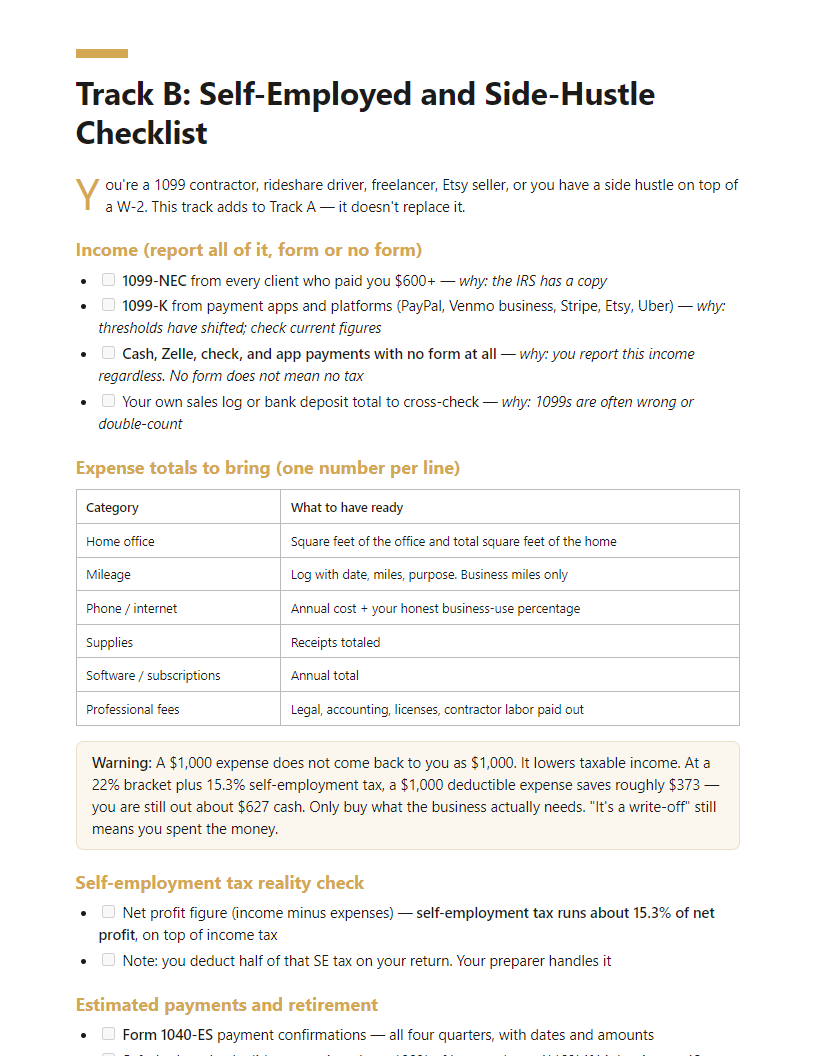
- Track B: Self-Employed and Side-Hustle Checklist
- Track C: Small Business Owner Checklist (Entity, Payroll, Assets)
- State Tax Prep: The Layer Most Checklists Skip
- Nine Mistakes That Cost Money or Trigger Letters
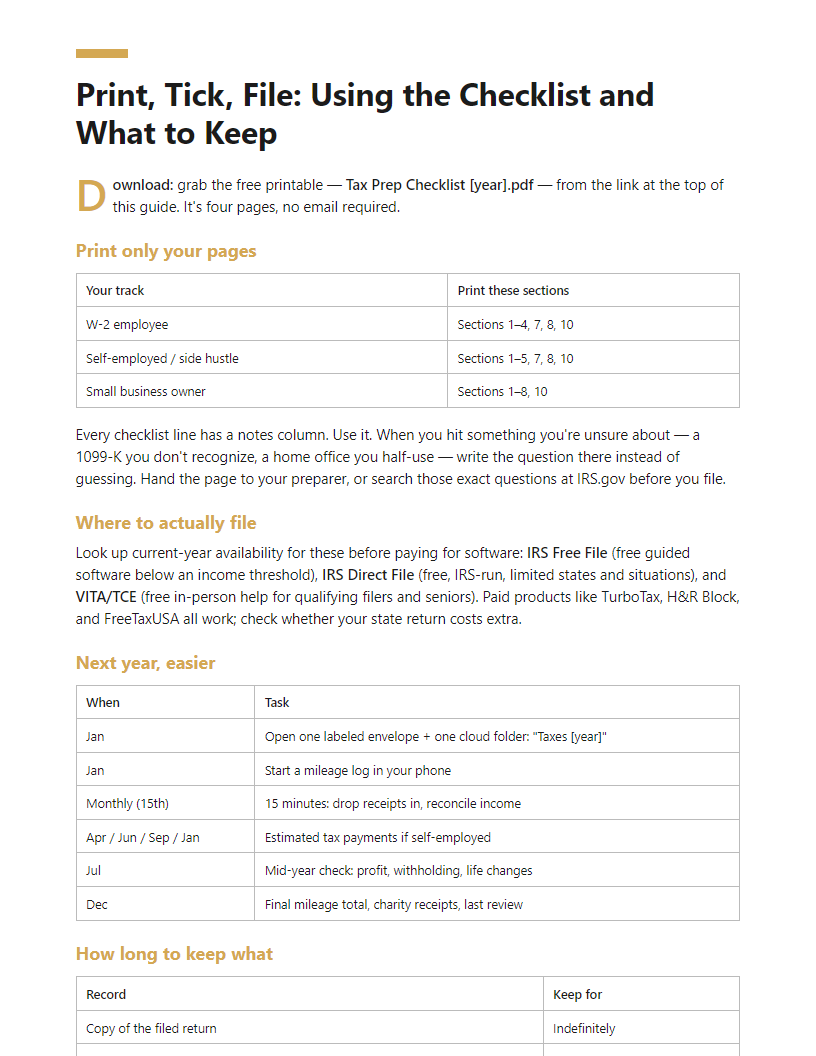
- Print, Tick, File: Using the Checklist and What to Keep
In this article
“I just want a free tax prep checklist PDF I can print, tick off, and stop worrying about.” Maybe this is your first filing year and nobody ever showed you the steps. Maybe you’ve filed ten times and still forget what counts as proof of income. Either way, generic lists don’t help, because a W-2 employee and a sole proprietor with inventory need very different piles of paper.
This page gives you the filing sequence in order, a plain-numbers explanation of deductions versus credits (no, a write-off is not a refund), and the mistakes that trigger letters. The downloadable PDF adds three separate tracks — W-2, self-employed, small business — each with checkboxes, the reason every document matters, a state-tax layer, and room for notes.
The short answer
To use a tax prep checklist PDF effectively:
- Pick your filer type — W-2 employee, self-employed/side hustle, or business owner. Don’t mix tracks.
- Gather identity documents — SSNs/ITINs, prior-year return, bank details for direct deposit.
- Collect income forms — W-2s, 1099-NEC/K/INT/DIV, K-1s, cash income logs.
- Collect deduction proof — receipts, mileage logs, 1098 forms, charitable records.
- Add the state layer — residency, part-year moves, local filings.
- File, then archive — keep records at least three years.
Start Here: Pick Your Filer Type Before You Gather Anything
Most checklists fail because they hand you one long list. Half of it doesn’t apply to you, so you waste an hour hunting for documents you were never going to need. Pick your track first.
Track A — W-2 employee only. You work for an employer who withholds taxes from your paycheck. You may also have bank interest, student loan interest, or tuition forms.
Track B — Self-employed, 1099, gig, or side hustle. You drive, freelance, sell online, or get paid without withholding. No entity, no employees.
Track C — Small business owner. You have an LLC, S corp, partnership, or C corp, and/or payroll, inventory, or equipment you depreciate.
Mixed situations are normal
Day job plus an Etsy shop? Do Track A and Track B. W-2 job plus an S corp on the side? Track A plus Track C. Combine tracks, don’t pick the “biggest” one.
Check the year before you print
Tax rules change every year — standard deduction amounts, mileage rates, contribution limits. This checklist is labeled with its tax year at the top. Before printing, confirm the year matches the return you’re filing, and check current figures on IRS.gov for any dollar amount you’re relying on.
What this guide is and isn’t
It’s educational. It is not tax advice for your specific situation. If you have rental property, multi-state income, crypto sales, a business sale, or a letter from the IRS, bring in a CPA or enrolled agent.
For first-time filers
Filing is document matching, not a test. You collect forms, type the numbers where they belong, and check your work. Nobody taught you this in high school. That’s a curriculum problem, not a you problem.
Deduction vs. Credit vs. Write-Off, in Plain Numbers
A deduction reduces your taxable income. A credit reduces your tax bill. Those are not the same thing, and the gap between them is where most money gets wasted.
The formula is one line:
Deduction × your marginal tax rate = actual dollars saved.
A $1,000 deduction at a 22% marginal rate saves you $220. Not $1,000. The other $780 is money you spent and will never see again.
A $1,000 credit cuts your tax owed by the full $1,000. A non-refundable credit can reduce your tax to $0 but no further. A refundable credit can push past $0 and come back to you as a refund.
| What you have | Saved at 12% | Saved at 22% | Saved at 24% |
|---|---|---|---|
| $1,000 deduction | $120 | $220 | $240 |
| $1,000 credit | $1,000 | $1,000 | $1,000 |
| $1,000 cash you kept | $1,000 | $1,000 | $1,000 |
Read the bottom row twice. Cash you never spent beats any deduction, every time.
“Write-off” is slang, not a rebate
A write-off is just an informal word for a business deduction. There is no government check attached to it. You have to actually incur the expense first — spend real money — before anything gets deducted.
The $0.78 rule
Spend $1 to save $0.22 and you are $0.78 poorer. That math never flips. A $60,000 truck at a 24% rate costs you about $45,600 after tax savings — and that assumes 100% business use plus a full first-year write-off under current Section 179 or bonus depreciation rules, which carry vehicle limits; otherwise the deduction is spread over several years and the savings arrive slower. You still paid $45,600.
So the honest test is not “can I write this off?” It’s “would I buy this if taxes didn’t exist?” If yes, buy it and take the deduction. If no, keep the cash. Cash reserves are what keep a business alive in a slow quarter; a truck you didn’t need is not.
Tip: The line for settling the argument at the dinner table: “It reduces taxable income, not the tax bill — and only if it’s a legitimate business expense.” Say it slowly. It works on spouses, in-laws, and your own impulse purchases.
The Six-Step Filing Sequence (What Order to Do Things In)
Order matters. Doing step 5 before step 2 is how people end up filing an amended return in June.
| Step | What you do | Typical timing |
|---|---|---|
| 1. Confirm status | Confirm filing status and dependent status | January |
| 2. Gather and sort documents | Collect every income document; sort into income, deductions, credits | Late January–mid February (most forms are issued by Jan 31) |
| 3. Choose deduction method | Total itemizable items, compare to the standard deduction | February |
| 4. Select filing tool | Free file, software, or preparer | February |
| 5. Review | Enter data, compare to last year’s return | March |
| 6. File & archive | E-file, save PDF + acceptance email, open next year’s folder | By the April filing deadline — check the current year’s exact date |
Step 1: Settle filing status and dependent status
Single, married filing jointly, married filing separately, head of household. Then the question first-time filers skip: can someone else claim you? If you’re 18 and living at home, your parents may be claiming you as a dependent. Ask them before you file — if you both claim you, the second return gets rejected.
Step 2: Wait for every income document
A late 1099 or a corrected W-2 is the most common reason people amend a return. Make a list of every job, gig app, bank, and brokerage you used last year. Tick each one off as the form arrives. Don’t file because you’re impatient.
Step 3: Decide standard vs. itemized before entering anything
Add up mortgage interest, state and local taxes paid, charitable giving, and large medical costs. Compare that total to the standard deduction for your status (check current figures). Take the bigger number. Most filers take the standard deduction and stop here.
Step 4: Pick how you’ll file
- IRS Free File / Direct File — free if you qualify by income or state. Start here.
- Commercial software (TurboTax, H&R Block, FreeTaxUSA and others) — free tiers exist for simple W-2 returns; expect to pay once you add self-employment, investments, or a state return.
- CPA or enrolled agent — costs the most, worth it for a business entity, payroll, or multi-state income.
Step 5: Enter, then compare to last year
Pull up last year’s return. If your refund or balance due swings hundreds of dollars without an obvious reason, you mistyped something or missed a form.
Step 6: File and archive the same day
Save the final PDF and the e-file acceptance confirmation — submitted is not accepted. Create next year’s folder before you close the laptop.
Nine Mistakes That Cost Money or Trigger Letters
These are the errors that show up every year, for first-timers and for people on their fifteenth return. Read the list before you file — a refresher costs five minutes.
- Buying something in December “for the write-off” — or expecting a deduction to refund the whole expense. A deduction lowers taxable income, not the tax you owe, and you have to actually spend the money first. Run the arithmetic in Section 2 before any year-end purchase. If the only argument for buying is “it’s a write-off,” it’s not an argument.
- Filing before every 1099 arrives. One late 1099-NEC or 1099-INT means a Form 1040-X and a second round of work. Compare this year’s income list against last year’s return before you hit submit.
- Name or SSN mismatch. The name on your return must match the Social Security card exactly — a new married name that wasn’t reported to SSA is a top e-file rejection.
- Wrong prior-year AGI. E-file identity verification uses it. Pull the exact number from last year’s return, not from memory.
- Itemizing when the standard deduction is bigger. Check both numbers every year. Most filers take the standard deduction; itemizing only wins if your total clears it.
- Claiming personal expenses as business deductions. The family dinner, the vacation that was “a client meeting,” the car used mostly for school runs. Business expenses must be ordinary and necessary for the business, and you need the record to prove it.
- Skipping quarterly estimated payments. If you’re self-employed and owe, you can get an underpayment penalty even if you pay in full by April. Pay as you earn.
- Mistyping your bank account or routing number. A refund sent to the wrong account is slow and painful to recover. Read both numbers off a check or your bank app, then read them back once more.
- Not keeping records. Keep returns and supporting documents three years from filing — six if you underreported income by more than 25%.
First-Time Filer Questions Nobody Wants to Ask Out Loud
Nobody teaches this in high school. Here are the questions people search for at 11pm instead of asking.
“Do I even have to file if I barely earned anything?”
Filing requirements depend on your income, age, and filing status — check the current year’s threshold before you decide. But here’s the part that matters: if your employer withheld federal income tax from your paychecks and you owe nothing, that money only comes back if you file. Low earners also miss refundable credits by not filing. File anyway.
“Can my parents still claim me?”
Possibly — it depends on your age, whether you’re a student, where you lived, and who paid for your support. Talk to them before either of you files. If you claim yourself and they claim you too, the second return gets rejected or both of you get a letter. One conversation prevents an amended return.
“If I deduct a $500 laptop, do I get $500 back?”
No. A deduction lowers the income you’re taxed on, not your tax bill. At a 22% rate, a $500 deduction saves you about $110 — and you still spent $500. You have to actually incur the expense to write it off, so a write-off is never free money.
“How long does this take, and what does it cost?”
With every document gathered, a simple W-2 return takes under an hour in software. Self-employed returns take longer because of the expense totals. Many people with simple returns qualify for free filing options; paid software tiers cost more once you add self-employment or state returns. Compare current prices before you start — the cheap tier often covers you.
“What if I made a mistake, or missed the deadline?”
Mistakes get fixed with an amended return. Don’t panic and don’t re-file the same return. If you missed the deadline and you’re owed a refund, file as soon as you can. If you owe, file anyway — penalties and interest keep growing while you wait.
“When should I pay someone?”
Try it yourself first, even if you don’t file it. Then take your numbers to an accountant and ask what you got wrong. That’s how you learn what’s happening. Hire out permanently when you have payroll, multiple states, an S-corp, or rental property.
- ✓Track A: W-2 employee document checklist with a why-you-need-it line per item
- ✓Track B: self-employed and side-hustle checklist covering 1099-K, mileage and quarterly payments
- ✓Track C: small business owner checklist for entity type, payroll and fixed assets
- ✓State tax prep layer: residency, part-year moves and local filing prompts
- ✓Printable checkboxes plus a notes column for each line item
- ✓Post-filing record retention table: what to keep and for how long
Frequently asked questions
Does a tax write-off mean I get the full amount back?
No. A deduction lowers your taxable income, not your tax bill dollar-for-dollar. Spend $1,000 on a deductible expense in the 22% bracket and you save roughly $220 — you're still out $780. A tax credit is different: a $1,000 credit cuts your tax by $1,000. Never buy something you don't need "for the write-off."
What documents does a first-time filer actually need?
Usually fewer than you fear: your Social Security number, every W-2 from jobs you held last year, any 1099 forms, student loan interest (1098-E) or tuition (1098-T) statements, your bank account and routing numbers for a refund, and whether a parent still claims you as a dependent. That last question matters — ask before you file.
Is this tax prep checklist PDF free to download?
Yes. The PDF is a free download, print-ready, with checkboxes and a notes column. It contains three separate tracks (W-2, self-employed, small business owner), a short why-you-need-it line for each document, a state tax prep section, and guidance on what to keep after filing and for how long.
Do I need a different checklist if I'm self-employed?
Yes. Self-employed filers add 1099-NEC and payment-platform 1099-K forms, a cash income log, quarterly estimated tax payment records, mileage and home office figures, business expense categories, and self-employment tax. A W-2-only checklist skips all of that, which is exactly how deductions get missed and estimated-payment penalties appear.
Will buying equipment in December lower my tax bill?
Only partly, and only if you genuinely need the equipment. A $5,000 purchase might cut your tax by $1,100–$1,500 depending on bracket and depreciation treatment — meaning you still spent real cash. Buying to "save on taxes" reduces your cash position every time. Buy when the purchase earns or protects revenue.
We collected 128 real questions and comments about "tax prep checklist pdf" (91 from YouTube comments, 37 from search suggestions), grouped them into 10 recurring problems, and built this guide to resolve the 5 that block people most. The top-ranking pages were reviewed for gaps; 7 of those gaps became dedicated sections.
Edited by Alex Hirn · Last updated November 4, 2026 · How we make our guides
More in Money & Budgeting
 premium
 premium
 premium
 premium