Workbook · 28-page PDF · Premium
Finance Planner: What It Costs, What It Does, and How to Use One
Compare finance planner fees (flat, hourly, AUM, advice-only), start the 50/30/20 split, and get a weekly review checklist. Premium PDF planner pack inside.
The full workbook, ready to print
- ✓12-page printable planner pack (budget, debt, goals, review)
- ✓Six-step monthly budget build from your bank statement
- ✓Debt payoff list, payoff order chart and balance tracker
- ✓20-minute weekly and monthly review routine with checklist
- ✓DIY-or-hire decision table: net worth and complexity triggers
- ✓Fee-only planner vetting checklist with red and green flags
- ✓Word-for-word scripts for raises, rent and recurring bills
Hosted on FileJoker. Premium members download instantly; free download has a wait.
In a hurry? Free one-page checklist31 items to tick off · print-ready PDF, no sign-upDownload freeA look inside the PDF
11 sections · 28 pages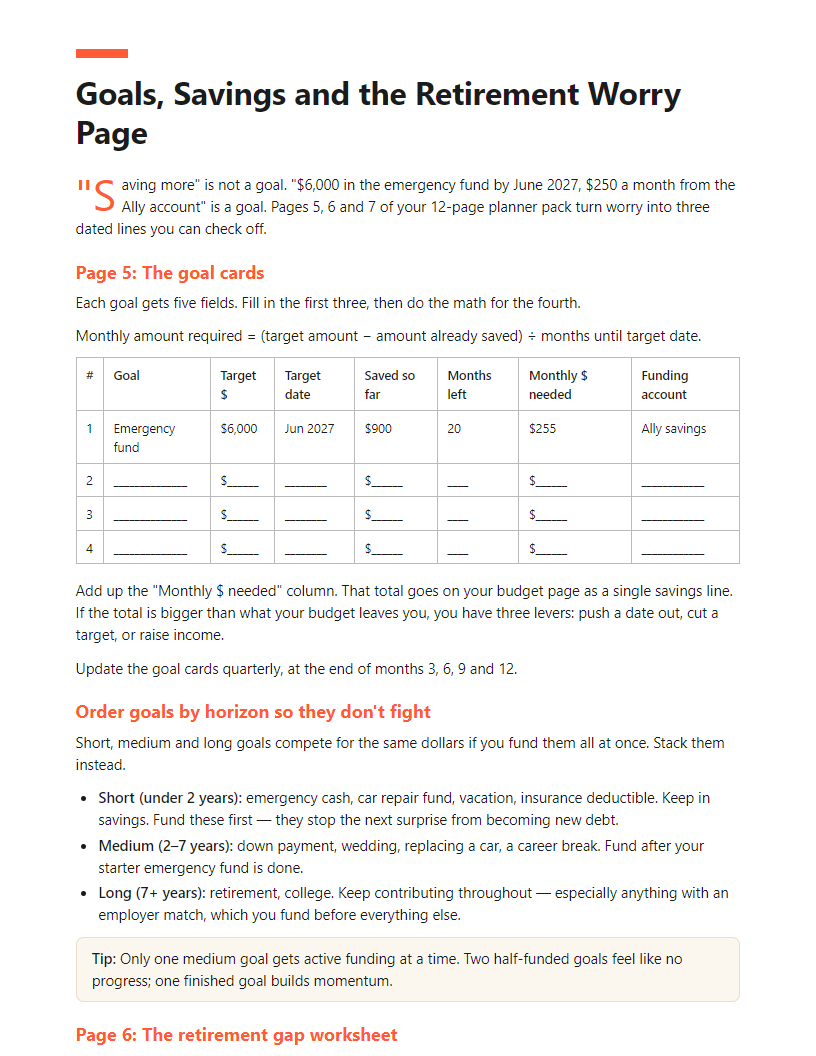
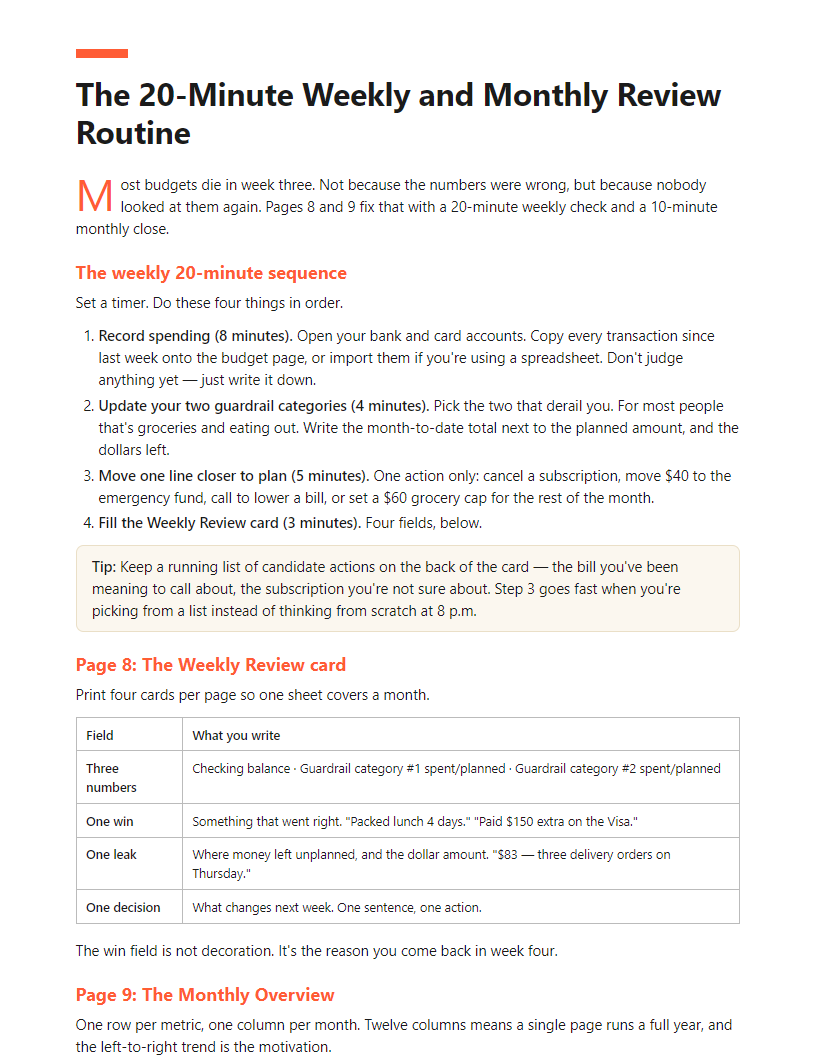
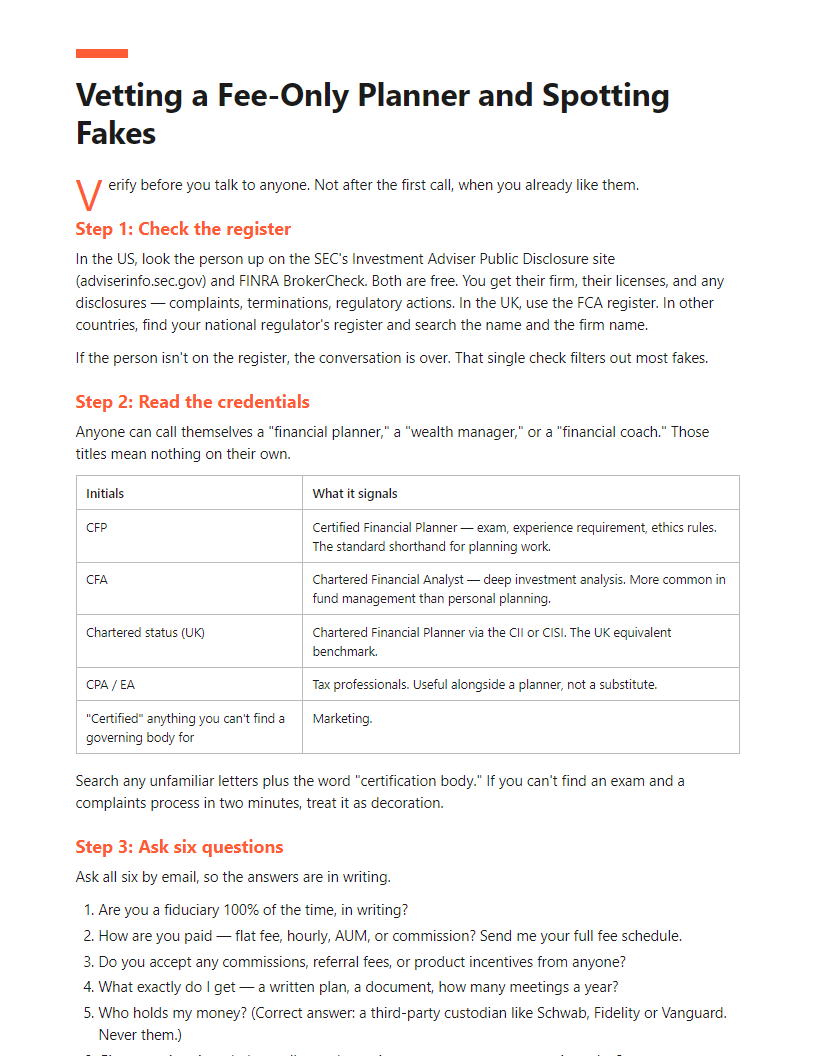
Full table of contents
- Why a 'Finance Planner' Is a Tool, Not a Person (and Which One You Need)
- Build the Monthly Budget Page: Six Steps From Bank Statement to Plan
- The Debt Payoff Pages: List, Order, Track
- Goals, Savings and the Retirement Worry Page
- The 20-Minute Weekly and Monthly Review Routine
- Adviser Fee Structures Side by Side: What Each One Really Costs
- DIY or Hire? Life-Stage Triggers and Net Worth Thresholds
- Vetting a Fee-Only Planner and Spotting Fakes
- Eight Mistakes That Kill a Finance Planner in Month Two
- The Income Lever: Scripts for Raises, Rates and Recurring Bills
- Your 12-Page Planner Pack and How to Use It Monthly
In this article
- The short answer
- Why a ‘Finance Planner’ Is a Tool, Not a Person (and Which One You Need)
- Quick Answer: Planner Terminology, Fees and the 50/30/20 Starting Split
- Adviser Fee Structures Side by Side: What Each One Really Costs
- Eight Mistakes That Kill a Finance Planner in Month Two
- FAQ: Planners, Fees and Budget Rules
“I don’t know if a finance planner is worth 1% of my money — or whether I just need a better spreadsheet.” If that sounds like you, you’re not alone: most people mix up the tool and the profession, stall on budgeting after two weeks, and quietly panic about debt and retirement.
This page separates the two meanings, shows what advisers actually charge under each fee model with dollar examples, gives you the 50/30/20 starting split, and lists the eight mistakes that kill most budget systems by month two.
The premium PDF goes further: a printable 12-page planner pack with monthly budget pages, debt payoff trackers, goal and retirement sheets, a 20-minute review routine, and scripts for raising your income.
The short answer
“Finance planner” means two things — pick the one you need:
- A planner tool — a printable or digital workbook with budget, debt, goal and review pages you fill in monthly.
- A financial planner (person) — a professional who builds a plan across cash flow, debt, tax, insurance, investing and retirement.
- Typical costs: flat plan £/$1,500–4,000; hourly £/$200–400; AUM around 1% a year (that’s $5,000 on $500,000); advice-only subscriptions £/$1,000–3,000 a year.
- Starting split: 50% needs, 30% wants, 20% savings and debt payoff.
- Rule of thumb: DIY with a planner tool until complexity or net worth outgrows it.
Why a ‘Finance Planner’ Is a Tool, Not a Person (and Which One You Need)
Search “finance planner” and you get two different things. One is a printed or digital book with budget, debt and goal pages you fill in yourself. The other is a person you pay to advise you. You probably need one of them right now — not both.
The tool version
Paper planners like Erin Condren and Clever Fox give you bound, dated pages: monthly budget spreads, bill trackers, savings pages. They look good. Two problems: you get one copy of each page, and when the year runs out you buy another book.
A fill-in PDF fixes both. Duplicate any page as many times as you need. Print the debt tracker twelve times, or fill it in on a tablet with a stylus. No re-buying next January.
| Paper planner | Fill-in PDF | |
|---|---|---|
| Extra copies of a page | Buy another book | Print again, free |
| Works on tablet/phone | No | Yes |
| Cost next year | Full price again | $0 |
Three signs you need the tool first
- You can’t say what you spent last month without opening your bank app.
- You don’t have every debt written in one place with its balance and interest rate.
- No savings goal of yours has a dollar figure and a date attached.
If any of those is true, a professional can’t help you much yet. They’d spend the first meeting building what’s in this workbook — and charging you for it.
Three signs a professional is worth a call
- You have equity compensation (RSUs, stock options) with vesting and tax decisions.
- You own a business, so personal and business finances are tangled.
- You’re within a few years of retirement and deciding how to draw money down.
Tip: Sections 7 through 9 cover fee structures, when hiring pays off, and how to check a planner’s credentials. Skip ahead if you already track your spending.
How this workbook is built
Twelve pages, in this order: monthly budget; sinking funds list; debt inventory; debt payoff tracker; goal cards; retirement gap; a “what would I do if” worksheet; weekly review cards; monthly overview, which includes the net worth row; adviser fee comparison plus vetting checklist; negotiation prep sheet; and a 12-month cadence calendar. Some pages you fill in weekly or monthly. Others you touch once a year, or once ever.
Quick Answer: Planner Terminology, Fees and the 50/30/20 Starting Split
Four words get used as if they mean the same thing. They don’t.
| Term | What it means | Who it’s for | Typical cost |
|---|---|---|---|
| Budgeting | Planning where each month’s income goes | Anyone with income and bills | $0 (paper or a spreadsheet) |
| Financial planning | A written plan covering cash flow, debt, insurance, taxes, retirement | People with a goal or a life change coming | Hourly, flat plan fee, or annual retainer |
| Wealth management | Ongoing investment management plus planning, usually with account minimums | People with sizable portfolios | Often ~1% of assets per year |
| FP&A (financial planning & analysis) | A corporate finance job — forecasting and budgeting for a company | Employers, not consumers | Not a service you buy |
If a job listing or article mentions FP&A, it has nothing to do with your household money. Ignore it.
The five fee shapes you’ll meet
- AUM (assets under management): a percentage of your portfolio each year, commonly around 1%.
- Flat annual retainer: a set dollar amount per year for ongoing advice.
- Hourly: you pay for time, like a lawyer.
- One-off plan fee: a single payment for a written plan you then execute yourself.
- Advice-only: planning with no product sales and no assets held.
Example: 1% on a $250,000 portfolio is about $2,500 a year. You pay it whether the market rises or falls, and the dollar amount grows as your balance grows. That’s the number to compare against DIY index investing before you decide the fee is worth it.
Section 7 breaks each structure down. Many firms also set minimums — which is why people in their early 30s with good incomes get told they don’t have enough assets to take on yet.
50/30/20, in one paragraph
Aim 50% of take-home pay at needs, 30% at wants, 20% at savings and extra debt payments. It’s a starting split, not a law. High rent areas blow past 50% on needs routinely. Use it to see how far off you are, then set your own percentages on the budget page.
This guide gives you frameworks, templates and questions to ask. It does not tell you what to buy or hold — that depends on your tax situation, timeline and risk tolerance.
Adviser Fee Structures Side by Side: What Each One Really Costs
Fee talk gets vague fast. Put the same portfolio through four models and the differences stop being abstract.
The four models on the same numbers
| Model | How billed | $100k | $250k | $1m | Best fit | Watch-outs |
|---|---|---|---|---|---|---|
| AUM percentage | ~1% of assets managed, billed quarterly from the account | $1,000/yr | $2,500/yr | $10,000/yr | Complex, ongoing work: estate plans, business sale, multi-account tax coordination | Cost rises as your balance grows even if the work doesn’t; many firms set account minimums and turn smaller balances away |
| Flat annual retainer | Fixed dollar amount, monthly or quarterly | $2,000–$8,000/yr | $2,000–$8,000/yr | $2,000–$8,000/yr | Ongoing advice when your assets are large but your needs are simple | Confirm what’s included; “financial planning” can mean one call a year |
| Hourly | Per hour at $200–$400/hr; say five hours a year | $1,000–$2,000/yr | $1,000–$2,000/yr | $1,000–$2,000/yr | Specific questions: 401(k) fund choice, Roth conversion math, one-time review | Scope creep; ask for an hour estimate in writing |
| One-off advice-only plan | Project fee for a written plan, no assets managed | $1,500–$4,000 per plan | $1,500–$4,000 per plan | $1,500–$4,000 per plan | DIY investors who want a plan they implement themselves | You do the execution; plan goes stale in 2–3 years |
The hourly and flat-fee rows don’t move across the columns. That’s the point: your balance doesn’t change the work, so it shouldn’t change the bill.
Ten years of 1% versus a plan you refresh
Say your portfolio averages $250,000 over a decade. At 1%, that’s roughly $2,500 a year, about $25,000 in fees — more if the balance grows, because the fee grows with it. The dollars you pay also stop compounding for you.
Now the advice-only route: one written plan, refreshed every three years. Four plans across ten years. At $2,500–$3,500 a plan, you’re looking at roughly $10,000–$14,000 total, with no drag tied to your balance.
That gap is the honest answer to “would an advisor do better than I could?” The advisor has to beat their own fee before they add a dollar.
When the percentage fee is actually cheaper
Percentage billing wins when the work is heavy and continuous:
- A closely held business you’re selling, with deal structure and tax timing in play
- An estate with trusts, blended-family beneficiaries, or property in multiple states
- Concentrated stock, RSUs, or options needing a multi-year sell-down plan
- Ongoing coordination between your CPA, attorney, and portfolio
Pay hourly for that volume of work and the bill can pass 1% easily.
The layers that don’t show up on the fee schedule
The advisory fee is one line. Ask about the rest:
- Fund expense ratios inside recommended funds
- Platform or custodian fees on the account
- Trading or transaction charges
- Commissions on any product sold to you
- Insurance loads and surrender charges on annuities or permanent life policies
Two 1% advisors can land a full percentage point apart once these stack.
Tip: Send this email before the first meeting: (1) What is my all-in annual cost in dollars, including fund expense ratios and platform fees? (2) Are you a fiduciary at all times, in writing? (3) Do you or your firm receive any payment from third parties on what you recommend? Vague answers are the answer.
Reframe the fee as a share of your savings
One percent of assets sounds small. Measure it against what you actually add each year instead.
Example: You save $15,000 a year and hold $250,000. The $2,500 fee is 17% of everything you set aside that year. On $1m, the $10,000 fee is two-thirds of that same savings rate.
Write your own version on the goals page: annual fee ÷ annual savings. If that percentage makes you wince, price an hourly or advice-only planner before signing anything ongoing.
Eight Mistakes That Kill a Finance Planner in Month Two
Month one is easy. Month two is where budgets die. Here are the eight failure points, and the fix for each.
1. Budgeting from optimism, not statements
You write “$400 groceries” because that sounds reasonable. Your last 90 days say $610. The plan fails on day nine and you blame yourself. Pull the real numbers off your statements and start from those, then cut deliberately.
Tip: One reader checked their actual grocery spending and said they wanted to cry. That reaction is the point — it’s data, not a verdict.
2. Blurring groceries and eating out into one line
“Food: $900 a month” hides everything. Split them. Someone who spends $2,000 a month on restaurants needs to see that number alone, not buried under milk and eggs. Also expect a trade: when eating out drops, groceries rise. Budget for that shift instead of calling it a failure.
3. Treating one overspend as total failure
You blow $180 on a weekend. Then you stop logging anything and restart in January. A budget is a guide, not a straitjacket. Adjust the remaining weeks and keep the same page — restarting from scratch costs you the history that makes month three easier.
4. Forgetting annual and irregular costs
Car registration, insurance renewal, the vet, Christmas. These aren’t emergencies; they’re appointments you refused to write down. List every irregular cost for the year, divide by 12, and fund it monthly.
| Irregular cost | Annual | Monthly set-aside |
|---|---|---|
| Car insurance | $1,200 | $100 |
| Holidays/gifts | $900 | $75 |
| Car maintenance | $600 | $50 |
5. Tracking with no goal attached
Tracking alone is bookkeeping. Without a dated target, there’s no scoreboard and no reason to open the page in week six. “$6,000 emergency fund by June 2027” gives every skipped takeout a purpose.
6. Cutting only, never touching income
“Honestly, I have nothing to cut down. I need to make more money.” If your essentials already eat 70% of take-home, cutting harder won’t fix it. Ask for the raise, raise your rates, or price your role against market data. Section 11 has the scripts.
7. Buying an ongoing relationship for a one-time question
Inherit $600,000 and hand it straight to a 1% manager and you’ve committed to about $6,000 a year, when the real question — how to invest a lump sum without wrecking your taxes — may take one engagement. Match the billing to the work: Section 7 compares the four fee models on the same numbers.
8. Hiding the planner in an app you never open
An unopened app tracks nothing. Print the pages, or pin the file somewhere you actually look — desk, fridge, phone home screen. Visibility beats features.
FAQ: Planners, Fees and Budget Rules
What exactly does a financial planner do — and what don’t they do?
A planner looks at your whole money picture and builds a plan: cash flow, debt, insurance gaps, tax-smart account choices, retirement projections, estate basics. Good ones also talk you out of panic-selling in a bad month.
What they don’t do: guarantee returns, beat the market reliably, or fix a spending problem you won’t look at. They also usually aren’t attorneys or CPAs. One retired finance executive’s approach is a good model — he knew taxes and investments, so he hired an estate attorney for wills and trusts, not a generalist.
What is the 50/30/20 rule, and does it work in a high-rent city?
Split take-home pay: 50% needs, 30% wants, 20% savings and extra debt payments. It’s a starting split, not a law.
If rent eats 45% of your pay on its own, the 50 bucket is already blown. Adapt it:
- Try 60/20/20 and protect the 20% savings line first.
- Or flip to 60/25/15 for a year while you raise income (see the scripts section).
- Recheck after any raise or move — don’t let the wants bucket absorb it.
Tip: A budget is a guide, not a straitjacket. It’s admitting you have a limit, which you do, because nobody has infinite money.
How much does a financial planner get paid, and what’s typical?
Pay model shapes advice. Someone paid by commission gets paid when you buy a product. Someone paid a flat fee gets paid whether you buy anything or not.
| Model | Typical range (check current figures) | Watch for |
|---|---|---|
| Hourly | $200–$400/hr | Scope creep on hours |
| Flat plan | $1,500–$4,000 one-time | What’s excluded |
| Retainer | $2,000–$8,000/yr | Renewals you don’t use |
| AUM | ~1%/yr, sliding down over $1m | Cost grows as you save |
| Commission | Paid by the product | Not fee-only |
Is 1% AUM worth it, or should I just DIY?
Do the dollar math, not the percent math. One percent on $300,000 is $3,000 a year, every year, whether the market is up 20% or down 20% — as one reader put it, they aren’t absorbing 1% of the loss.
DIY is reasonable if your situation is simple: W-2 income, a 401(k), an IRA, one or two broad index funds, no dependents with complex needs. Advice becomes worth paying for when complexity shows up — equity compensation, a business, a divorce, an inheritance, a special needs child, retirement drawdown and Social Security timing.
Example: At 30 with good income and a simple portfolio, many people get told they don’t have enough assets for an AUM firm to take them on. That’s not a verdict on you. It’s a sign you want an hourly or flat-fee planner instead.
Is FP&A the same as financial planning?
No. FP&A is Financial Planning & Analysis — a corporate finance job doing budgets and forecasts for a company. It has nothing to do with your household money.
Can a printable PDF replace a paper planner?
Yes, for the function. A Clever Fox or Erin Condren book gives you binding, thick paper and a nice cover for roughly $25–$40. A printable gives you the same pages, reprintable when you mess up a month, and fillable on a tablet.
Do I need an adviser to invest?
Not to start. A low-cost total-market or global ETF, bought every month, is an acceptable plan for most of your working life. Hire a fee-only planner for the decisions around it — taxes, withdrawals, estate — not to pick funds.
- ✓12-page printable planner pack (budget, debt, goals, review)
- ✓Six-step monthly budget build from your bank statement
- ✓Debt payoff list, payoff order chart and balance tracker
- ✓20-minute weekly and monthly review routine with checklist
- ✓DIY-or-hire decision table: net worth and complexity triggers
- ✓Fee-only planner vetting checklist with red and green flags
- ✓Word-for-word scripts for raises, rent and recurring bills
Frequently asked questions
What does a financial planner actually do?
A financial planner maps your whole money picture, not just investments: cash flow and budget, emergency fund, debt payoff order, insurance gaps, tax-efficient accounts, retirement projections and estate basics. You should leave with a written plan, specific actions and a review schedule. Investment management is optional and often billed separately — ask which services are included before you sign.
How does the 50/30/20 budget rule work?
Split take-home pay three ways: 50% to needs (housing, utilities, groceries, minimum debt payments, transport), 30% to wants (eating out, subscriptions, travel) and 20% to savings and extra debt payments. It's a starting calibration, not a law. If rent eats 45% alone, shrink wants to 20% and protect the savings line first, then re-check the split each quarter.
How much does a financial planner get paid?
Employed planners at firms typically earn a salary plus bonus, often £/$60,000–120,000 mid-career, more with a book of clients. Independent planners are paid by clients directly: a flat plan fee, an hourly rate, an annual retainer, or a percentage of assets under management — usually around 1%, sloping down above £/$1 million.
What is a typical fee for a financial planner?
Four common models: AUM at roughly 0.5–1.25% a year; flat comprehensive plans at £/$1,500–4,000; hourly at £/$200–400; advice-only retainers at £/$1,000–3,000 a year. On a $400,000 portfolio, 1% AUM costs $4,000 annually versus a $2,500 one-off plan. Always ask for the fee in currency, not percentages, and whether commissions apply.
I feel buried in debt — where do I start?
List every debt with balance, rate and minimum payment on one page. Pay all minimums, then throw every spare pound or dollar at either the highest rate (cheapest overall) or the smallest balance (best for motivation). Pick one method and don't switch. Track the falling total monthly — visible progress is what keeps people going past month two.
Why do my budgets fail after a few weeks?
Usually three reasons: the budget was based on guesses instead of three months of real statements, irregular costs (car repairs, gifts, annual renewals) had no sinking fund, and there was no scheduled review. Fix it with a 20-minute weekly check-in, a separate line for irregular bills, and realistic grocery and eating-out numbers pulled from your actual spending.
We collected 178 real questions and comments about "finance planner" (109 from YouTube comments, 4 from People Also Ask, 65 from search suggestions), grouped them into 10 recurring problems, and built this guide to resolve the 7 that block people most. The top-ranking pages were reviewed for gaps; 7 of those gaps became dedicated sections.
Edited by Alex Hirn · Last updated September 25, 2026 · How we make our guides
More in Money & Budgeting
 premium
 premium
 premium
 premium+2 bonuses