Workbook · 26-page PDF · Premium
Tax Deduction Worksheet for Small Business (Schedule C Ready)
Track every write-off with a tax deduction worksheet for small business: 22 Schedule C categories, receipt log, quarterly tax math. Download the workbook.
The full workbook, ready to print
- ✓22-category quarterly expense worksheet, each line mapped to its Schedule C box
- ✓Quarterly receipt-capture system with a filing log and monthly 15-minute routine
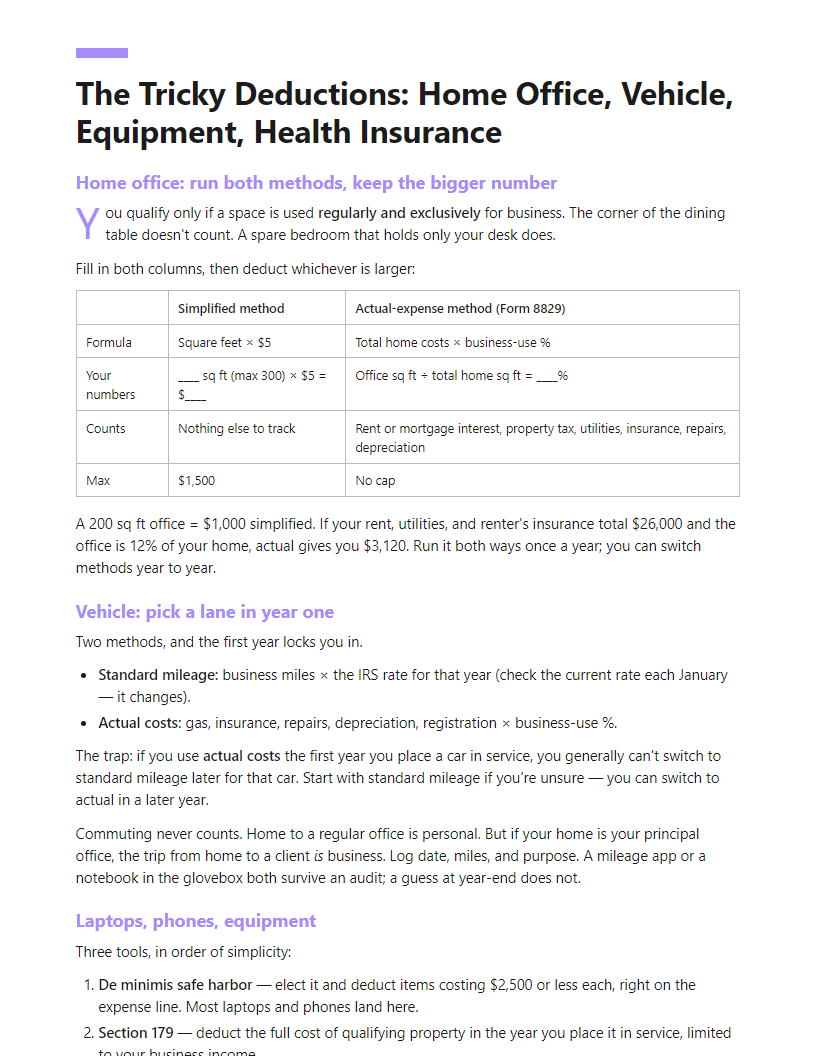
- ✓Home office calculator comparing simplified vs. Form 8829 actual-expense results
- ✓Vehicle mileage log plus standard-mileage vs. actual-cost comparison table
- ✓Side-by-side entity table: sole proprietor, LLC, S-corp, C-corp — with switching steps and deadlines
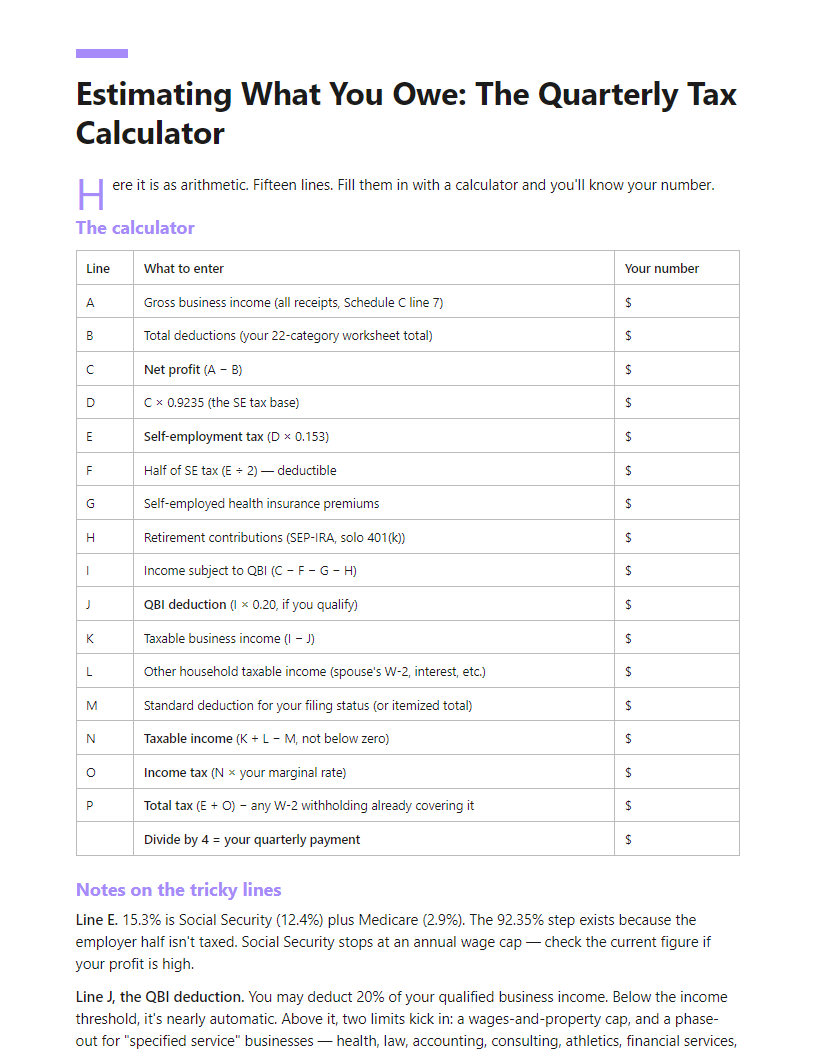
- ✓Estimated quarterly tax calculator with safe-harbour worksheet and payment due dates
- ✓Year-end filing checklist covering 1099-NEC deadlines, depreciation schedules, and SEHI reporting
Hosted on FileJoker. Premium members download instantly; free download has a wait.
In a hurry? Free one-page checklist32 items to tick off · print-ready PDF, no sign-upDownload freeA look inside the PDF
10 sections · 26 pages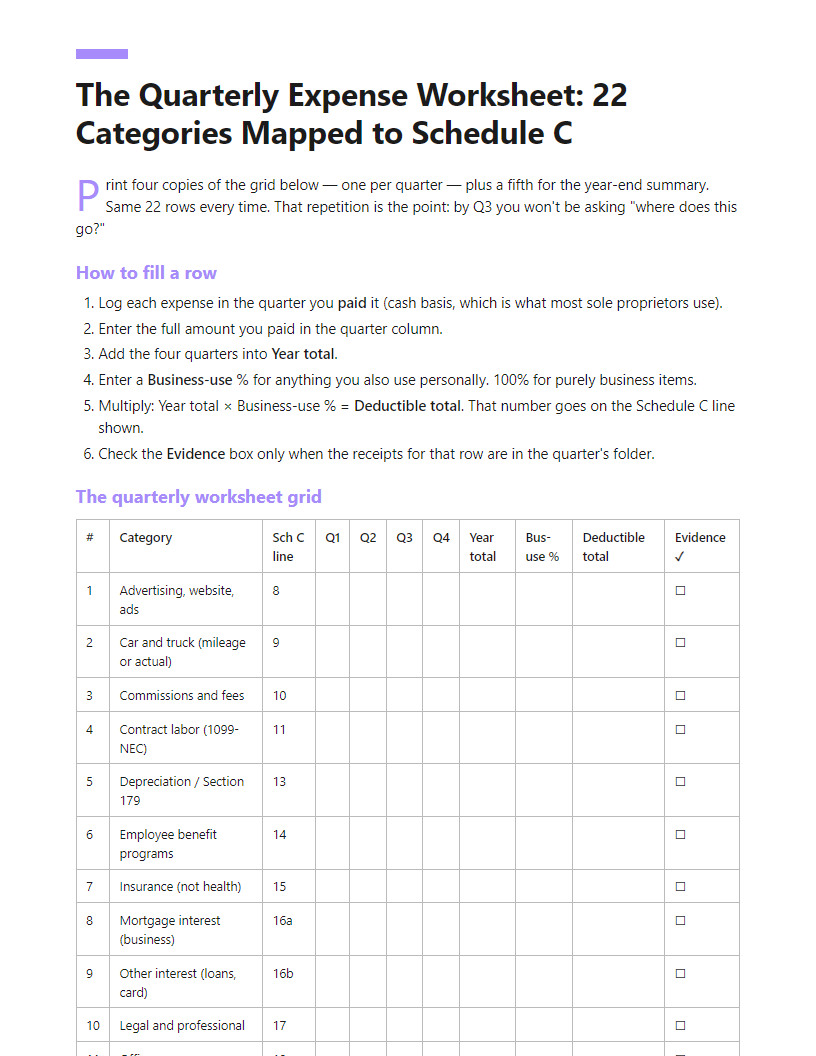
Full table of contents
- Why a Worksheet Beats a Cheat Sheet (and How to Use This Workbook)
- Quick Answer: What Counts as a Deductible Business Expense
- Step 1: Set Up Your Quarterly Capture System
- The Quarterly Expense Worksheet: 22 Categories Mapped to Schedule C
- The Tricky Deductions: Home Office, Vehicle, Equipment, Health Insurance
- Entity Choice: Sole Proprietor vs. LLC vs. S-Corp vs. C-Corp
- Estimating What You Owe: The Quarterly Tax Calculator
- Nine Mistakes That Cost Small Business Owners Money (or Trigger Letters)
- Year-End Filing Checklist
- Official Sources, Forms, and What to Check Each January
In this article
You know you’re overpaying, but nobody ever taught you this. You’ve got receipts in three places, a laptop you think counts, a spare room you hope qualifies, and an accountant who files your return without telling you what you missed. A tax deduction worksheet for small business turns that guesswork into a line-by-line record you can hand over with confidence.
This page gives you the rules: what actually counts as a deductible business expense, the nine mistakes that cost owners money or trigger IRS letters, and the forms to check each January.
The premium PDF workbook goes further — 22 expense categories mapped to Schedule C, a quarterly capture system, home office and vehicle calculators, entity comparison tables, and an estimated tax worksheet.
The short answer
A business expense is deductible when it is ordinary (common in your trade) and necessary (helpful and appropriate). To claim it correctly:
- Confirm the expense serves a business purpose, not a personal one.
- Split mixed-use items (phone, car, laptop) by a documented business-use percentage.
- Record date, amount, vendor, and purpose — keep the receipt.
- Map each expense to a Schedule C line (Part II) or to Form 8829 / Form 4562.
- Capitalise and depreciate assets over $2,500 unless you elect Section 179 or bonus depreciation.
- Total quarterly, then recalculate your estimated tax payment.
Why a Worksheet Beats a Cheat Sheet (and How to Use This Workbook)
Search “small business tax deductions” and you get a list. Advertising. Home office. Mileage. Meals. The list tells you what exists. It never tells you where to write the number down, which line of Schedule C it belongs on, or what you owe because of it.
That gap is why people overpay. You can know that a laptop is deductible and still lose the deduction because the receipt is gone and the amount never made it onto a form.
Nobody taught this in school. That is normal, and it is fixable in an afternoon.
The three jobs this workbook does
- Capture. A simple system for logging expenses as they happen, so you are not reconstructing March in April.
- Classify. Every expense gets matched to a specific Schedule C line — 22 categories, mapped for you.
- Calculate. A plain-arithmetic worksheet that turns your totals into a realistic estimate of your next quarterly payment.
Capture, classify, calculate. If a page is not doing one of those three things, it is not in here.
Two ways to use it
- The 90-minute catch-up. You are behind, filing is close, and you need everything in one place. Work straight through sections 3 to 7 in one sitting with your statements open.
- The 20-minute quarterly. Four short sessions a year, one at the end of each quarter. Faster, less painful, and your numbers are far more accurate because you still remember what the charges were for.
What to have on hand
- Bank and credit card statements for the period you are covering
- Your mileage app export or paper log
- Home utility bills and rent or mortgage statements (for the home office worksheet)
- Last year’s tax return, if you have one
- Any 1099-NEC or 1099-K forms you have received
Two honest notes before you start
This is educational material, not tax, legal, or accounting advice. Your situation may have wrinkles a workbook cannot see. Confirm any limit or rule on IRS.gov or with a licensed preparer before you file.
Dollar amounts move. Standard mileage rates, Section 179 caps, QBI income thresholds, and the Social Security wage base all change annually — sometimes mid-year. Every worksheet line that depends on one of those has a check current rate box. Fill it in from IRS.gov the day you use the sheet, not from memory.
Quick Answer: What Counts as a Deductible Business Expense
Nobody teaches this in school. Here’s the whole rule, in one sentence from the IRS: a business expense is deductible if it is ordinary and necessary.
- Ordinary means common and accepted in your line of work. A photographer buying lenses is ordinary. A bookkeeper buying lenses is not.
- Necessary means helpful and appropriate for your business. It does not mean indispensable. You don’t have to prove you’d have gone broke without it.
That’s it. Everything else is detail about proof, percentages, and timing.
The 60-second decision tree
Run every expense through these four gates, in order.
| Gate | Question | If NO | If YES |
|---|---|---|---|
| 1 | Was this for the business — ordinary and necessary in your trade? | Not deductible. Stop. | Go to gate 2 |
| 2 | Do you have proof (receipt, invoice, bank or card record, log)? | Not deductible in practice. Create the record now or let it go. | Go to gate 3 |
| 3 | Is any part of it personal? | Go to gate 4 | Deduct the business percentage only — and write down how you got that percentage |
| 4 | Will it last beyond this year and cost a meaningful amount (roughly $2,500+ per item)? | Deduct 100% this year | Capitalize it — depreciate, or elect Section 179 / bonus depreciation (see Section 5) |
The mixed-use rule
If an item serves both your business and your personal life, deduct only the business share and document the math that produced it — a mileage log, a square-footage measurement, a month of call records.
Warning: “As far as the IRS knows my laptop is 100 percent business use” is a popular joke and a bad plan. If you also stream shows on it, the honest answer is a percentage. Pick a defensible number, write down how you got it, and keep that note with the receipt. A reasonable 80% you can explain beats a 100% you can’t.
Six things people deduct that they shouldn’t
- Commuting miles — home to your regular work location is personal. Business-to-business driving counts.
- Everyday clothing — if you could wear it on the street, it’s not deductible, even if you only wear it to work.
- Most client entertainment — tickets, golf, concerts. Business meals are a separate, limited rule.
- Personal grooming — haircuts, gym, skincare, even if you’re on camera.
- Fines and penalties — parking tickets, late tax penalties, violations.
- The value of your own unpaid time — you can’t deduct wages you didn’t pay yourself.
What a “write-off” actually saves you
A deduction lowers your taxable income, not your tax bill, dollar for dollar.
A $1,000 deduction cuts about $1,000 off your net profit. That saves you your marginal income tax rate plus self-employment tax on that amount — roughly $220 to $400 for most sole proprietors, depending on your bracket. You still spent the $1,000. Never buy something just for the write-off; you’re paying a dollar to save a quarter.
Nine Mistakes That Cost Small Business Owners Money (or Trigger Letters)
1. Claiming 100% business use on a laptop, phone, or car you also use personally
“As far as the IRS knows my laptop is 100% business use” is a bet, not a deduction. In an exam, the conversation is short: Do you own another computer? Another phone? Another car? If the answer is no, 100% is not believable, and the examiner reduces the deduction to a number they pick. Write down an honest percentage — 80% business, 20% personal — and note how you got there. A believable 80% that survives beats a 100% that gets cut to 50%.
2. Leaving easy deductions on the table
The expenses people forget most: startup costs incurred before you opened, business bank and merchant fees, software subscriptions billed to a personal card, courses and professional development, and retirement contributions (a SEP-IRA or solo 401(k) cuts income tax, not self-employment tax). Scan last year’s personal card statement for business charges you never recorded.
3. One account for everything, reconstructed from memory in April
Memory is not a record. Rebuilding twelve months of spending in April means you miss real deductions and claim some you can’t support. Separate accounts fix this in one afternoon — see Step 1.
4. Expensing a capital asset (or capitalizing something you could expense)
A $4,000 piece of equipment deducted over years when Section 179 or bonus depreciation would let you take it now costs you cash this year. The reverse — expensing something that should be depreciated — invites a correction letter. Check the rule before you write the number down.
5. Skipping Form 1099-NEC for contractors paid $600 or more
If you paid an unincorporated contractor $600 or more during the year, you file a 1099-NEC. Penalties apply per form and rise the later you file — check current figures on IRS.gov. Collect a W-9 before you pay anyone the first time.
6. Deducting the whole loan payment
Loan principal is not deductible. You didn’t pay income tax on the borrowed money, so repaying it isn’t an expense. Only the interest portion is deductible, plus loan fees. Your lender’s year-end statement splits it for you. So: are small business loans tax deductible? The interest is. The money itself is not, and what you buy with it is deducted under its own rules.
7. Paying a preparer who only does data entry
If your preparer never asks a question you didn’t prompt, you’re buying typing. Ask these five:
- Based on my numbers, should I elect S-corp status this year — and what’s the break-even?
- Which retirement plan saves me the most tax at my income?
- Am I taking the home office deduction the better way?
- What should I buy or defer before December 31?
- What’s my projected quarterly payment for next year?
8. Guessing at mileage
No log, no deduction. Dates, miles, purpose.
9. Skipping quarterly payments and hoping
Underpayment penalties accrue by quarter, not at filing. Pay something on time, every quarter, even if the estimate is rough.
Frequently Asked Questions
Can I deduct a laptop I also use personally?
Yes — the business percentage. Estimate honestly: if you use it for client work four days a week and Netflix the rest, 70% is defensible. Prove it with a simple log for a representative two to four weeks (dates, task, business or personal), kept with the receipt. “As far as the IRS knows it’s 100% business” is a position you’d have to defend out loud in an exam, and almost nobody wins it.
Do I need an LLC before I can take deductions?
No. A sole proprietor with no registration at all deducts the exact same expenses on the same Schedule C. An LLC gives you liability protection under state law; it changes nothing about what’s deductible. Don’t delay tracking expenses while you wait on paperwork.
Are business loan payments deductible?
Only the interest, not the principal. The principal is repayment of money you were never taxed on in the first place. Split each payment using your lender’s amortization statement: interest goes on Schedule C Line 16b (16a for mortgage interest paid to banks). What you buy with the loan money may be deductible or depreciable on its own.
I had no income this year. Can I still claim expenses?
Yes, if you were actually operating — open for business, seeking customers, with records to show it. The result is a net loss that can offset other income on your Form 1040, like a spouse’s W-2 wages. Repeated losses year after year invite the hobby-loss question, so keep evidence that you’re running this to make a profit: a price list, marketing, a separate bank account.
How much should I set aside from each payment?
Set aside 30% of every dollar that lands in the business account, moved to a separate savings account the day it arrives. Treat that as a conservative placeholder, not your real rate. Once you run the Section 7 calculator you’ll have an effective rate on gross receipts, and it’s usually lower — the $60,000 gross example there lands near 15% of gross after deductions. Switch to your own calculated number as soon as you have it, and re-check it each quarter.
Can I switch to S-corp mid-year, and can I switch back?
S-corp status is an election you make on Form 2553, with timing rules — check current deadlines on IRS.gov. You can revoke it later, but the IRS generally blocks re-electing for five years after a revocation. Don’t flip back and forth. Make the switch when profit is consistently high enough that payroll costs are worth it.
Do I need receipts under $75, or will bank statements do?
There is a real $75 rule, but it’s narrow. The IRS doesn’t require documentary evidence for travel and transportation expenses under $75 — lodging is excluded, so you need a receipt for a hotel at any amount. You still have to record the amount, date, place and business purpose in a log or app. In practice, keep the receipt anyway: statements prove you paid someone, not what you bought or why, which is the question an auditor asks.
Is the free IRS worksheet enough?
The IRS publishes the rules and the forms accurately — Publication 535 and Schedule C instructions are authoritative. What they don’t give you is a quarterly tracking system. Use their definitions; use a worksheet to capture the numbers.
Official Sources, Forms, and What to Check Each January
The forms and publications to bookmark
Everything in this workbook traces back to a free IRS document. Pull current-year versions from IRS.gov each January — the content changes.
| Document | What it’s for |
|---|---|
| Schedule C | Your profit or loss; every worksheet line maps here |
| Schedule C instructions | Line-by-line guidance on what belongs where |
| Schedule SE | Self-employment tax |
| Form 8829 | Home office, actual-expense method |
| Form 4562 | Depreciation, Section 179, listed property |
| Form 2553 | S-corp election |
| Publication 334 | Tax Guide for Small Business; business expenses, category by category |
| Publication 587 | Business use of your home |
| Publication 463 | Travel, gift, and car expenses |
The five numbers to re-check every January
These move. Write the current figures at the top of your Q1 worksheet before you record a single expense.
- Standard mileage rate (cents per mile)
- Section 179 expensing cap
- Bonus depreciation percentage (it has been phasing down)
- QBI deduction income thresholds for your filing status
- Social Security wage base for self-employment tax
Check current figures on IRS.gov rather than a blog post from two years ago.
Free help that is actually free
- IRS Small Business and Self-Employed Tax Center — forms, publications, and recorded workshops, no cost.
- VITA and TCE — free return preparation if you meet the income or age criteria. Find a site through the IRS locator.
- SCORE — free volunteer mentoring from retired business owners and accountants.
Choosing a preparer who earns the fee
If you’ve paid a chain preparer and walked out with no advice, you bought compliance, not planning. Compliance is filling in the boxes you already handed over. Planning is being told, in October, what to do before December 31.
Look for a CPA or an Enrolled Agent — EAs are licensed by the IRS and often cheaper. At a first meeting, bring your filled-in worksheets and ask: should I elect S-corp status, am I missing a retirement plan deduction, and what should I change next year? A preparer who can’t answer those is a data-entry service.
Warning: State and local rules differ from federal ones. This workbook does not cover partnerships, payroll tax filing, or sales tax. Nobody taught you this in school — that’s normal, and it’s also why you verify against the source.
- ✓22-category quarterly expense worksheet, each line mapped to its Schedule C box
- ✓Quarterly receipt-capture system with a filing log and monthly 15-minute routine
- ✓Home office calculator comparing simplified vs. Form 8829 actual-expense results
- ✓Vehicle mileage log plus standard-mileage vs. actual-cost comparison table
- ✓Side-by-side entity table: sole proprietor, LLC, S-corp, C-corp — with switching steps and deadlines
- ✓Estimated quarterly tax calculator with safe-harbour worksheet and payment due dates
- ✓Year-end filing checklist covering 1099-NEC deadlines, depreciation schedules, and SEHI reporting
Frequently asked questions
Can I deduct a laptop I use for both work and personal tasks?
Yes, but only the business-use share. Estimate the percentage honestly — for example, 70% business use of a $1,200 laptop gives an $840 deduction — and keep a short usage log supporting it. Items under your capitalisation threshold (commonly $2,500) can be expensed immediately; higher-cost equipment is depreciated or expensed via Section 179 on Form 4562.
What qualifies for the home office deduction?
The space must be used regularly and exclusively for business and be your principal place of business. A dining table fails the exclusive test; a dedicated room passes. The simplified method gives $5 per square foot up to 300 sq ft ($1,500 max). The actual-expense method on Form 8829 allocates rent, utilities, insurance, and repairs by square footage and often yields more.
Should I form an LLC or elect S-corp status to save tax?
An LLC alone changes liability, not taxation — single-member LLCs still file Schedule C and pay self-employment tax on all profit. An S-corp election splits income into reasonable salary plus distributions, which can cut self-employment tax once profit reliably exceeds roughly $40,000–$60,000, but adds payroll filings and costs. You can elect later using Form 2553.
How do I calculate quarterly estimated taxes?
Project annual net profit, subtract the qualified business income deduction and half of self-employment tax, then apply your income tax bracket plus 15.3% self-employment tax on the first portion of net earnings. Divide by four. Safe harbour: pay 100% of last year's tax (110% if AGI exceeded $150,000) to avoid underpayment penalties, regardless of this year's outcome.
What records do I need if the IRS asks questions?
Keep receipts or invoices showing date, amount, vendor, and business purpose; bank and card statements alone are usually insufficient for meals and travel. Mileage requires a contemporaneous log of date, destination, purpose, and miles. Reimbursements through an S-corp need a written accountable plan and expense reports. Retain records at least three years after filing — seven for bad debts and worthless securities.
Why does my accountant never suggest ways to save tax?
Most tax preparers are paid to file what you bring them, not to plan ahead. Arriving with a completed category-by-category worksheet changes the conversation: they can see missed write-offs, flag an entity election, or time equipment purchases. Planning questions are best asked in Q3 or Q4, before the year closes — by April, most levers are already gone.
We collected 97 real questions and comments about "tax deduction worksheet for small business" (59 from YouTube comments, 38 from search suggestions), grouped them into 12 recurring problems, and built this guide to resolve the 7 that block people most. The top-ranking pages were reviewed for gaps; 7 of those gaps became dedicated sections.
Edited by Alex Horn · Last updated November 11, 2026 · How we make our guides