Template · 25-page PDF · Premium
Invoice Template Freelance Writer: The Complete Invoicing Kit
What every invoice template freelance writer needs: required line items, tax and no-company rules, late-payment emails and a payment tracker. Start here.
The full workbook, ready to print
- ✓Ready-to-use invoice templates in Word, Google Sheets and fillable PDF
- ✓Copy-paste line items for 6 types of writing work, including rights and kill fees
- ✓Three real anonymised writer invoices, annotated line by line
- ✓Sales tax and VAT decision steps for US and UK writers
- ✓A 4-email late-payment follow-up sequence you can send as-is
- ✓Billing cadence comparison: hourly vs per-project vs weekly vs monthly
- ✓Pre-send checklist and a payment tracker sheet
Hosted on FileJoker. Premium members download instantly; free download has a wait.
In a hurry? Free one-page checklist32 items to tick off · print-ready PDF, no sign-upDownload freeA look inside the PDF
12 sections · 25 pages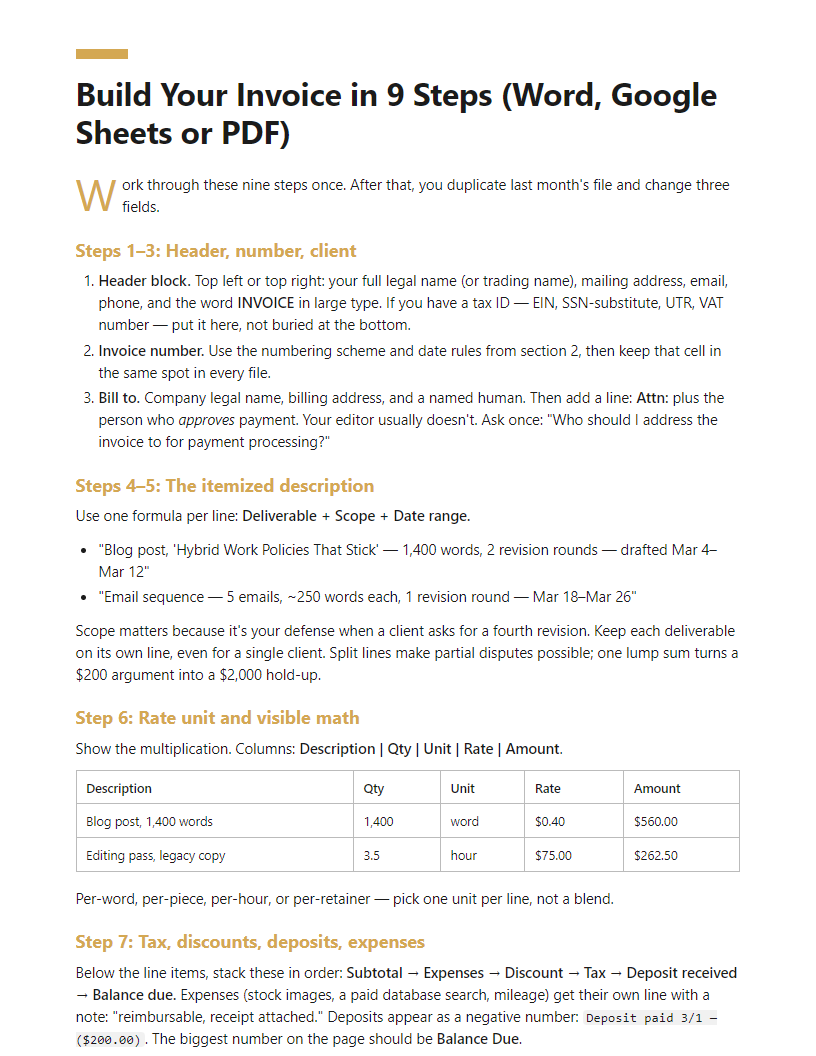
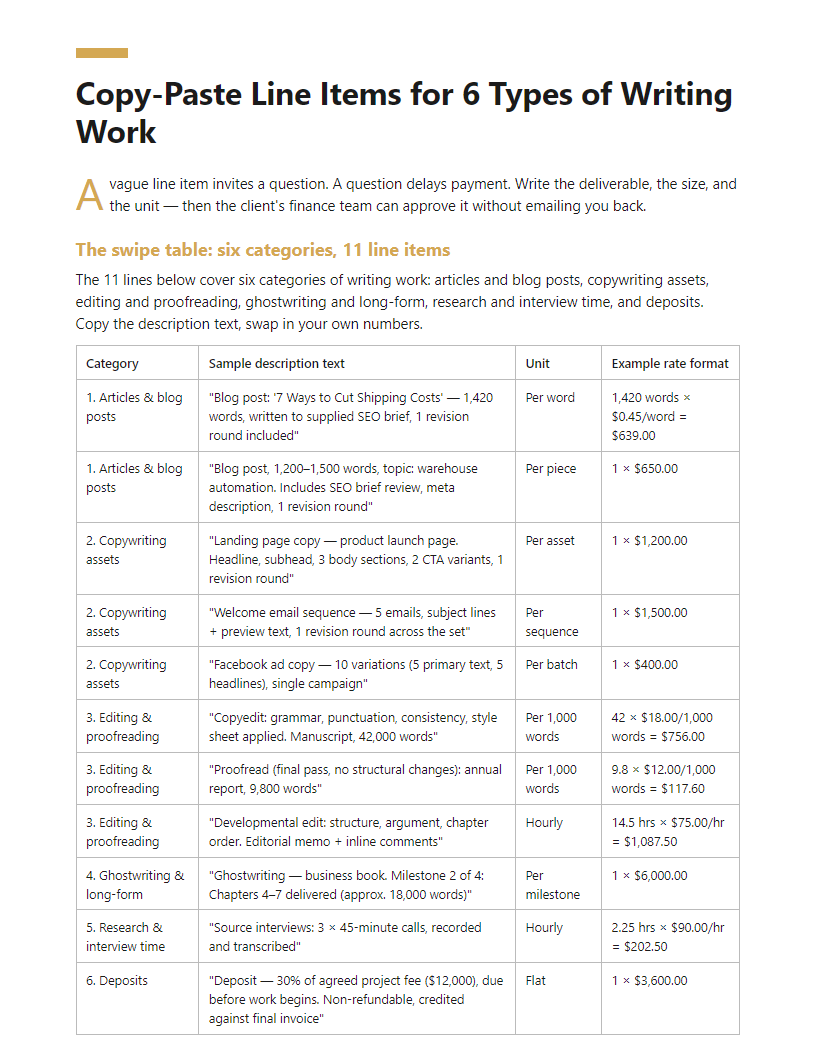
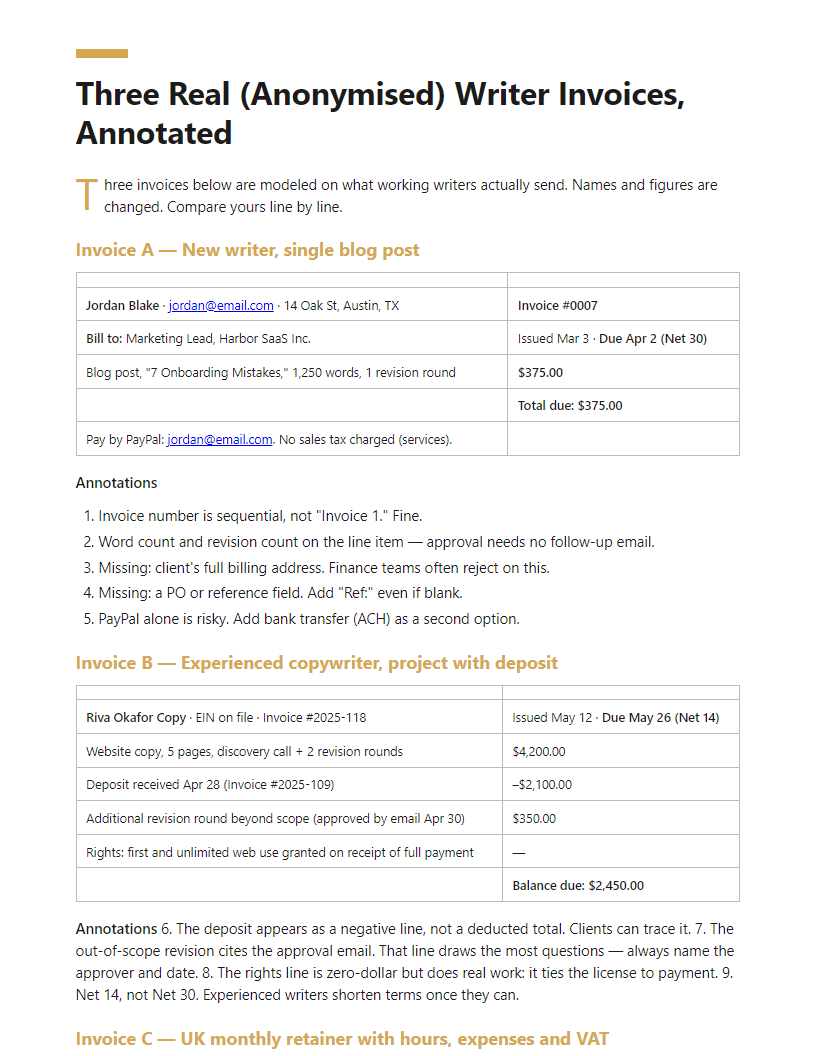
Full table of contents
- Why Writer Invoices Are Different (and Why Generic Templates Fail You)
- The Short Answer: What Every Freelance Writing Invoice Must Contain
- Can You Invoice Without a Registered Company? US and UK Rules Explained
- Should You Add Tax? Sales Tax, VAT and the Writer's Tax Line
- Build Your Invoice in 9 Steps (Word, Google Sheets or PDF)
- Copy-Paste Line Items for 6 Types of Writing Work
- Three Real (Anonymised) Writer Invoices, Annotated
- Hourly, Per-Project, Weekly or Monthly? Choosing Your Billing Cadence
- Late Payments: A 4-Email Follow-Up Sequence for Writers
- Nine Invoicing Mistakes That Delay Your Payment
- Pre-Send Checklist and Payment Tracker
- Your Templates: Word, Google Sheets and Fillable PDF
In this article
- The short answer
- Why Writer Invoices Are Different (and Why Generic Templates Fail You)
- The Short Answer: What Every Freelance Writing Invoice Must Contain
- Can You Invoice Without a Registered Company? US and UK Rules Explained
- Nine Invoicing Mistakes That Delay Your Payment
- Freelance Writer Invoicing FAQ
You finished the article, the client loved it, and now you’re staring at a blank document wondering what an invoice is even supposed to look like. Hunting for an invoice template freelance writer types can actually use burns hours — most results are generic, ask for your email, or skip the things writers bill for: rights, revisions, kill fees and rush rates.
This page gives you the structure every writing invoice needs, whether you can legally invoice without a registered company in the US or UK, and the nine mistakes that quietly delay your payment. The premium PDF adds ready-made templates in Word, Google Sheets and fillable PDF, copy-paste line items for six types of writing work, three annotated real invoices, a four-email late-payment sequence and a payment tracker.
The short answer
A freelance writer’s invoice needs nine elements:
- The word “Invoice” plus a unique invoice number.
- Your legal name, address and contact details (trading name optional).
- The client’s company name, billing address and contact or PO reference.
- Issue date and a clear due date (e.g. Net 14 or Net 30).
- Itemised lines: piece title, word count, rate and amount.
- Extras you agreed: revisions, rush fee, kill fee, rights or licence terms.
- Subtotal, any tax or VAT line, and the total due.
- Payment methods and bank or transfer details.
- Late-payment terms.
Why Writer Invoices Are Different (and Why Generic Templates Fail You)
Most invoice templates were built for people who sell things. A plumber bills for a part and two hours of labor. You bill for 1,400 words, two rounds of revisions, a headline variant the client asked for on Slack, and the right to publish it under someone else’s name. Generic templates have no language for any of that.
Writer invoices go wrong at three predictable moments:
- Unclear scope. The invoice says “blog post — $600.” The client remembers asking for three. Nothing on paper settles it.
- Missing rights language. Ghostwriting, work-for-hire, first rights, usage limits — if the invoice doesn’t name what the client is buying, you can’t charge for more later.
- No payment terms. No due date, no late fee, no “Net 14.” Invoices without a deadline get paid whenever.
Online invoice generators hand you a pretty shell. The design is fine. The thinking isn’t there: the default Canva and Adobe service-invoice templates ship with generic “Service / Hours / Rate” rows only, so a kill fee, a revision overage or a usage-rights charge has no obvious home. You still have to invent the wording, which is where the hour of searching goes.
What’s in this kit
- 3 template formats — Word, Google Sheets, fillable PDF
- 12 copy-paste line items — articles, copywriting, editing, ghostwriting, revisions, rush fees and more
- 4 late-payment emails — polite to firm, ready to send
- 1 payment tracker — see what’s outstanding at a glance
Two ways to use it
The 10-minute path: jump to [s12], download the format you like, copy the line items you need from [s6], check [s11], send. Done before your coffee cools.
The 60-minute path: read straight through. You’ll set your billing cadence, settle the tax question, save your chase emails, and open the tracker. You do this once and invoicing stops being a decision.
It works for unregistered sole operators billing under their own name, UK sole traders, and US LLCs. Tax and registration rules for both countries are in [s3] and [s4].
The Short Answer: What Every Freelance Writing Invoice Must Contain
An invoice is payable when it answers three questions: who is owed, by whom, and by when. Everything else is detail. Here are the 11 fields that must appear.
| # | Field | What to write |
|---|---|---|
| 1 | Your name or trading name | Your legal name works fine. Add “dba” or trading name if you use one |
| 2 | Your address and contact | Street address or mailing address, email, phone (optional) |
| 3 | Client’s legal name and billing contact | The entity that pays, plus the named person or AP email |
| 4 | Unique invoice number | Never repeat one. See numbering below |
| 5 | Issue date | The day you send it |
| 6 | Due date | An actual date, not “Net 30” alone |
| 7 | Itemized description | What you wrote, for whom, word count, revision rounds |
| 8 | Quantity and rate | 1,400 words @ $0.40/word, or 1 article @ $600 |
| 9 | Subtotal | Before tax |
| 10 | Tax line | Even if it reads “Tax: $0.00” or “VAT not applicable” |
| 11 | Total due | Bold it. One number, with currency code |
Payment details block
List the method you want used first, because clients pay with whatever they see at the top. For US clients, bank transfer (ACH) is usually cheapest for both sides. For cross-border work, Wise often beats PayPal on fees.
Include: account name, account number and routing number (US) or IBAN/SWIFT (international), plus one backup method. A Stripe or PayPal payment link is useful for small clients who want to click and be done.
Invoice numbering that never collides
Pick one scheme and never change it mid-year:
- Sequential by year: INV-2026-001, INV-2026-002. Simple, clean, no client information leaked.
- Client-coded: ACME-2026-004. Easier to search when a client asks “which invoice?”
Never restart at 001 for a new client inside the same scheme. That is how two invoices end up with the same number.
Copy this into an email in 60 seconds
INVOICE INV-2026-014
Jane Doe · 42 Oak Street, Austin, TX 78701 · jane@janedoewrites.com

Bill to: Acme Media LLC
Attn: Accounts Payable, ap@acmemedia.com

Issue date: March 3, 2026
Due date: April 2, 2026 (Net 30)

DESCRIPTION                                 QTY      RATE     AMOUNT
Feature article, "Remote Onboarding"      1,400 w   $0.40     $560.00
Two revision rounds (included)                 —         —       $0.00
Headline variants (additional scope)           5    $10.00      $50.00

Subtotal                                                      $610.00
Tax                                                             $0.00
TOTAL DUE (USD)                                               $610.00

Pay by ACH: Jane Doe · Acct 123456789 · Routing 987654321
Backup: PayPal jane@janedoewrites.com
What you can leave off
- A logo. It changes nothing about whether you get paid.
- A purchase order number you were never given. Ask for it before you invoice, or omit the field.
- An hour-by-hour breakdown nobody requested. It invites line-item haggling.
- Your Social Security number or tax ID, unless the client asks via a W-9.
Can You Invoice Without a Registered Company? US and UK Rules Explained
Yes. You can send an invoice today, under your own name, with no company behind it. An invoice is not a legal entity — it’s a document requesting payment. Anyone can issue one.
United States
If you write for money and haven’t formed anything, you are a sole proprietor by default. No registration, no LLC, no filing. You invoice under your legal name: Jane Rivera.
US clients paying you $600 or more in a year will ask for a Form W-9 so they can issue a 1099-NEC. The W-9 asks for a taxpayer ID. That can be your Social Security number — or an EIN.
Get the EIN. It’s free from the IRS, takes about 15 minutes online, and you get the number immediately. Sole proprietors with no employees can have one. Then your SSN never travels through a client’s accounts payable inbox.
Tip: Put your EIN on the W-9, not the invoice. Most invoices don’t need a tax ID at all unless the client’s system asks for one.
United Kingdom
You invoice as a self-employed sole trader. Register for Self Assessment with HMRC once your self-employed income passes the reporting threshold (check current figures on gov.uk). HMRC issues you a Unique Taxpayer Reference (UTR).
Your UTR is for your tax return, not your invoices. You don’t have to print it on client invoices.
You may invoice under your own name, or use a trading name: Jane Rivera trading as Rivera Copy. If you use a trading name, your own legal name must still appear on the invoice. A trading name can’t include “Limited,” “Ltd,” “LLP” or “plc” — those are reserved for registered companies.
Do I need a registered entity to send this invoice?
| Your situation | US | UK |
|---|---|---|
| Billing under your own legal name | No registration needed. Sole proprietor by default. | No registration needed. Sole trader. Register for Self Assessment with HMRC. |
| Want a business name on the invoice | File a DBA (“doing business as”) with your state or county — usually $10–$100. | Use “Your Name trading as Business Name.” No registration required. |
| Want a business bank account in a business name | Bank will usually require a DBA plus an EIN. | Bank will usually require proof of the trading name. |
| Want liability protection or a company number | Form an LLC or corporation. | Register a limited company at Companies House. |
What to put in the “Company name” field
Delete it, or type your own name. Templates include that field because they were built for businesses. An invoice from “Jane Rivera, Freelance Writer” is just as payable as one from a limited company.
Warning: Some clients’ onboarding forms demand a company registration number. Reply: “I’m a sole proprietor/sole trader — I don’t have a company number. My taxpayer ID is on the attached W-9.” Most accept this immediately. If a client refuses to pay anyone without a company number, that’s their procurement policy, not the law — ask them to route you through their contractor process instead.
Nine Invoicing Mistakes That Delay Your Payment
Open your last invoice next to this list. Most payment delays trace back to one of these nine.
1. You addressed it to your editor, not the billing entity. Your editor approves the work. Accounts payable pays it. If the invoice says “Attn: Sarah” and no company name, it can sit in Sarah’s inbox for three weeks. Fix: bill the legal entity, with your contact’s name on a separate “Attn:” line.
2. Your descriptions are vague. “Writing services, October — $1,800” gives finance nothing to match against a purchase order. It gets bounced back for detail. Fix: deliverable, size, unit. “Blog post, ‘Tax Deadlines for Freelancers,’ 1,400 words — $420.”
3. There’s no due date. “Payable on receipt” is not a date. Neither is “Net 30” on its own — the client has to do the math, and they won’t hurry. Fix: write the actual date. “Due: March 14, 2026.”
4. You reuse invoice number 001. Three clients all holding an “Invoice 001” from you looks careless, and it wrecks your own records at tax time. Fix: one running sequence across all clients, or a per-client prefix like ACME-004.
5. You left off the deposit you already received. If you took 50% upfront and bill the full amount, the client either pays twice or stops to query it. Both cost you time. Fix: show the full fee, then a line reading “Less deposit received Feb 3 — $600,” then the balance due.
6. You skipped the tax line on a client that needs it. Some clients cannot process an invoice without a tax number or a VAT line, even a zero-rated one. Their system rejects it silently. Fix: ask once at onboarding what their finance team requires, then build it into your template.
7. You sent an editable Word file. A .docx can be altered after it leaves you, and it renders differently on their screen. Fix: export to PDF every time. Keep the Word or Sheets file as your working copy.
8. Your payment details are missing or stale. No account number, no PayPal address, or bank details from a closed account. The invoice stalls and nobody tells you. Fix: check the payment block every time you duplicate the file — it’s the one field people forget to update.
9. You invoiced late. Many companies run payments once a month, on a fixed date, with a cutoff a week earlier. Miss it by two days and you wait another month. Fix: ask each client when their payment run falls, and invoice at least five business days before.
Tip: Fix these once in your master template. Then invoicing stops being paperwork you dread and becomes a five-minute copy-and-change job.
Freelance Writer Invoicing FAQ
Can I invoice clients while I’m employed full-time?
Yes, in most cases. Your day job doesn’t stop you from invoicing side work as a sole proprietor (US) or sole trader (UK) — the invoice itself looks identical to any other. Check your employment contract first for moonlighting, conflict-of-interest, or IP clauses, since those are between you and your employer, not your client. You report the freelance income separately from your salary. For the registration side, see [s3].
Should I add sales tax or VAT to a writing invoice?
Usually no tax is due. Most US states don’t tax writing services, and UK writers only charge VAT once they’re registered. Check your own state’s rules and your current VAT position before you send.
But always show a tax line, even when the amount is zero. An invoice with no tax row at all is what triggers accounts payable queries — a reader can’t tell whether you forgot or it genuinely doesn’t apply. Use the exact wording for your situation from the tax-line wording table in [s4] (“Should You Add Tax?”), for example “Sales tax: $0.00” or “VAT not applicable.”
How do I invoice a client in another country, and in which currency?
Bill in the currency named in your agreement. If none was named, bill in your own currency and state it explicitly: “All amounts in USD.” Add the payment rails that work across borders — Wise, PayPal, or your IBAN/SWIFT details. Say who covers transfer fees. If you don’t, the fee comes out of your total.
What do I do if a client ignores my invoice for 60 days?
Stop sending the same email. Call the accounts payable line and get a named person and a payment date in writing. Pause all work in progress and say so. At 60 days, send a formal demand with a 7-day deadline, then decide between small claims court, a collections service, or writing it off. Keep every email — you’ll need the paper trail.
Do I need a contract before I can send an invoice?
No. In both the US and UK an emailed brief and acceptance generally forms a contract, but written scope is what you rely on in a dispute. So put the basics in writing — scope, fee, revision rounds, payment terms. One paragraph in an email counts.
Can I charge a late fee, and how much is reasonable?
Only if you stated it before the work started. Common practice is 1.5% per month on the overdue balance, or a flat fee such as $25. UK writers can claim statutory interest and a fixed recovery charge — check current figures. Print the fee on the invoice itself, under your payment terms.
What’s the difference between an invoice, a quote and a receipt?
| Document | When you send it | What it does |
|---|---|---|
| Quote | Before the work | Proposes a price. Not a demand for payment. |
| Invoice | After delivery (or per your schedule) | Requests payment by a stated date. |
| Receipt | After money arrives | Confirms payment was made. |
- ✓Ready-to-use invoice templates in Word, Google Sheets and fillable PDF
- ✓Copy-paste line items for 6 types of writing work, including rights and kill fees
- ✓Three real anonymised writer invoices, annotated line by line
- ✓Sales tax and VAT decision steps for US and UK writers
- ✓A 4-email late-payment follow-up sequence you can send as-is
- ✓Billing cadence comparison: hourly vs per-project vs weekly vs monthly
- ✓Pre-send checklist and a payment tracker sheet
Frequently asked questions
Can I send invoices as a freelance writer without a registered company?
Yes. In the US you can invoice as a sole proprietor using your legal name and SSN or an EIN — no LLC required. In the UK, sole traders invoice under their own name once registered as self-employed with HMRC. Use your legal name, a real address and a unique invoice number, and keep copies for tax records.
Do I need to charge sales tax or VAT on writing work?
It depends on where you and your client are based. Most US states do not tax freelance writing services, but a few tax certain digital or advertising deliverables, so check your state. In the UK you only add VAT once you're VAT-registered or over the threshold. If no tax applies, leave the tax line out entirely rather than writing "0%".
What line items belong on a writing invoice?
Bill per deliverable, not in vague lumps. List the piece title or working headline, agreed word count, rate (per word, per hour or flat), and quantity. Add separate lines for extra revision rounds beyond the agreed number, rush or weekend fees, kill fees, interview or research time, and the rights granted — for example first North American serial rights or full copyright transfer.
Which format should I use — Word, Google Sheets or PDF?
Build and edit in Word or Google Sheets, then always send a PDF. Sheets auto-calculates totals and tax, Word suits writers who prefer a clean document, and PDF prevents accidental edits and renders identically on the client's screen. Name the file clearly: YourName_Invoice_0042_ClientName.pdf, so accounts payable can find it later.
Should I invoice per project, hourly, or monthly?
Per-project suits one-off articles and copywriting with a defined scope. Hourly fits editing, consulting and open-ended research where scope drifts. Monthly or twice-monthly batching works best for ongoing retainers and regular contributors — fewer invoices, steadier cash flow, and easier reconciliation for the client's finance team. Agree the cadence in writing before you start work.
What do I do when a client doesn't pay on time?
Send a short, neutral reminder the day after the due date, attaching the original invoice. Escalate on a schedule: a polite nudge at day 7, a firmer note referencing your late-payment terms at day 14, and a final notice at day 30 stating next steps. Keep every message factual, pause new work, and never apologise for asking.
We collected 55 real questions and comments about "invoice template freelance writer" (18 from YouTube comments, 37 from search suggestions), grouped them into 14 recurring problems, and built this guide to resolve the 7 that block people most. The top-ranking pages were reviewed for gaps; 7 of those gaps became dedicated sections.
Edited by Alex Horn · Last updated November 11, 2026 · How we make our guides