Template · 13-page PDF · Free
Sleep Log Template: Build One and Actually Read the Results
Build a sleep log template that shows real patterns in 14 nights. Column list, the 10-4-3-2-1 rule, and a free printable log plus daily checklist. Download it.
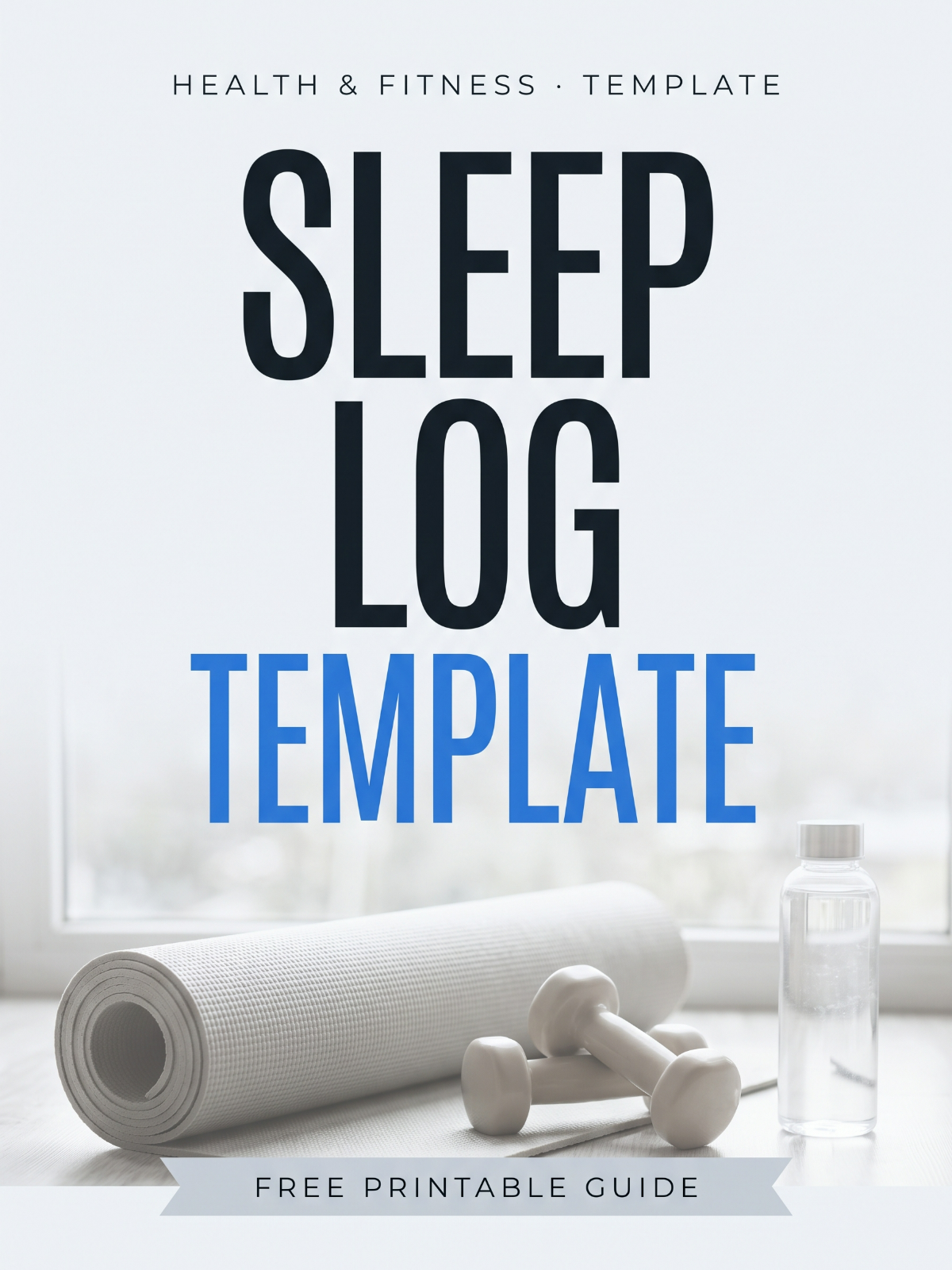
The full guide as a PDF
- ✓Printable 14-night sleep log with pre-labelled columns
- ✓Step-by-step build tutorial for making your own log from blank paper or a spreadsheet
- ✓Customisation sheet for mood, day-quality and trigger factors
- ✓Two-week pattern interpretation pass with worked examples
- ✓Seven mistakes checklist that ruin a sleep log
- ✓Migration guide for upgrading your log without losing existing data
- ✓Daily morning fill-in checklist for the 14-day run
Hosted on FileJoker. Free download, no sign-up.
A look inside the PDF
9 sections · 13 pages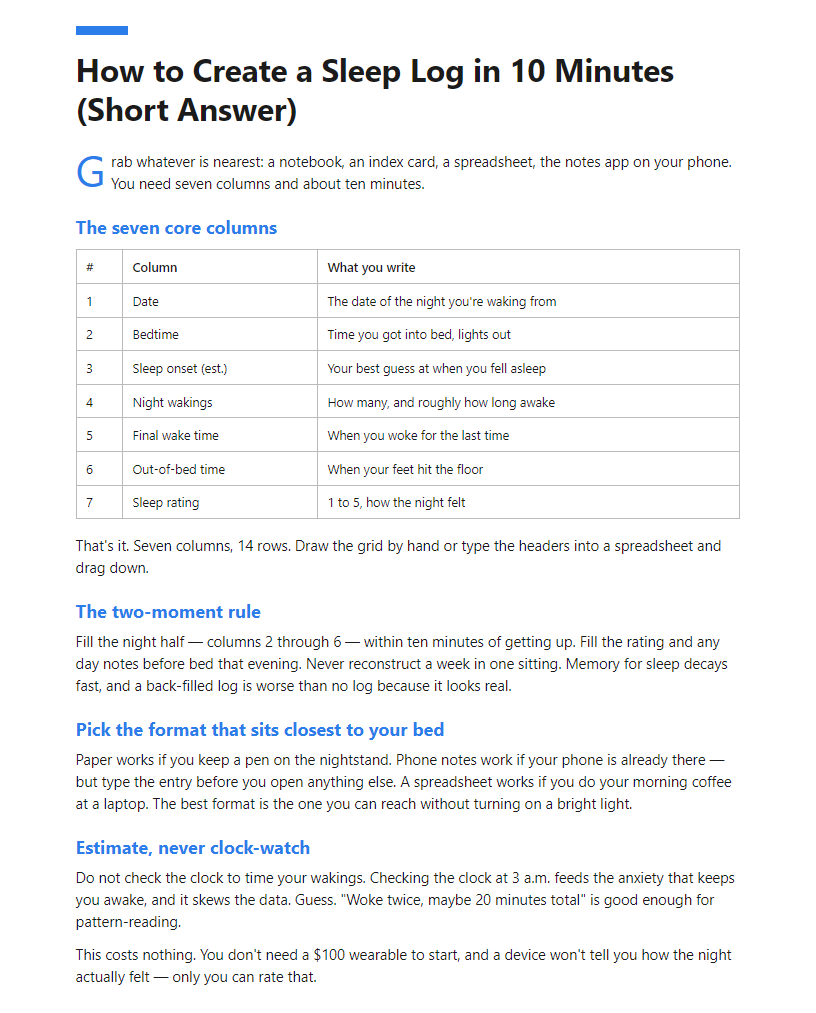
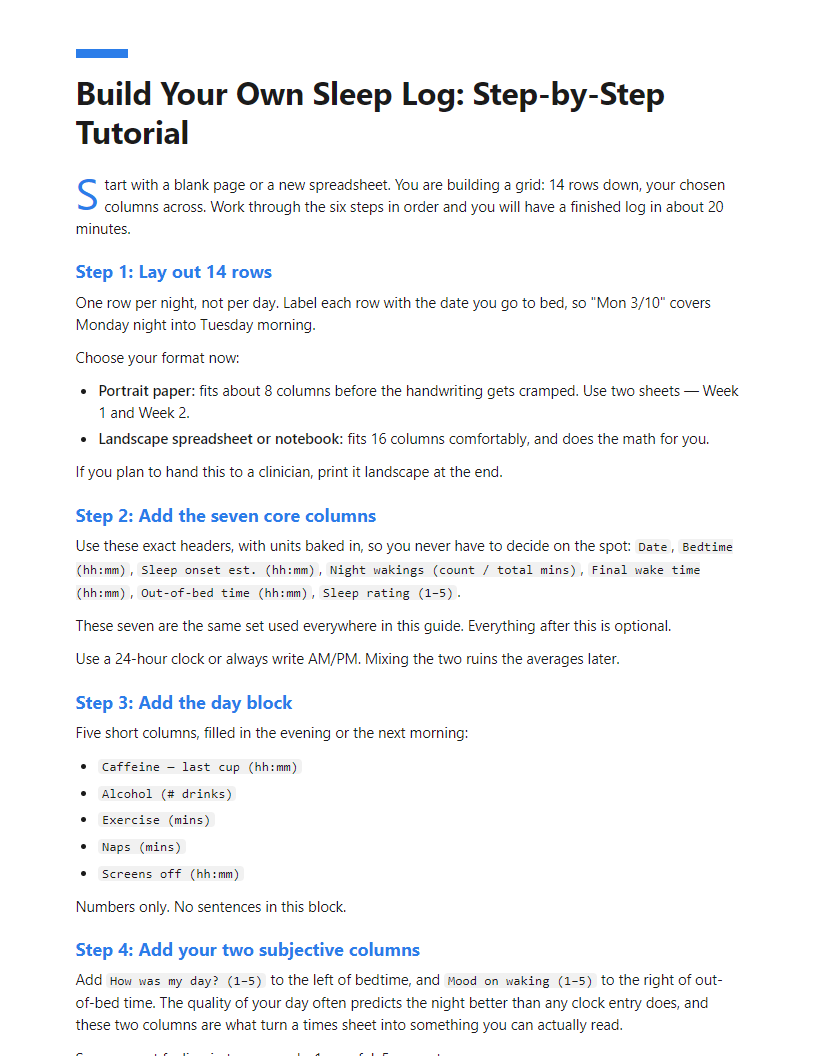
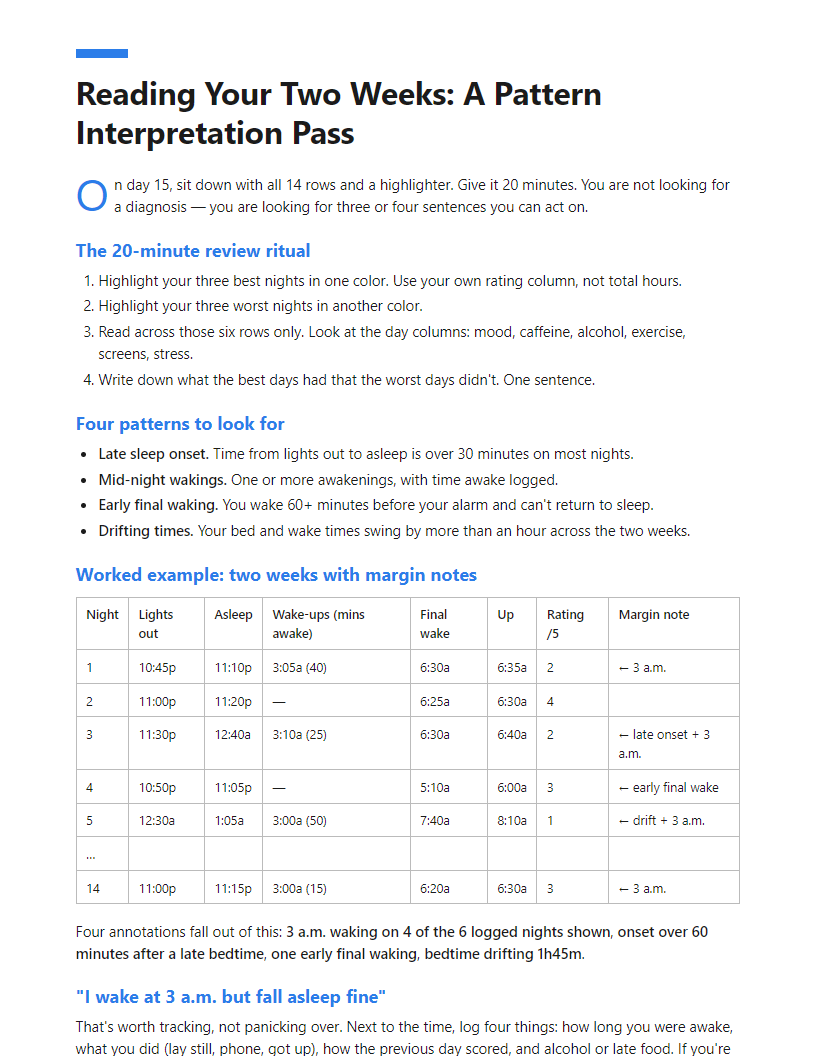
Full table of contents
- How to Create a Sleep Log in 10 Minutes (Short Answer)
- Build Your Own Sleep Log: Step-by-Step Tutorial
- Customising the Log: Mood, Day Quality and Trigger Factors
- The 10-4-3-2-1 Rule, Explained and Turned Into Columns
- Reading Your Two Weeks: A Pattern Interpretation Pass
- Manual Log vs Fitbit: Using Both Without the Argument
- Seven Mistakes That Ruin a Sleep Log
- Upgrading Your Log Without Losing Two Weeks of Data
- Your 14-Day Log Setup and Daily Checklist
In this article
You don’t want another blank grid. You want to know what to put in the columns, how long to track, and what the numbers mean once you’ve filled them in — especially if your doctor asked for it, or you keep waking at 3am and can’t tell whether that’s a problem.
This page shows you how to build a sleep log template from scratch in about ten minutes, which columns earn their place, how the 10-4-3-2-1 rule becomes trackable data, and how to combine your own ratings with Fitbit or watch data without the two contradicting each other.
The free PDF adds the full 14-day log, a mood and trigger customisation sheet, and a pattern interpretation pass you run at the end of week two.
The short answer
To create a sleep log:
- Set up 8 columns: date, bedtime, lights-out, estimated time to fall asleep, night wakings, final wake time, out-of-bed time, and a 1–5 quality rating.
- Add trigger columns: caffeine, alcohol, last meal, screens, exercise, stress.
- Fill it in once each morning, within 15 minutes of waking — never during the night.
- Estimate, don’t clock-watch. Rough numbers are fine and clinically accepted.
- Track 14 consecutive nights, weekends included.
- Then review: calculate average time in bed vs time asleep, and circle repeating patterns.
Why a Blank Form Is Not a Sleep Log
Most sleep diaries fail for the same three reasons.
Too many columns. A printed form asks for 18 data points per night. By night four you skip the hard ones, then you skip the whole row.
Filled in at the wrong time. If you try to record bedtime at bedtime, you’re doing paperwork when you should be winding down. If you reconstruct the week on Sunday, you’re guessing.
No review step. Fourteen rows of numbers sitting in a notebook tell you nothing. Without a reading pass, a log is just data entry.
Why 14 days
Three nights shows you noise. One bad night from a late coffee looks identical to a real pattern. Thirty days is a commitment most people abandon around day nine.
Two weeks gives you two of every weekday. If you wake at 3 a.m. on both Tuesdays, that’s a pattern. If it happened once, it was Tuesday.
What a log can and can’t do
A sleep log records what happened: times, interruptions, how you felt. That’s it. It can’t diagnose sleep apnea, insomnia disorder, or anything else — only a clinician can do that, and a good log makes their job much faster.
What it does well is show repetition. Same wake time, same trigger, same bad day after the same kind of night.
Here you’ll build the log yourself, choose columns that match your situation, and run a structured pass to read the pattern at the end.
How to Create a Sleep Log in 10 Minutes (Short Answer)
Grab whatever is nearest: a notebook, an index card, a spreadsheet, the notes app on your phone. You need seven columns and about ten minutes.
The seven core columns
| # | Column | What you write |
|---|---|---|
| 1 | Date | The date of the night you’re waking from |
| 2 | Bedtime | Time you got into bed, lights out |
| 3 | Sleep onset (est.) | Your best guess at when you fell asleep |
| 4 | Night wakings | How many, and roughly how long awake |
| 5 | Final wake time | When you woke for the last time |
| 6 | Out-of-bed time | When your feet hit the floor |
| 7 | Sleep rating | 1 to 5, how the night felt |
That’s it. Seven columns, 14 rows. Draw the grid by hand or type the headers into a spreadsheet and drag down.
The two-moment rule
Fill the night half — columns 2 through 6 — within ten minutes of getting up. Fill the rating and any day notes before bed that evening. Never reconstruct a week in one sitting. Memory for sleep decays fast, and a back-filled log is worse than no log because it looks real.
Pick the format that sits closest to your bed
Paper works if you keep a pen on the nightstand. Phone notes work if your phone is already there — but type the entry before you open anything else. A spreadsheet works if you do your morning coffee at a laptop. The best format is the one you can reach without turning on a bright light.
Estimate, never clock-watch
Do not check the clock to time your wakings. Checking the clock at 3 a.m. feeds the anxiety that keeps you awake, and it skews the data. Guess. “Woke twice, maybe 20 minutes total” is good enough for pattern-reading.
This costs nothing. You don’t need a $100 wearable to start, and a device won’t tell you how the night actually felt — only you can rate that.
The 10-4-3-2-1 Rule, Explained and Turned Into Columns
“What is the 10-4-3-2-1 sleep rule?” It is a countdown of five cut-offs. The first four numbers are hours before lights out. The last one is a count, not an hour: how many times you hit snooze in the morning.
| Number | What it means | Cut-off if bedtime is 11:00 p.m. | Log checkbox |
|---|---|---|---|
| 10 | No more caffeine | 1:00 p.m. | ☐ Caffeine 10 |
| 4 | No more alcohol or big meals | 7:00 p.m. | ☐ Food/alcohol 4 |
| 3 | No more work | 8:00 p.m. | ☐ Work 3 |
| 2 | No more screens | 9:00 p.m. | ☐ Screens 2 |
| 1 | Hit snooze one time, ideally zero | Next morning | ☐ Snooze 1 |
You will see variants online — some swap the 1 for “dim the lights one hour before bed,” others move alcohol to the 3. Pick one version and keep it fixed for 14 days, or your scores will not compare. This guide uses the version in the table above throughout.
Where it came from
The rule circulates widely online as a wellness habit stack. It is a popular heuristic, not a clinical standard. No sleep body publishes it as a guideline, and the hour counts are round numbers for memorability, not thresholds from a trial. Treat it as a hypothesis you test on yourself, which is exactly what a 14-day log is for.
Turn it into five boxes
Add one narrow column to your log, headed 10-4-3-2-1. Each morning write a score out of 5: how many of the five you actually hit. Takes three seconds. If you want detail, use five tiny boxes instead of a number so you can see which one you keep missing.
Test it on yourself
After 14 days, sort your nights into two piles: 4 or 5 hits, and 2 or fewer. Average your sleep quality rating in each pile. If the gap is a point or more on your 1–5 scale, the countdown is doing something for you. If both piles average the same, stop scoring all five and keep only the one that matters.
Tip: One factor may be doing most of the work in your own log. Check each column separately — compare nights you hit the caffeine cut-off against nights you missed it, then do the same for each of the other four.
When a rule is impossible
Shift work, an evening-only gym, a late family dinner — some of these cannot move. Do not leave the box blank. Mark it as a forced miss, with a letter: W for work, G for gym, F for family. Now your log shows the trade-off instead of pretending you failed.
Manual Log vs Fitbit: Using Both Without the Argument
“Subjective personal memory is worthless — a tracker gives vastly better information.” That’s a common view, and it’s half right. A wearable does beat your memory at some things. It also guesses at others, and it cannot record the parts that usually explain a bad night.
What each one is good at
| Metric | Best captured by device | Best captured by you |
|---|---|---|
| Time in bed (lights out to up) | ✔ | — |
| Total time asleep (estimate) | ✔ | — |
| Night movement / restlessness | ✔ | — |
| Night-to-night consistency | ✔ | — |
| Sleep stages (REM, deep, light) | Loose inference only | — |
| How rested you feel on waking | — | ✔ |
| Mood and stress during the day | — | ✔ |
| Caffeine, alcohol, last meal timing | — | ✔ |
| What woke you, and what you were thinking at 3 a.m. | — | ✔ |
| Naps, screens, late work | — | ✔ |
Wearables read movement and heart rate, then infer the rest. Stage data is an estimate, not a reading. Treat “1h 12m deep sleep” as a rough signal, not a fact.
The two-column setup
Add two columns side by side: Device hours and My sleep rating (1–5). Fill both every morning. The gap between them is data in itself.
Seven device hours plus a rating of 2 points to sleep quality or daytime load, not sleep quantity. Five device hours plus a rating of 4 tells you your body may need less than you assumed. Three or four nights with a wide gap is worth raising with a clinician.
That’s also why clinicians ask for a diary even when you own a tracker. They need the symptom — how you slept — alongside the measurement.
Tip: No device, no budget? A $2 notebook and a bedside pen cover every core column in this guide. Nothing here requires a paid app or a tracker. If you buy one later, you can add the device column to the log you already have.
Sleep Log FAQ
How do I create a sleep log if I have no printer?
You don’t need one. A sheet of notebook paper, an index card taped to the nightstand, or a new note on your phone all work. Draw 14 rows down the page and write your column headings across the top. Paper and printing are the format, not the method.
What is the 10-4-3-2-1 sleep rule in one sentence?
Stop caffeine 10 hours before bed, alcohol and big meals 4 hours before, work 3 hours before, screens 2 hours before, and hit snooze 1 time (ideally zero) in the morning.
How do I make my own sleep tracker in a spreadsheet?
Open a blank sheet. Put your column names in row 1, your 14 dates down column A, then freeze row 1 so the headings stay visible as you scroll. Add one formula column for time in bed and one for estimated sleep time, and let the spreadsheet do the subtraction. That’s the whole build — about 20 minutes, and you can add columns later without starting over.
How do I create a sleep pattern view from 14 days of rows?
A pattern shows up when you read down a column instead of across a row. Highlight the three best nights in one color and the three worst in another, then look at what the other columns were doing on those dates. Sorting the sheet by sleep quality does the same job in one click.
I wake at exactly 3 a.m. but fall asleep fine — is that worth logging?
Yes, and it’s one of the easiest things a log can clarify. Add a tick-box column for “woke in the night” and a rough minutes-awake estimate. Two weeks will tell you whether it happens every night or five nights out of 14, and whether it tracks with alcohol, late meals, a warm room, or stress from the day before. A wake-up you fall back asleep from quickly is usually low-concern — but you can’t say that until you’ve counted.
How many days should I track before showing anyone?
Fourteen. Seven days can be distorted by one bad week; two weeks covers both weekends and shows what’s typical.
Does my wearable replace the diary?
No. The wearable records what your body did. The log records what you did, took, drank, worried about, and how you felt the next day — and a clinician needs both halves.
- ✓Printable 14-night sleep log with pre-labelled columns
- ✓Step-by-step build tutorial for making your own log from blank paper or a spreadsheet
- ✓Customisation sheet for mood, day-quality and trigger factors
- ✓Two-week pattern interpretation pass with worked examples
- ✓Seven mistakes checklist that ruin a sleep log
- ✓Migration guide for upgrading your log without losing existing data
- ✓Daily morning fill-in checklist for the 14-day run
Frequently asked questions
How do I create a sleep log?
Draw a table with one row per day and columns for bedtime, lights-out, how long you took to fall asleep, number and length of wakings, final wake time, time you got out of bed, and a 1–5 rating of how rested you feel. Add two or three trigger columns such as caffeine and alcohol. Fill it in each morning and keep going for 14 nights before judging anything.
What is the 10-4-3-2-1 sleep rule?
It's a countdown of cut-offs before bed: no caffeine 10 hours before, no food 4 hours before, no work 3 hours before, no screens 2 hours before, and no snooze button (one alarm, one get-up) — or 1 hour of wind-down, depending on the version. In a log, turn each number into a yes/no tick box so you can see which cut-off actually correlates with your better nights.
How do I make my own sleep tracker instead of using a premade one?
Use a notebook, a printed grid, or a spreadsheet with one row per night. A DIY tracker beats a premade one because you choose the columns: if migraines, shift work, or a baby drives your sleep, those get their own column. Keep it to ten columns maximum — anything longer gets abandoned by night four. The step-by-step build is in the PDF tutorial.
Is a manual sleep log reliable if I already wear a Fitbit?
Both measure different things. Your wearable estimates sleep stages and timing; your log records how rested you actually feel and what you did that day. Sleep clinicians use subjective diaries as standard precisely because perceived sleep drives insomnia treatment. Log your own numbers first, then add the device's total sleep in a separate column, and compare weekly rather than nightly.
Should I track waking at the same time every night?
Yes — a fixed wake time is one of the most readable patterns a log can surface. Record the clock time, how long you stayed awake, and what you did. Over 14 nights you'll see whether it tracks with alcohol, late meals, a heating timer, room temperature, or a consistent sleep-cycle boundary. Isolated wakings are normal; the same time for ten-plus nights is worth showing a clinician.
We collected 11 real questions and comments about "sleep log template" (7 from YouTube comments, 4 from People Also Ask), grouped them into 10 recurring problems, and built this guide to resolve the 6 that block people most. The top-ranking pages were reviewed for gaps; 7 of those gaps became dedicated sections.
Edited by Alex Hirn · Last updated October 18, 2026 · How we make our guides