Workbook · 26-page PDF · Premium
Diabetic Meal Plan: What to Eat, When, and How to Begin
Build a diabetic meal plan without carb math: plate method, meal timing, 9 mistakes to avoid, plus a 7-day planner, grocery list and swap tables. Start here.
The full workbook, ready to print
- ✓7-day plan with step-by-step cooking instructions for every meal
- ✓Printable grocery list organised by supermarket aisle
- ✓Swap tables with carb counts for plantain, potato, pasta, rice, bread and granola
- ✓Hunger and cravings troubleshooting sheet for weight loss
- ✓Adaptation pages for kidney disease, high blood pressure and insulin users
- ✓30-day tracker with a weekly review checklist
Hosted on FileJoker. Premium members download instantly; free download has a wait.
In a hurry? Free one-page checklist31 items to tick off · print-ready PDF, no sign-upDownload freeIncluded bonuses — free with the guide
2 extra guides from the same topic Free PDF · 13 pagesSleep Log Template: Build One and Actually Read the ResultsBuild a sleep log template that shows real patterns in 14 nights. Column list, the 10-4-3-2-1 rule, and a free printable log plus daily checklist. Download it.
 Free PDF · 14 pagesWorkout Tracker Printable: Weekly, Monthly and Yearly SheetsFree workout tracker printable: weekly log, monthly grid and yearly PR ledger, plus a metric shortlist and print checklist. Download and start logging today.
A look inside the PDF
11 sections · 26 pages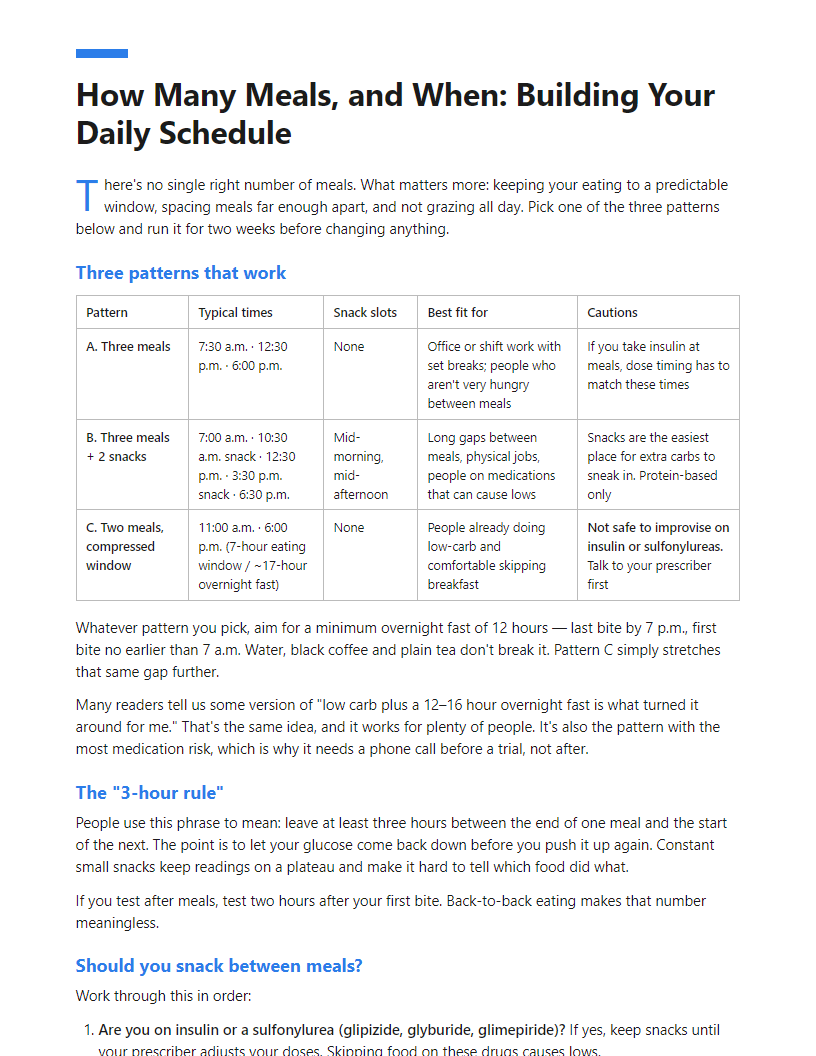
Full table of contents
- Start Here: What to Do in Your First Week
- The Plate Method in 60 Seconds (No Counting)
- How Many Meals, and When: Building Your Daily Schedule
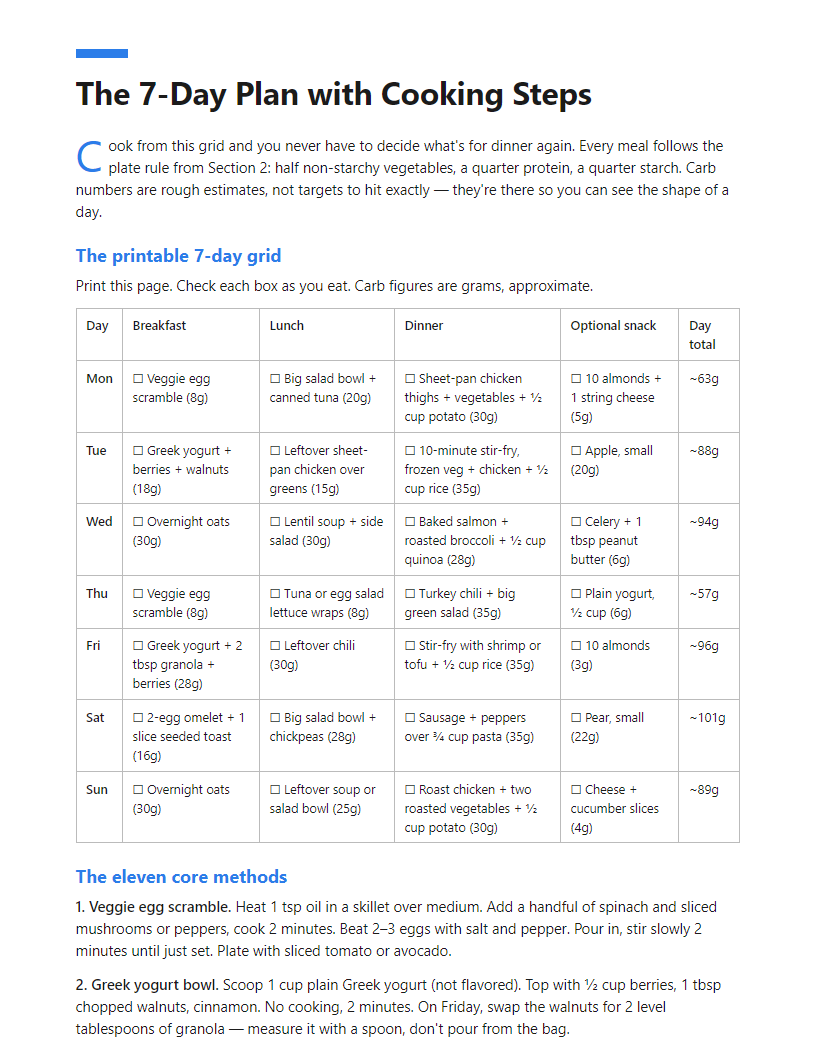
- The 7-Day Plan with Cooking Steps
- Your Printable Grocery List
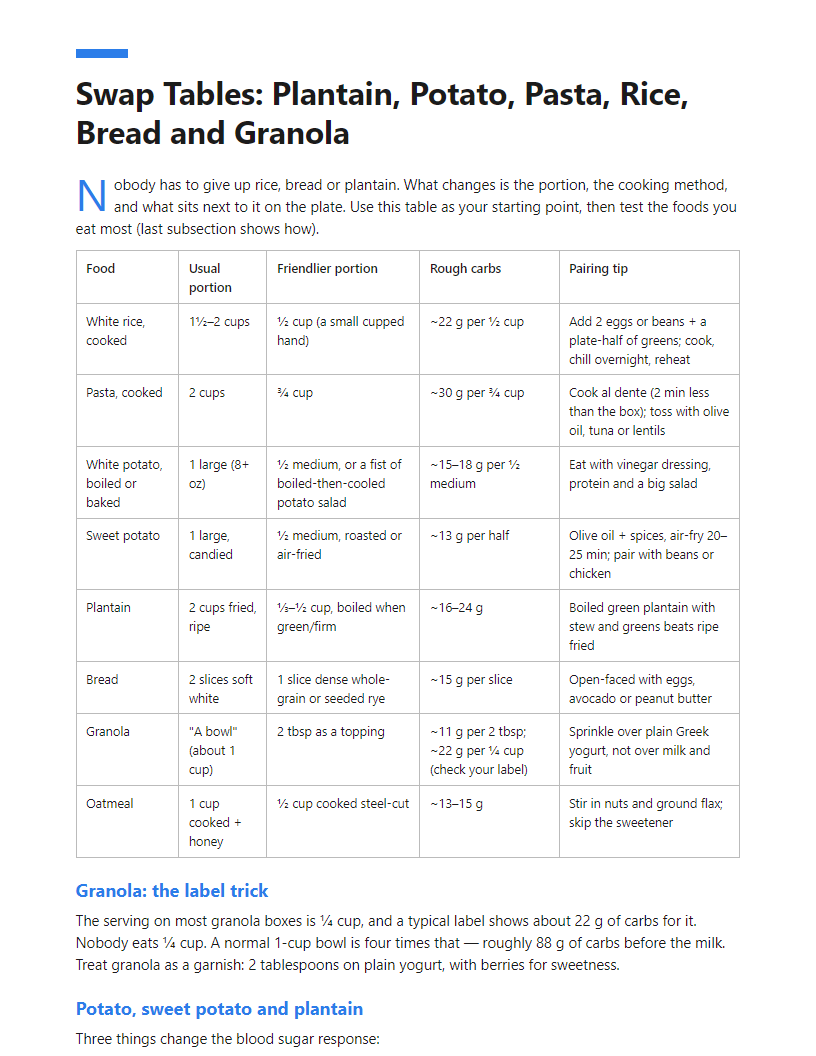
- Swap Tables: Plantain, Potato, Pasta, Rice, Bread and Granola
- Low-Carb, Keto and Intermittent Fasting vs. the Standard Plate
- Staying Full: Hunger, Cravings and Weight Loss
- Nine Mistakes That Flatten Results
- Adapting the Plan: Kidney Disease, Blood Pressure and Other Conditions
- The 30-Day Tracker and Weekly Checklist
In this article
You were handed a diagnosis and a pamphlet, and now every meal feels like a test you might fail. You don’t want a lecture on glycaemic index — you want a diabetic meal plan that tells you what to buy, what to cook tonight, and whether the plantain, pasta or granola in your cupboard is still allowed.
This page gives you the first-week actions, the plate method in plain language, a realistic meal-and-snack schedule, and an honest comparison of low-carb, keto and intermittent fasting against standard advice.
The premium PDF goes further: a full 7-day plan with cooking steps, a printable grocery list, swap tables with carb counts, and a 30-day tracker you can tick off.
The short answer
A workable diabetic meal plan follows five steps:
- Build every plate by halves: half non-starchy vegetables, one quarter protein, one quarter starch or fruit.
- Eat on a schedule: three meals roughly 4–5 hours apart, plus one snack only if you are genuinely hungry or on insulin.
- Cap starch by portion, not by rule: about one cupped handful of rice, pasta, potato or plantain per meal.
- Drink water or unsweetened drinks instead of juice, soda and sweet tea.
- Test and adjust: check glucose before and two hours after a repeat meal, then shrink the starch if it spikes.
Start Here: What to Do in Your First Week
If you were diagnosed this week, you don’t need another lecture on what diabetes is. You need to know what to put on the plate tonight. Start with three decisions.
The three decisions that cover most of your results
- Plate shape. Half the plate non-starchy vegetables, a quarter protein, a quarter starch. Same shape at lunch and dinner. That’s the whole system — Section 2 takes 60 seconds to explain it.
- Drink choice. Switch every sweetened drink to water, unsweetened tea, coffee without sugar, or sparkling water. Liquid sugar hits your blood glucose fastest and fills you up least.
- Meal timing. Pick a fixed window for your meals and stop eating 2–3 hours before bed. Section 3 helps you build the schedule around your work and family.
Do those three today. Everything else in this workbook is refinement.
Why the clinic visit felt useless
“Eat healthy, cut carbs, watch portions” is true and useless. One reader got sent to a nutritionist who told her to go vegan — which wasn’t happening. Generic advice fails because it doesn’t name foods you actually buy, and it hands you nothing to follow on Tuesday night.
A workbook is different. You get a named 7-day plan with cooking steps, a grocery list you can print and take to the store, swap tables for plantain, rice, pasta and bread, and a 30-day tracker. Nothing here requires you to count every carb.
How to use this guide
- Read Sections 2 and 3 today (about 10 minutes).
- Print the 7-day plan, grocery list and tracker pages.
- Shop once, cook Week 1 as written, mark the tracker each day.
- In Week 2, swap meals you didn’t like using the swap tables. Repeat the week four times to finish the 30 days.
Tip: Don’t redesign your whole diet. Change dinner first, keep it for a week, then change breakfast.
Numbers, targets and the limits of this book
General reference points: an A1C under 5.7% is typically called normal, 5.7–6.4% prediabetes, and 6.5% or higher diabetes. Many adults with type 2 diabetes are given an A1C goal around 7%, but goals differ by age, medications and other conditions.
Warning: This workbook is educational, not medical advice. Your clinician sets your targets and your medication plan. Changing how you eat can lower your blood glucose quickly — if you take insulin or a sulfonylurea, tell your prescriber before you start so doses can be adjusted and you avoid a low.
The Plate Method in 60 Seconds (No Counting)
Take a 9-inch dinner plate. Not a platter. Draw an imaginary line down the middle, then split one half in two. That’s the whole system.
- Half the plate: non-starchy vegetables. Broccoli, green beans, cabbage, collards, salad, peppers, okra, zucchini, tomatoes, cauliflower.
- One quarter: protein. Chicken thigh, fish, eggs, ground turkey, tofu, beans (beans count as protein and carb — see below), cheese, lean beef.
- One quarter: carb. Rice, potato, plantain, pasta, bread, tortilla, oats, fruit, or milk.
No food is banned. The quarter-plate is the limit, and that is why pasta and even granola can appear in the plan — at a quarter-plate portion, not a cereal-bowl portion.
Six real plates
| Plate | Half: vegetables | Quarter: protein | Quarter: carb |
|---|---|---|---|
| Weeknight chicken | Roasted broccoli + green salad | 4 oz baked chicken thigh | 1 small baked potato |
| Caribbean | Steamed cabbage + carrots | 4 oz stewed fish | 1/2 cup boiled green plantain |
| Vegetarian | Sautéed spinach + peppers | 3/4 cup tofu or paneer | 1/2 cup brown rice |
| Mexican | Cabbage slaw + salsa + peppers | 4 oz ground beef | 2 corn tortillas |
| Breakfast | Spinach + tomato in the eggs | 2–3 eggs | 1 slice whole-grain toast |
| Indian | Bhindi (okra) + cucumber raita | 1 cup rajma or chana | 1 small roti |
The optional carb ceiling
If you like numbers, aim for roughly 30–45 g carbs per meal and 15 g per snack as a starting point. That is a starting point, not a prescription — your dietitian or doctor may set a different target.
Three drink rules
- Drink water, unsweetened tea or coffee, or seltzer. No soda, sweet tea, or juice — even 100% juice.
- Count milk and smoothies as carbs, not drinks.
- If you drink alcohol, have it with food, not alone.
Plate or counting?
Use the plate when you cook at home, eat out, or feel overwhelmed. Use counting when you’re on insulin that’s dosed to carbs, or when the plate stops working and you need to see numbers.
Example: Same chicken dinner. Built wrong: 2 cups pasta, chicken breast, two forkfuls of broccoli. Built right: 1/2 cup pasta, same chicken, and broccoli filling half the plate. Same foods. Different plate.
How Many Meals, and When: Building Your Daily Schedule
There’s no single right number of meals. What matters more: keeping your eating to a predictable window, spacing meals far enough apart, and not grazing all day. Pick one of the three patterns below and run it for two weeks before changing anything.
Three patterns that work
| Pattern | Typical times | Snack slots | Best fit for | Cautions |
|---|---|---|---|---|
| A. Three meals | 7:30 a.m. · 12:30 p.m. · 6:00 p.m. | None | Office or shift work with set breaks; people who aren’t very hungry between meals | If you take insulin at meals, dose timing has to match these times |
| B. Three meals + 2 snacks | 7:00 a.m. · 10:30 a.m. snack · 12:30 p.m. · 3:30 p.m. snack · 6:30 p.m. | Mid-morning, mid-afternoon | Long gaps between meals, physical jobs, people on medications that can cause lows | Snacks are the easiest place for extra carbs to sneak in. Protein-based only |
| C. Two meals, compressed window | 11:00 a.m. · 6:00 p.m. (7-hour eating window / ~17-hour overnight fast) | None | People already doing low-carb and comfortable skipping breakfast | Not safe to improvise on insulin or sulfonylureas. Talk to your prescriber first |
Whatever pattern you pick, aim for a minimum overnight fast of 12 hours — last bite by 7 p.m., first bite no earlier than 7 a.m. Water, black coffee and plain tea don’t break it. Pattern C simply stretches that same gap further.
Many readers tell us some version of “low carb plus a 12–16 hour overnight fast is what turned it around for me.” That’s the same idea, and it works for plenty of people. It’s also the pattern with the most medication risk, which is why it needs a phone call before a trial, not after.
The “3-hour rule”
People use this phrase to mean: leave at least three hours between the end of one meal and the start of the next. The point is to let your glucose come back down before you push it up again. Constant small snacks keep readings on a plateau and make it hard to tell which food did what.
If you test after meals, test two hours after your first bite. Back-to-back eating makes that number meaningless.
Should you snack between meals?
Work through this in order:
- Are you on insulin or a sulfonylurea (glipizide, glyburide, glimepiride)? If yes, keep snacks until your prescriber adjusts your doses. Skipping food on these drugs causes lows.
- Are you genuinely hungry three hours after a meal? If yes, your last meal was short on protein or vegetables. Fix the meal first, then decide about the snack.
- Is the gap longer than five hours? Add one protein snack: a hard-boiled egg, a small handful of nuts, plain Greek yogurt, cheese.
- Do you wake between 2 and 4 a.m. shaky or sweaty? Report it. That’s a medication conversation, not a bedtime cookie.
- None of the above? Skip the snack.
Breakfast sets the day
Your first meal tends to set the tone. A high-carb breakfast — cereal, toast, juice, granola — spikes you early, and the crash two hours later drives mid-morning snacking. A breakfast built on protein and fat holds most people to lunch without effort.
Tip: If you don’t want breakfast, don’t force it. Eat at 11 a.m. instead. Just keep the time the same every weekday.
Worksheet: your meal clock
Write actual clock times, not “morning.”
| Weekday | Weekend | |
|---|---|---|
| First meal | ________ | ________ |
| Snack (if any) | ________ | ________ |
| Second meal | ________ | ________ |
| Snack (if any) | ________ | ________ |
| Last meal | ________ | ________ |
| Kitchen closed | ________ | ________ |
Keep weekend times within 90 minutes of weekday times. Post the card on the fridge.
Low-Carb, Keto and Intermittent Fasting vs. the Standard Plate
You’ll see people online say they “reversed” their diabetes with low carb and fasting. Some of them did. That’s worth taking seriously — and worth understanding before you copy it.
What “remission” actually means
Remission means your A1c stays in the non-diabetic range without glucose-lowering medication, usually for at least three months. It is not a cure. Remission is most likely when diagnosis was recent (within a few years), when you still make your own insulin, and when meaningful weight loss happens. It’s less likely after many years on insulin. If you’re tired of injections and finger sticks, that’s a reasonable goal to raise with your doctor — but it’s a goal, not a guarantee, and any medication change has to come from them.
Three intensity levels
| Standard plate | Moderate carb | Strict low carb / keto | |
|---|---|---|---|
| Daily carbs | ~130–180 g | ~60–120 g | Under 50 g (keto often under 30 g) |
| Typical day | Oatmeal + eggs; chicken, rice, big salad; fish, potato, broccoli | Eggs + berries; chicken, ½ cup rice, salad; fish, extra greens, no starch | Eggs + avocado; chicken and salad with olive oil; salmon and green beans |
| Pros | Easiest to keep; family-friendly; fits most cultural foods | Strong A1c and weight results; still allows rice, bread, plantain in small portions | Fastest drop in glucose and often appetite |
| Trade-offs | Slower results if A1c is high | Requires measuring starch portions | Hard to eat out; constipation and fatigue early; often not sustainable long-term |
| Not for you if | — | — | You’re pregnant, have kidney disease, a history of eating disorder, or take insulin/sulfonylureas without a medication review first |
Where this book sits: the 7-day plan in Section 4 is a moderate-carb plan, roughly 60–95 g of carbs a day. Thursday is the lowest day at about 57 g; Saturday is the highest at about 101 g. So you are already in the middle column, not the standard-plate column — the standard plate’s 130–180 g is what most people eat before they change anything.
All three levels use the same plate. Moderate and low carb simply shrink or drop the starch quarter and replace it with more vegetables, protein, and fat. To move the Section 4 plan down toward strict low carb, drop the rice, potato, pasta, oats and fruit snacks. To move it up, add a second starch serving at dinner.
Time-restricted eating
Two common versions: a 12-hour window (eat 8 a.m. to 8 p.m.) or a 16:8 window (eat noon to 8 p.m.). The 12-hour version is close to normal eating and is safe for most people. The 16-hour version skips a meal, and that’s where medication matters.
Warning: If you take insulin, a sulfonylurea (glipizide, glyburide), or glinides, skipping meals can cause a low. Talk to your prescriber before you shorten your eating window or cut carbs sharply. Doses often need to come down — that conversation is the point, not a formality.
Red flags — stop and call your doctor
- Dizziness, shakiness, sweating, confusion
- Two or more readings under 70 mg/dL in a week
- Weight loss faster than about 2 lb per week that you didn’t plan
- Dark urine, headaches, cramps, racing heart — usually dehydration or low sodium in the first weeks of low carb
Pick the one you’ll repeat
A moderate plan you follow for 90 days beats a strict plan you quit in 11 days. If a nutritionist once told you to go vegan and you knew you never would, the problem was fit, not willpower. Choose the level that still lets you eat your own food, then commit to 90 days and recheck your A1c.
Nine Mistakes That Flatten Results
Good plans stall for predictable reasons. Check this list whenever your numbers drift up and you can’t see why.
1. Cutting carbs at dinner, drinking juice at breakfast
A cup of orange juice hits your blood sugar faster than the rice you gave up. Same for smoothies with three fruits, sweet tea, and flavored coffee drinks. Fix: eat the whole fruit instead. Liquid carbs are the first thing to go, before you touch dinner.
2. Trusting the front of the package
“Diabetic,” “sugar-free,” “keto-friendly,” “no added sugar” and “whole grain” are marketing. Sugar-free cookies still have flour. Granola is the classic trap — a half-cup can carry 40–50g of carbs, more than two slices of bread. Fix: turn the box over, read grams of total carb per serving, then measure what a serving actually looks like in your bowl.
3. Meals with no fat and no protein
A plain bowl of oatmeal, a rice cake, a banana on the run — these spike fast and leave you hungry in 90 minutes. Fix: never eat a carb naked. Add eggs, nuts, Greek yogurt, cheese or olive oil to every carb you eat.
4. Changing everything at once
You go strict on Monday, cook three new recipes, cut coffee, start walking, and by week two you’re done. Being diagnosed is overwhelming enough without rebuilding your whole life in seven days. Fix: change one meal first — usually breakfast. Hold it for two weeks before touching the rest.
5. Portion drift
The plate slowly grows. The quarter of starch becomes a third, then half. Nobody notices because no single meal feels wrong. Fix: go back to a 9-inch plate once a month for a week. Re-measure rice and pasta with a cup measure.
6. Random testing
Checking your meter at scattered times tells you almost nothing. Fix: test right before a meal, then two hours after that same meal. Change one food, repeat, compare. That pairing is how you learn whether your body handles plantain, sweet potato or pasta — which no nutritionist can tell you from a handout.
7. Waiting for a number instead of tracking the trend
One high reading isn’t a failure. A1C reflects about three months. Fix: watch your 7-day average and your post-meal rises. Ask your doctor what target range they want for you; standard targets exist, but yours may differ.
8. Quitting a food group you actually like
If a plan says go vegan and that isn’t happening, the plan is wrong for you. Fix: use the swap tables in Section 6 to shrink and pair the foods you already eat.
9. Ignoring sleep, alcohol and stress
Short sleep and a few drinks raise morning readings on their own. Fix: note sleep hours and alcohol in your tracker before you blame dinner.
FAQ and Disclaimer
What does a normal meal actually look like?
A 9-inch plate: half non-starchy vegetables, a quarter protein, a quarter starch. In practice that’s grilled chicken thigh, a pile of roasted broccoli and peppers, and ½ cup of cooked rice. Not a diet plate. A normal plate with the starch portion shrunk and the vegetable portion grown.
What’s the “3-hour rule”?
It’s shorthand for two different habits, so check which one someone means. The first: leave at least 3 hours between finishing one meal and starting the next, so your glucose has time to come back down instead of stacking spike on spike. The second: stop eating 3 hours before bed, which usually improves morning readings. Both are reasonable. Neither is an official medical rule.
Should I eat between meals?
Only if you’re genuinely hungry or your medication requires it. Three meals with no snacks works well for most people. If you take insulin or a sulfonylurea, ask your clinician before dropping snacks — skipping food on those medications can drop you too low.
What’s the best breakfast — oats, eggs or granola?
Eggs win on predictability. Two or three eggs with vegetables move glucose very little for most people — confirm with your own meter. Steel-cut or rolled oats work for some people and spike others hard; test with your meter at 1 and 2 hours before you make them a habit. Store granola is usually the worst of the three — half a cup can carry 30 to 50 grams of carbs plus added sugar. If you love it, use 2 tablespoons as a topping on plain Greek yogurt, not as a bowl.
Plate method, low-carb, Mediterranean or DASH — which is best?
There’s no single winner. All four lower glucose when followed. The plate method is easiest to start because it needs no counting. Mediterranean and DASH overlap heavily with it. Low-carb usually drops glucose fastest, but it’s harder to maintain and needs medication review first. Pick the one you’ll still be doing in six months.
Can diet alone reduce or replace my medication?
Sometimes it reduces it. People do lower doses, stop a medication, or reach remission — usually with meaningful weight loss. Remission is real and documented, but it isn’t guaranteed and it isn’t permanent for everyone. If you’re tired of injections and finger sticks, the honest path is: change the food, track the numbers, bring the log to your clinician, and let them adjust the prescription. Never cut a dose yourself.
I’m prediabetic with family history. Is this plan for me?
Yes. Nothing here requires a diagnosis. The plate, the schedule, and the swaps are the same.
Disclaimer
This workbook is educational information only. It is not medical, dietetic, or pharmaceutical advice, and it does not replace care from your doctor, diabetes educator, or registered dietitian. Do not start, stop, or change any medication — including insulin — based on anything in this guide. Talk to your clinician before changing how you eat if you take glucose-lowering medication, have kidney disease, are pregnant, or have any other medical condition.
- ✓7-day plan with step-by-step cooking instructions for every meal
- ✓Printable grocery list organised by supermarket aisle
- ✓Swap tables with carb counts for plantain, potato, pasta, rice, bread and granola
- ✓Hunger and cravings troubleshooting sheet for weight loss
- ✓Adaptation pages for kidney disease, high blood pressure and insulin users
- ✓30-day tracker with a weekly review checklist
Frequently asked questions
What does a normal meal look like for someone with diabetes?
It looks like ordinary food in controlled proportions: grilled chicken or fish, a large serving of salad or cooked greens, and a cupped handful of rice, potato or wholegrain bread. Add a spoon of olive oil, avocado or nuts for fat. Nothing is banned — the starch portion and the drink alongside it do most of the blood-sugar work.
What is the 3-hour rule for diabetics?
It usually refers to leaving about three hours between finishing a meal and eating again, so glucose has time to return toward baseline instead of stacking spike on spike. It's also used to mean stopping food roughly three hours before bed, which improves fasting readings. Most people do better with 4–5 hour gaps and no constant grazing.
What is the best breakfast when you have diabetes?
One with protein and fat first, starch second: eggs with vegetables, plain Greek yoghurt with berries and nuts, or oats cooked with milk and topped with seeds. Avoid juice, sweetened cereal and most granola — a typical granola bowl carries 40–60g of carbs before milk. If you eat toast, keep it to one slice alongside protein.
Which eating plan works best for type 2 diabetes?
The best plan is the one you can repeat for a year. The plate method, Mediterranean-style eating and moderate low-carb all improve HbA1c; stricter keto and time-restricted eating can drop glucose faster but need medication review with your doctor to avoid hypos. Start with the plate method, then tighten carbs if your two-hour readings stay high.
How do I actually start in the first week?
Pick three breakfasts, three lunches and three dinners you already like, adjust each to the plate ratio, and shop once for all of them. Swap sugary drinks for water on day one. Test before and two hours after your most repeated meal. Repeat the same week twice — familiarity, not variety, is what makes a plan stick.
Why am I still hungry on a diabetic meal plan?
Usually too little protein, too little fat, or meals spaced so far apart that you overeat later. Aim for a palm of protein at every meal, keep some fat in the dish, and fill volume with non-starchy vegetables. If hunger hits 90 minutes after eating, your starch portion was too large and too fast-digesting.
We collected 109 real questions and comments about "diabetic meal plan" (77 from YouTube comments, 4 from People Also Ask, 28 from search suggestions), grouped them into 16 recurring problems, and built this guide to resolve the 6 that block people most. The top-ranking pages were reviewed for gaps; 7 of those gaps became dedicated sections.
Edited by Alex Hirn · Last updated November 3, 2026 · How we make our guides