Workbook · 24-page PDF · Premium
Savings Challenge Printable PDF Free Download — Plus a Custom Builder
Compare 11 savings challenge types, decode the jargon and pick a plan you'll finish. Worksheet, mistake checklist and goal blueprints inside. Start today.
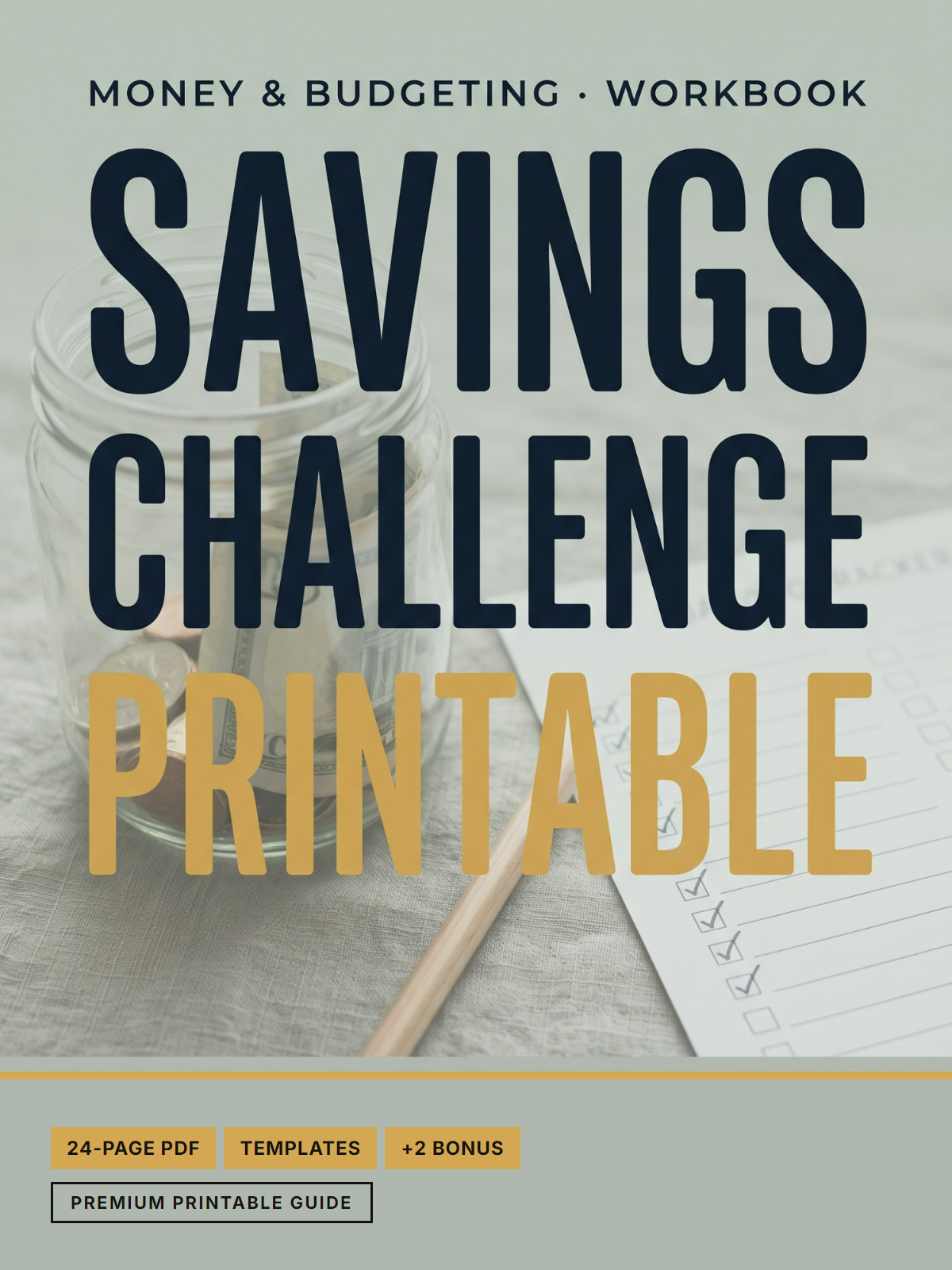
The full workbook, ready to print
- ✓7-step worksheet for building a custom challenge from scratch
- ✓Goal blueprints with per-payday numbers for $500, $1,000, $5,000 and $10,000
- ✓Low-income and irregular-income rescaling tables
- ✓12-week accountability system with weekly check-in prompts
- ✓Blank savings grids, envelope numbering sheets and colour-in trackers
- ✓Payday launch checklist to start without a false start
Hosted on FileJoker. Premium members download instantly; free download has a wait.
In a hurry? Free one-page checklist30 items to tick off · print-ready PDF, no sign-upDownload freeIncluded bonuses — free with the guide
2 extra guides from the same topic Free PDF · 16 pagesCruise Packing List Carnival: The First-Timer's ChecklistA cruise packing list for Carnival built around their rules: banned items, ID musts, forgotten essentials, plus a free printable checklist. Download yours.
 Free PDF · 14 pagesWorkout Tracker Printable: Weekly, Monthly and Yearly SheetsFree workout tracker printable: weekly log, monthly grid and yearly PR ledger, plus a metric shortlist and print checklist. Download and start logging today.
A look inside the PDF
10 sections · 24 pages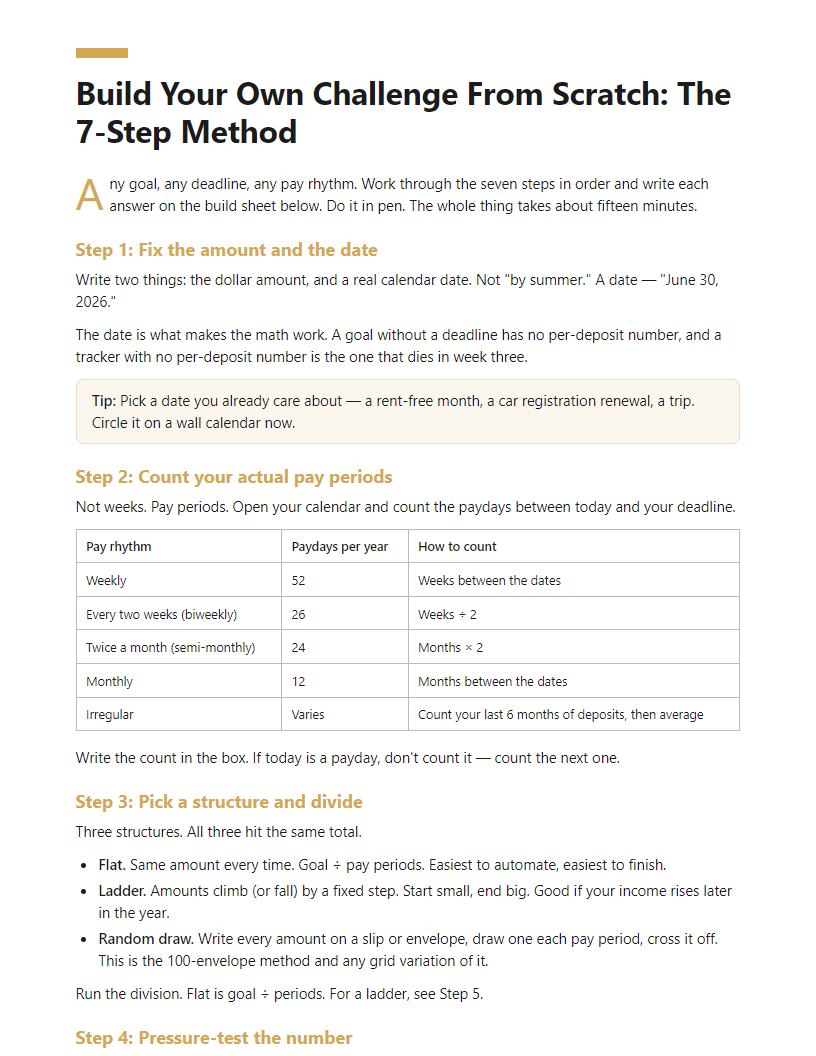
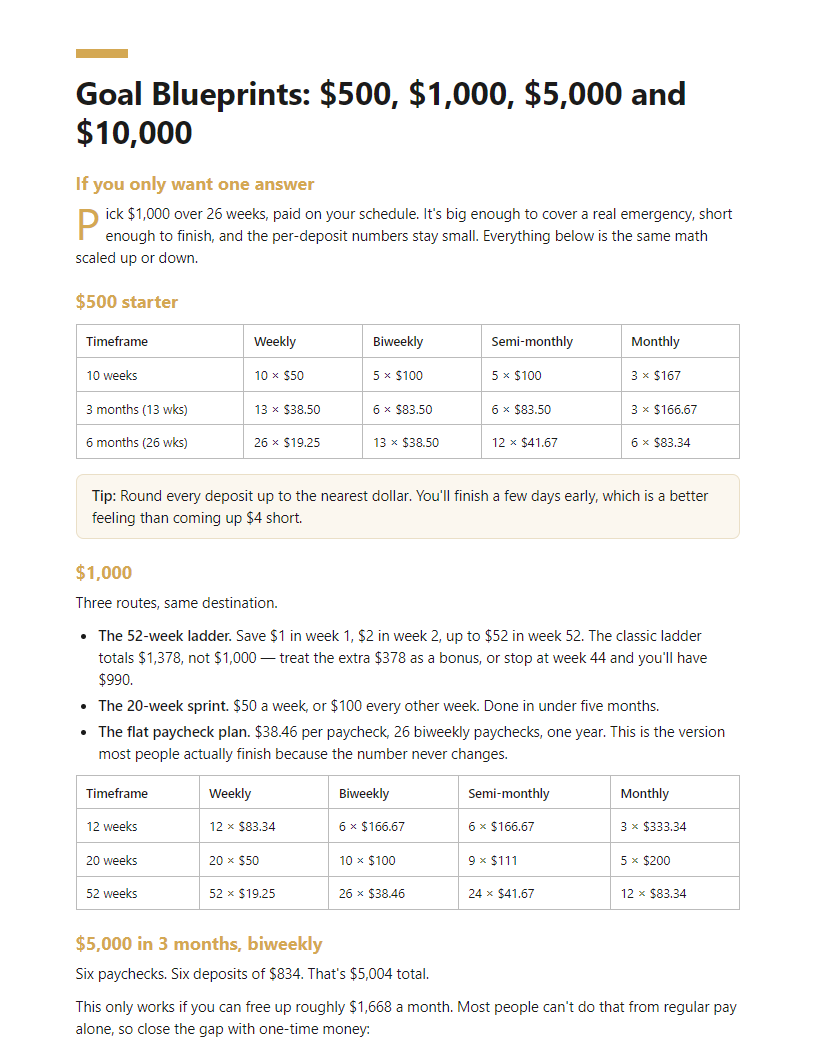
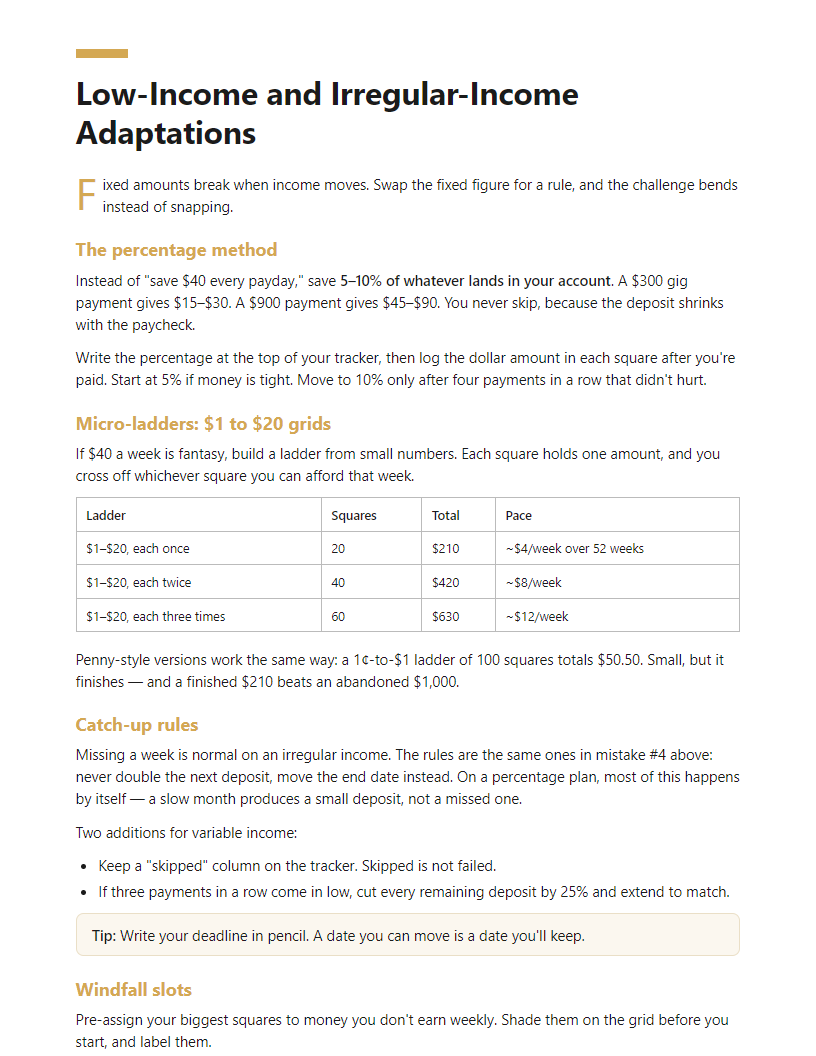
Full table of contents
- Why Most Downloaded Savings Trackers Die in Week Three
- Savings Challenge Jargon, Decoded
- Eleven Challenge Types Compared Side by Side
- Build Your Own Challenge From Scratch: The 7-Step Method
- Goal Blueprints: $500, $1,000, $5,000 and $10,000
- Low-Income and Irregular-Income Adaptations
- Nine Mistakes That Kill a Savings Challenge
- Staying Accountable After You Print: The 12-Week System
- Your Printable Pack: Blank Grids, Envelope Sheets and Trackers
- Launch Checklist: Ready to Start on Your Next Payday
In this article
You searched for a savings challenge printable PDF free download because you need a real plan — save $5,000 in three months on biweekly pay, or stretch toward $10,000 without pretending your budget is bigger than it is. Maybe you’ve seen the 100 envelope challenge and the “6x6” jargon and thought: I’m a complete beginner, where do I even start?
This page gives you the decision work most lists skip: what each challenge type actually demands per paycheck, which one fits an irregular or low income, and the nine mistakes that kill trackers by week three. The premium PDF goes further — a 7-step method to build your own challenge from scratch, goal blueprints for $500 to $10,000, and blank printable grids you fill in yourself.
The short answer
To start a savings challenge with a printable PDF:
- Set the target and deadline — e.g. $5,000 in 12 weeks.
- Divide by your pay cycle, not the calendar: $5,000 ÷ 6 biweekly paychecks = $834 each.
- Pick a structure — flat weekly, escalating biweekly, envelope numbering, or penny-style for tiny budgets.
- Choose a printable with enough boxes to match your number of deposits.
- Automate the transfer on payday, then colour in the box.
- Review every 4 weeks and rescale the amount rather than quitting.
Why Most Downloaded Savings Trackers Die in Week Three
Most savings trackers fail for three reasons, and none of them are about willpower.
- The amount came from a picture. You saw a 52-week grid on Pinterest, printed it, and never checked whether week 40’s $40 deposit fits your actual budget.
- No pay-cycle match. The grid wants weekly deposits. You get paid biweekly, monthly, or whenever the work comes in. By week three you’re guessing.
- No place to put the money. Cash stays in your checking account, rent clears, and the “savings” quietly disappears.
Why generic 52-week grids punish low and irregular incomes
The classic grid ramps up: $1 in week 1, $52 in week 52. That back-loads your biggest deposits into the holidays. If your income swings month to month, a fixed weekly number guarantees missed boxes. Three blank squares feel like failure, so the sheet goes in a drawer.
The four goal tiers
Pick the row your budget can actually cover. These are rough monthly commitments, before any adjustments you’ll make in Section 7.
| Goal | In 6 months | In 12 months | In 24 months |
|---|---|---|---|
| $500 | $84/mo | $42/mo | $21/mo |
| $1,000 | $167/mo | $84/mo | $42/mo |
| $5,000 | $834/mo | $417/mo | $209/mo |
| $10,000 | $1,667/mo | $834/mo | $417/mo |
Tip: If you’ve never finished a challenge, start at $500. A finished $500 beats an abandoned $5,000 every time.
The 90-second self-check
- Write down your take-home pay for one pay period.
- Subtract every bill and expense that lands in that same period — rent, food, gas, phone, minimum debt payments.
- Take what’s left. Halve it. That’s your realistic per-period savings number.
- Multiply by the number of pay periods in a year. Compare it to the table above.
What makes this a workbook, not a printable
A printable gives you boxes. This gives you three things in order: a plan sized to your pay cycle, a template you fill in with your own numbers, and an accountability system for the 12 weeks after you print. The boxes are the last step, not the first.
The 60-Second Answer: Which Challenge Should You Pick?
Do this math before you print anything:
Your goal ÷ the number of paydays before your deadline = your per-deposit amount.
That single number decides everything else. If you get paid every two weeks, you have 26 pay periods a year. Weekly is 52. Monthly is 12.
If the number that comes out scares you, change the deadline — not the goal. A $1,000 goal in three months (6 paychecks) is $167 per paycheck. The same goal over six months is $77. Same finish line, different speed.
The decision table
| Goal | Timeframe | Pay rhythm | Per deposit | Best format |
|---|---|---|---|---|
| $500 | 3 months | Biweekly | $84 | Flat biweekly tracker |
| $500 | 6 months | Weekly | $20 | Weekly flat grid |
| $1,000 | 6 months | Biweekly | $77 | Flat biweekly tracker |
| $1,000 | 12 months | Monthly | $84 | Monthly 12-box tracker |
| $5,000 | 3 months | Biweekly | $834 | Flat biweekly tracker |
| $5,000 | 12 months | Biweekly | $192 | 100-envelope challenge |
| $10,000 | 12 months | Biweekly | $385 | 100-envelope or variable grid |
| $10,000 | 24 months | Biweekly | $192 | 100-envelope challenge |
Pick your default in 10 seconds
- New to this? Biweekly flat-amount tracker, same dollar figure every payday, deposit made the morning you get paid. Boring works.
- Tight or variable income? A penny challenge or low-denomination ladder. You save $1 some weeks and $20 others, which matches how your money actually arrives.
- Big lump goal ($5,000–$10,000)? 100-envelope or an envelope-style variable grid. You pull higher amounts in good weeks and small ones in lean weeks.
Example: $5,000 in 3 months, paid every two weeks. That’s 6 paychecks. $5,000 ÷ 6 = $834 per payday. If $834 isn’t there, stretch to 6 months — 13 deposits of $385.
Warning: Don’t average a number you’ve never actually transferred. Test one deposit this payday before you commit to 26 of them.
Savings Challenge Jargon, Decoded
Templates and Facebook groups use shorthand. Here’s what each term actually asks you to do.
Grid challenges: 6x6, 5x5 and friends
A grid challenge is just a box of squares. The two numbers are the rows and columns. A 6x6 grid has 36 squares. A 5x5 grid has 25.
What you put in each square is up to the template. Two common versions:
- Numbered: square 1 = $1, square 2 = $2, and so on. A 6x6 numbered grid totals $666. A 5x5 totals $325.
- Flat amount: every square is the same. Thirty-six squares at $10 each = $360.
You color in or cross off a square each time you deposit. That’s the whole mechanic.
The 100-envelope challenge
You label 100 envelopes 1 through 100. Each day (or payday) you pull one, put that many dollars inside, and mark it done. Filling all 100 totals $5,050.
Two ways to run it. Sequential means you work from 1 up to 100 in order — easy at the start, brutal at the end. Random draw means you shuffle and pick blind, which spreads the big envelopes across the whole challenge. Same total either way.
Penny challenges and no-spend days
The penny challenge adds one cent per day: $0.01 on day 1, $0.02 on day 2, up to $3.65 on day 365. Total: $667.95. The reverse penny challenge runs it backward — you start with $3.65 and finish with a penny — so the hard months come first, while motivation is high.
A no-spend day isn’t a deposit. It’s a day you buy nothing beyond fixed bills. Some trackers ask you to move a set amount (say $10) into savings for each no-spend day you log.
Three different jobs
- Savings challenge: a fixed amount by a fixed date, with a game attached.
- Sinking fund: money set aside for a known future cost — car registration, Christmas, new tires. You spend it on purpose.
- Emergency fund: untouched cash for job loss, a dead furnace, an ER bill. You don’t plan to spend it at all.
A challenge is the method. A sinking fund or emergency fund is the destination.
Deposit rhythms
| Term | What it means | Deposits per year |
|---|---|---|
| Weekly | Same day every week | 52 |
| Biweekly | Every 14 days | 26 |
| Semi-monthly | Twice a month (e.g. 1st and 15th) | 24 |
| Monthly | Once a month | 12 |
Warning: Biweekly and semi-monthly are not the same. Fourteen-day cycles give you 26 paychecks a year, not 24. Two months a year you’ll get three checks. That’s two bonus deposits — worth $200 on a $100 rhythm.
Glossary at a glance
| Term | Plain English | Total if completed |
|---|---|---|
| 5x5 grid (numbered $1–$25) | 25 squares, $1 to $25 | $325 |
| 6x6 grid (numbered $1–$36) | 36 squares, $1 to $36 | $666 |
| 6x6 grid (flat $10) | 36 squares, $10 each | $360 |
| 100-envelope | Envelopes $1 to $100 | $5,050 |
| 52-week ladder | Week 1 = $1 … week 52 = $52 | $1,378 |
| Penny challenge | $0.01 rising to $3.65 over 365 days | $667.95 |
| Reverse penny | Same amounts, high to low | $667.95 |
| Flat weekly $20 | $20 every week, 52 weeks | $1,040 |
Tip: Ladder means the amount climbs each time. Flat means it never changes. Random draw means you pick the amount blind from a pool. Flat is the only one you can predict week to week — pick it if your budget is tight.
Eleven Challenge Types Compared Side by Side
Every challenge below is just a different way of deciding how much and how often. Compare the totals, then shortlist two.
| Challenge | Total saved | Duration | Difficulty | Best for |
|---|---|---|---|---|
| 52-week classic ladder ($1 → $52) | $1,378 | 52 weeks | Easy start, hard finish | Weekly pay, steady income |
| 52-week reverse ($52 → $1) | $1,378 | 52 weeks | Hard start, easy finish | Front-loading before the holidays |
| 100-envelope | $5,050 | 100 draws | Hard | Visual savers with slack in the budget |
| 50-envelope (half version) | $1,275 | 50 draws | Moderate | Same idea, smaller stakes |
| Penny challenge ($0.01 → $3.65) | $667.95 | 365 days | Easy, then steep | Daily habit builders |
| Penny variant ($0.01–$1.00 daily) | ~$184 | 365 days | Very easy | Tight budgets, under $20/month |
| Biweekly flat | You choose | Your call | Easy | Anyone paid every two weeks |
| Monthly flat | You choose | Your call | Easy | Salaried, one payday a month |
| Round-up | Depends on your card spending | Ongoing | Easiest | Irregular income, card spenders |
| No-spend days | Varies | 30 days | Moderate | Breaking impulse spending |
| Bill-ahead tracker | One month of bills | 6–12 months | Moderate | Getting one month ahead |
The ladder challenges
The 52-week classic asks for $1 in week 1 and $52 in week 52. The math works, but December costs you $200 in four weeks. The reverse version flips it: big deposits in January, pocket change by Christmas. Same $1,378 either way.
The envelope challenges
A 100-envelope run holds $1 to $100 and totals $5,050. Pull two envelopes a week and you finish in about a year. The 50-envelope version holds $1 to $50 and totals $1,275 — closer to a 52-week ladder, half the pressure.
The penny challenges
Day 1 is a penny, day 365 is $3.65, and you end with $667.95. Most of it lands in the last three months, so it gets hard right when the holidays hit. If $100+ months are out of reach, cap the daily amount at $1.00 and repeat the $0.01–$1.00 cycle — that’s about $184 a year, or roughly $15 a month.
The flat challenges
These are the boring ones that actually finish. Pick your amount, pick your rhythm, repeat it. Biweekly flat matches 26 paychecks a year; monthly flat matches one payday. If you want something to check off, draw the biweekly version as a 26-box grid and divide your goal by 26.
The flexible ones
- Round-up: every card purchase rounds to the next dollar and the difference moves to savings. No fixed deposit, so it survives a bad month. Your total depends on how often you use the card, so look at last month’s statement to estimate it.
- No-spend days: mark a set number of days per month, bank what you’d have spent.
- Bill-ahead tracker: instead of generic savings, your target is one full month of bills. Save one-twelfth of a month’s bills each month and you’re a month ahead in a year. You stop paying this month’s rent from this month’s check.
Irregular income vs. fixed salary
Ladder, penny and envelope challenges assume a predictable payday — they tell you what to save, not your bank account. If your income swings, use round-up, percentage-based flat deposits, or no-spend days instead.
Tip: If you want one recommendation and no debate: the biweekly flat challenge sized to your goal. The amount never changes, so there’s nothing to miscalculate and nothing to dread later in the year.
Nine Mistakes That Kill a Savings Challenge
1. Picking the amount before counting your pay periods
A number from a picture is a guess. Count the paydays between now and your deadline first, then divide. If $1,000 over 26 weeks lands on $38.46 per week and you’re paid biweekly, your real number is $76.92 every other Friday — not $20 because $20 looked friendly.
2. Leaving the money in your spending account
Visible money gets spent. Move each deposit to a separate account the same day, or into a labeled cash envelope you keep out of your wallet. If your bank offers a second free savings account, open it before you start.
Tip: Set the transfer to run the morning after payday, not the evening. Money that arrives before you’ve looked at your balance never feels like yours to spend.
3. Waiting for January 1st
January 1 is a date on a calendar. Your next payday is the only start date with money attached to it, because that’s when cash actually shows up. A challenge begun on March 14 and finished beats one begun on January 1 and quit in week three.
4. Doubling up after a missed week
This is the quit trigger. You miss one $40 week, tell yourself you’ll pay $80 next time, miss that too, and now you owe $120 and you’re done. Don’t catch up — push your finish date out instead.
| You missed | Bad fix | Good fix |
|---|---|---|
| 1 deposit | Double the next one | Add one week to the end date |
| 3 deposits | Triple up “soon” | Cut the weekly amount, extend the deadline |
| A whole month | Start over at week 1 | Resume where you stopped |
5. Running three challenges at once
A 100-envelope challenge, a 52-week grid, and a no-spend month all in the same quarter is three failures waiting. Run one. If you want a single recommendation: $1,000 over 26 weeks, deposited on your own pay cycle.
6. Running one with no named purpose
“Savings” is not a purpose. “Car repair fund” or “December gifts” is. Write the purpose on the top of the tracker before your first deposit — an unnamed pot gets raided first.
7. Filing the printed tracker in a drawer
Print it and tape it where you stand every day: fridge, bathroom mirror, inside the front door. A tracker you can’t see is a tracker you don’t fill in.
8. Using last year’s dated template
A 2022 grid has the wrong weekdays for 2026. Your “Friday” column lands on a Tuesday, your deposit dates drift, and the whole sheet stops matching your paychecks. Use an undated tracker and write the dates in yourself — it works for any year and any pay rhythm.
9. Raiding the fund for a “nearly emergency”
New tires with a flat tire is an emergency. New tires because there’s a sale is not. Write one line on the tracker before you start: I will withdraw only for [X]. Sign it. Then a near-miss can’t argue with you.
Frequently Asked Questions
How do I make my own savings challenge?
Short version of the seven-step method: pick your goal amount, pick your deadline, count the actual paydays between now and then, divide the goal by that number, round to a figure you can hit on your worst week, decide where the money lives, then write the dates on a blank grid. Build sheet and worked examples are in the workbook.
The order matters. The amount comes last, after the paydays are counted, not first because a number looked friendly.
How do I save $5,000 in 3 months, paid every 2 weeks?
Three months gives you six or seven biweekly paydays, depending on where your pay dates fall. Count them on a calendar first — don’t assume.
| Paydays in 3 months | Per deposit | Per week equivalent |
|---|---|---|
| 6 | $833.34 | $416.67 |
| 7 | $714.29 | $357.15 |
That’s a large bite out of take-home pay. If $833 per payday isn’t realistic, you have three honest options: stretch the deadline to six months ($416 per biweekly payday), cut the goal to $2,500, or fund part of it from a lump sum like a tax refund or bonus and save only the gap.
Warning: If the per-deposit number makes you wince, you won’t make it past the first month. Change the deadline, not your estimate of what you can afford.
How do I make my own 100 envelope savings challenge?
Label 100 envelopes 1 through 100, shuffle them, and draw a few each week. Pay the amount on the envelope and mark it off. Numbers 1–100 add up to $5,050.
To scale it down, keep 100 envelopes but change the values:
- Half values (0.50 to 50 in $0.50 steps) = $2,525
- Numbers 1–50 twice = $2,550
- Fixed $10 per envelope = $1,000
- Fixed $5 per envelope = $500
Use the envelope log sheet so you can track progress even if an envelope goes missing.
Tip: Draw your envelopes on payday, not on a random evening. Tying the draw to money arriving is what keeps the stack moving.
What are some examples of savings challenges?
The common ones: the 52-week challenge, the 100-envelope challenge, 6x6 and 5x5 grids, round-up saving, no-spend months, biweekly flat amounts, percentage-of-pay saving, and reverse challenges that start with the big numbers. Section 4 compares eleven of them side by side with totals and difficulty.
Pick one. Running two at the same time splits your money and your attention, and neither sheet gets finished.
Does a savings challenge work if my income changes every month?
Yes, if you save a percentage instead of a fixed dollar amount. Set a floor you can hit in a bad month and a stretch figure for a good one. The adaptations section covers percentage saving, floor-and-catch-up, and what to do in a zero-income month.
A floor of $25 that you hit every month beats a $200 target you clear twice and then abandon. Raise the floor once you’ve held it for three months straight.
Can I use these templates for another currency or a different year?
Every sheet is undated and currency-neutral. Write 2026, 2027, or any year in the date column, and treat the numbers as your own currency — rand, pounds, pesos. The math doesn’t change. Round deposit amounts to whatever note or coin is normal where you live.
Because the sheets are undated, you write the real dates in yourself, so your deposit days always line up with your actual paydays instead of drifting off a printed calendar.
- ✓7-step worksheet for building a custom challenge from scratch
- ✓Goal blueprints with per-payday numbers for $500, $1,000, $5,000 and $10,000
- ✓Low-income and irregular-income rescaling tables
- ✓12-week accountability system with weekly check-in prompts
- ✓Blank savings grids, envelope numbering sheets and colour-in trackers
- ✓Payday launch checklist to start without a false start
Frequently asked questions
How do you make your own savings challenge?
Start from the goal, not the template. Write the amount and deadline, count how many paydays fall inside that window, then divide. Decide whether each deposit is identical (flat) or rises over time (escalating). Draw one box per deposit on a blank grid, label each with its amount, and set a standing transfer. Build in two "skip" boxes so one bad week doesn't end the challenge.
How can I save $5,000 in 3 months with biweekly pay?
Three months gives you roughly six or seven biweekly paychecks, so you need about $715–$834 per payday. Split it: cut fixed costs first (subscriptions, insurance, groceries), then assign overtime, bonuses or side income straight to the goal. Move the money the same hour you're paid. If $834 is impossible, extend to 16 weeks or lower the target to $3,500 and finish it rather than abandoning it.
How do I make a 100 envelope savings challenge?
Number 100 envelopes from 1 to 100 and put that many dollars in each — completed, it totals $5,050. Draw two envelopes at random per week and fund them, which takes about a year. For a tighter budget, number them in 25-cent or 50-cent steps instead, or use 50 envelopes numbered 1–50 for a $1,275 goal. Track drawn numbers on a printed grid so you never double-fund.
What are some examples of savings challenges?
Common formats include the 52-week escalating challenge ($1,378), the penny challenge ($667.95 a year), the 100 envelope challenge ($5,050), flat weekly or biweekly deposits, no-spend months, round-up challenges, the 6x6 grid, bingo-style amount cards, and reverse 52-week (starting high, ending low). The guide compares eleven types side by side with total saved, deposit size and difficulty.
Which savings challenge works on a low or irregular income?
Choose percentage-based or bingo-style challenges rather than fixed weekly amounts. With irregular income, commit a share of each payment — say 10–15% — instead of a dollar figure, so lean weeks don't break the streak. Bingo cards let you tick off whichever amount you can afford that week. The PDF includes adaptations that rescale the $500, $1,000, $5,000 and $10,000 blueprints to variable paychecks.
How do I stay motivated after printing the tracker?
Most trackers die in week three because the only feedback is a coloured box. Put the sheet where you handle money daily, pair every deposit with an automatic transfer so willpower isn't involved, and schedule a four-week review to adjust the amount. Name the goal specifically. The PDF's 12-week accountability system adds weekly check-in prompts, a streak-repair rule and milestone rewards.
We collected 85 real questions and comments about "savings challenge printable pdf free download" (6 from YouTube comments, 4 from People Also Ask, 75 from search suggestions), grouped them into 15 recurring problems, and built this guide to resolve the 7 that block people most. The top-ranking pages were reviewed for gaps; 7 of those gaps became dedicated sections.
Edited by Alex Hirn · Last updated October 12, 2026 · How we make our guides
More in Money & Budgeting
 premium
 premium
 premium
 premium