Workbook · 30-page PDF · Premium
Retirement Party Tips: Plan a Party That Actually Feels Personal
Retirement party tips that cover length, agenda, budget and etiquette — plus a premium 6-week timeline, budget tracker and run-of-show template. Download inside.
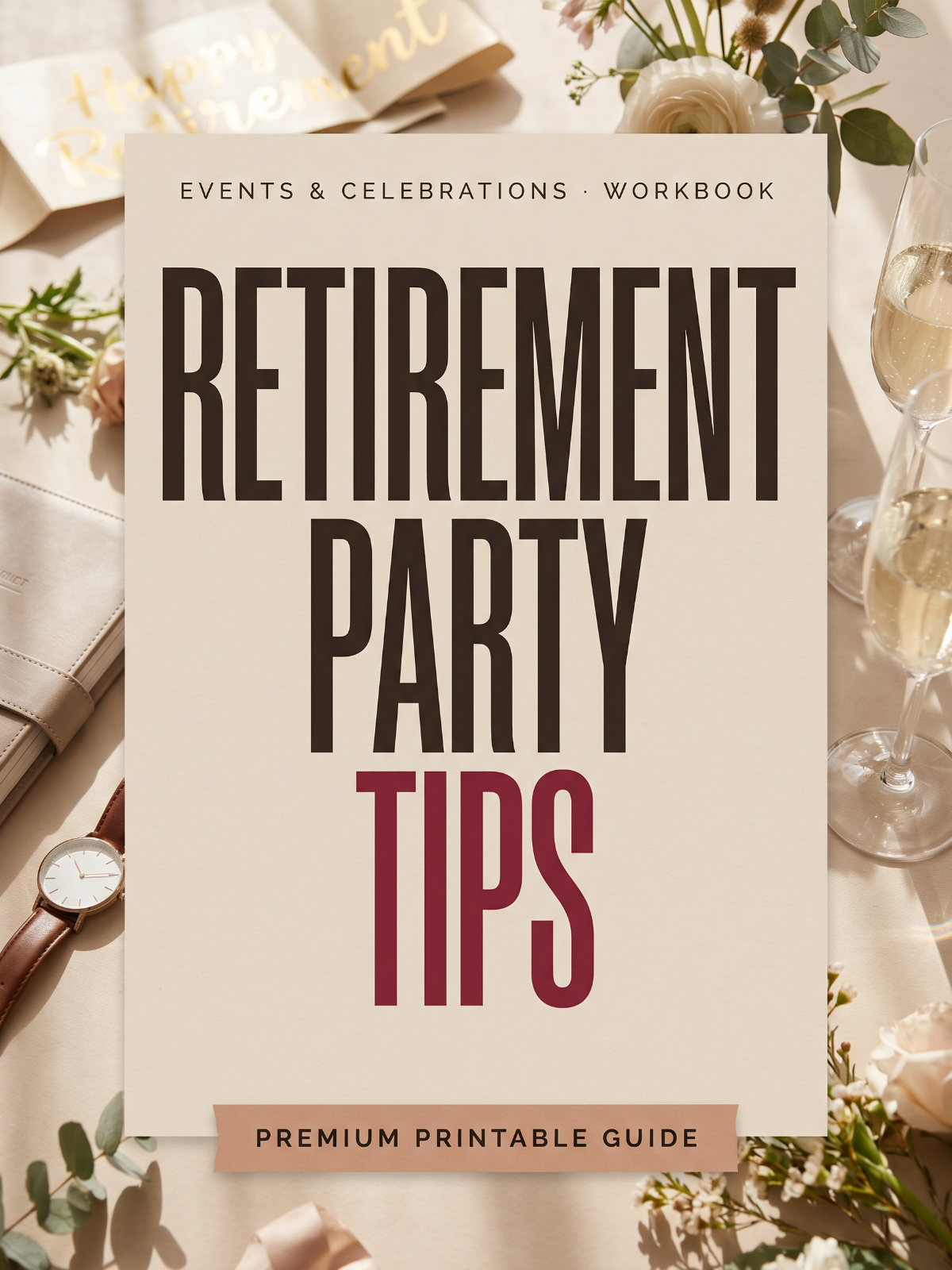
The full workbook, ready to print
- ✓6-week countdown with week-by-week tasks and owners
- ✓Fill-in budget tracker with per-head cost breakdowns
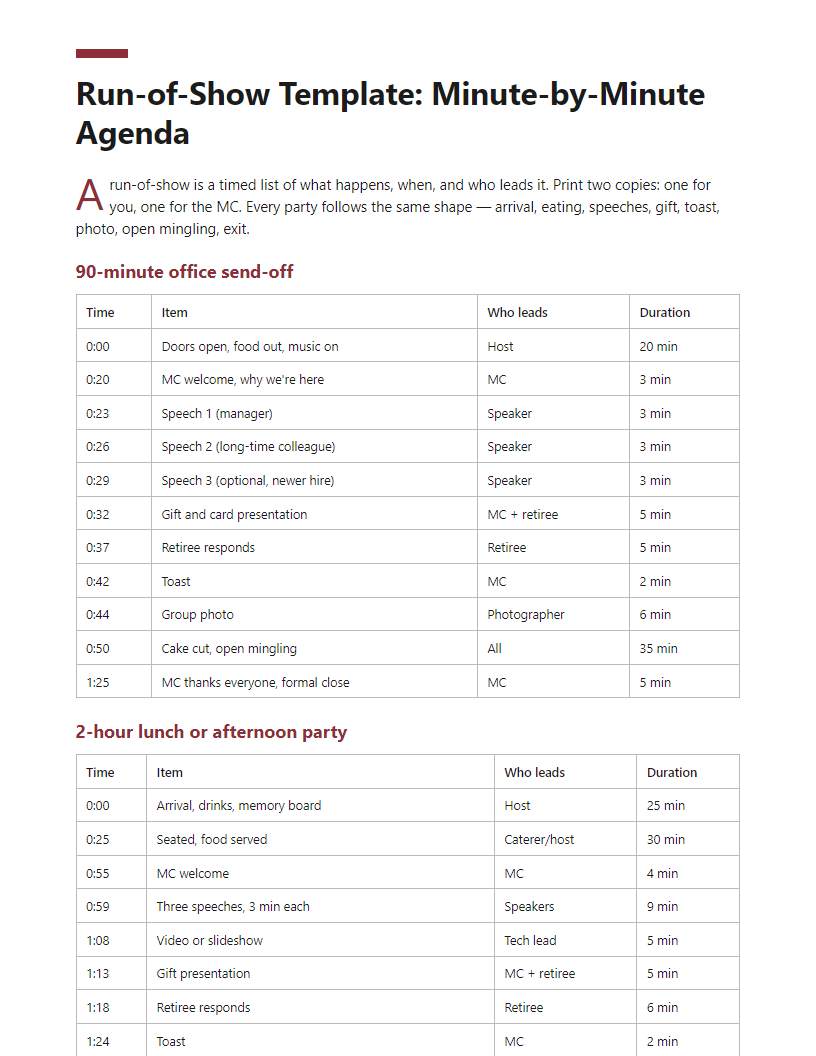
- ✓Minute-by-minute run-of-show template for a 2- and 3-hour party
- ✓Copy-and-paste invitation wording plus three speech outlines
- ✓Virtual and hybrid party setup guide with timing adjustments
- ✓Day-before, day-of and day-after master checklist
Hosted on FileJoker. Premium members download instantly; free download has a wait.
In a hurry? Free one-page checklist30 items to tick off · print-ready PDF, no sign-upDownload freeIncluded bonuses — free with the guide
1 extra guide from the same topic
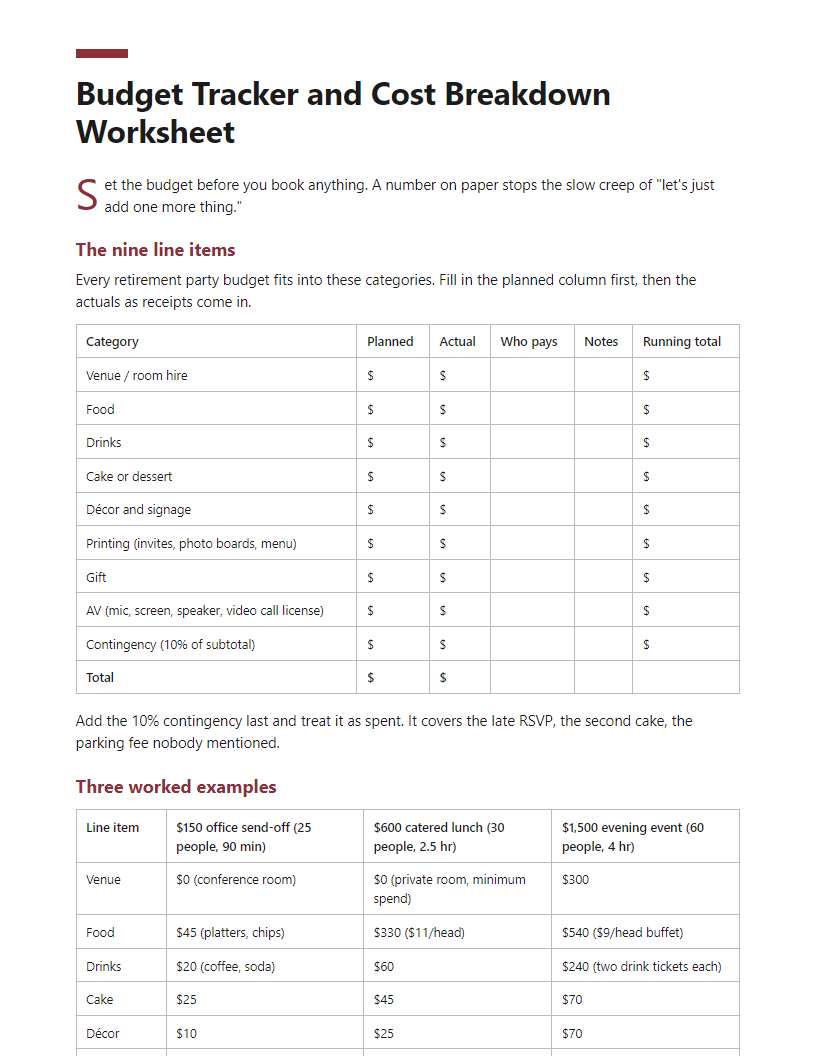
A look inside the PDF
12 sections · 30 pages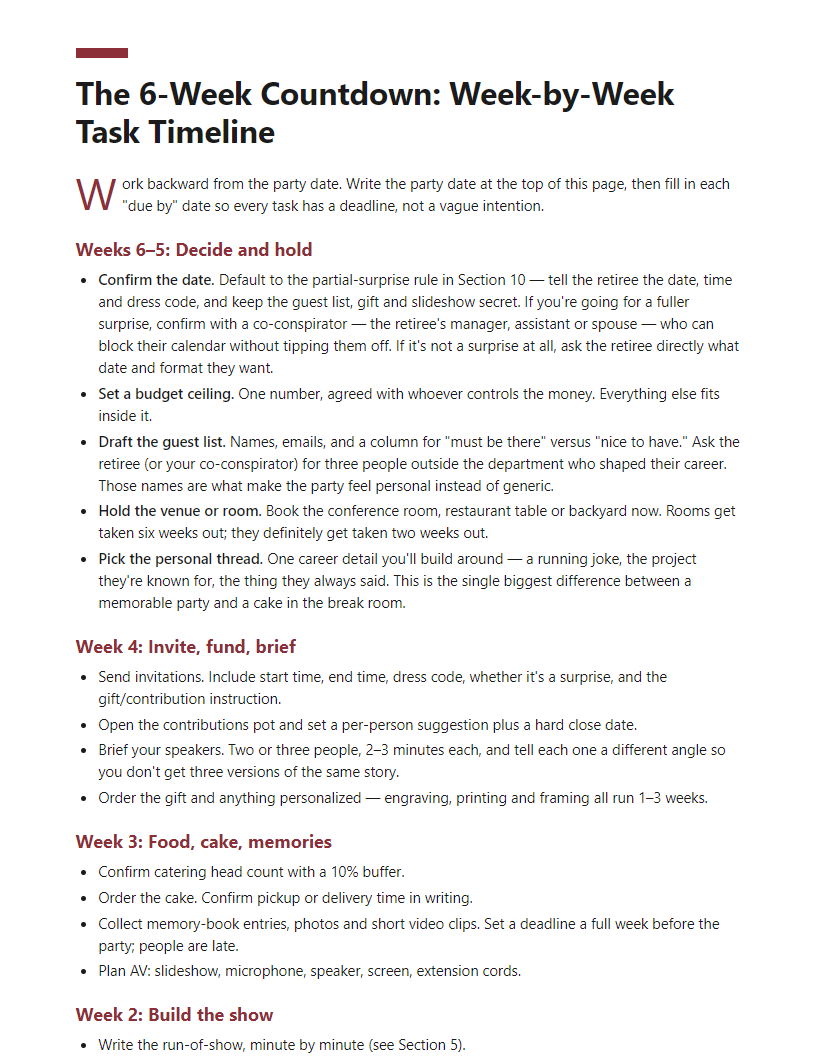
Full table of contents
- Why Most Retirement Parties Feel Generic (and What Fixes It)
- The Short Answers: Length, Agenda, Budget and Etiquette
- The 6-Week Countdown: Week-by-Week Task Timeline
- Budget Tracker and Cost Breakdown Worksheet
- Run-of-Show Template: Minute-by-Minute Agenda
- Invitation and Speech Templates You Can Copy
- Etiquette: Gifts, Speeches, Awkward Guests and the Reluctant Retiree
- Personalising It: Career-Based Themes and Memorable Moments
- Virtual and Hybrid Retirement Parties
- Nine Mistakes That Sink Retirement Parties
- Master Checklist: Day Before, Day Of, Day After
- Frequently Asked Questions
In this article
- The short answer
- Why Most Retirement Parties Feel Generic (and What Fixes It)
- The Short Answers: Length, Agenda, Budget and Etiquette
- Etiquette: Gifts, Speeches, Awkward Guests and the Reluctant Retiree
- Personalising It: Career-Based Themes and Memorable Moments
- Nine Mistakes That Sink Retirement Parties
- Frequently Asked Questions
You’ve been handed the job of organising the send-off and you’re stuck: you want it to feel special, not like another cake-in-the-breakroom afternoon. You’re also unsure what the etiquette actually is, what usually happens at a retirement party, and how many hours it should run before people drift away. These retirement party tips give you the straight answers — timing, agenda, budget ranges, gift and speech rules, and what to do when the retiree hates being the centre of attention.
The page covers the decisions you need today. The premium PDF goes further with a week-by-week countdown, a budget tracker you can fill in, copy-and-paste invitations and speech outlines, and a minute-by-minute run-of-show.
The short answer
Plan a retirement party in this order:
- Confirm with the retiree — ask about guest list, tone and whether they want a speech.
- Set the date and budget — typically £15–£40 (or $20–$50) per head.
- Book the venue and catering 4–6 weeks ahead.
- Send invitations 3 weeks out, with gift guidance included.
- Build a run-of-show — arrival, food, 2–3 short speeches, gift, retiree’s reply, mingling.
- Keep it to 2–3 hours — the sweet spot for energy and attendance.
- Capture it — photos, a memory book, printed tributes.
Why Most Retirement Parties Feel Generic (and What Fixes It)
Generic retirement parties happen for one reason: the planner skips the three decisions that shape everything else, then defaults to a cake in the break room.
The three inputs
- Guest list size. Twelve people and sixty people need different rooms, budgets and formats. Count before you plan.
- The retiree’s comfort with attention. Some people want a microphone and plenty of stories told about them. Others want to shake hands and leave. Ask someone close to them if you don’t know.
- Who pays. Employer budget, staff collection, family, or split. This sets your ceiling and who signs off on spending.
Pick your format
| Format | Typical guests | Duration | Budget band | Effort |
|---|---|---|---|---|
| Office send-off | 10–40 | 60–90 min | $100–$400 | Low |
| Evening party | 30–80 | 3–4 hours | $1,000–$4,000 | High |
| Family dinner | 8–20 | 2–3 hours | $300–$1,200 | Medium |
| Hybrid / virtual | 15–60 | 45–75 min | $50–$500 | Medium |
Budget bands are planning estimates — check current local venue and catering prices before you commit.
The one personal thread rule
“How do I make a retirement party special?” You pick one career detail and run it through everything. Not five themes. One.
A nurse who worked nights for 31 years: invitations styled as a shift handover note, a “last shift” badge as the gift, speeches that each start with one night-shift story. A teacher: name tags as hall passes, a yearbook-style memory book, a final bell.
One thread makes the room feel like it belongs to that person. Generic balloons do not.
Tip: Interview two people who worked with the retiree longest. The thread is usually in their first three stories.
How to use this workbook
- Print now: the 6-week timeline (s3) and budget tracker (s4). One owner fills both in.
- Print at week 3: the run-of-show (s5) and invitation templates (s6).
- Print at week 5: speech scripts (s6) for each speaker, and the master checklist (s11).
60-second readiness check
Before you book anything, you can answer: guest count, format, who pays, the personal thread, and the date the retiree is actually free. If any one is blank, don’t book.
The Short Answers: Length, Agenda, Budget and Etiquette
How long should it be?
- Office send-off (break room or conference room): 90 minutes. Long enough for food, three short speeches and a gift.
- Lunch or afternoon party: 2–3 hours.
- Evening party at a restaurant or venue: 3–4 hours.
Anything past four hours turns into a regular party and the retiree stops being the center of it. Anything under 60 minutes feels rushed, and people arrive late.
What usually happens
The standard order of events, in sequence:
- Arrival and mingling (15–30 min) — drinks, name tags if guests come from different eras of the career.
- Food — open the buffet or serve the first course before anyone speaks.
- Welcome (2–3 min) — host explains why everyone is here and what’s coming.
- Speeches (three named speakers, 3 minutes each, 9 minutes total) — a boss, a long-time colleague, sometimes a family member.
- Gift presentation and the retiree’s response — the emotional peak.
- Cake and toast.
- Informal close — photos, goodbyes, hand out any take-home items.
Keep the formal block to 30 minutes total. Everything else is mingling.
Quick-reference card
| Party type | Duration | Typical guests | Agenda slots | Budget per head |
|---|---|---|---|---|
| Office send-off | 90 min | 10–30 | Welcome, 3 speeches, gift, cake | $5–$15 (cake, drinks, decor) |
| Catered lunch/afternoon | 2–3 hr | 20–60 | Mingle, food, welcome, 3 speeches, gift, toast | $20–$45 |
| Restaurant dinner | 3–4 hr | 15–50 | Drinks, dinner, welcome, 3 speeches, gift, toast, dessert | $45–$100+ |
| Virtual | 45–60 min | 10–40 | Welcome, slideshow, 3 speeches, gift reveal, open chat | $0–$25 (shipped items) |
Check current local catering and venue prices before you lock a number — these are planning starting points, not quotes.
Who pays
Employers usually cover office send-offs and often a catered lunch. For restaurant dinners, colleagues typically chip in per head, or each guest pays their own check. Group gifts run on voluntary contributions, with a suggested amount, never a required one.
Core etiquette, in five lines
- No roasting. Affectionate stories, yes. Jokes at the retiree’s expense, no.
- No pension, salary or severance talk. Money is private, always.
- No pressure to give a gift. Suggest a contribution range, accept $0 without comment.
- No mandatory attendance. Invite warmly, then let people decline.
- The retiree gets the last word. Every speech runs before theirs.
When to break the defaults
Break them when the retiree is introverted — cut to 60 minutes, drop to two speakers, no surprise. Break them for remote teams — go virtual and shorter, since 90 minutes on video is a slog. Break them for partial retirement — call it a role change, skip the finality, and keep the goodbye language out of the speeches.
Etiquette: Gifts, Speeches, Awkward Guests and the Reluctant Retiree
Gifts: one group gift beats twenty small ones
Collect once, buy once. A single meaningful gift lands better than a pile of mugs.
- Set a suggested range, not a required amount. “$10–$25, whatever works for you” is standard for a colleague. Close teammates often give more.
- Make giving private. Use an envelope with a trusted collector, or an online pool. Never pass a signup sheet that shows who gave what.
- Don’t pressure anyone. Interns, part-timers and new hires should hear “completely optional” in writing.
- Cap the card, not the cash. Everyone signs the card, whether or not they contributed.
What to skip: anything referencing age or decline (rocking chairs, “over the hill” items), office-branded junk, joke gag gifts that only three people understand, and cash handed over loose. If you give money, use a gift card or a check inside a card.
Present it in one moment, not in dribs. After the second speech, the MC calls the retiree up, reads the card’s cover message aloud, and hands over the gift. Two minutes. Then photos.
Tip: The detail people remember is rarely the gift. It’s the book of handwritten notes from 30 colleagues, or the framed photo from their first week. Budget $0 and three weeks of collecting for that.
Who to invite
Work outward in rings: current team, wider department, former colleagues the retiree stayed close to, long-standing clients or partners, and family.
- Former colleagues: ask the retiree for five names, or check with their closest work friend. People who left years ago often make the night.
- Clients and partners: invite only if the relationship was personal and your company allows it. Check gift policies first.
- Family: spouse, partner, adult kids. Invite them to evening and weekend parties; office send-offs during work hours are usually staff-only.
If it’s a surprise, tell the retiree’s partner or a family member in week 5. They’ll know about vacations, medical appointments and whether a surprise is welcome at all.
Colleagues who didn’t get along with the retiree
Attendance is optional. Make that explicit in the invitation (“drop in if you can”). Nobody should have to explain an absence.
Speeches, though, are not improv hour. Brief every speaker: stick to work, keep it under three minutes, no inside jokes about conflicts, no “we’ll finally get some peace” lines.
For the card, a neutral message is perfectly polite:
- “Wishing you all the best in retirement.”
- “Thank you for your years of service. Enjoy what comes next.”
- “Congratulations on a long career.”
Sign your name. Done.
The retiree who hates attention
Ask first. “Would you rather have a party, a team lunch, or nothing at all?” is a fair question, and the answer is binding.
Low-key options that still feel special:
- A team lunch with no speeches, just a card and a gift at the end.
- Coffee and cake at 3 p.m., 30 minutes, no podium.
- A memory book and a private handover with their manager.
For anyone nervous, send them the run-of-show two days ahead with an opt-out clause: “You don’t have to speak. If you’d rather skip it, I’ll close instead.”
Forced-out, redundancy or health-related exits
Celebrate the career, not the exit. Say “marking 22 years here” rather than “sending her off.” Leave alone: the reason for leaving, severance, the restructure, health details, and anything about “what’s next” unless they raise it. Brief every speaker on those boundaries in writing.
Personalising It: Career-Based Themes and Memorable Moments
Two personal touches done well beat ten done halfway. Pick based on what the retiree actually did for 30 years and what they’re heading toward next.
Career-matched theme starters
Use the career as a light frame, not a costume party.
| Career | Low-key frame |
|---|---|
| Teacher | Chalkboard welcome sign, notes from former students, an apple-themed cake |
| Nurse / healthcare | “Shift change” sign-out board, scrubs-blue table colors, framed unit photo |
| Engineer | Blueprint-style invitation, a labeled “final project: retirement” poster |
| Military | Flag display, shadow box, unit insignia on the program |
| Sales | Final “closed” sign, a mock contract guests sign, quota-met bell |
| Trades | Toolbox centerpiece, hard hat guest book, “last job” job card |
| Public sector | Years-of-service timeline, proclamation read aloud, department photos |
Five high-impact, low-cost moments
These are the ones people remember. Pick two.
- Memory book. Pass a blank book or a stack of cards around the office for two weeks. Ask one specific question: “What’s one thing you learned from [Name]?” Specific prompts beat “write something nice.”
- Timeline wall. Tape photos, badges, old org charts and project artifacts along a wall in date order. Guests cluster around it during arrival — it solves the awkward first 20 minutes.
- “Then and now” photos. First-day badge photo next to a current one, printed large. Cheap, funny, warm.
- Video messages. Collect 30–60 second clips from people who can’t attend — former colleagues, a retired boss, clients. Six clips cut together runs about five minutes. Build it into the run-of-show so it has a slot, not a scramble.
- Symbolic handover object. The keys, the headset, the badge, the stapler, the first tool they were issued. Hand it to a successor or back to the retiree in a frame. Thirty seconds, big emotional payoff.
Hobby and next-chapter angles
Point the party forward, not only backward.
- Travel: a map where guests pin places they recommend, or a card file of tips.
- Garden: seed packets as favors, a group gift of tools or a nursery gift card.
- Grandchildren: invite them. A short message from a grandchild beats any speech.
- Side business or volunteering: ask guests for one contact or piece of advice on a card.
What to skip
- Over-themed décor. If the room needs explaining, it’s too much. Two or three touches, not a full build.
- Novelty gifts that mock age. Canes, hearing-aid jokes, “over the hill” banners. Some people find it funny. Many don’t, and you won’t know which until it’s unwrapped.
- Gag awards with a sharp edge. Anything about weight, hair, mistakes or office conflicts. If you’d hesitate to say it to their face alone, cut it.
The two-touch decision grid
Score each idea you’re considering:
| Question | Yes = 1 point |
|---|---|
| Does it reference something only this person’s colleagues would know? | |
| Can one named person own it by the date you set? | |
| Does it cost under $50? | |
| Would the retiree be comfortable, not embarrassed? |
Run every idea through it. Take the two with the highest scores. Drop the rest without guilt.
Nine Mistakes That Sink Retirement Parties
1. The open-ended speech list
“Anyone who wants to say a few words” turns 15 minutes into 50. People check their phones. The retiree stands at the front too long.
Fix: Name three speakers in advance. Give each a 3-minute cap and tell them the cap twice. Offer everyone else the memory book or the open-mic slot at the end, after the formal part closes.
2. A date half the team can’t make
Friday afternoons empty out. Month-end buries finance. School pickup takes out parents at 3 p.m.
Fix: Ask the retiree’s closest two colleagues which day and hour works for the most people, then check the team calendar before you send anything.
3. Holding it on the retiree’s actual last day
Last days are admin days — handovers, badge returns, goodbye emails. The guest of honor arrives drained.
Fix: Schedule it 2–5 days before the final day. They get to enjoy it, and they still have time to say personal goodbyes afterward.
4. Surprising someone who hates surprises
Some people find a surprise party genuinely stressful, especially if they’d have dressed differently or invited their spouse.
Fix: Use a partial surprise. Tell them the date, time and dress code. Keep the guest list, the gift and the slideshow secret. If you want a full surprise, get consent from their partner or closest work friend first — they’ll know.
5. Collecting money with no amount and no deadline
“Chip in if you want” produces awkward silence and a thin envelope. People don’t know what’s normal, so they guess or skip it.
Fix: State a suggested range ($10–$25 is common — adjust to your team), name the deadline, and name one collector. Give a private opt-out.
6. Nobody owns the gift, the cake or the music
The most common party failure is an unassigned task. Everyone assumes someone else has it. Nobody does.
Fix: Write a name beside every line on your run-of-show: gift keeper, cake collector, playlist, photos, MC. One name, not “the team.”
7. A venue with no AV
You built a 4-minute slideshow and the room has no screen, no HDMI cable, and speakers that won’t reach past row two.
Fix: Visit the room. Test the cable, the sound and the laptop with the actual file. Have a backup: phone hotspot, your own speaker, printed photos on a board.
8. Forgetting dietary needs
A cake and a cheese tray exclude more people than you’d think. Being left without food is the clearest signal that nobody thought about you.
Fix: Ask on the invitation RSVP. Order at least one vegetarian, one gluten-free and one non-alcoholic option, and label every platter.
9. No plan for the partner or family
If you invite a spouse, adult kids or a grandchild, they arrive knowing nobody.
Fix: Assign a host to greet them, seat them near friendly colleagues, and brief the MC to name them from the front. Ask the retiree first whether they want family there at all — some prefer to keep work and home separate.
Frequently Asked Questions
How do I make a retirement party special without a big budget?
Spend on memory, not decor. The three cheapest things consistently land hardest:
- A letter book. Ask 15–20 people for one paragraph each. Print, bind in a $10 binder, hand it over at the gift moment.
- Named stories. Three speakers, each telling one specific story — not a résumé read-aloud.
- The retiree’s own food. Their favorite cake, their lunch spot’s catering, the snack they kept in their desk drawer.
A $40 party with a letter book beats a $900 party with a banner and a generic plaque. Personal detail is free; it just takes two weeks of asking. If you have $100 total, put $60 into food the retiree actually likes, $25 into printing photos and the letter book, and $15 into a card everyone signs.
What is proper etiquette for a retirement party?
See the five etiquette lines and the group-gift range in s2.
What usually happens, and how long should it run?
See the standard order of events and the duration table in s2, and the timed run-of-show templates in s5.
Should the retiree pay for anything?
No. Not the venue, not the food, not their own gift. If they insist on hosting and paying themselves, that’s their call — but then it’s their party to plan, and you’re a guest. If the budget is short, shrink the party rather than letting the retiree quietly cover the gap. A 45-minute coffee-and-cake send-off that costs $50 is better than a catered lunch they paid for.
Do you invite their family?
Ask the retiree first. For an evening or weekend party, spouses and adult children are normal and usually welcome. For a 90-minute workplace send-off, family often feels out of place unless the retiree wants them there.
Whatever you decide, state it plainly on the invitation — “partners welcome” or “colleagues only” removes all doubt. If one family member is speaking, tell the retiree in advance so they aren’t blindsided mid-party.
Is a surprise party a good idea?
Usually not. Surprises remove the retiree’s control on a day that’s already emotional, and they may show up in a T-shirt. Tell them the date and format; keep the gift, the guest list or the letter book as the surprise.
What if the retiree refuses a party altogether?
Take the no seriously, then offer something smaller:
- A team lunch at a restaurant, no speeches
- Coffee and cake at their desk, 20 minutes
- Just the letter book and the gift, handed over privately
Ask which of the three they’d accept. Most people say yes to one.
Tip: Ask once, in private, and let them answer the next day. A refusal given on the spot is often just discomfort with being the center of attention, and it can soften when they’ve had time to picture the smaller version.
- ✓6-week countdown with week-by-week tasks and owners
- ✓Fill-in budget tracker with per-head cost breakdowns
- ✓Minute-by-minute run-of-show template for a 2- and 3-hour party
- ✓Copy-and-paste invitation wording plus three speech outlines
- ✓Virtual and hybrid party setup guide with timing adjustments
- ✓Day-before, day-of and day-after master checklist
Frequently asked questions
How do you make a retirement party feel special?
Anchor it in the person, not the occasion. Build the theme around their career or a hobby, collect short written tributes from colleagues and clients into a memory book, and display photos from across their years of service. Ask two or three people who genuinely know them to speak for 90 seconds each. Specific stories beat generic praise every time, and a personalised gift lands harder than a gift card.
What is proper etiquette for a retirement party?
The retiree never pays. Organisers set a voluntary contribution amount and never pressure anyone to give. Invite everyone in the immediate team — excluding people creates lasting friction. Speeches should be positive, short and free of inside jokes that exclude family guests. Avoid ageing jokes. Tell the retiree the running order in advance so they aren't ambushed, and let them decline a response speech.
What usually happens at a retirement party?
A standard agenda runs: arrival and drinks (30 minutes), food and mingling (45 minutes), a host welcome, two or three short speeches from a manager and close colleagues, the gift presentation, a brief reply from the retiree, then cake, photos and informal goodbyes. Some workplaces add a slideshow, a memory book signing table or a career-timeline display during the mingling phase.
How many hours should a retirement party last?
Two to three hours is the standard. Lunchtime office parties often run 60–90 minutes; evening events at a restaurant or venue typically run three hours. Anything past three hours tends to lose momentum unless there's dancing or a full dinner. Set a clear end time on the invitation so guests can plan, and schedule speeches around the 45–60 minute mark when attendance peaks.
What if the retiree hates being the centre of attention?
Scale down and warn them. Choose a small lunch or afternoon tea with their closest colleagues instead of an all-staff event. Skip the microphone — hand over a bound book of written tributes rather than making people speak. Tell them exactly what will happen and when, confirm they won't be asked to respond publicly, and give them a clear, agreed exit time.
We collected 4 real questions and comments about "retirement party tips" (4 from People Also Ask), grouped them into 4 recurring problems, and built this guide to resolve the 4 that block people most. The top-ranking pages were reviewed for gaps; 7 of those gaps became dedicated sections.
Edited by Alex Hirn · Last updated November 4, 2026 · How we make our guides
More in Events & Celebrations
 premium
 premium
 premium
 premium