Template · 24-page PDF · Premium
Christmas Gift List: Plan Every Recipient, Budget and Buy Date
Build a Christmas gift list with set spend limits per person, gift counts and buy-by dates. Includes a budget worksheet and week-by-week checklist. Take a look.
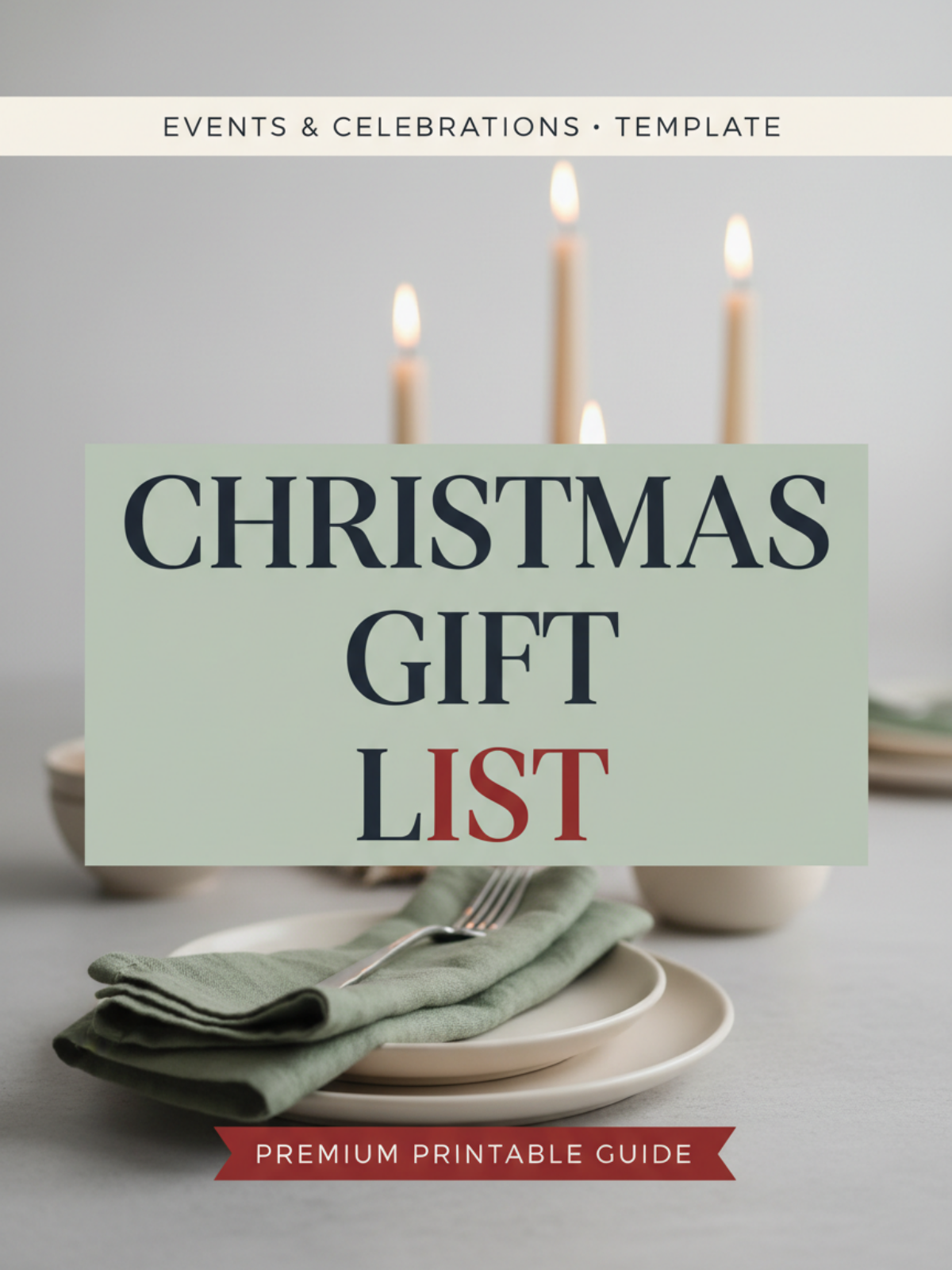
The full workbook, ready to print
- ✓Six-step budget worksheet that divides one total across every recipient
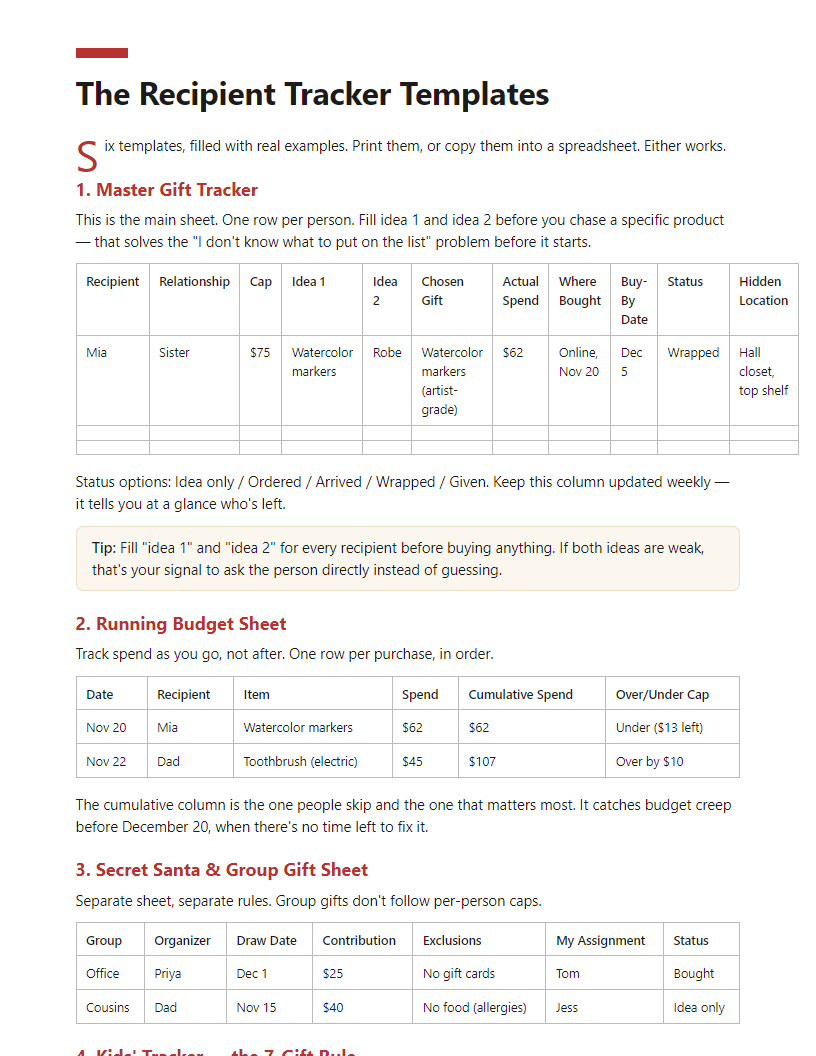
- ✓Recipient tracker templates with spend limit, gift ideas, buy-by date and status
- ✓Scripts and wording for requesting a pricier gift without guilt
- ✓Budget tier gift lists by age and price band, including under $20
- ✓Quality-check guide for cheap buys and dupes (silk vs satin, materials, sellers)
- ✓Fairness planner for sibling and family spend disparity
- ✓Week-by-week Christmas gift checklist from November to wrapping day
Hosted on FileJoker. Premium members download instantly; free download has a wait.
In a hurry? Free one-page checklist28 items to tick off · print-ready PDF, no sign-upDownload freeA look inside the PDF
11 sections · 24 pages
Full table of contents
- Why Gift Idea Lists Fail (and What a Tracker Does Instead)
- Quick Answers: How Much to Spend, How Many Gifts, and the Gift Rules
- Build Your Gift Budget in Six Steps
- The Recipient Tracker Templates
- Writing Your Own Wish List Without Feeling Greedy
- Budget Tiers: Real Gift Ideas by Age and Price
- Cheap Without Cheap-Looking: Checking Quality and Dupes
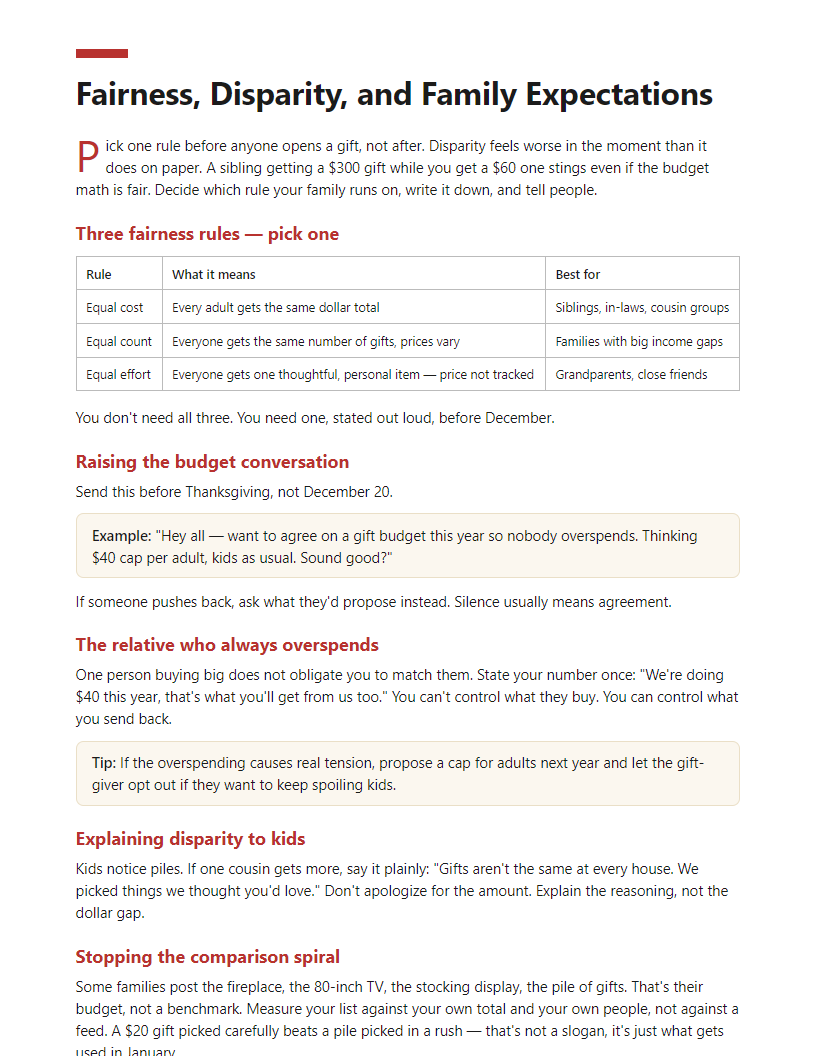
- Fairness, Disparity, and Family Expectations
- Nine Mistakes That Blow the Christmas Budget
- The Week-by-Week Christmas Gift Checklist
- Digital Versions: Amazon Lists, Shared Docs, and Apps
In this article
“I don’t know how much to spend, how many gifts to ask for, or how to tell my parents what I want without sounding spoiled.” If that sounds familiar, your Christmas gift list probably isn’t the problem — the structure behind it is. A pile of gift ideas tells you nothing about what you can actually afford.
Here you get straight answers on spend per person, how many gifts is reasonable, and the 7-gift and 5-gift rules, plus the mistakes that quietly wreck December budgets and how shared digital lists compare.
The premium PDF turns that into a working planner: recipient tracker templates, budget tiers with real gift ideas by age and price, wording for asking without guilt, and a week-by-week buying checklist.
The short answer
A Christmas gift list works when it tracks money, not just ideas:
- Set a total budget first — then divide it, don’t add up afterwards.
- Assign a limit per person: typically more for parents and partners, a modest fixed amount for friends, colleagues and teachers.
- List recipients, not products — one row each.
- Add 1–3 gift ideas per person inside that limit.
- Set a buy-by date for each row to avoid rush shipping and panic buying.
- Record what’s bought, wrapped and sent, and update the running total every purchase.
Why Gift Idea Lists Fail (and What a Tracker Does Instead)
By December 10, you’ve seen 150 gift guides and still don’t know what to buy your sister. That’s not a research problem. It’s a decision problem.
Three things December doesn’t give you
Most people shop without three basic controls:
- No per-person cap. You know your total budget, maybe. You don’t know what any one person “gets.” So the budget bends every time.
- No deadline. “Sometime in December” isn’t a date. Without a buy-by date, shipping cutoffs and sold-out sizes make the decision for you.
- No record of what you bought. By gift number 12, you can’t remember if you already got your nephew something. So you buy twice, or panic and overspend on gift 13.
Gift idea lists make all three worse, not better. A 150-idea roundup gives you more options, which means more comparing, more tabs open, more “maybe this instead.” It expands what you want to buy. It does nothing for what you need to decide: who, how much, and by when.
What a tracker holds instead
A tracker replaces browsing with seven fixed fields per person:
| Field | Purpose |
|---|---|
| Recipient | Who the gift is for |
| Relationship | Sets the budget tier |
| Budget cap | Hard ceiling, set before shopping |
| Idea | One gift, not five options |
| Actual spend | What you paid, checked against the cap |
| Buy-by date | Shipping or event deadline |
| Status | Idea / Ordered / Wrapped |
Fill this once and shopping becomes checking boxes, not browsing.
“It’s not about the money” is a rule, not a guilt trip
“Christmas isn’t about expensive presents” is true. It’s also not an excuse to skip planning. Treat it as a budget rule: set a low, honest cap, pick one thoughtful idea, and stop. A $15 cap with a specific idea beats an unlimited budget with no idea at all — for your wallet and your nephew.
Tip: No interest in another app? Print the tracker and fill it in by hand. The fields work the same on paper.
Quick Answers: How Much to Spend, How Many Gifts, and the Gift Rules
You need two numbers before you open any tracker: how much per person, and how many items per person. Here’s where to start.
Per-person spending bands
These are starting points, not rules. Adjust by your own income and family norms.
| Relationship | Low | Typical | Generous | Suggested gift count |
|---|---|---|---|---|
| Partner | $50 | $100–150 | $250+ | 1–3 |
| Parents (each) | $30 | $60–80 | $150 | 1–2 |
| Siblings | $20 | $40–60 | $100 | 1 |
| Children (each) | $40 | $75–150 | $250+ | 3–5 |
| Grandparents (each) | $20 | $40–50 | $100 | 1 |
| Close friends | $15 | $25–40 | $75 | 1 |
| Coworkers | $5 | $10–15 | $25 | 1 |
| Teachers | $10 | $15–25 | $50 | 1 |
Tip: If asking for something above the “typical” band feels wrong, you’re not greedy — you just need a wish list structure that gives your family an easy yes. See section 5 for the full three-tier breakdown.
The 7-gift rule and the 4-gift rule
The 7-gift rule: something you want, something you need, something to wear, something to read, something to do, something to share, something for the soul. Works well for kids with big extended families — it spreads gifts across categories so nothing feels random.
The 4-gift rule (want, need, wear, read): works for tighter budgets or fewer gift-givers. Some families extend it to 5 by adding “something to do.”
Use 7-gift when you have more buyers and want variety. Use 4-gift when you’re the main buyer and want to keep count low.
The budget math
Total holiday budget ÷ weighted recipients = starting cap per person. See section 3, Steps 3–4, for the full worked example with weights and dollar caps.
Your own wish list
Don’t build a separate tier system here — section 5 covers it in full: under $20 with 3–5 items, $20–50 with 2–3 items, and one clearly priced stretch item.
When to say no to an exchange
Skip it when the group has grown past 8 people, when budgets clearly don’t match, or when it’s causing stress instead of fun. Script: “I’m skipping gift exchanges this year to focus on a few people — let’s just do the dinner.”
Nine Mistakes That Blow the Christmas Budget
Your budget doesn’t get blown by one big purchase. It gets blown by nine small, predictable mistakes. Check your plan against this list before you buy anything.
1. Browsing before you cap
Opening a shopping app before you set a per-person number is the single biggest overspend trigger. You see something good, you justify it, and the cap you haven’t set yet never stops you. Set every cap in Section 3 before you open a single tab.
2. Forgetting the extras
Shipping, gift wrap, cards, and batteries aren’t line items people track, but they belong inside your total, not bolted on after. Section 3 has you fold these into Step 1 for this reason — treat them as a budget line, not an afterthought.
Example: On a $400 total, budget $35–70 for wrap, cards, and shipping as part of that $400, not on top of it.
3. Buying for the idea of a person
You buy what “a teenager” or “a mom” is supposed to want, not what this specific person mentioned in October. That mismatch is why gifts get returned. Check your notes for that person before you check the trend.
4. Missing the order-by date
Miss the shipping cutoff and you pay rush fees, or panic-buy a replacement in store at full price. Both cost more than the gift itself. Section 10 has the dates — use them.
5. Topping up because it “looks small”
A $20 gift that looks thin under wrapping paper tempts you to add “just one more thing.” That’s how a $20 gift becomes $45. If the cap says $20, wrap it well and stop there. A $20 gift under $20 isn’t a bad gift — it’s a budget working as planned.
6. Not logging purchases
No log means you forget what you bought, buy it twice, or lose a gift in a closet until February. Log every purchase the day you make it. One line: person, item, price, hidden location.
7. Letting a sale change your list
A flash sale on something for your cousin’s partner isn’t a reason to add a name you hadn’t planned to buy for. Sales should change the price you pay, not who’s on the list.
8. Letting gift cards and returns expire
A gift card bought in November with no plan to use it, or a return sitting in a bag past the store’s window, is money you’ve already spent twice. Set a reminder for return deadlines and gift-card balances before you file the receipt away.
Warning: Many stores cap returns at 30–90 days past the holiday — check current figures for each store before you assume you have until spring.
9. Apologizing for your own wish list
Writing “this is all optional” under every item over $20, or feeling bad for listing anything above $20 at all, isn’t a budget mistake — it’s a confidence mistake. Your list sets expectations. State the price, skip the apology.
Tip: If you want cheap-but-good options to fill out a short list, Section 6 has real ideas by price tier, including a full set under $20. For comparing your spending to what other families post online, Section 8 covers that spiral directly.
Digital Versions: Amazon Lists, Shared Docs, and Apps
Your paper tracker works in one house. Once family is spread across time zones, you need a version people can open from their phone.
Setting up a shareable wish list
Amazon’s list builder is the fastest universal option, even for gifts you won’t buy on Amazon.
- Go to Accounts & Lists > Your Lists > Create a List
- Name it “Christmas [Your Name] [Year],” not just “Wish List” — you’ll reuse the feature for birthdays
- Add items with the browser extension or app, from any site, not just Amazon
- Set privacy to “Shared” and copy the link — don’t leave it “Private” or no one can see it, and don’t set it “Public” or strangers can find it in search
- Turn on “Keep my shopping activity private on this list” in the list settings so purchases don’t spoil the surprise for you
Tip: This solves “how to make a Christmas wish list on Amazon” in under five minutes. Send the link instead of a screenshot — links update live as you add items. The surprise setting hides who bought what from the list owner, but it won’t hide items from other buyers, so duplicate purchases can still happen.
Spreadsheet column setup
If you prefer a shared doc, copy the same columns as the printable Master Gift Tracker so both versions stay in sync:
| Column | Example |
|---|---|
| Recipient | Mom |
| Idea 1 / Idea 2 | Watercolor markers / electric toothbrush |
| Budget cap | $40 |
| Status | Bought / Pending |
| Buyer | Whoever claims it |
Sheet permissions can’t hide a single column from one viewer. Instead, keep “Buyer” and “Status” on a second, separate sheet tab shared only with buyers, and give the recipient a link to a stripped-down tab showing just item ideas.
App vs. paper
Group apps (Giftster, Elfster, GiftList) beat paper when more than four people are buying for the same person and need to avoid duplicate gifts. They’re overkill for a household of two or three — a shared doc does the same job with no sign-up.
Keeping purchases hidden
Every app above has a “claim” feature: once someone marks an item bought, it grays out for other buyers but stays invisible to the list owner. Amazon’s surprise setting does something similar for the owner, but other shoppers still see open items — add a note in the shared doc so Amazon shoppers don’t double-buy.
Warning: Export or print the list before December 15. Servers slow down and links break during peak shopping weeks — a printed backup means one glitch doesn’t stall your whole plan.
Christmas Gift List FAQ
What is the 7 gift rule for Christmas, and does it work for adults?
The 7 gift rule gives each person: something they want, something they need, something to wear, something to read, something to do, something to share, something for the soul. It started as a kids’ rule. For adults, cut it down. Four categories (want, need, wear, do) cover most people without turning one person’s list into seven separate purchases.
Tip: Don’t apply the full 7-item version to a $50 budget. Pick 2–3 categories and go deeper on each.
What are the 5 main gifts for Christmas?
A simpler version some families use: want, need, wear, read, and one shared/experience gift. Five categories, five items, one per category. It works as a cap as much as a checklist — once you’ve filled all five, stop adding. If a list has four under-$20 stuffed animals instead of five distinct categories, it’s not following the rule, it’s just long.
What should I include on my list if I genuinely don’t want much?
List things you’ll actually use, even small ones: replacement items (socks, a water bottle), one splurge item under $50, and one experience (a class, tickets, a gift card to a specific place). Christmas isn’t about expensive presents — it’s fine to ask for practical things. A grandparent buying diapers or a coffee mug doesn’t need to feel apologetic about it, and you don’t need to pad a list just to look grateful.
What are the top gifts this year, and should trending items drive your list?
Some categories trend every year, even though the specific products change:
- Kids 6–12: collectible trading cards, build-it-yourself sets (blocks, model kits), fidget and sensory toys.
- Teens: budget earbuds, skincare sets, tickets to a concert or event.
- Adults: gift cards to a specific store, kitchen gadgets, experience gifts (classes, tickets).
For the actual top 10 this year, check current figures — the names change every season and any list printed here would be outdated by next December. Amazon’s and Target’s “most wished for” pages are good places to check current rankings. Treat trending items as a starting point, not a target: a trending item that doesn’t fit the recipient’s actual interests is still a miss, even at full price.
Is it rude to put prices or links on a wish list?
No. Links save the buyer a search and avoid duplicate or wrong-size gifts. For your under-$20 and $20–50 tiers, use the platform’s listed price — don’t round it or leave it blank. For your stretch item, state the price yourself in plain words (for example, “around $120”), the same way you’d write it in your own list. Stating the price isn’t rude; it’s what lets people split the cost or contribute toward it without guessing.
How much should a teenager ask for, and is asking for money acceptable?
Cash or gift cards are acceptable for teens and up, capped at one or two spots on the list, not the whole thing. For kids under 10, keep requests age-appropriate: toys, books, activities — not makeup or cash, which confuses gift-givers and skews the budget fast. A 7-year-old’s list should look like a 7-year-old’s list.
Example: A 10-item kids’ list with eight stuffed animals isn’t a budget problem, it’s a list-structure problem. Cap categories (one plush, one book, one activity) before the list gets written, not after it’s full.
- ✓Six-step budget worksheet that divides one total across every recipient
- ✓Recipient tracker templates with spend limit, gift ideas, buy-by date and status
- ✓Scripts and wording for requesting a pricier gift without guilt
- ✓Budget tier gift lists by age and price band, including under $20
- ✓Quality-check guide for cheap buys and dupes (silk vs satin, materials, sellers)
- ✓Fairness planner for sibling and family spend disparity
- ✓Week-by-week Christmas gift checklist from November to wrapping day
Frequently asked questions
What is the 7 gift rule for Christmas?
The 7-gift rule gives each person seven gifts in set categories — commonly something they want, need, wear, read, plus something to do, something handmade and a stocking gift. It caps the count, spreads spend across price points, and stops one expensive item swallowing the whole budget. Families often scale it down to four or five categories for older children and adults.
What are the top 10 gifts for Christmas each year?
Trending lists change annually, but the reliable categories don't: headphones and audio, skincare or fragrance sets, cosy clothing, kitchen gadgets, games and puzzles, books, jewellery, hobby kits, subscriptions, and experience tickets. Pick the category that matches the recipient, then choose a specific product inside your limit. That order stops you overspending just because an item is popular.
What should I include on my own Christmas list?
Include a spread of prices: two or three mid-range items, several under $20, and at most one bigger "wish" item. For each, add a link, size, colour and model number so nobody buys the wrong version. Five to ten options is plenty — it gives family choice without reading like a demand list.
What are the 5 main gifts for Christmas?
The 5-gift version is something they want, need, wear, read and do — the "do" gift being an experience or activity. It's popular with parents who find seven too many and want one memory-based gift. Set a price band per category first, so the five gifts land on your budget rather than above it.
How do I ask for an expensive gift without feeling greedy?
Ask once, early, with a reason and a price — vagueness causes more awkwardness than honesty. Offer a split option: grandparents or siblings contributing together, or the gift replacing several smaller ones. Give cheaper alternatives in the same list so there's a graceful way to say no. If money is tight at home, lead with the under-$20 ideas instead.
We collected 148 real questions and comments about "christmas gift list" (124 from YouTube comments, 4 from People Also Ask, 20 from search suggestions), grouped them into 13 recurring problems, and built this guide to resolve the 7 that block people most. The top-ranking pages were reviewed for gaps; 7 of those gaps became dedicated sections.
Edited by Alex Hirn · Last updated October 2, 2026 · How we make our guides
More in Events & Celebrations
 premium
 premium
 premium
 free