Template · 23-page PDF · Premium
Puppy Training Schedule: 8 Weeks to 6 Months, Week by Week
A puppy training schedule by age: potty, naps, crate, socialisation and commands in one daily plan, plus week-by-week planner and checklists. Start today.

The full workbook, ready to print
- ✓Printable week-by-week planner from 8 weeks to 6 months with tick-box rows
- ✓One-page daily schedule grid for potty, meals, naps, training and socialisation
- ✓Apartment night plan: crate placement, 3am break timings and a 14-night fade-out
- ✓Step-by-step potty and bite-inhibition fix sheets with troubleshooting branches
- ✓First-72-hours introduction protocol for resident dogs and cats
- ✓Rescue and stubborn-puppy adaptations of the standard planner
- ✓Daily and weekly checklists plus a vetted sources and printables list
Hosted on FileJoker. Premium members download instantly; free download has a wait.
In a hurry? Free one-page checklist40 items to tick off · print-ready PDF, no sign-upDownload freeIncluded bonuses — free with the guide
1 extra guide from the same topicA look inside the PDF
11 sections · 23 pages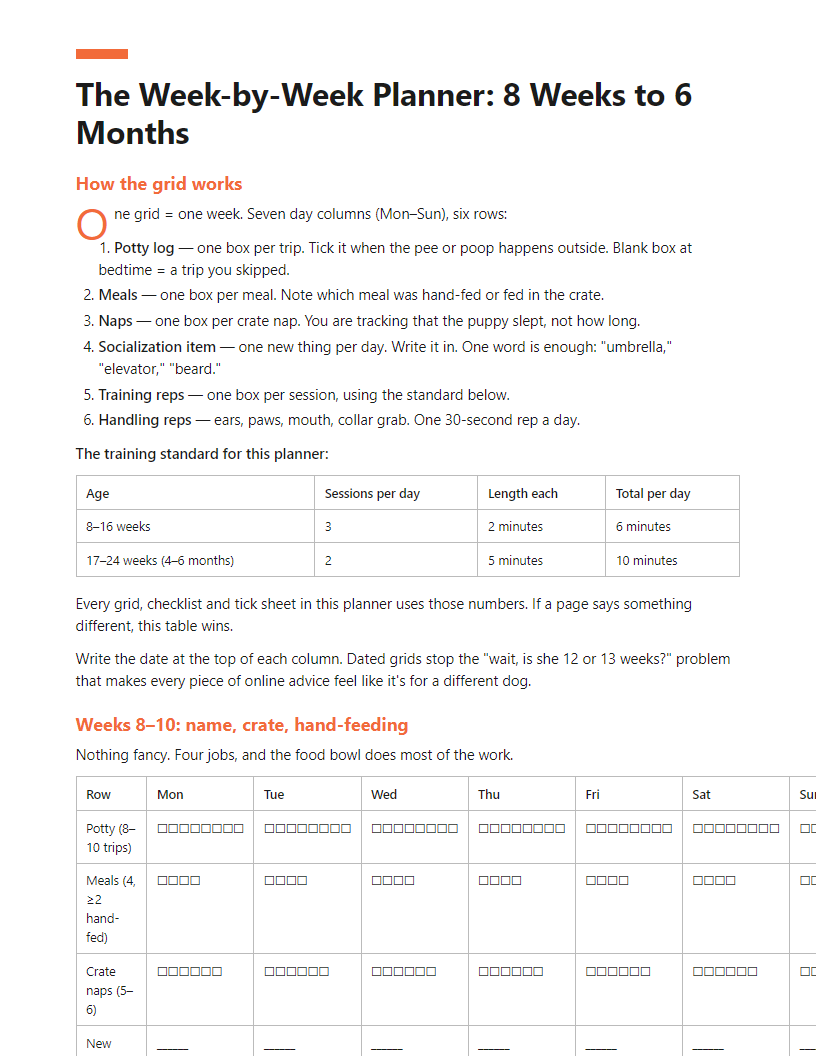


Full table of contents
- Why Your Puppy Week Feels Like Chaos (And What a Planner Fixes)
- The Puppy Schedule in One Page: Default Day by Age
- 3-3-3, 7-7-7, 10-10-10: Which Age Rule Actually Applies to You
- The Week-by-Week Planner: 8 Weeks to 6 Months
- Nights and the Crate: A Plan for Apartments Where Crying It Out Is Not an Option
- Potty Training and the Biting Phase: Step-by-Step Fixes
- Introducing Your Puppy to Resident Dogs and Cats
- Adapting the Planner: Rescue Pups, Stubborn Pups and Real-Life Weeks
- Nine Scheduling Mistakes That Undo a Week of Progress
- Daily and Weekly Checklists
- Where to Go Next: Trusted Sources and Printables
In this article
It’s 3am, the crate is rocking, the howling has not stopped, and you are quietly wondering whether you have already ruined this dog. You have read twenty articles and still cannot answer the simple question: what am I actually supposed to do tomorrow, hour by hour?
This page gives you a puppy training schedule you can follow from day one — a default day by age, how often to take a puppy out, when to nap, when to train, and which age rule (3-3-3, 7-7-7, 10-10-10) applies to your situation. The premium PDF turns it into a printable week-by-week planner from 8 weeks to 6 months, with tick-box rows for potty, sleep, socialisation and commands, plus night-time crate plans for apartments.
The short answer
A workable puppy training schedule repeats the same loop all day:
- Potty first — outside on waking, after eating, after play, then every hour per month of age.
- Feed — 3–4 meals a day up to 4 months, 3 after.
- Play and train — two to three 5-minute sessions: name, sit, come, crate.
- Socialise — one new sight, sound or surface per day.
- Nap in the crate — 30–60 minutes awake, then 1–2 hours sleep; 16–20 hours total.
- Final potty at bedtime, one night break for young pups.
Why Your Puppy Week Feels Like Chaos (And What a Planner Fixes)
Your puppy’s day is not random. Four things drive almost every behavior problem in the first months, and they all run on a clock:
- Potty — bladder capacity by age, plus trips after every sleep, meal and play session
- Sleep and crate — puppies need 18–20 hours a day, and an overtired puppy bites more
- Food and water — meal times set potty times; free feeding makes accidents unpredictable
- Socialization and training reps — short, daily, planned, not “when we get around to it”
Schedule one and ignore the rest, and the week falls apart. A puppy who naps at the wrong time pees at the wrong time and chews your hands at 9 p.m.
Week 1 and 2 exhaustion is a scheduling problem
“I was really starting to regret getting a puppy.” That feeling is common, and it is almost never about the puppy you picked. It’s about three or four night wakings with no plan for who gets up, when, and what happens next. With fixed alarm-based wake-ups instead of surprises, most owners report sleeping in 3–4 hour blocks by night 10–14.
What’s normal in the first 72 hours
- Crying at night in the crate or pen
- Accidents indoors, including right after a successful trip outside
- Refusing one or more meals
- Biting hands, sleeves and ankles, hard
None of these mean you failed. They mean the puppy left its litter days ago.
What this planner does not replace
Warning: This is a scheduling tool, not medical or behavioral advice. Your vet sets the vaccination timetable and decides where your puppy can safely walk. Call your vet for refusing food beyond 24 hours, vomiting, diarrhea or lethargy. Hire a certified behaviorist for real aggression, resource guarding or panic-level fear.
How to use this guide
- Print the planner in Section 4.
- Find your puppy’s current age block — 8–10 weeks, 11–16 weeks, or 17–24 weeks.
- Copy the default day for that same age block from Section 2 onto your fridge.
- Check the boxes daily. Missing boxes show you exactly what to fix tomorrow.
Tip: Every table and checklist in this guide uses the same three age blocks, so the column you find in Section 2 is the column you use in Section 4.
The Puppy Schedule in One Page: Default Day by Age
Find your puppy’s age column, copy the times, adjust the wake time to your own alarm. Everything else shifts with it.
| 8–10 weeks | 11–16 weeks | 4–6 months | |
|---|---|---|---|
| Wake / first potty | 6:30 a.m. | 6:30 a.m. | 6:30–7:00 a.m. |
| Potty interval (awake) | Every 45–60 min | Every 60–90 min | Every 2–3 hours |
| Meals | 4 (7:00, 11:00, 3:00, 6:30) | 3 (7:00, 12:00, 5:00) | 2–3 (7:00, 12:30, 5:30) |
| Nap blocks | 5–6 naps, 1–2 h each; 18–20 h sleep total | 4–5 naps, 1–2 h each; 16–18 h total | 3–4 naps or settle periods, 1–2 h; 14–16 h total |
| Training | 3–4 sessions × 2–3 min | 2 blocks × 5 min | 2–3 blocks × 5–10 min |
| Socialization | Carry-outings, doorstep watching, 1 new surface or sound daily | 1 outing per day (10–20 min) | 1 outing per day + one “hard” distraction rep |
| Last water offer | 2 hours before lights out | 2 hours before lights out | 2 hours before lights out |
| Bedtime / crate | 9:30–10:00 p.m. | 10:00 p.m. | 10:00–10:30 p.m. |
| Night potty trips | 1–2 (midnight, 3:30 a.m.) | 0–1 | 0 |
How the day actually runs
Every block follows the same loop: potty → play or training → potty → nap in the crate. Sleep is not optional downtime. An overtired puppy bites more, ignores you, and has more accidents.
At 8–10 weeks, set a kitchen timer for 45 minutes and take the puppy out whether or not you see a signal. Also go out after every wake-up, every meal, and every play session — those three moments cause most accidents. Four small meals spread across the day also spread out the poops, which makes the pattern easier to read.
At 11–16 weeks, drop to three meals, add the two 5-minute training blocks and one outing. This is the window where name, “yes,” sit, down and come get their reps.
At 4–6 months, the bladder can wait, but the brain can’t sit still. Move to two or three meals if your vet agrees. Trade some potty trips for longer settle periods on a mat and harder practice in distracting spots.
The bladder rule — and when to ignore it
Age in months + 1 = hours a puppy can hold it. A 3-month-old: about 4 hours. That’s a maximum for a calm, crated puppy, not a schedule.
Ignore it and go out sooner when your puppy just woke up, just ate or drank, just played hard, is excited, is a small breed, or had an accident in the last hour.
Water
Free access all day near the crate or in the puppy zone. Pick the bowl up 2 hours before lights out, offer one last small drink, then one final potty trip. Put the bowl back down at the first morning potty.
Warning: Don’t restrict daytime water to cut accidents. Ask your vet first if your puppy is on medication, is very small, or the weather is above 80°F.
Tip: “Every inch of ground is fascinating” is normal. Run the same six-step potty loop every time — one boring spot, stand still, wait 3 minutes on a phone timer. The full sequence is in the potty training section.
3-3-3, 7-7-7, 10-10-10: Which Age Rule Actually Applies to You
Three “rules” show up in every puppy forum. They solve three different problems, and they were never meant to be stacked on top of each other. Here’s what each one actually covers.
3-3-3: for rescue and rehomed dogs
- 3 days to decompress. Expect hiding, refusing food, sleeping a lot, or accidents in the house.
- 3 weeks to settle. The dog learns your routine and starts showing real personality — including behaviors that were hidden the first week.
- 3 months to bond and feel at home.
This rule is about emotional adjustment after a move, not about age or training milestones. A puppy that came straight from a breeder at 8 weeks goes through a short version of day 1–3, then moves on. A 5-month-old from a shelter needs the full timeline.
7-7-7 (or 7x7): a socialization checklist
Before 12–16 weeks, expose your puppy to seven items in each category: surfaces, sounds, people types, objects, locations, movements and handling experiences. Think grass, tile, metal grate, doorbell, vacuum, men with beards, kids, umbrellas, car rides, nail touches.
This is a window, not a rule about settling in. The primary socialization window closes around 12–16 weeks; a fear period can also appear around 8–11 weeks, so keep exposures calm and short. If your puppy is older than that, you still do the list — slower, with more distance and more treats.
10-10-10: a potty-training loop
In this planner, 10-10-10 means ten minutes outside for potty, ten minutes of play or training, then ten minutes of calm settle in the crate or pen. It’s a single repeatable block you run several times a day. It has nothing to do with age or adoption. Use it whenever you need structure for one hour, especially in the first two weeks of potty training.
Other versions (10 minutes/10 reps/10 locations, or 10 minutes outside/10 feet of leash/10 seconds of praise) are also seen online, not what this planner uses.
Which one applies to you
| Your puppy | Rules that apply | Planner column to use |
|---|---|---|
| 8–10 weeks, from a breeder | 7-7-7 (start now), 10-10-10 (potty loop) | Week 1 onward, age column 8–10 weeks |
| 8–16 weeks, rescue or rehomed | All three: 3-3-3 for settling, 7-7-7 on a delayed start, 10-10-10 daily | Start at Week 1 regardless of age; use your puppy’s age column for times |
| 4–6 months, adopted with unknown history | 3-3-3 fully, 7-7-7 adapted at slower pace, 10-10-10 daily | Week 1 of planner, 4–6 month age column |
| 4–6 months, raised by you since 8 weeks | 7-7-7 mostly done; keep 10-10-10 if potty is unreliable | Continue at your current week |
Tip: If you just adopted, run the planner’s Week 1 no matter how old your puppy is. Age sets the potty gaps and meal count. Time in your home sets the training pace.
The weekly planner already schedules the 7-7-7 items as two socialization slots per day, builds the 10-10-10 loop into the potty column, and marks the 3-day and 3-week checkpoints for adopted pups. You follow one sheet, not three systems.
Nine Scheduling Mistakes That Undo a Week of Progress
Nine errors show up again and again. Each one erases roughly a week of work.
1. Opening the crate while the puppy is crying
You teach one lesson: crying opens doors. Wait for a two-second pause, then open. If the crying is a potty signal, go out silently — no play, no talk, straight back to the crate.
2. Free-feeding and late water
A bowl left down all day means you have no idea when poop is coming. Feed at set times, pick the bowl up after 15 minutes, and log it.
| Meals | Water | |
|---|---|---|
| 8–16 weeks | 3–4 set meals | Offer with meals, after play, after naps |
| 4–6 months | 2–3 set meals | Same, plus free access during the day |
| Last 2 hours before bed | No food | Small sips only, then a final potty trip |
Warning: A 3 a.m. accident after a full bowl at 9 p.m. is a schedule problem, not a puppy problem.
3. Skipping enforced naps
Run the nap blocks in the Section 2 table on the clock, not on how tired the puppy looks. A skipped nap shows up as a wild, mouthy evening.
4. Waiting for the final shot to socialize
The 8–16 week window closes on its own schedule. Ask your vet about safe options: carrying your puppy outside, car rides, clean friends’ homes, vaccinated adult dogs. Do not drop the entire socialization row from the planner.
5. Long training sessions
Twenty minutes teaches your puppy that training is boring. Do five 2-minute sessions spread across the day, tied to meals and potty trips. Ten minutes total beats twenty, every time.
6. “Just one night” on the sofa
She hated the crate, you were wrecked, so she slept on the couch. Now the crate means separation and the sofa means comfort. Move the crate next to your bed instead, so she can hear and smell you — same room, still the crate.
7. Changing the plan every time you read a new opinion
Three videos, three methods, three restarts. Pick this planner, run it for 14 days, then judge it. Puppies learn from repetition, and a plan you keep switching is not repetition.
8. Punishing accidents you find later
If you did not see it happen, the puppy cannot connect the mess to your reaction. Clean it with an enzyme cleaner and add a potty trip to that time slot.
9. No log
Memory fails at 5 a.m. Tick every potty trip, meal and nap on the grid. Patterns show up in three days — and so do the gaps that caused last night’s accident.
Puppy Schedule FAQ
What is the 3-3-3 rule, and does it apply to a puppy from a breeder?
It’s a decompression timeline for adopted dogs: 3 days to start to settle, 3 weeks to learn your routine, 3 months to feel at home. It describes shutdown and adjustment after a shelter or rescue transfer.
An 8-week-old from a breeder is not decompressing from a shelter. She’s a baby leaving her litter. Expect 2–4 rough nights, not three weeks of hiding. Use the planner from Week 1. Use 3-3-3 only if your pup is a rescue or came from an unknown home.
What is the 7-7-7 rule?
A socialization target for young puppies: by about 12–16 weeks, expose her to 7 new surfaces, 7 new objects, 7 new places, 7 new people, 7 new sounds, and so on. It’s a checklist, not a schedule. Count calm exposures only — a puppy who is frozen or panting is not learning anything good.
What is the 10-10-10 rule?
Two versions circulate. One is training format: 10 minutes, 10 repetitions, 10 different locations. The other is a potty routine: 10 minutes outside, 10 feet of leash, 10 seconds of praise the moment she goes. Both are fine. Neither replaces a clock-based day.
What should I train first?
In this order, over the first two weeks:
- Her name — say it once, pay with food the second she looks. Ten reps a day.
- A “yes” marker — say “yes,” then treat. This word tells her exactly which moment earned the food.
- The crate — feed every meal in there with the door open first.
- Sit — easiest command to get, easiest to use at doors and bowls.
Recall and “leave it” come after. Don’t start with tricks.
Tip: If your puppy is 7 weeks old, start today. There’s no waiting period. Two-minute sessions, three times a day.
How long can an 8-week-old hold it overnight?
Daytime rule of thumb: age in months plus one = hours. So an 8-week-old holds roughly 2–3 hours awake. At night, asleep and not drinking, most manage 3–4 hours.
Plan on one or two set potty trips a night at 8–10 weeks. Set an alarm before she cries. Waking her beats being woken.
Will she ever sleep through the night?
Yes. Most puppies drop to one night trip around 12 weeks and sleep 6–7 hours straight between 14 and 16 weeks. Some get there sooner.
The first week is the worst week. If you’re exhausted and quietly regretting the whole thing, that’s normal and it passes.
Is 12 or 16 weeks too late?
No. Socialization is easiest before 16 weeks, but training works at any age. Start at Week 1 of the planner regardless of your puppy’s age — the structure is what she’s missing, not the weeks.
- ✓Printable week-by-week planner from 8 weeks to 6 months with tick-box rows
- ✓One-page daily schedule grid for potty, meals, naps, training and socialisation
- ✓Apartment night plan: crate placement, 3am break timings and a 14-night fade-out
- ✓Step-by-step potty and bite-inhibition fix sheets with troubleshooting branches
- ✓First-72-hours introduction protocol for resident dogs and cats
- ✓Rescue and stubborn-puppy adaptations of the standard planner
- ✓Daily and weekly checklists plus a vetted sources and printables list
Frequently asked questions
What does the 10-10-10 rule mean for puppies?
It is a potty-training prompt: take your puppy out for 10 minutes, wait up to 10 minutes for them to go, and reward within 10 seconds of finishing. Some trainers use it for toilet timing after sleeping, eating and playing. It fixes the two most common errors — coming inside too soon, and praising too late for the puppy to connect it.
What is the 7-7-7 rule for puppies?
A socialisation target for breeders and new owners: by around 7 weeks (and repeated through 12–16 weeks) the puppy should meet 7 new people, visit 7 new places, walk on 7 different surfaces, hear 7 new sounds, eat from 7 containers, play with 7 toys and face 7 small challenges. It is a checklist, not a deadline — quality and calm exposure beat ticking numbers.
What is the 3-3-3 rule for puppy training?
It describes adjustment after homecoming: roughly 3 days of shutdown and stress, 3 weeks to learn the routine and show real personality, and 3 months to feel fully bonded and settled. It applies best to rescues and older pups. Use it to set expectations — do not judge behaviour or training progress in the first 72 hours.
What should I train my puppy first?
Name recognition and a reward marker come first, because everything else depends on your puppy looking at you. Then toilet routine, crate comfort, sit, and come. Handling and gentle mouth pressure follow within the first fortnight. Keep sessions to 3–5 minutes, two or three times a day, and always end while your puppy still wants more.
How do I stop my puppy crying in the crate at night in a flat?
Put the crate beside your bed for the first weeks so your puppy can hear and smell you. Feed the last meal early, potty right before bed, and set one alarm for a silent 3am toilet break. Answer whimpering with a quiet lead-and-out, not play. Move the crate 30cm per night once nights settle.
How do I stop puppy biting and nipping?
Biting is normal from 8–20 weeks. Keep a tug toy or chew within reach and redirect the mouth onto it before contact. If teeth touch skin, say nothing, stand up and step away for 20 seconds, then return calmly. Never wave hands away or squeal excitedly. Most nipping spikes come from overtiredness — an enforced nap usually ends the session.
We collected 189 real questions and comments about "puppy training schedule" (182 from YouTube comments, 4 from People Also Ask, 3 from search suggestions), grouped them into 20 recurring problems, and built this guide to resolve the 9 that block people most. The top-ranking pages were reviewed for gaps; 7 of those gaps became dedicated sections.
Edited by Alex Hirn · Last updated September 24, 2026 · How we make our guides
More in Pets
 free
 free
 free
 premium+1 bonus