Cheat sheet · 18-page PDF · Free
Dog Vaccination Schedule Chart: Every Shot by Age, Explained
Dog vaccination schedule chart by age: core vs non-core shots, catch-up steps if you missed one, plus a printable record sheet. Download the free PDF.
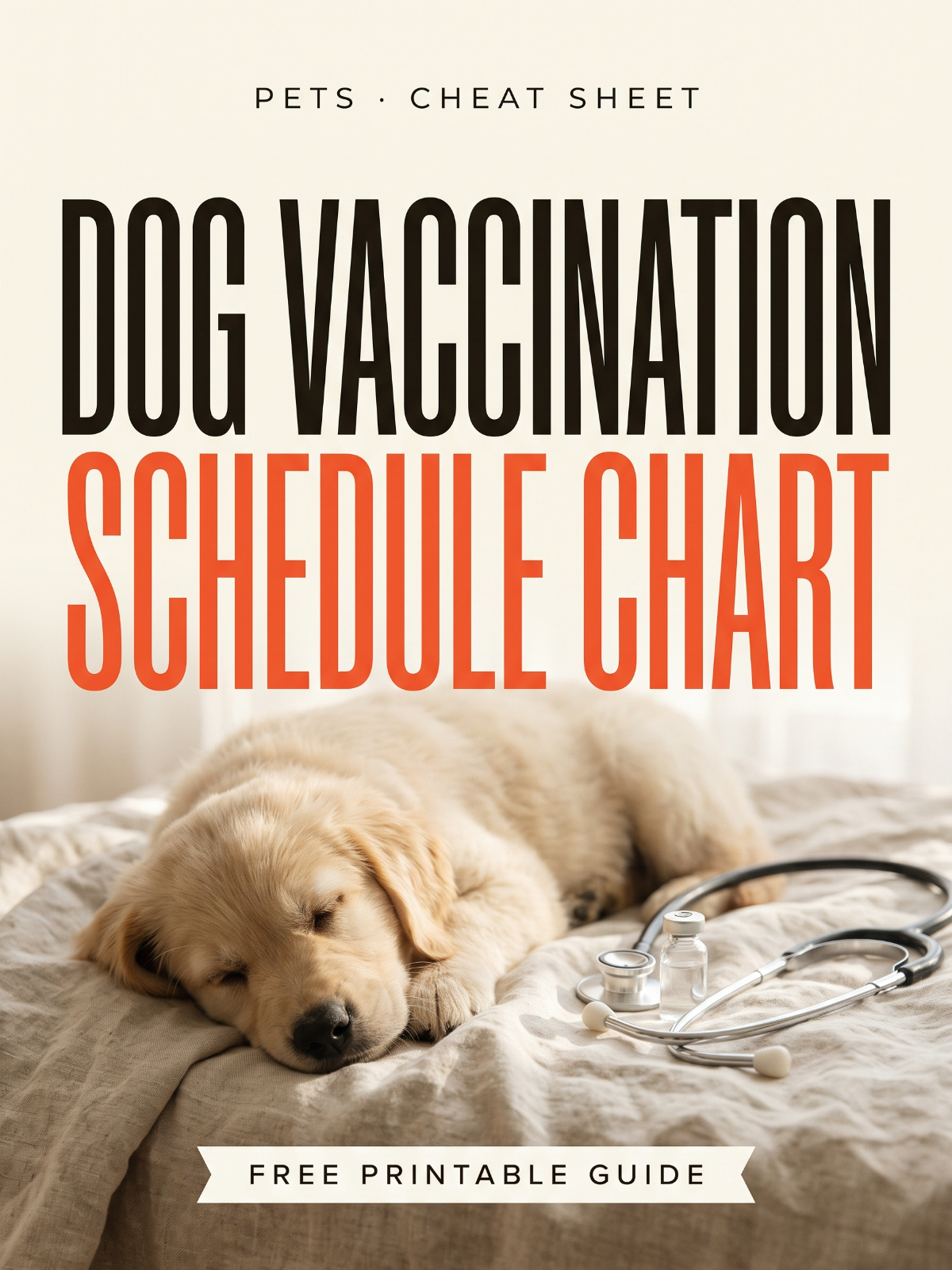
The full guide as a PDF
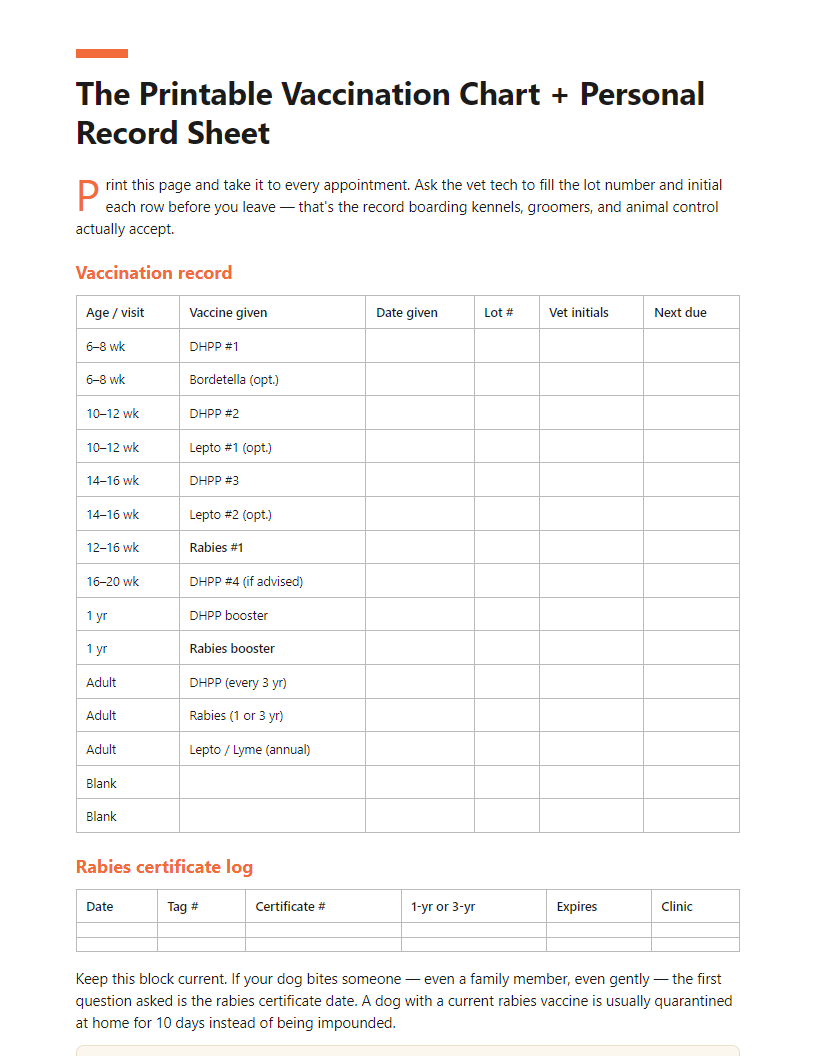
- ✓Printable vaccination chart with a fill-in record sheet for your dog's dates, clinic and lot numbers
- ✓Catch-up decision flow: what happens if a shot is 1, 3 or 8+ weeks late
- ✓Side-effect timeline table: normal hours 1–48 vs call-the-vet red flags
- ✓US cost ranges per vaccine and per visit, plus low-cost clinic options
- ✓Pre-appointment checklist of questions and records to bring
- ✓Unknown-history sheet for adopted and rescue dogs
- ✓QR link to the 2026 AAHA guideline updates
Hosted on FileJoker. Free download, no sign-up.
A look inside the PDF
11 sections · 18 pages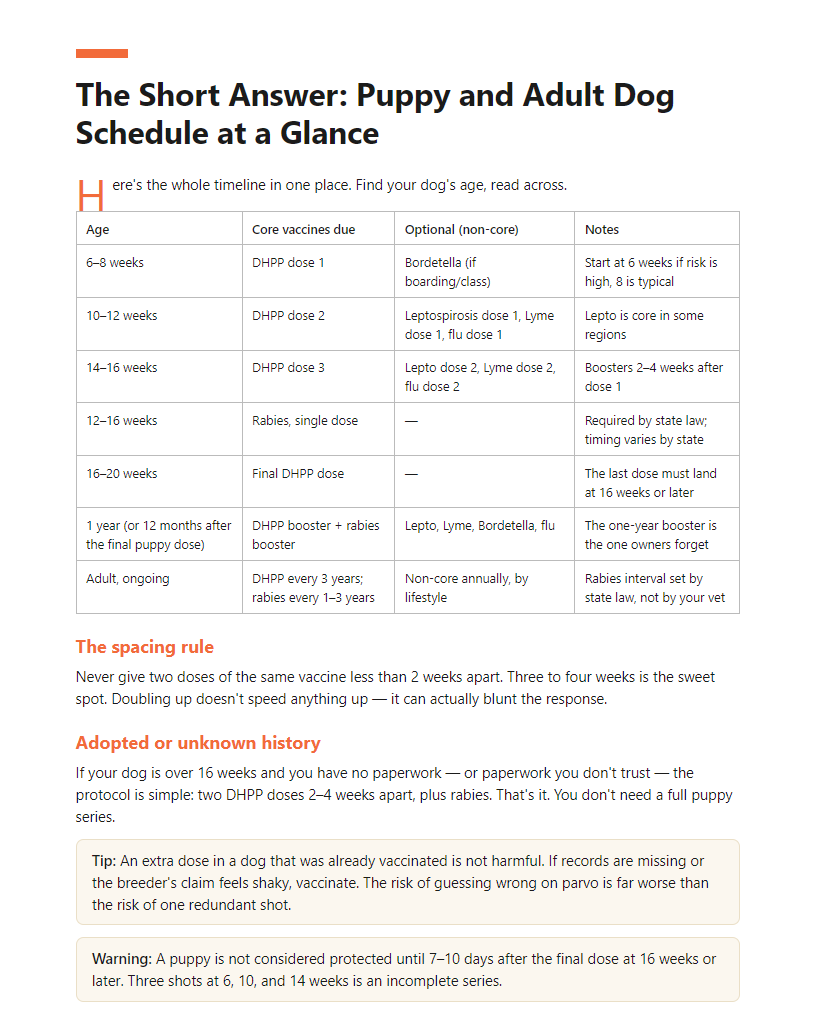
Full table of contents
- Why Most Vaccine Schedules Confuse Owners
- The Short Answer: Puppy and Adult Dog Schedule at a Glance
- Core vs Non-Core: What Every Dog Needs and What Depends on Lifestyle
- The Printable Vaccination Chart + Personal Record Sheet
- Step-by-Step: Catching Up After a Missed or Delayed Shot
- When Can the Puppy Go Outside? A Week-by-Week Exposure Plan
- Side Effects: Normal Timeline vs Call-the-Vet Signs
- Seven Mistakes That Leave Dogs Unprotected
- What Vaccines Actually Cost in the US (and How to Pay Less)
- Pre-Appointment Checklist
- Authoritative Sources and the 2026 Update Link
In this article
- The short answer
- Why Most Vaccine Schedules Confuse Owners
- The Short Answer: Puppy and Adult Dog Schedule at a Glance
- Core vs Non-Core: What Every Dog Needs and What Depends on Lifestyle
- When Can the Puppy Go Outside? A Week-by-Week Exposure Plan
- Seven Mistakes That Leave Dogs Unprotected
- Frequently Asked Questions
- Authoritative Sources and the 2026 Update Link
“I just want one page that tells me which shot my dog needs and when.” If you’ve been piecing together advice from your vet’s handout, a breeder’s note and three contradictory forums, this dog vaccination schedule chart puts it all in one place. You’ll see puppy shots from 6 weeks through the final booster, adult boosters by year, and which vaccines are core for every dog versus lifestyle-based add-ons you can reasonably discuss with your vet.
You’ll also learn when your puppy can safely walk outside. The free printable PDF adds a fill-in record sheet for your dog, catch-up steps after a missed shot, a side-effect timeline, and real US cost ranges.
The short answer
Standard dog vaccination schedule at a glance:
- 6–8 weeks: DHPP (distemper, hepatitis, parvo, parainfluenza) #1; optional Bordetella.
- 10–12 weeks: DHPP #2; start Leptospirosis and Lyme if lifestyle calls for it.
- 14–16 weeks: DHPP #3 plus rabies (final puppy dose no earlier than 16 weeks).
- 12 months (or 1 year after the last puppy dose): DHPP and rabies booster.
- Adults: DHPP and rabies every 1–3 years per label and state law; Lepto, Bordetella, Lyme and flu annually if at risk.
Always confirm intervals with your veterinarian.
Why Most Vaccine Schedules Confuse Owners
Ask three vets for a puppy schedule and you’ll get three slightly different handouts. That’s not sloppiness. Three separate systems are at work: AAHA’s vaccination guidelines (medical best practice), your state’s rabies law (a legal requirement that varies by state), and your vet’s read on your individual dog’s risk — where you live, where the dog goes, how old it is.
A printed chart can handle the first two. The third needs a conversation.
You need three things, and this guide gives you all three:
- An age timeline — which shot at which week, from 6 weeks through adulthood.
- A core vs non-core split — what every dog needs by law or by risk of death, and what depends on lifestyle.
- A record sheet — somewhere to write your own dog’s dates, clinic name, and next due date.
Where this comes from
This is a plain-English summary of AAHA and WSAVA vaccination guidance plus standard US rabies law practice. It is educational, not medical advice. Your veterinarian examines your dog; a PDF cannot. Schedules in this guide are written for the United States. Rabies rules and disease risk differ sharply in India, the Philippines, and elsewhere — use your national schedule there.
Guidelines get revised. Section 12 lists every source, and the PDF includes a QR link to check the 2026 AAHA update before you rely on these dates.
How to use the chart
Print it. Fill in what you know. Bring it to the appointment and ask your vet to correct it.
The Short Answer: Puppy and Adult Dog Schedule at a Glance
Here’s the whole timeline in one place. Find your dog’s age, read across.
| Age | Core vaccines due | Optional (non-core) | Notes |
|---|---|---|---|
| 6–8 weeks | DHPP dose 1 | Bordetella (if boarding/class) | Start at 6 weeks if risk is high, 8 is typical |
| 10–12 weeks | DHPP dose 2 | Leptospirosis dose 1, Lyme dose 1, flu dose 1 | Lepto is core in some regions |
| 14–16 weeks | DHPP dose 3 | Lepto dose 2, Lyme dose 2, flu dose 2 | Boosters 2–4 weeks after dose 1 |
| 12–16 weeks | Rabies, single dose | — | Required by state law; timing varies by state |
| 16–20 weeks | Final DHPP dose | — | The last dose must land at 16 weeks or later |
| 1 year (or 12 months after the final puppy dose) | DHPP booster + rabies booster | Lepto, Lyme, Bordetella, flu | The one-year booster is the one owners forget |
| Adult, ongoing | DHPP every 3 years; rabies every 1–3 years | Non-core annually, by lifestyle | Rabies interval set by state law, not by your vet |
The spacing rule
Never give two doses of the same vaccine less than 2 weeks apart. Three to four weeks is the sweet spot. Doubling up doesn’t speed anything up — it can actually blunt the response.
Adopted or unknown history
If your dog is over 16 weeks and you have no paperwork — or paperwork you don’t trust — the protocol is simple: two DHPP doses 2–4 weeks apart, plus rabies. That’s it. You don’t need a full puppy series.
Tip: An extra dose in a dog that was already vaccinated is not harmful. If records are missing or the breeder’s claim feels shaky, vaccinate. The risk of guessing wrong on parvo is far worse than the risk of one redundant shot.
Warning: A puppy is not considered protected until 7–10 days after the final dose at 16 weeks or later. Three shots at 6, 10, and 14 weeks is an incomplete series.
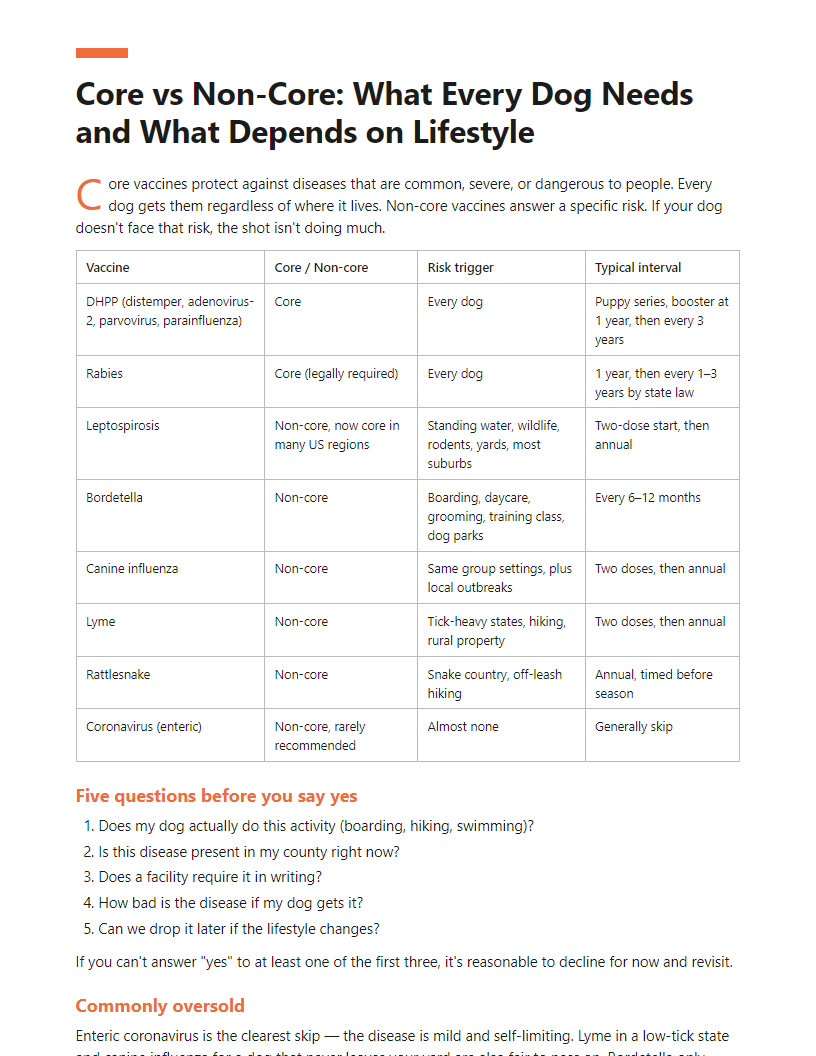
Core vs Non-Core: What Every Dog Needs and What Depends on Lifestyle
Core vaccines protect against diseases that are common, severe, or dangerous to people. Every dog gets them regardless of where it lives. Non-core vaccines answer a specific risk. If your dog doesn’t face that risk, the shot isn’t doing much.
| Vaccine | Core / Non-core | Risk trigger | Typical interval |
|---|---|---|---|
| DHPP (distemper, adenovirus-2, parvovirus, parainfluenza) | Core | Every dog | Puppy series, booster at 1 year, then every 3 years |
| Rabies | Core (legally required) | Every dog | 1 year, then every 1–3 years by state law |
| Leptospirosis | Non-core, now core in many US regions | Standing water, wildlife, rodents, yards, most suburbs | Two-dose start, then annual |
| Bordetella | Non-core | Boarding, daycare, grooming, training class, dog parks | Every 6–12 months |
| Canine influenza | Non-core | Same group settings, plus local outbreaks | Two doses, then annual |
| Lyme | Non-core | Tick-heavy states, hiking, rural property | Two doses, then annual |
| Rattlesnake | Non-core | Snake country, off-leash hiking | Annual, timed before season |
| Coronavirus (enteric) | Non-core, rarely recommended | Almost none | Generally skip |
Five questions before you say yes
- Does my dog actually do this activity (boarding, hiking, swimming)?
- Is this disease present in my county right now?
- Does a facility require it in writing?
- How bad is the disease if my dog gets it?
- Can we drop it later if the lifestyle changes?
If you can’t answer “yes” to at least one of the first three, it’s reasonable to decline for now and revisit.
Commonly oversold
Enteric coronavirus is the clearest skip — the disease is mild and self-limiting. Lyme in a low-tick state and canine influenza for a dog that never leaves your yard are also fair to pass on. Bordetella only matters if your dog mixes with other dogs.
Putting the risk in numbers
Skepticism is reasonable, so compare the two sides directly. The largest US study of vaccine reactions in dogs found roughly 38 adverse events per 10,000 doses given — about 0.4%, and most were mild swelling, soreness, or a day of lethargy. Serious reactions are a small fraction of that.
Now the disease side. Untreated parvovirus kills around 90% of infected puppies; with intensive hospital care, survival is roughly 80–90%, at a cost that usually runs into the thousands. Distemper has no cure. Rabies is close to 100% fatal and transmissible to you.
That’s the trade: a small chance of a sore shoulder against a large chance of death from a disease that is cheap to prevent. The honest argument against over-vaccination isn’t “skip core shots” — it’s “don’t repeat them more often than the label and local law require.”
Titer testing
A titer measures antibodies for distemper, adenovirus, and parvovirus. Labs report a protective threshold; a result at or above it supports skipping a DHPP booster in an adult dog. It cannot replace rabies: state law counts doses, not antibody levels. Cost is the catch — titers typically run $50–150, against $25–60 for the DHPP booster itself.
When Can the Puppy Go Outside? A Week-by-Week Exposure Plan
Full protection arrives about 1–2 weeks after the final DHPP dose, given at 16 weeks or older. For most puppies that means roughly 17–18 weeks before open-access walks and dog parks are reasonable. But waiting until then to socialize is its own risk.
The exposure timeline
| Puppy age | Safe now | Use caution | Still wait |
|---|---|---|---|
| 8–10 wks (1 dose) | Carried outings, your own yard, clean homes of friends with vaccinated dogs | Private yards of known, vaccinated dogs | All public ground, pet stores, parks |
| 10–12 wks (2 doses) | Same as above, plus puppy class with proof-of-vaccination | Quiet, paved areas not used by dogs — carried or brief | Grass strips, rest stops, trails |
| 12–16 wks (3 doses) | Puppy class, vaccinated adult dog playdates, car rides, sidewalk sitting in a carrier | Low-traffic concrete sidewalks on leash | Dog parks, pet store floors, communal grass |
| 16 wks to +1 week after final dose | Everything from the row above | Longer leash walks on paved, low-traffic routes | Dog parks, pet store floors, communal grass |
| 1–2 weeks after final dose | Everything — walks, trails, dog parks, pet stores | — | Nothing |
What “carried” buys you
Yes — you can take an 8-week-old puppy to the store parking lot in your arms. Carried outings give sights, sounds, traffic noise, strangers, and elevator rides with no ground contact. That covers most of what early socialization needs.
Avoid these specifically
Dog parks, pet store floors, highway rest stops, shared apartment grass, and any spot with unknown dogs’ feces. Parvovirus survives in soil for months and resists most household cleaners.
Warning: The AVSAB Position Statement on Puppy Socialization (2008) states that “more dogs under three die of behavior problems than of infectious disease.” Total isolation until 18 weeks misses the prime socialization window, which closes around 12–14 weeks.
Puppy classes
A class that requires proof of at least one DHPP dose plus deworming, held on a cleanable floor, is the safest structured socialization you can buy. Ask what their vaccination policy is before you enroll.
Seven Mistakes That Leave Dogs Unprotected
1. Stopping the series at 12 weeks
Two or three doses isn’t a finished series. The final dose must land at 16 weeks or later (see the schedule in section 2).
2. Doubling up or crowding doses together
Same-vaccine doses need 2 weeks minimum, 3–4 weeks standard (see section 5, step 3). Two different vaccines on the same day is fine.
3. Treating a rabies tag as a certificate
The tag on the collar proves nothing on its own. Boarding kennels, airlines, and animal control want the signed certificate showing the vaccine’s lot number and expiration date.
After a bite, that certificate decides what happens next. With a current one, most jurisdictions allow a 10-day home quarantine. Without it, your dog may be impounded at your expense, and the quarantine runs longer. Keep the certificate with your record sheet, not in a drawer.
Warning: A vaccinated dog can still carry rabies virus in saliva in rare cases. Any bite to a person gets reported and medically evaluated, no matter the vaccine status.
4. Saying yes — or no — to non-core by reflex
Ask one question before each non-core shot: does my dog actually meet this exposure? (Full decision rule in section 3.) The common error in both directions is leptospirosis — refused out of habit by owners who live exactly where it circulates.
5. Letting the 1-year booster lapse
This one costs you three years. Miss the 12-month rabies booster and most states treat the next shot as a first dose again — your dog gets a 1-year vaccine, not a 3-year one, and only qualifies for the 3-year interval after that. A lapse of a few weeks can mean two extra clinic visits and two extra fees over the next four years. Check your state’s exact lapse rule; it’s set by law, not by your vet.
6. Walking an under-vaccinated puppy in high-traffic spots
Parvo survives in soil for months. Socialize on the schedule in section 6, not at the dog park.
7. Losing the paperwork
No record means no proof, and no proof usually means re-vaccination. Clinics keep files, but they close, merge, and purge old records. You are the backup.
Tip: Photograph every certificate the day you get it and email it to yourself with the dog’s name in the subject line. It’s searchable from your phone at the boarding desk.
Frequently Asked Questions
What is the recommended vaccine schedule for a dog?
Puppies: DHPP every 2–4 weeks from 6–8 weeks until at least 16 weeks of age, rabies at 12–16 weeks (check your state’s minimum age), then a booster of both at roughly 12 months. Adult dogs with unknown history: two DHPP doses 2–4 weeks apart, one rabies, then boosters. After that, DHPP and rabies run on a three-year cycle for most dogs. The full age-by-age table is in section 2, and the printable version is in the chart.
How do I check whether these dates are still current?
Go to aaha.org and open the canine vaccination guidelines page. The publication or revision date sits at the top — compare it to the date printed on your chart. AAHA also hosts a lifestyle-based vaccine calculator on the same site, which reflects the current version. For rabies intervals, check your own state’s law separately, since state rules override general guidance. Don’t rely on a blog post, including this one, as the live source. Section 12 has the direct links.
What vaccines do dogs really need every year, and which are every 3 years?
| Vaccine | Typical adult interval |
|---|---|
| DHPP (distemper, adeno, parvo, parainfluenza) | Every 3 years |
| Rabies | Every 3 years (1 year in some states and for the first adult dose) |
| Leptospirosis | Annually |
| Bordetella | Every 6–12 months |
| Canine influenza, Lyme | Annually |
The annual ones are annual because immunity is shorter, not because they’re optional extras.
Which dog vaccines can I skip?
None of the core ones — DHPP and rabies. Rabies is also a legal requirement in every US state. Non-core vaccines are a risk decision: a dog that never boards, never swims, and never hikes may not need Bordetella, lepto, or Lyme. Ask your vet to name the specific exposure each one covers, then decide.
If my vaccinated dog bites someone, are they safe from rabies?
Not automatically. A current rabies vaccine makes transmission very unlikely, but the bitten person still needs medical care and the bite still gets reported. Your dog will typically be observed for 10 days. Proof of a current rabies certificate usually means home quarantine instead of impoundment — that’s the legal protection it buys you.
Do schedules differ outside the US?
The core puppy series is the same worldwide. What changes is rabies: in India and the Philippines, rabies is endemic, so vaccination often starts earlier and is boosted annually. The UK uses a similar DHP series with lepto, and rabies only for travel. Follow your national veterinary association’s schedule for intervals.
Authoritative Sources and the 2026 Update Link
Don’t take this chart on faith. Every recommendation here traces back to one of four free, public documents. Read them yourself.
- AAHA Canine Vaccination Guidelines (aaha.org) — the US standard for core and non-core timing. The site also hosts a free Vaccine Calculator: enter your dog’s age, location, and lifestyle and it returns a dose-by-dose plan you can print and compare to your vet’s handout.
- WSAVA Vaccination Guidelines (wsava.org) — written for a global audience and available in several languages. If you’re in India, the Philippines, or anywhere outside North America, use this one. Local rabies law and disease pressure differ, so pair it with your national veterinary council’s rules.
- AVMA (avma.org) — plain summaries plus links to each state’s rabies statute, which sets the legal 1-year vs 3-year interval.
- AVSAB Position Statement on Puppy Socialization — the source for starting classes before the series ends.
Each AAHA guideline publishes its authors’ funding and conflict-of-interest disclosures in the front matter — read that list and judge for yourself. The documents are free either way: no paywall, no brand gate.
2026 update: scan the QR code for the page tracking AAHA’s next revision.
- ✓Printable vaccination chart with a fill-in record sheet for your dog's dates, clinic and lot numbers
- ✓Catch-up decision flow: what happens if a shot is 1, 3 or 8+ weeks late
- ✓Side-effect timeline table: normal hours 1–48 vs call-the-vet red flags
- ✓US cost ranges per vaccine and per visit, plus low-cost clinic options
- ✓Pre-appointment checklist of questions and records to bring
- ✓Unknown-history sheet for adopted and rescue dogs
- ✓QR link to the 2026 AAHA guideline updates
Frequently asked questions
What is the recommended vaccination schedule for a dog?
Puppies get DHPP every 2–4 weeks from 6–8 weeks of age until at least 16 weeks, usually three or four doses, plus rabies at 12–16 weeks. A booster follows at roughly one year. After that, most adult dogs receive DHPP and rabies every three years, with Leptospirosis, Bordetella, Lyme or canine influenza given annually when lifestyle or regional risk justifies them.
Has the dog vaccine schedule changed for 2026?
The core framework is stable: DHPP and rabies remain core, with the final puppy dose at 16 weeks or later and triennial adult boosters. Updates in recent AAHA guidance focus on risk-based use of Leptospirosis (now recommended for most dogs in many regions), serology options and revised intervals for non-core products. Check the 2026 link in our sources section before your appointment.
What vaccines does a dog actually need every year?
Core vaccines — DHPP and rabies — are generally given every three years after the one-year booster, not annually. The genuinely annual shots are non-core, lifestyle-based ones: Leptospirosis, Bordetella, canine influenza and Lyme. If your clinic recommends yearly DHPP, ask whether a three-year product or antibody titer test fits your dog instead.
Which dog vaccines can I skip?
Rabies is legally required nearly everywhere and can't be skipped. DHPP protects against diseases with high mortality, so skipping is not advised. Non-core vaccines are the discussable ones: Bordetella matters mainly for boarding, daycare and grooming; Lyme for tick-heavy regions; influenza for group settings. Skip based on genuine low exposure, not convenience — and revisit if your dog's routine changes.
What should I do if we missed or delayed a vaccination?
Don't restart from zero in most cases. If a puppy dose is more than 2–3 weeks late, your vet typically continues the series rather than beginning again, still finishing at 16 weeks or later. For adults overdue on boosters, a single dose usually restores protection, though rabies rules vary by state. Book promptly and limit high-risk exposure meanwhile.
We collected 78 real questions and comments about "dog vaccination schedule chart" (19 from YouTube comments, 4 from People Also Ask, 55 from search suggestions), grouped them into 11 recurring problems, and built this guide to resolve the 7 that block people most. The top-ranking pages were reviewed for gaps; 7 of those gaps became dedicated sections.
Edited by Alex Hirn · Last updated October 20, 2026 · How we make our guides
More in Pets
 free
 free
 premium+1 bonus
 premium+1 bonus