Checklist · 28-page PDF · Premium
Checklist for First Apartment: Essentials, Costs and Move-In Timeline
A room-by-room checklist for first apartment moves with real costs, rent-to-income benchmarks and a budget tracker. See what to buy first — and what can wait.
The full workbook, ready to print
- ✓8-week move timeline with weekly task lists
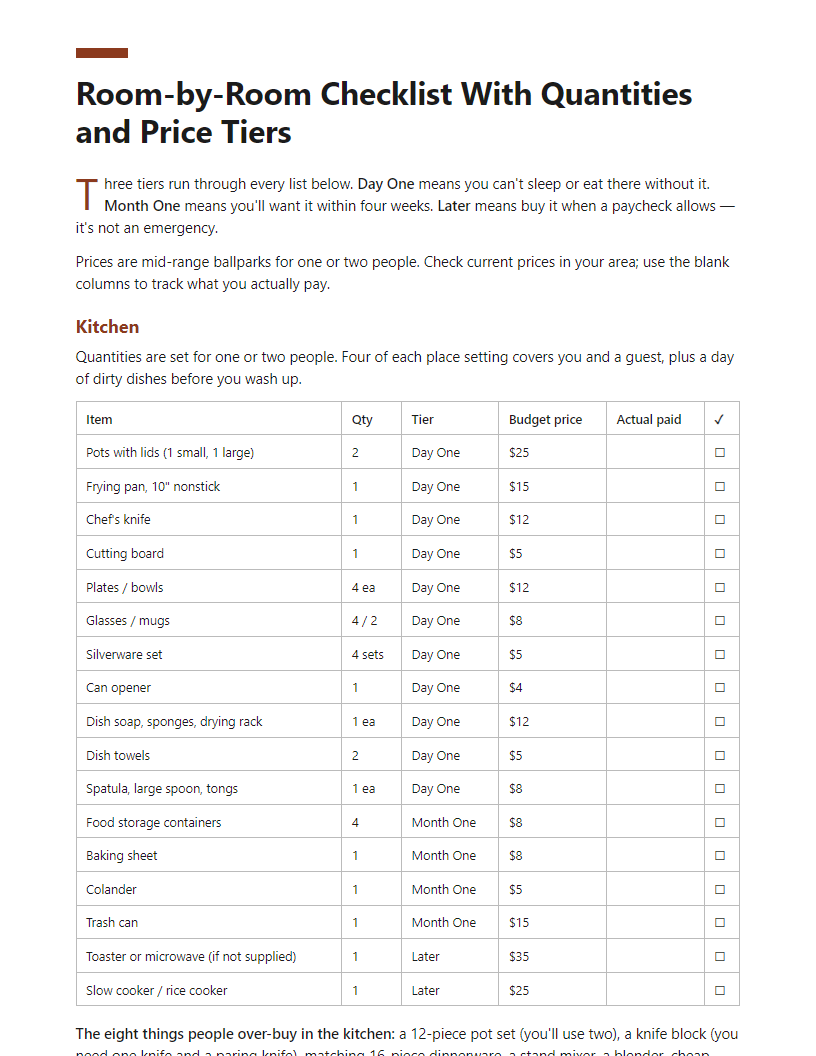
- ✓Room-by-room checklist with quantities and three price tiers
- ✓Hidden-fee move-in cost sheet (application, pet, amenity, deposit)
- ✓Budget tracker for purchases with running totals
- ✓No-cosigner approval packet template and document list
- ✓Sourcing comparison table: dollar store vs thrift vs marketplace vs new
- ✓Rent affordability worksheet with income benchmarks
Hosted on FileJoker. Premium members download instantly; free download has a wait.
In a hurry? Free one-page checklist41 items to tick off · print-ready PDF, no sign-upDownload freeIncluded bonuses — free with the guide
2 extra guides from the same topic Free PDF · 17 pagesFridge Organization Chart: The Right Shelf for Every FoodUse this fridge organization chart to store food in the right zone, cut waste and keep produce fresh. Free printable poster plus 10-minute reset checklist.
 Free PDF · 21 pagesThe Checklist for Decluttering Your Home, Room by RoomChecklist for decluttering your whole home, room by room. Free printable with 125 points, decision scripts and a progress tracker. Grab it free.
A look inside the PDF
10 sections · 28 pages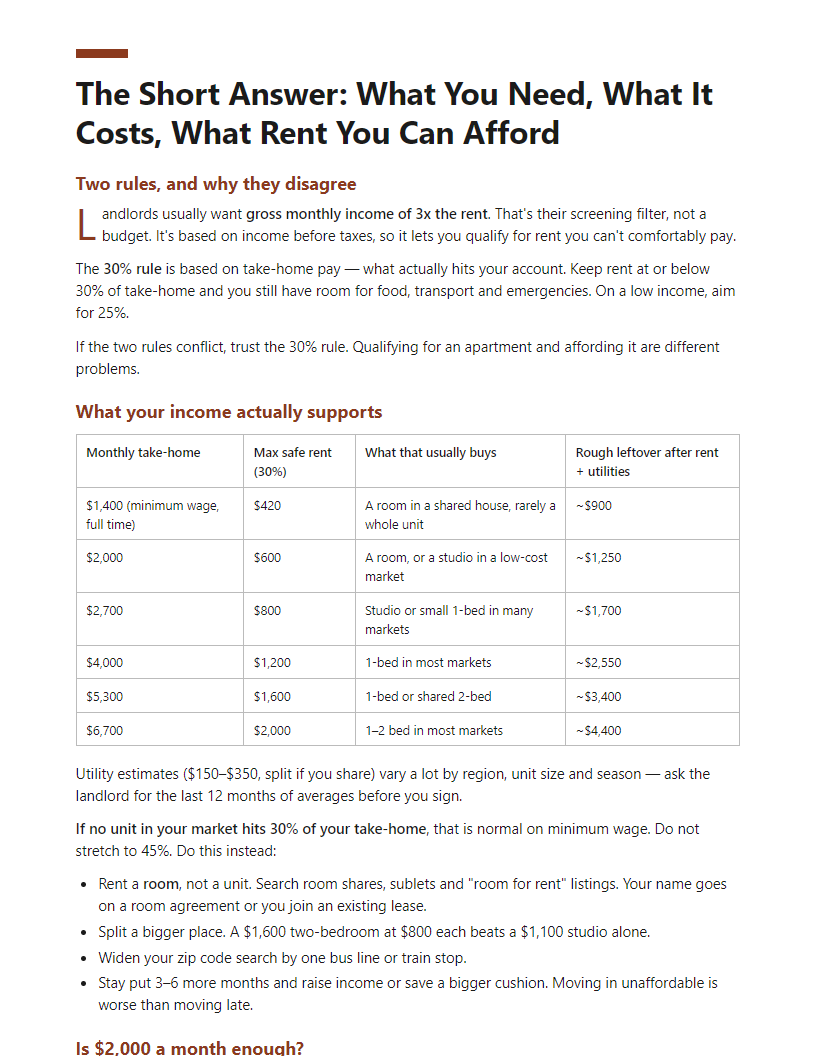
Full table of contents
- Why Most First-Apartment Lists Fail You
- The Short Answer: What You Need, What It Costs, What Rent You Can Afford
- Getting Approved With No Cosigner, Thin Credit, or Hard-to-Prove Income
- The Real Move-In Cost Sheet: Hidden Fees and the Money Timeline
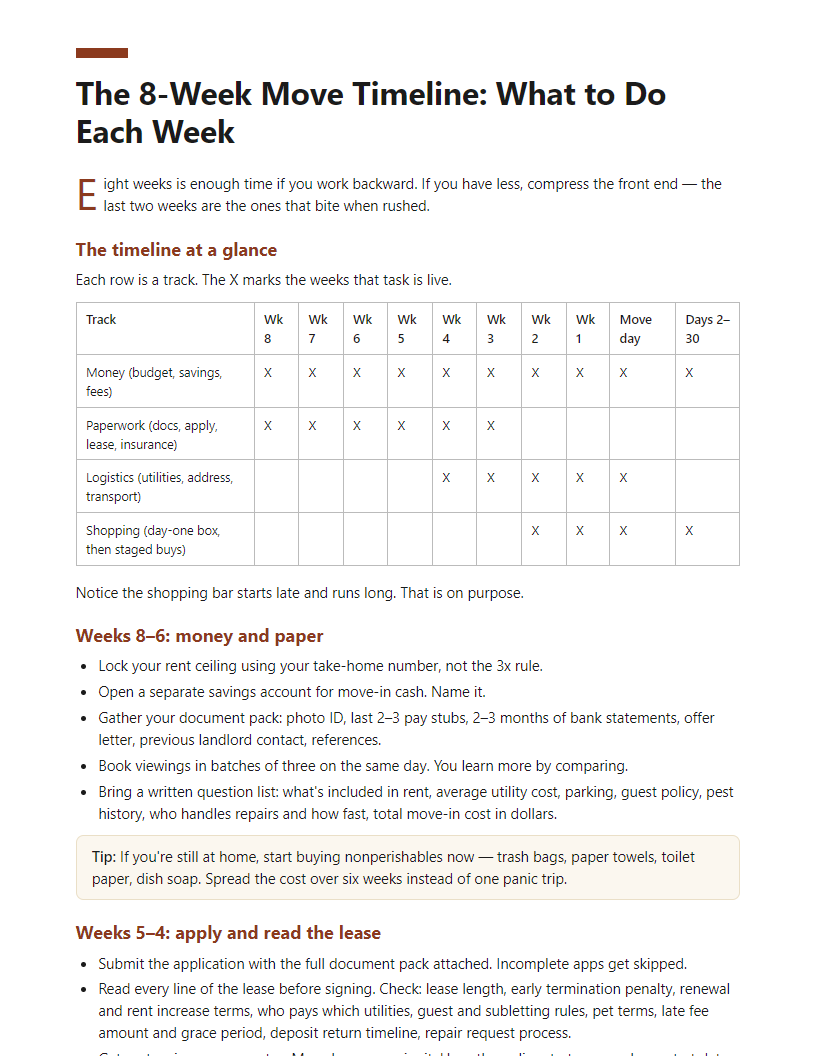
- The 8-Week Move Timeline: What to Do Each Week
- Room-by-Room Checklist With Quantities and Price Tiers
- Sourcing Smart: Dollar Store vs Thrift vs Marketplace vs New
- Moving Out Alone Without Family Support: The Mental Prep Plan
- Nine Mistakes That Cost First-Time Renters the Most Money
- Worksheets, Trackers and Next Steps
In this article
You’ve found a place — or you’re close — and now you’re staring at a blank list wondering what you actually need, what you can afford on your income, and how you’ll get approved without a cosigner. This checklist for first apartment moves answers all three. You’ll get the true essentials (not a 300-item wish list), honest cost ranges, the rent tier your paycheck can realistically carry, and the small items people always forget: trash bags, toilet paper, a shower curtain liner, a plunger.
The premium PDF goes further: an 8-week move timeline, a room-by-room checklist with quantities and price tiers, a hidden-fee cost sheet, and a budget tracker you can fill in as you buy.
The short answer
For a first apartment, work in this order:
- Sleep — bed or mattress, pillow, two sheet sets.
- Bathroom — towels, shower curtain and liner, toilet paper, plunger, cleaner.
- Kitchen — pot, pan, knife, cutting board, two of each dish and utensil.
- Cleaning and safety — trash bags, all-purpose spray, broom, first-aid kit, flashlight.
- Admin — renters insurance, utility setup, lock check.
Budget roughly $600–$1,200 for essentials and keep rent plus utilities near 30% of take-home pay. Sofas, decor and extras come later.
Why Most First-Apartment Lists Fail You
Most “first apartment checklist” posts are a list of 150 things to buy. They don’t tell you what any of it costs, when to buy it, or how you’re getting approved for the place in the first place. That’s why people move in with a shower curtain and no trash bags.
A first apartment actually costs you in three stages:
- Approval — proving you can pay, often with thin credit and no cosigner.
- Move-in cash — deposit, first month, fees you didn’t see coming.
- The first 30 days of invisible supplies — toilet paper, dish soap, a trash can, a can opener, light bulbs. Small items, real money.
This workbook ties every item to a week and a dollar amount. You’re not reading a shopping list. You’re filling in three connected tools: a room-by-room checklist, a budget tracker, and an 8-week timeline. Each one feeds the next.
Pick your path
| Your situation | Start here |
|---|---|
| Moving in 8+ weeks | Section 2, then follow the full timeline in Section 5 |
| Moving in under 3 weeks | Section 2 and Section 4 (costs), then the “Week 1–2” blocks of Section 6 |
| Already moved in, short on stuff | Section 6 checklists, then Section 7 for cheap sourcing |
What you’ll fill in
- Affordability worksheet — the real rent number your income supports.
- Hidden-fee tally — application, admin, pet, utility setup, renters insurance.
- Room checklists — kitchen, bedroom, bathroom, cleaning, with quantities.
- Purchase tracker — what you bought, where, what you paid, what’s still missing.
One note on timing
August and September are peak moving months, when students and families move at once. Expect more competition for units, fewer concessions, and higher prices on movers and trucks. If you can sign for an October–February move-in, you usually get more room to negotiate.
If the idea of doing this alone makes your chest tight, that’s normal. Nobody is yelling at you here. Work one week at a time, and let the checkboxes carry the parts your brain can’t hold.
The Short Answer: What You Need, What It Costs, What Rent You Can Afford
Two rules, and why they disagree
Landlords usually want gross monthly income of 3x the rent. That’s their screening filter, not a budget. It’s based on income before taxes, so it lets you qualify for rent you can’t comfortably pay.
The 30% rule is based on take-home pay — what actually hits your account. Keep rent at or below 30% of take-home and you still have room for food, transport and emergencies. On a low income, aim for 25%.
If the two rules conflict, trust the 30% rule. Qualifying for an apartment and affording it are different problems.
What your income actually supports
| Monthly take-home | Max safe rent (30%) | What that usually buys | Rough leftover after rent + utilities |
|---|---|---|---|
| $1,400 (minimum wage, full time) | $420 | A room in a shared house, rarely a whole unit | ~$900 |
| $2,000 | $600 | A room, or a studio in a low-cost market | ~$1,250 |
| $2,700 | $800 | Studio or small 1-bed in many markets | ~$1,700 |
| $4,000 | $1,200 | 1-bed in most markets | ~$2,550 |
| $5,300 | $1,600 | 1-bed or shared 2-bed | ~$3,400 |
| $6,700 | $2,000 | 1–2 bed in most markets | ~$4,400 |
Utility estimates ($150–$350, split if you share) vary a lot by region, unit size and season — ask the landlord for the last 12 months of averages before you sign.
If no unit in your market hits 30% of your take-home, that is normal on minimum wage. Do not stretch to 45%. Do this instead:
- Rent a room, not a unit. Search room shares, sublets and “room for rent” listings. Your name goes on a room agreement or you join an existing lease.
- Split a bigger place. A $1,600 two-bedroom at $800 each beats a $1,100 studio alone.
- Widen your zip code search by one bus line or train stop.
- Stay put 3–6 more months and raise income or save a bigger cushion. Moving in unaffordable is worse than moving late.
Is $2,000 a month enough?
Depends whether that’s take-home or gross, and where you live. Here’s $2,000 take-home in a low-cost area with rent at $700 (studio or a room in a shared place):
- Rent: $700
- Utilities + internet: $140
- Phone: $45
- Groceries: $300
- Transport (bus pass or gas + insurance): $220
- Renters insurance: $15
- Household supplies, laundry: $60
- Left: about $520 for debt, savings, medical, everything else
It works — barely — if rent stays near $700. At $1,200 rent, the same income leaves you about $20. That’s not a budget, that’s a countdown.
Total cash to get in the door
Move-in cash is almost always more than first month’s rent. Plan for:
| Low | Mid | High | |
|---|---|---|---|
| Security deposit | $0 (deposit-free) | 1 month | 2 months |
| First month’s rent | 1 month | 1 month | 1 month |
| Application + admin fees | $40 | $100 | $250 |
| Utility setup deposits | $0 | $100 | $300 |
| Starter supplies + furniture | $300 | $800 | $1,800 |
On $1,000 rent, that’s roughly $1,340 at the low end, $3,000 mid, $5,350 high. Save toward the mid number.
The 40 items you need on day one
These are the Day One items from the room-by-room checklist later in this guide — same list, same tiers, just stripped to names. That later section is the expanded version, with quantities, prices and check boxes.
- Sleep (5): mattress, mattress protector, sheet set, pillow, blanket
- Bathroom (7): toilet paper, shower curtain + liner + rings, bath towel, hand towel, hand soap, plunger, bath mat
- Kitchen (14): pot, skillet, spatula, wooden spoon, chef’s knife, cutting board, can opener, 2 plates, 2 bowls, 2 cups, silverware set, dish soap, sponge, dish towel
- Cleaning (5): all-purpose spray, paper towels, broom, trash bags, laundry detergent
- Light, power and tools (9): lamp, lightbulbs, blackout curtains, surge protector, phone charger, flashlight, batteries, screwdriver set, tape measure
Three common items are not on this list on purpose: trash can, first-aid kit and fire extinguisher. They’re Month One. A grocery bag holds trash for a week.
Moving Out Alone Without Family Support: The Mental Prep Plan
Moving out alone is a logistics problem and a nervous-system problem at the same time. One reader put it plainly: “I am very anxious and miserable when I am by myself… I want to have my own place full of plants and cats.” Both things can be true. Prep for the feelings the same way you prep for the deposit.
Name the fear, then defuse it
| The fear | The action that defuses it |
|---|---|
| “I won’t make rent.” | Know your exact break-even number: rent + utilities + phone + transit + groceries. Write it down. Compare it to your take-home pay, not your gross. |
| “Something will break and I can’t fix it.” | Save the landlord’s maintenance number in your phone before move-in day. Learn where the water shutoff and breaker box are during your walkthrough. |
| “I’ll be alone if something goes wrong.” | Build the support list below. Four names is enough. |
| “I’m doing this wrong and everyone else knows how.” | Nobody’s first apartment is finished. Half-furnished and paid for beats fully furnished and behind on rent. |
Build your support list before key handover
Write these four down and keep them on your fridge:
- One emergency contact who answers the phone at 2 a.m.
- One local clinic or urgent care — address, hours, and whether they take your insurance.
- One neighbor you’ve said hello to. That’s the whole requirement.
- One friend within 30 minutes who could show up if you’re sick, locked out, or falling apart.
Tip: If family isn’t on this list, that’s normal for a lot of people reading this. A coworker, an old roommate, or a friend’s parent counts.
The first-night ritual
Unpacking everything on night one is how you end up at 1 a.m. crying over a box of silverware. Do three things, then stop:
- Make the bed. Sheets, pillow, blanket. Fully made.
- Set up the bathroom. Toilet paper, soap, towel, toothbrush, shower curtain.
- Eat one hot meal. Takeout is fine. Sitting down to eat in your own place changes how it feels.
Everything else waits until morning.
Money anxiety protocol
- Set a low-balance alert on your checking account. Pick a number that gives you a week of warning, not a day.
- Target a starter emergency fund of one month’s rent. Build it in $20 chunks. Having $300 saved removes more anxiety than $300 of furniture adds.
- If rent will be late, call your landlord before the due date, not after. Propose a specific date you’ll pay. Late-and-silent is what gets people evicted; late-and-communicating usually doesn’t.
Weeks 2 through 6
The novelty wears off around week two. That gap is where loneliness lands.
- Keep one fixed routine — same wake time, a weekly grocery run, a walk after work.
- Commit to one recurring social thing: a class, a shift with coworkers, a standing video call.
- If low mood lasts more than two weeks, you stop eating or sleeping normally, or you’re isolating on purpose, talk to a clinic or a counselor. That’s a practical fix, not a failure.
Nine Mistakes That Cost First-Time Renters the Most Money
1. Signing before you read the fee schedule and the break-lease clause
“All the fees these places add on is crazy” — that reaction comes from reading the fees after signing. Ask for the full fee schedule in writing before you apply. Then find the early-termination clause. Two months’ rent plus forfeited deposit is common, and that’s the number you’re on the hook for if a job falls through.
2. Buying furniture before you measure
Measure the doorway, the hallway turn, the stairwell, the elevator, and the wall where the thing is going. Write the numbers in your phone. A couch you can’t get through the door is a total loss — you rarely get the delivery fee back, and private-sale furniture is never refundable.
3. Spending the whole budget in week one
The expensive mistake isn’t the sofa. It’s being broke on day four with no trash bags, toilet paper, cleaning supplies, soap, or paper towels. One renter listed exactly that: “it was the little things I didn’t think of that screwed me.” Hold back $150 of your furnishing budget for the boring consumables run.
4. Buying nice instead of buying complete
Go cheap, get in, upgrade on later paychecks. A $5 dollar-store set of silverware works as well as a $40 one while you’re still missing a shower curtain. Half-furnished and broke is worse than fully furnished and basic.
5. Skipping move-in condition photos
A security deposit is often a full month’s rent, and you lose it over scuffs that were there before you arrived. Run the move-in photo protocol in s4 on day one, before you unpack a single box.
6. Paying an online vendor for pay stubs or bank statements
It’s fraud, verification is routine, and you lose the application fee and the unit. See the full warning in s3, and use the alternative-documents list there instead.
Warning: The same caution applies to “guarantor services” with no license, no physical address, and payment by Cash App or Zelle. Confirm your landlord already accepts that specific company before you send money.
7. Renting at the absolute top of your approval limit
Approval at 3x rent is the landlord’s filter, not your budget. If you’re approved for $1,200 and take it, utilities, renters insurance, and the parking fee land on top of a payment you can barely make. Rent below your ceiling and keep the gap as your utility buffer. One slow month at work shouldn’t put you behind on rent.
8. Taking a used mattress or curbside upholstery without inspection
Bed bugs travel in mattresses, box springs, and soft furniture. A treatment can run into the hundreds and your lease may make you pay for it. Buy the mattress new — a budget one is the one Day One item worth full price. Hard surfaces off the curb are fine; fabric is not.
9. Rent-to-own furniture stores
The weekly payment looks small. Over the full term you often pay double or more the sticker price, and you own nothing if you miss payments. The store can repossess the set you’ve already paid $900 toward. Thrift, Marketplace, and a slow build beat it every time.
First Apartment FAQ
What do you actually need for your first apartment?
Around 40 items, not 150. Bed and bedding. Towels. Shower curtain and liner. Toilet paper, trash bags, trash can. One pot, one pan, one sheet pan. A knife, cutting board, spatula, can opener. Two plates, two bowls, two mugs, two sets of silverware. Dish soap, sponge, dish rack. All-purpose cleaner, paper towels, toilet brush, plunger. Laundry detergent and a hamper. Light bulbs, a lamp if the room has no overhead light, a power strip, a basic tool kit, batteries. A first-aid kit and a fire extinguisher. Everything else — couch, coffee table, matching dishes — can wait a paycheck or three.
Is $2,000 a month enough for an apartment?
It depends entirely on your market, and on whether that $2,000 is take-home or gross. Run the math instead of guessing.
Section 2 works the full example: $2,000 take-home with rent at $700 in a low-cost area leaves about $520 a month after utilities, phone, groceries, transport, insurance and household supplies. That’s the only version of this budget in the guide — use it as your template and swap in your own numbers.
The thing that breaks it is rent. At $700 it works, barely. Push rent higher in a pricier market and the leftover disappears fast. At $2,000 take-home, one person can live alone in a cheap market and will need a roommate in an expensive one. That’s not a failure. Splitting a 2-bed usually costs less per person than any studio in the same zip code, and it halves utilities too. Check current rents in your actual neighborhood before you decide.
What are the essentials room by room?
Bedroom: mattress, sheets, pillow, blanket, blackout curtains, lamp. Bathroom: shower curtain + liner + rings, bath mat, two towels, toilet paper, plunger, toilet brush. Kitchen: pot, pan, sheet pan, knife, cutting board, two of each dish item, dish soap, sponge, trash can. Living room: one seat, one light, a power strip. Laundry/cleaning: detergent, all-purpose spray, broom or vacuum, paper towels, trash bags.
What should I know before signing my first lease?
Six things, in order:
- The full fee schedule — application, admin, pet, parking, trash, valet trash, insurance. Ask in writing before you apply.
- What’s included in rent and what you pay separately. Gas, electric, water, internet.
- The break-lease clause. What does leaving early actually cost?
- Renters insurance requirements. Usually required, usually $10–20 a month.
- Move-in documentation. Photograph and video every room before you unpack. That’s your deposit.
- Who fixes what, and how fast. Get the maintenance process in writing.
What if I have no credit and no cosigner?
You still have options. Lead with income: offer 2–3 months of pay stubs, bank statements, and an offer letter if you’re new to a job. Target private landlords and small owners over large management companies — they screen with judgment, not software. Offer a larger deposit or prepaid rent if you can. Bring a rental résumé with prior landlord references and on-time payment proof (utilities, phone, rent payments). A roommate who does qualify can carry the application.
How much should I save before moving out?
Move-in costs plus one month of living expenses as a buffer. Practically: first month’s rent, deposit (often one month), application and admin fees, utility deposits, plus the Day One starter kit. Budget $750–$900 for that kit at the mid-range prices used in Section 6, or $400–$500 for a secondhand-only version — thrift and marketplace finds for the bulky items, new for anything that touches your body or your food. Then one more month of rent sitting untouched.
- ✓8-week move timeline with weekly task lists
- ✓Room-by-room checklist with quantities and three price tiers
- ✓Hidden-fee move-in cost sheet (application, pet, amenity, deposit)
- ✓Budget tracker for purchases with running totals
- ✓No-cosigner approval packet template and document list
- ✓Sourcing comparison table: dollar store vs thrift vs marketplace vs new
- ✓Rent affordability worksheet with income benchmarks
Frequently asked questions
What do you actually need for your first apartment?
Far less than most lists claim. Day one you need a place to sleep, a working bathroom, one pot and pan, two plates, two sets of utensils, towels, bedding, cleaning supplies, trash bags and toilet paper. Add a shower curtain liner, plunger, basic tool kit and a flashlight. Everything else — sofa, dining table, decor, small appliances — can wait until you've lived there a few weeks and know what you actually use.
Is $2,000 a month enough for an apartment?
It can be, outside high-cost metros. The common rule is rent at or below 30% of gross pay, so $2,000 a month supports roughly $600 rent — tight for a solo one-bedroom in most cities but workable with a roommate or in a lower-cost area. Many landlords also want income of 2.5–3x the rent. Budget utilities, internet, groceries and transport before deciding; those often add $400–$600 monthly.
What are the true essentials for a first apartment?
Essentials are the items that make the place livable and safe: bed and bedding, towels, shower curtain and liner, toilet paper, a pot, pan, knife, cutting board, dishes, utensils, cleaning spray, sponges, broom, trash can and bags, light bulbs, a basic tool kit, first-aid supplies and a flashlight. Renters insurance counts too — it's usually $10–$20 a month and often required by the lease.
How do I get approved with no cosigner or credit history?
Lead with proof you can pay. Offer a larger deposit or two to three months prepaid rent, bring bank statements showing steady deposits, and provide a letter from your employer with pay dates and salary. Rent-reporting services and landlord references from a previous sublet help. Smaller independent landlords are more flexible than large management companies, and some buildings accept third-party guarantor services for a fee.
How do I prove income if I'm self-employed or don't have pay stubs?
Substitute documentation: three to six months of bank statements, your most recent tax return or 1099s, signed client contracts, and an accountant's letter confirming average monthly income. Invoicing platform exports work too. Present a single tidy PDF packet rather than scattered files — landlords approve what's easy to verify. If income is uneven, show an average across six months and keep a visible cash reserve.
How do I furnish cheaply without wasting money?
Buy consumables and hygiene items new from discount stores, buy furniture secondhand, and only splurge on your mattress. Marketplace and thrift stores cover sofas, tables, dressers and lamps for a fraction of retail. Ask family for hand-me-downs before buying. Hold off on decor for 30 days — you'll know your real needs by then and avoid the classic trap of a styled living room with no plunger.
We collected 77 real questions and comments about "checklist for first apartment" (65 from YouTube comments, 4 from People Also Ask, 8 from search suggestions), grouped them into 13 recurring problems, and built this guide to resolve the 7 that block people most. The top-ranking pages were reviewed for gaps; 7 of those gaps became dedicated sections.
Edited by Alex Horn · Last updated November 14, 2026 · How we make our guides
More in Home & Organizing
free premium+3 bonuses
 premium+1 bonusfree