Template · 24-page PDF · Premium
How to Build a Schedule for Studying That You Actually Follow
Build a schedule for studying that survives real life: energy mapping, Pomodoro blocks and backward planning from exam day. Get the template inside.

The full workbook, ready to print
- ✓Fill-in weekly schedule grid with pre-marked Pomodoro blocks
- ✓Energy-curve mapping worksheet for your real 7-day week
- ✓Task duration estimator table (estimate vs. actual tracking)
- ✓Backward planning calculator from exam date to today
- ✓Emergency 10-day plan for when nothing has been studied
- ✓Adaptation sheets for ADHD, chronic illness, CPTSD, and no study space
- ✓48-hour reset protocol and pre-flight schedule checklist
Hosted on FileJoker. Premium members download instantly; free download has a wait.
In a hurry? Free one-page checklist22 items to tick off · print-ready PDF, no sign-upDownload freeA look inside the PDF
11 sections · 24 pages

Full table of contents
- Why Study Timetables Collapse by Wednesday
- Step 1: Map Your Real Week and Energy Curve
- Step 2: Estimate How Long Tasks Actually Take
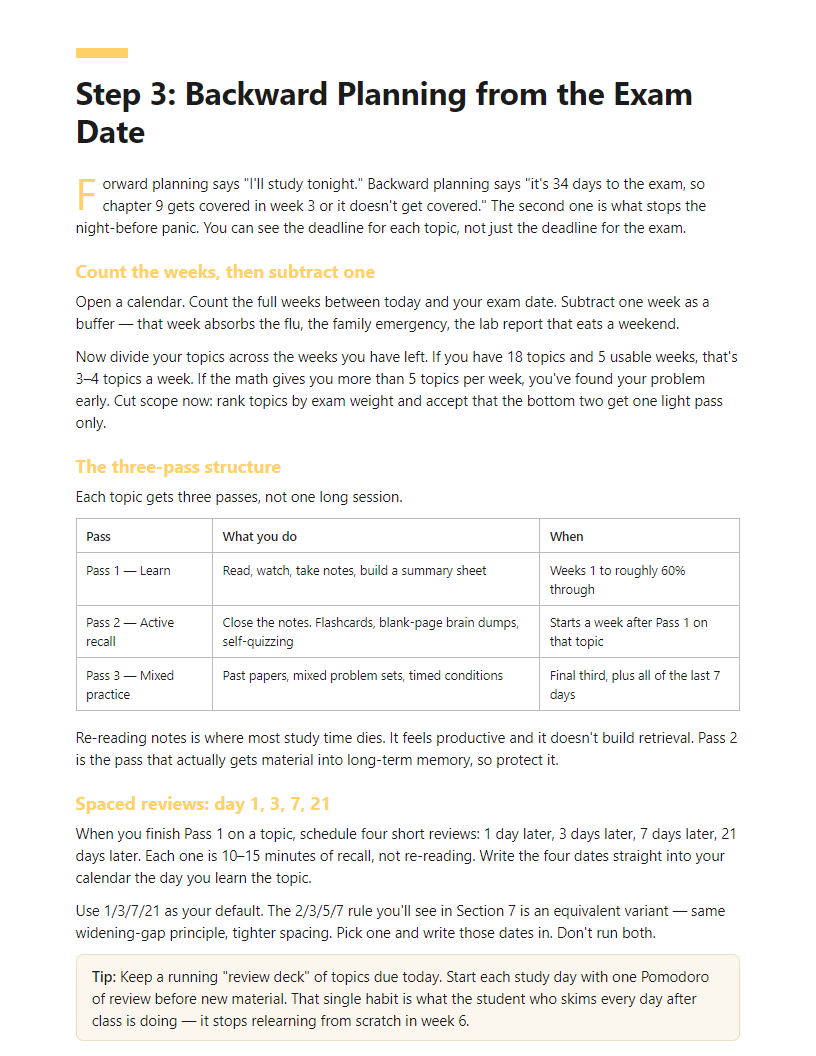
- Step 3: Backward Planning from the Exam Date
- The Weekly Template: Fill-In Grid with Pomodoro Blocks
- Named Study Rules Decoded: 2/3/5/7, 7-8-9, 50/10 and When Each Works
- Adapting the Template: Chronic Illness, ADHD, CPTSD, and No Study Space
- Emergency Mode: Exam in 10 Days and Nothing Studied
- Seven Scheduling Mistakes and the Fix for Each
- Falling Off and Getting Back On: The 48-Hour Reset
- Pre-Flight Checklist: Is Your Schedule Actually Going to Survive?
In this article
You wrote out a perfect schedule for studying on Sunday night, colour-coded every hour, and by Wednesday it was already dead — one task ran long, you felt guilty, and you stopped looking at the plan altogether. Then the exam is ten days away and you’ve barely started.
Here you’ll get the honest reason time-blocked timetables collapse, the named study rules people keep asking about (2/3/5/7, 7-8-9, 50/10) explained plainly, and seven fixable scheduling mistakes.
The premium PDF goes further: a fill-in weekly grid built around your real energy curve, a task-duration estimator, backward planning from your exam date, emergency mode for ten-day panics, and adaptations for ADHD, chronic illness, CPTSD, and having no quiet study space.
The short answer
A schedule for studying works when it is built backwards from the exam, not forwards from Monday. Do it in five steps:
- Map your fixed week — classes, work, travel, sleep. Schedule only what’s left.
- Mark your energy curve — put hard subjects in your two best hours, revision in weak hours.
- Work backwards from the exam date, splitting the syllabus across available days.
- Block in Pomodoro units (25/5 or 50/10), not vague hours — and fill only 60% of free time.
- Keep two empty catch-up slots each week so one bad day never kills the plan.
Why Study Timetables Collapse by Wednesday
Most study schedules don’t fail because you’re lazy. They fail because of four design problems, and you can usually spot yours in under a minute.
1. Overscheduling. You block nine hours of study into a day that holds five. By 2 p.m. you’re behind, so you feel bad, so you do nothing. One reader described it exactly: “I’d put so many things on my schedule and when I’m not able to execute even the first few tasks of the day then I’d feel bad and I wouldn’t do anything at all.”
2. Rigidity. Your plan is timed to the minute. One task runs 40 minutes over, or a shift gets moved, and the whole afternoon is void. A schedule with no slack is a schedule with one chance.
3. No bad-day version. You built the plan for your best self — slept well, no pain, no flare, focus intact. Bad days happen weekly. Without a smaller version to drop down to, a bad day becomes a quit.
4. No link to the exam date. The plan says “study biology Tuesday.” It doesn’t say whether that pace finishes the syllabus before the exam. So you can follow it perfectly and still cram the night before.
“I’m lazy” is almost always a wrong diagnosis
Lazy people don’t rebuild their timetable five times. If you keep re-planning, that’s a capacity problem (too much in too few hours) or a design problem (no slack, no fallback). Re-planning itself becomes the procrastination — it feels productive and costs you the study block.
What a template fixes
Advice tells you what to do. A template decides in advance, so you’re not re-deciding every Sunday. Your Tuesday default, your bad-day default, your catch-up slot: already set.
The sequence here is: diagnose → estimate how long tasks really take → backward-plan from the exam → fill the weekly grid → recover when you fall off.
Before you start, gather three things: your exam dates, your syllabus or topic list, and your fixed commitments (classes, work shifts, appointments, commute).
The Short Answer: What a Good Study Schedule Actually Looks Like
A schedule that survives contact with real life has six features. Copy this shape and adjust later.
1. Two to four Pomodoro blocks on a weekday. Four to six on a weekend day. A Pomodoro block is 25 minutes of work plus a 5-minute break. Four blocks is roughly two hours of real study — which is a solid weekday for most people with classes or a job.
2. Plan to 60% of your free hours. If you have five hours free after dinner and chores, schedule three. The other 40% absorbs overruns, slow starts, and the thing you forgot. This is the direct fix for scheduling nine hours, finishing three, and feeling like a failure by 9 p.m.
3. One subject per block, named by task. Write “10 chem problems” or “redo quiz 3, questions 1–15,” not “revise chem.” Vague blocks are where procrastination hides. Named tasks tell you when you’re done.
4. One empty catch-up slot every day, plus an optional two-block overflow window on the weekend. The daily slot takes whatever ran long that day. The weekend window is there for the week that goes badly. If nothing overran, both turn into free time you earned.
5. Anchor blocks to the exam date, not your motivation. Count the weeks left, divide the material, and let the calendar set the pace.
6. Two versions of every day. Write a Full Day and a Bad Day before the week starts, so you’re not deciding at 7 p.m. while exhausted.
| Tuesday | Full Day | Bad Day |
|---|---|---|
| Block 1 | 10 chem problems (25 min) | 5 chem problems (25 min) |
| Block 2 | Chem: check answers, log errors | — |
| Block 3 | Bio flashcards, chapter 4 | Bio flashcards, 15 min only |
| Block 4 | Catch-up / spare | — |
| Total | ~2 hrs | ~40 min |
A Bad Day is not a skipped day. It’s the minimum version that keeps the habit and the countdown intact.
Named Study Rules Decoded: 2/3/5/7, 7-8-9, 50/10 and When Each Works
You’ve probably seen these rules on study accounts and forums. Some are built on real memory research. Some are just tidy numbers. Here’s what each one actually claims and whether it’s worth layering onto your grid.
The 2/3/5/7 rule
Review material on day 2, day 3, day 5, and day 7 after you first learn it. The gaps widen as the memory gets stronger. This is a spacing ladder, and spacing is the most evidence-adjacent idea on this page — repeated exposure spread over days beats the same total minutes crammed into one night.
One catch. “Review” has to mean retrieval, not rereading. If you just reread notes, you get a feeling of familiarity and no recall. Close the notes, write what you remember, then check. That’s the difference between “I’ve seen this” and “I can produce this in an exam.”
The 7-8-9 rule
Seven hours of sleep, eight hours of work or school, nine hours split across study, meals, commute, and life. It’s a budgeting heuristic, not a research finding. Its value is that it forces you to admit the day has 24 hours and you’ve already spent 15 of them. Use it as a sanity check on Step 1, not as a prescription.
50/10 vs. 25/5
Pomodoro variants. 25 minutes work plus a 5-minute break, or 50 plus 10. Neither is magically correct. Match the block to the task.
| Rule | What it claims | Best use case | Limitation |
|---|---|---|---|
| 2/3/5/7 | Reviewing at day 2, 3, 5, 7 locks material into long-term memory | Facts, formulas, vocab, anatomy, drug lists — anything cumulative like MCAT or boards content | Useless if “review” means passive rereading; needs tracking across weeks |
| 7-8-9 | 7h sleep, 8h school/work, 9h for study and life | A one-time reality check on how many study hours exist | Folk heuristic; ignores commute, caregiving, illness, variable shifts |
| 25/5 Pomodoro | Short sprints beat long sessions | Starting when avoidant, flashcards, problem sets, low-focus days | Too short for essays, lab reports, long reading — you reset before you’re warm |
| 50/10 Pomodoro | Longer blocks allow deep work | Practice exams, writing, dense reading, past papers | Hard on bad days; skip the break and you’ll crash by block three |
Stacking one rule without rebuilding
Pick one. Only one.
- Adding 2/3/5/7: keep your grid as-is. Label the first 10 minutes of every study block “review,” and write which topic is due back. A column in your backward plan is enough.
- Adding 50/10: change block length in the grid, not block count. Two 50/10 blocks is a full weekday.
Tip: Five minutes of recall every day after class beats one three-hour relearn the night before. The daily skim is doing the spacing work for you.
Seven Scheduling Mistakes and the Fix for Each
Mistake 1: Planning to the minute
“2:15–2:50 biology, 2:50–3:00 break, 3:00–3:40 chem.” Precision feels like control. It actually raises collapse risk, because a single 10-minute overrun knocks every later block off its peg and the whole day reads as failed.
Fix: block, not clock. Name the half of the day, not the minute. “Afternoon: 2 Pomodoros chem, 1 bio.” Order matters; start times don’t.
Mistake 2: Scheduling 100% of your free time
If every open hour has a task in it, there’s nowhere for an overrun, a late bus, or a friend’s crisis to go. One disruption and you’re behind by definition.
Fix: leave one empty catch-up slot per week — a two-block window, usually Saturday or Sunday. Nothing is scheduled in it. It absorbs whatever slipped. If nothing slipped, it’s free time you earned.
Mistake 3: Planning for your best self
The schedule you write on Sunday night is written by a rested, optimistic person. Monday-you has a headache and a shift. Build around the best day and you’ll fail four days out of five.
Fix: plan for your median day. Ask what you actually did on a normal Tuesday last month. Schedule that. Good days then become bonus, not the baseline you keep missing.
Mistake 4: Re-planning instead of studying
Plans go sideways, so you rebuild the plan. Then it goes sideways again, so you rebuild it again. Planning feels productive and costs you nothing emotionally — which is exactly why it’s a trap.
Fix: a 15-minute weekly planning cap. Set a timer once a week. When it rings, the plan is final for seven days. Mid-week changes get written in the margin, not into a new grid.
Mistake 5: Tasks you can’t count
“Revise biology” has no finish line, so you can’t estimate it, can’t schedule it, and never feel done.
Fix: rewrite every task as a countable unit. “20 flashcards,” “past paper Q1–Q5,” “summarize pages 112–130 on one sheet.” If you can’t count it, you can’t close it.
Mistake 6: Scheduling study but not review
You cover chapter 4 once in week 2 and never see it again. By week 6 it’s gone. This is the retention leak — hours spent, nothing retained, and a panicked re-learn the night before.
Fix: every new topic gets a review date the same day you study it. Book a 5-minute skim within 24 hours and a 25-minute review 7 days later. Daily 5-minute skims of recent notes cost almost nothing and stop the re-learn entirely.
Mistake 7: No bad-day default
Miss one day, feel guilty, miss three, quit. The gap between “full plan” and “nothing” is where schedules die.
Fix: define your bad-day minimum now — one Pomodoro, flashcards only, done lying down if needed. Bad days stay inside the plan instead of ending it.
Study Schedule Questions, Answered
What is a good schedule for studying?
Two to four Pomodoro blocks on a school day, four to six on a weekend day. One block is 25 minutes of work plus a 5-minute break, or 50/10 if the material needs longer runway. That’s roughly 1.5–3 hours on weekdays and 3–5 hours on weekends — less than most students plan and more than most actually complete. Schedule less than you think you can do and overestimate how long each task takes.
What is the 2/3/5/7 study rule, and does it improve recall?
It’s a spaced review pattern: revisit material 2 days, 3 days, 5 days, and 7 days after you first learn it. The specific numbers aren’t magic, but the principle behind them is solid — spaced, repeated retrieval beats one long review session. This is the fix for the reader complaint that “reviewing my notes doesn’t stick.” Rereading is passive. Close the notes, write what you remember, then check. Section 7 breaks down where each named rule holds up.
What is the 7-8-9 rule?
Seven hours of sleep, eight hours for school and work, nine hours for everything else, including study. It’s a daily budget, not a study method. It fits people who are chronically overbooked and need to see on paper that the hours don’t exist. It fits poorly if you work nights, have a chronic illness with unpredictable energy, or carry a care load.
Morning, evening, or split?
Whichever one matches your energy curve from Step 1 — not the one study accounts recommend. Timetables only work when they match your actual lifestyle. If you’re sharpest at 6 a.m., put hard material there and keep evenings for flashcards. If you fade at 3 p.m. and pick up at 9 p.m., stop fighting it.
Tip: Split schedules suit anyone with a long commute or a job. Two shorter sessions beat one long one you keep skipping.
How many hours a day before finals?
Three to five on study days in the final two weeks, built backward from the exam date — not eight. Daily contact matters more than volume. Even 5 minutes of reviewing today’s notes after class keeps material warm and cuts how much relearning you face later.
What about MCAT, boards, or another months-out exam?
Same method, longer runway. Use Step 3: count the full weeks to test day, subtract one as a buffer, then divide your topics across the weeks that are left. Section 6 works this through for a 12-week build — content review plus 2,000 qbank questions plus 6 full-length practice tests — and shows how many weekly blocks that actually costs. Run the numbers before you commit, not in week 7 when you’re behind.
Paper, Google Calendar, or an app?
| Tool | Best for | Weak spot |
|---|---|---|
| Paper planner | Seeing one week at a glance; low friction | No reminders; easy to abandon |
| Google Calendar | Fixed commitments and alarms | Encourages planning to the minute |
| Study app | Timers and streak tracking | Streak loss triggers quitting |
Put only fixed-time items on a calendar. Keep study blocks on a flexible list so a 20-minute overrun doesn’t knock the day over.
- ✓Fill-in weekly schedule grid with pre-marked Pomodoro blocks
- ✓Energy-curve mapping worksheet for your real 7-day week
- ✓Task duration estimator table (estimate vs. actual tracking)
- ✓Backward planning calculator from exam date to today
- ✓Emergency 10-day plan for when nothing has been studied
- ✓Adaptation sheets for ADHD, chronic illness, CPTSD, and no study space
- ✓48-hour reset protocol and pre-flight schedule checklist
Frequently asked questions
What does a good study schedule actually look like?
A good one is realistic, not full. It uses roughly 60% of your free hours, blocks study in 25- or 50-minute Pomodoro units with breaks, puts your hardest subject in your highest-energy window, and leaves two unscheduled catch-up slots a week. Each block names a specific task — "past paper, Section B" — not a subject, so you know when you're finished.
What is the 2/3/5/7 study rule?
It's a spaced-repetition timing rule: review new material 2 days after learning it, then again at 3, 5 and 7 days. The widening gaps force recall just as memory starts to fade, which strengthens retention far more than rereading. In practice you schedule four short 15–20 minute review blocks per topic rather than one long cram session.
Which study schedule is best for me?
The best schedule is the one shaped around your real constraints. Night-energy students should not copy 5 a.m. routines. If you have class until 4 p.m. and a shift on weekends, you need short weekday blocks and one longer weekend session. Start by logging your actual energy and availability for one week, then schedule into the gaps you genuinely have.
What is the 7-8-9 rule for studying?
It's a daily balance guideline: roughly 7 hours of study or class, 8 hours of sleep, and 9 hours for everything else — meals, travel, exercise, people. The point isn't the exact numbers but protecting sleep first, since sleep deprivation destroys the memory consolidation your study hours were meant to produce.
What should I do after falling off my study schedule?
Don't rebuild the whole plan or try to "catch up" everything. Take 48 hours: do one 25-minute block on the most important topic today to break the avoidance, then re-run backward planning from the exam date with your remaining days only. Cut the lowest-value topics deliberately. Guilt spirals cost more study time than the missed days did.
We collected 159 real questions and comments about "schedule for studying" (138 from YouTube comments, 4 from People Also Ask, 17 from search suggestions), grouped them into 10 recurring problems, and built this guide to resolve the 7 that block people most. The top-ranking pages were reviewed for gaps; 7 of those gaps became dedicated sections.
Edited by Alex Hirn · Last updated November 2, 2026 · How we make our guides